3B模型碾压英伟达谷歌后,Om AI端侧原生VLX模型:小参数实现物理世界精准感知
TL;DR - Chinese startup Om AI (联汇) raised several hundred million RMB and open-sourced VLX-Seek 1.5, an "edge-native" streaming vision-language model family (3B/10B) built for on-device physical AI rather than compressed from a cloud model. It matters because it stakes out an edge-first architectural position against cloud-centric efforts from NVIDIA, Google, and Physical Intelligence.
- Edge-native, not edge-deployed: latency, power, compute, and deployment cost are treated as architectural constraints at design time, instead of post-hoc compression/distillation/quantization of a large cloud model.
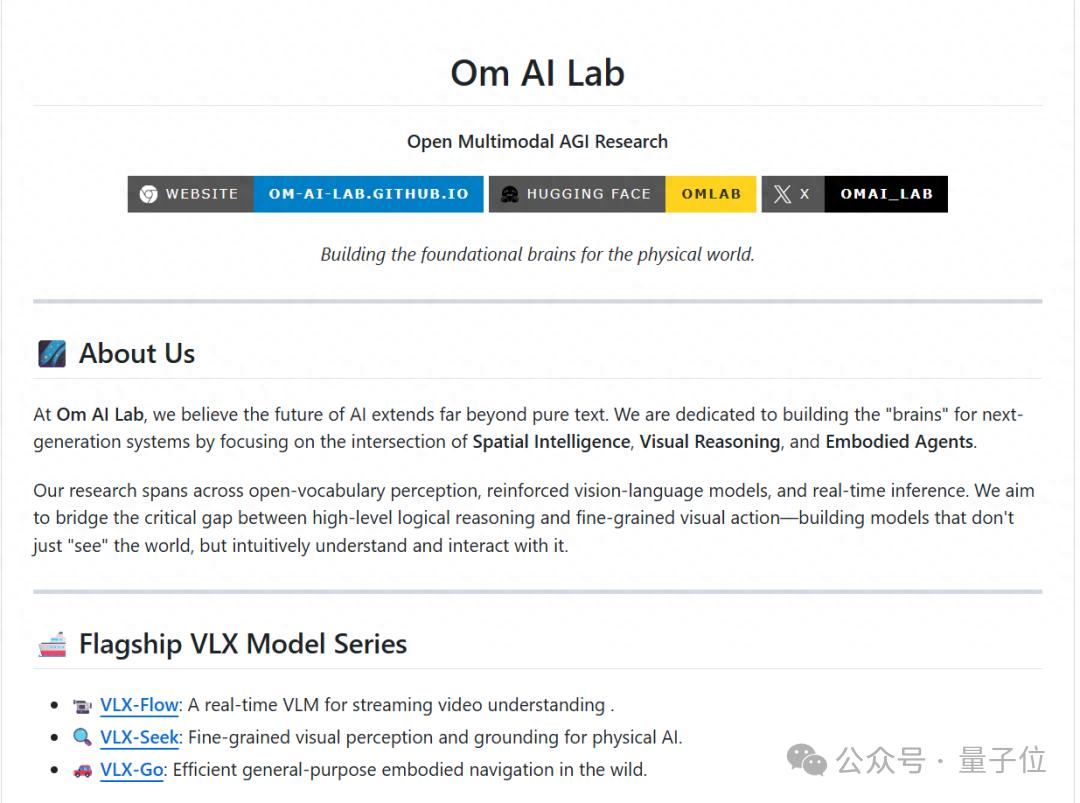
- Streaming multimodal pipeline: continuous video-stream input with on-device real-time understanding, structured as a three-stage loop — Flow (persistent attention), Seek (fine-grained reasoning), Go (execution control) — versus the frame-by-frame batch inference of conventional VLMs.
- Reported benchmarks (vendor-published, not independently verified): VLX-Seek 1.5-3B vs. NVIDIA LocateAnything-3B — LVIS Mean 57.5 vs. 50.7 (+13.4%); RefCOCOg test Mean 80.2 (+3.4%); RefDrone F1 73.2 vs. 52.3 (+40%), instance Acc 58 vs. 35.6 (+62.9%).
- Hallucination as a safety metric: introduces Object Hallucination = FP / number of GT objects; scores 18 vs. 71.3 for LocateAnything-3B on RefDrone, framing "refusing to answer" as critical for drones/security robots where false alarms are costlier than misses.
- Ecosystem play: open-sourcing to set a de facto standard (explicitly analogized to Kubernetes/cloud-native), paired with the OmAgent platform, OttoPlex御行 deployments, an OttoBox AI Studio AI-PC product, and Homer AI wearable serving ~100k visually impaired users.