WWW 2026 唯一最佳长文|大模型该信「查到的」还是「记得的」?|GAIR Paper 110
Ranking
Observed public metrics from 1 member.
Merged summary
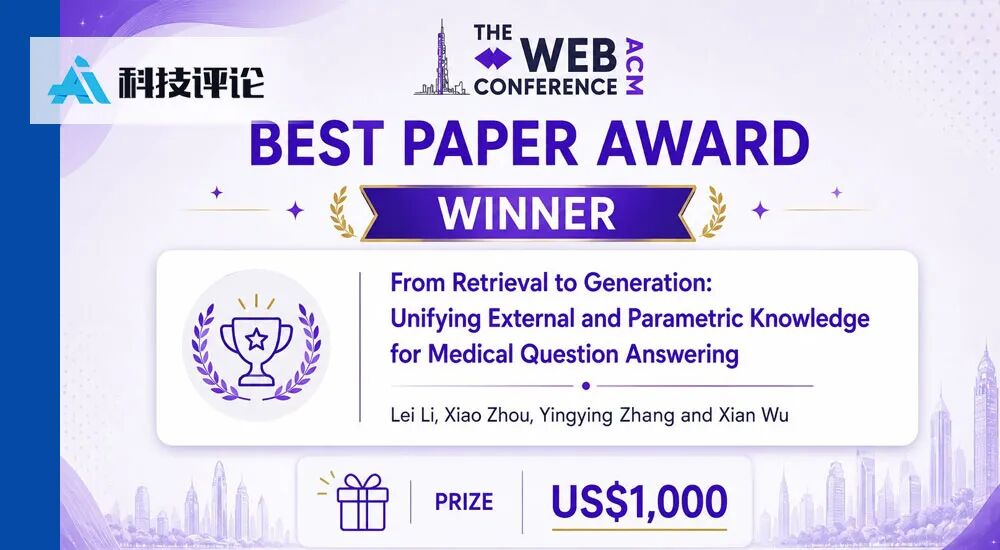
TL;DR - WWW 2026’s sole Best Long Paper introduces MedRGAG, a training-free medical QA framework that combines retrieved evidence with model-generated knowledge based on what information each question requires. It improves reliability by identifying knowledge gaps and selecting complementary evidence rather than merely ranking documents by similarity.
- KGCC summarizes retrieved evidence, identifies missing knowledge, and generates targeted background material to fill gaps.
- KADS selects a compact, low-redundancy evidence set based on knowledge coverage, countering rankers’ preference for highly similar generated text.
- Across five medical QA benchmarks and three 7B–8B readers, MedRGAG averaged 12.5% relative improvement over MedRAG and 4.5% over MedGENIE.
- The pipeline requires no reader retraining but adds latency and depends on capable auxiliary models for decomposition, gap detection, and evidence selection.
Sources (1)
WWW 2026 唯一最佳长文|大模型该信「查到的」还是「记得的」?|GAIR Paper 110
TL;DR - WWW 2026’s sole Best Long Paper introduces MedRGAG, a training-free medical QA framework that combines retrieved evidence with model-generated knowledge based on what information each question requires. It improves reliability by identifying knowledge gaps and selecting complementary evidence rather than merely ranking documents by similarity.
- KGCC summarizes retrieved evidence, identifies missing knowledge, and generates targeted background material to fill gaps.
- KADS selects a compact, low-redundancy evidence set based on knowledge coverage, countering rankers’ preference for highly similar generated text.
- Across five medical QA benchmarks and three 7B–8B readers, MedRGAG averaged 12.5% relative improvement over MedRAG and 4.5% over MedGENIE.
- The pipeline requires no reader retraining but adds latency and depends on capable auxiliary models for decomposition, gap detection, and evidence selection.