陶哲轩在菲尔兹颁奖现场:数学迎来百年新危机
Ranking
Overall
50
Content
50
Popularity
N/A
No observed public metrics; popularity remains neutral/archived.
Merged summary
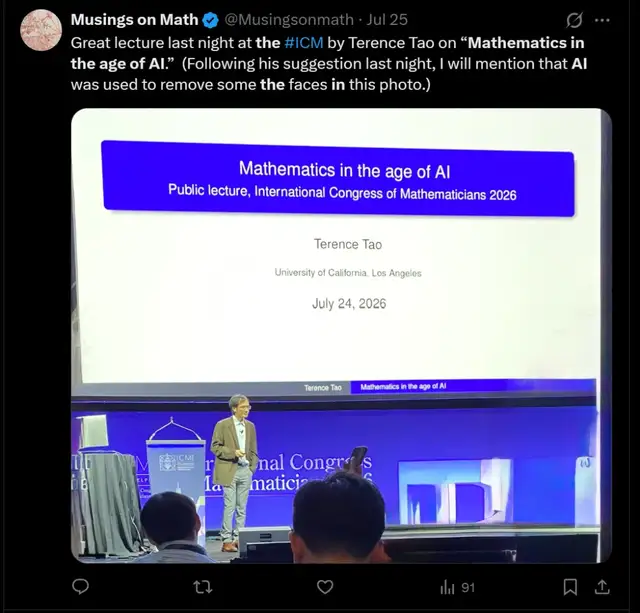
TL;DR - Terence Tao argues that AI could shift mathematics from proof scarcity to proof abundance, creating bottlenecks in verification, explanation, peer review, and canonization. He calls for human accountability and evaluation systems that reward understanding rather than merely producing proofs first.
- AI reportedly solved 7 of 10 new research-level First Proof problems at publishable quality under controlled evaluation.
- Tao warns that optimizing for proof production could yield formally correct results that humans cannot understand, communicate, or integrate into mathematical knowledge.
- He proposes disclosing AI use and holding human authors fully responsible for correctness, citations, and expert-level explanations.
- AI should be constrained in education and talent development, while mathematicians—not product incentives—should define its rules elsewhere.
Sources (1)
陶哲轩在菲尔兹颁奖现场:数学迎来百年新危机
Public signals
N/A
TL;DR - Terence Tao argues that AI could shift mathematics from proof scarcity to proof abundance, creating bottlenecks in verification, explanation, peer review, and canonization. He calls for human accountability and evaluation systems that reward understanding rather than merely producing proofs first.
- AI reportedly solved 7 of 10 new research-level First Proof problems at publishable quality under controlled evaluation.
- Tao warns that optimizing for proof production could yield formally correct results that humans cannot understand, communicate, or integrate into mathematical knowledge.
- He proposes disclosing AI use and holding human authors fully responsible for correctness, citations, and expert-level explanations.
- AI should be constrained in education and talent development, while mathematicians—not product incentives—should define its rules elsewhere.