GPT-5.6自己优化自己实锤了,新的左脚踩右脚已经出现
Ranking
Overall
75
Content
85
Popularity
N/A
No observed public metrics; popularity remains neutral/archived.
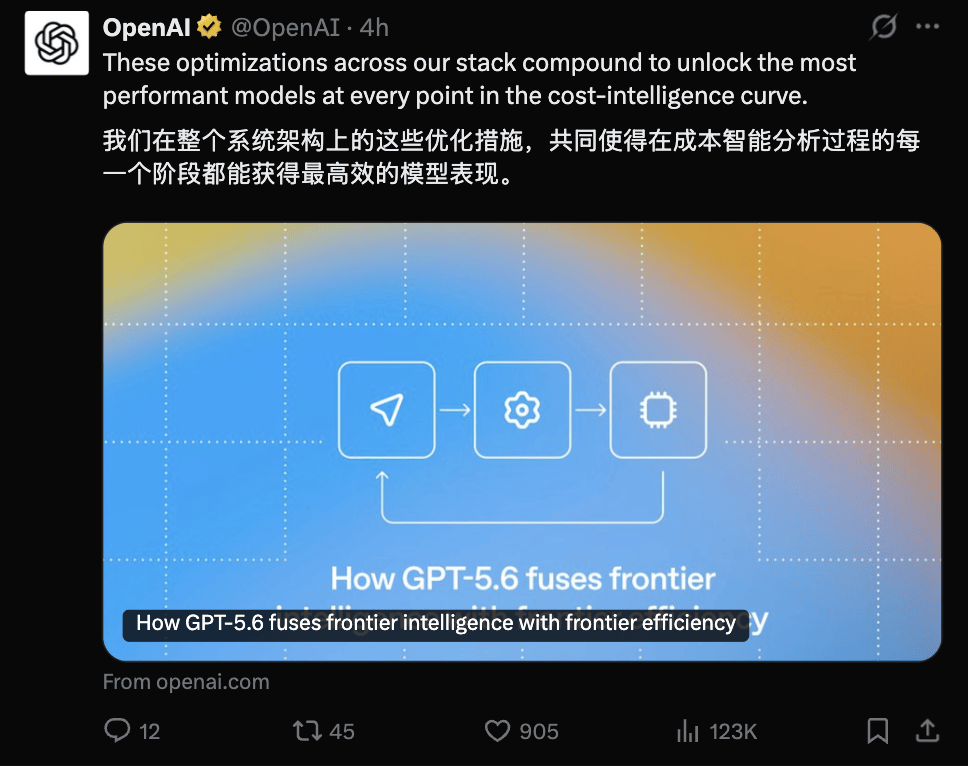
Merged summary
TL;DR - OpenAI reportedly deployed GPT-5.6 to optimize its own production stack, cutting end-to-end serving costs by 20% and improving token-generation efficiency by over 15%. The system resembles an early, human-supervised self-improvement loop rather than fully autonomous recursive self-improvement.
- GPT-5.6 analyzes production traffic, tests routing strategies, and tunes batching, sharding, and KV-cache configurations.
- It uses Codex to rewrite Triton and Gluon kernels and runs hundreds of experiments to optimize speculative-decoding draft models.
- A Rust agent harness reduces repeated work through on-demand tool discovery, capped tool outputs, and append-only contexts that preserve prompt-cache validity.
- Humans still define objectives, permissions, and evaluations and approve production deployments.
Sources (1)
GPT-5.6自己优化自己实锤了,新的左脚踩右脚已经出现
Public signals
N/A
TL;DR - OpenAI reportedly deployed GPT-5.6 to optimize its own production stack, cutting end-to-end serving costs by 20% and improving token-generation efficiency by over 15%. The system resembles an early, human-supervised self-improvement loop rather than fully autonomous recursive self-improvement.
- GPT-5.6 analyzes production traffic, tests routing strategies, and tunes batching, sharding, and KV-cache configurations.
- It uses Codex to rewrite Triton and Gluon kernels and runs hundreds of experiments to optimize speculative-decoding draft models.
- A Rust agent harness reduces repeated work through on-demand tool discovery, capped tool outputs, and append-only contexts that preserve prompt-cache validity.
- Humans still define objectives, permissions, and evaluations and approve production deployments.