GPT-Live can listen while it speaks. To make that feel natural at ChatGPT scale, we rebuilt the…
Ranking
Overall
68
Content
75
Popularity
N/A
No observed public metrics; popularity remains neutral/archived.
Merged summary
TL;DR - OpenAI announced GPT-Live, a full-duplex voice system in ChatGPT that can listen while it speaks, backed by a rebuilt voice stack spanning client and model. It matters because it targets the turn-taking latency and interruption problems that make current voice assistants feel unnatural at production scale.
- Full-duplex audio: the model processes incoming speech concurrently with its own output, rather than strict listen-then-respond turn taking.
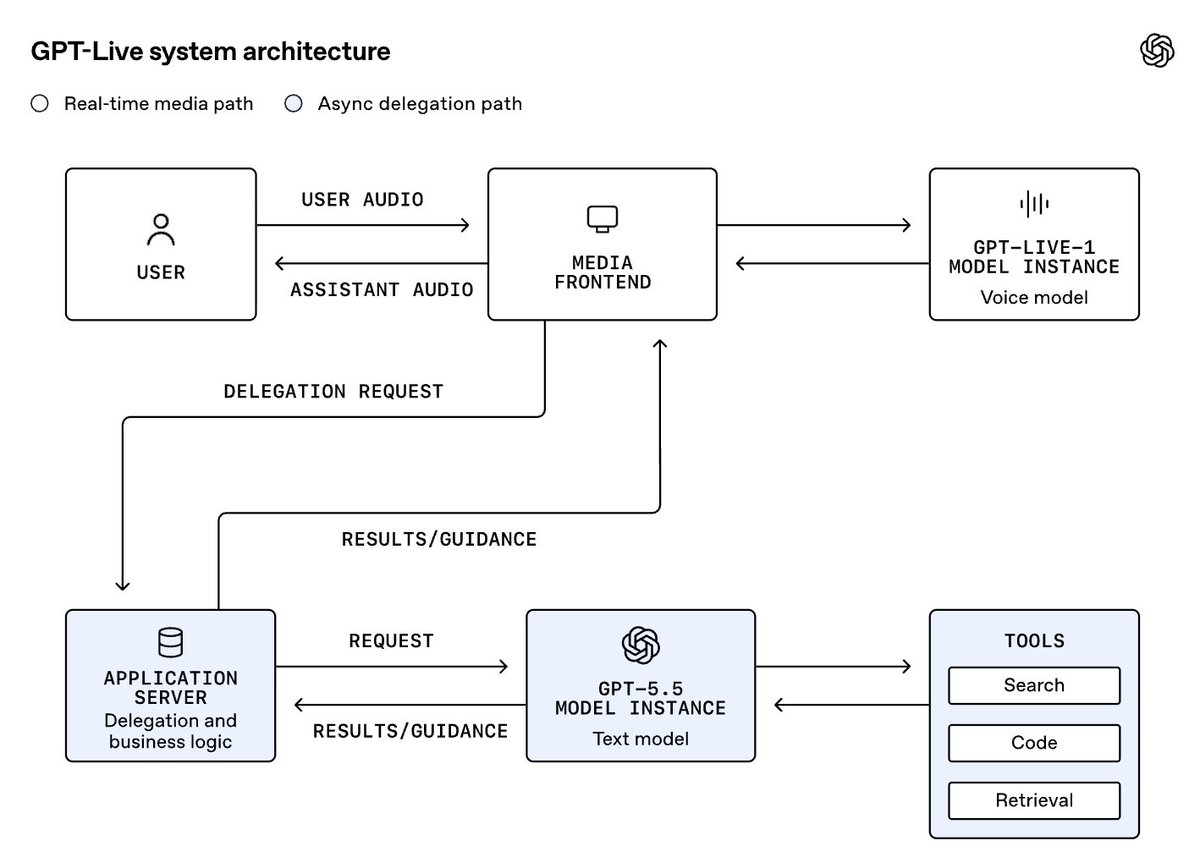
- The voice stack was re-engineered end to end ("client to model"), implying changes beyond the model itself — transport, buffering, and client-side audio handling.
- Continuous audio streaming decouples conversation flow from compute: longer reasoning steps and tool calls run without stalling or breaking the dialogue.
- Content is a short announcement post with no benchmarks, latency figures, or architecture details, so specifics of the design are not disclosed here.
Sources (1)
GPT-Live can listen while it speaks. To make that feel natural at ChatGPT scale, we rebuilt the…
Public signals
N/A
TL;DR - OpenAI announced GPT-Live, a full-duplex voice system in ChatGPT that can listen while it speaks, backed by a rebuilt voice stack spanning client and model. It matters because it targets the turn-taking latency and interruption problems that make current voice assistants feel unnatural at production scale.
- Full-duplex audio: the model processes incoming speech concurrently with its own output, rather than strict listen-then-respond turn taking.
- The voice stack was re-engineered end to end ("client to model"), implying changes beyond the model itself — transport, buffering, and client-side audio handling.
- Continuous audio streaming decouples conversation flow from compute: longer reasoning steps and tool calls run without stalling or breaking the dialogue.
- Content is a short announcement post with no benchmarks, latency figures, or architecture details, so specifics of the design are not disclosed here.