AI SSD:大模型推理的存储范式转移
Ranking
No observed public metrics; popularity remains neutral/archived.
Merged summary
TL;DR - A 量子位 industry analysis arguing that SSDs are moving from passive file storage into the real-time inference data path, as KV Cache and MoE expert weights become first-class infrastructure resources. It matters because inference throughput and GPU utilization increasingly hinge on storage/network data movement rather than raw FLOPS.
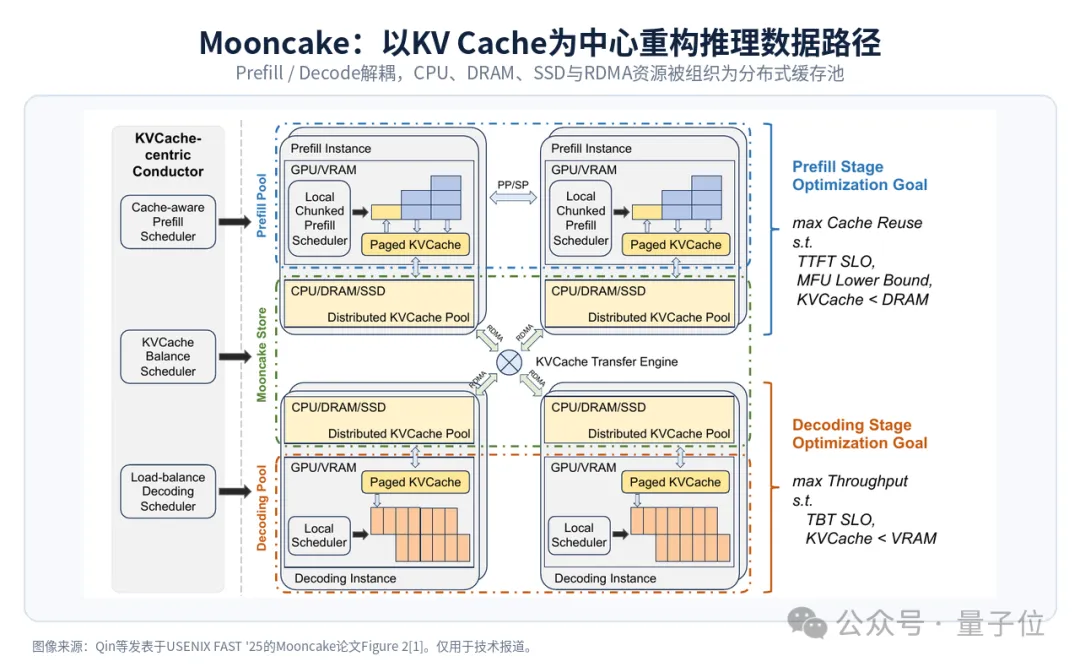
- Two reference signals: Moonshot AI/Tsinghua's Mooncake (USENIX FAST '25) uses a KVCache-centric disaggregated architecture pooling cluster CPU/DRAM/SSD/NIC, reporting 59%–498% more effective request capacity vs. baselines and 100B+ tokens/day in production; NVIDIA's CMX adds a Pod-level Flash "G3.5" tier between local SSD (G3) and shared storage (G4), with vendor-claimed up to 5x token throughput/power efficiency.
- Traditional SSD design (sequential bandwidth, IOPS, cost/GB) mismatches inference needs: KV Cache writes cause write amplification and unpredictable tail latency, and LBA layouts are blind to model layers, KV blocks, and MoE expert execution order.
- The article splits products into "AI-workload-hardened enterprise SSDs" (InnoGrit 洞庭-N3X, Huawei OceanDisk LC 560) and "inference-participating AI SSDs" with three routes: Phison aiDAPTIV (dedicated cache SSD + middleware, up to 100 DWPD), Longsys SPU+iSA (5nm controller, in-storage compression, hybrid NAND tiering), and Infplane–Maxio (AI-native, near-memory compute spanning middleware/firmware/controller/NAND).
- Vendor-published figures are flagged as marketing-scope numbers; real gains depend on cache hit rate, model, network, and scheduling policy.
Sources (1)
AI SSD:大模型推理的存储范式转移
TL;DR - A 量子位 industry analysis arguing that SSDs are moving from passive file storage into the real-time inference data path, as KV Cache and MoE expert weights become first-class infrastructure resources. It matters because inference throughput and GPU utilization increasingly hinge on storage/network data movement rather than raw FLOPS.
- Two reference signals: Moonshot AI/Tsinghua's Mooncake (USENIX FAST '25) uses a KVCache-centric disaggregated architecture pooling cluster CPU/DRAM/SSD/NIC, reporting 59%–498% more effective request capacity vs. baselines and 100B+ tokens/day in production; NVIDIA's CMX adds a Pod-level Flash "G3.5" tier between local SSD (G3) and shared storage (G4), with vendor-claimed up to 5x token throughput/power efficiency.
- Traditional SSD design (sequential bandwidth, IOPS, cost/GB) mismatches inference needs: KV Cache writes cause write amplification and unpredictable tail latency, and LBA layouts are blind to model layers, KV blocks, and MoE expert execution order.
- The article splits products into "AI-workload-hardened enterprise SSDs" (InnoGrit 洞庭-N3X, Huawei OceanDisk LC 560) and "inference-participating AI SSDs" with three routes: Phison aiDAPTIV (dedicated cache SSD + middleware, up to 100 DWPD), Longsys SPU+iSA (5nm controller, in-storage compression, hybrid NAND tiering), and Infplane–Maxio (AI-native, near-memory compute spanning middleware/firmware/controller/NAND).
- Vendor-published figures are flagged as marketing-scope numbers; real gains depend on cache hit rate, model, network, and scheduling policy.