openJiuwen发布业界首个企业级分布式蜂群架构,联合邮储成功落地金融生产环境
Ranking
Overall
50
Content
50
Popularity
N/A
No observed public metrics; popularity remains neutral/archived.
Merged summary
TL;DR — Huawei-backed open-source platform openJiuwen released what it calls the industry's first enterprise-grade distributed "swarm" (蜂群) agent architecture, and China Postal Savings Bank has put it into live financial production — a signal that multi-agent systems are moving from pilots to regulated, at-scale deployment.
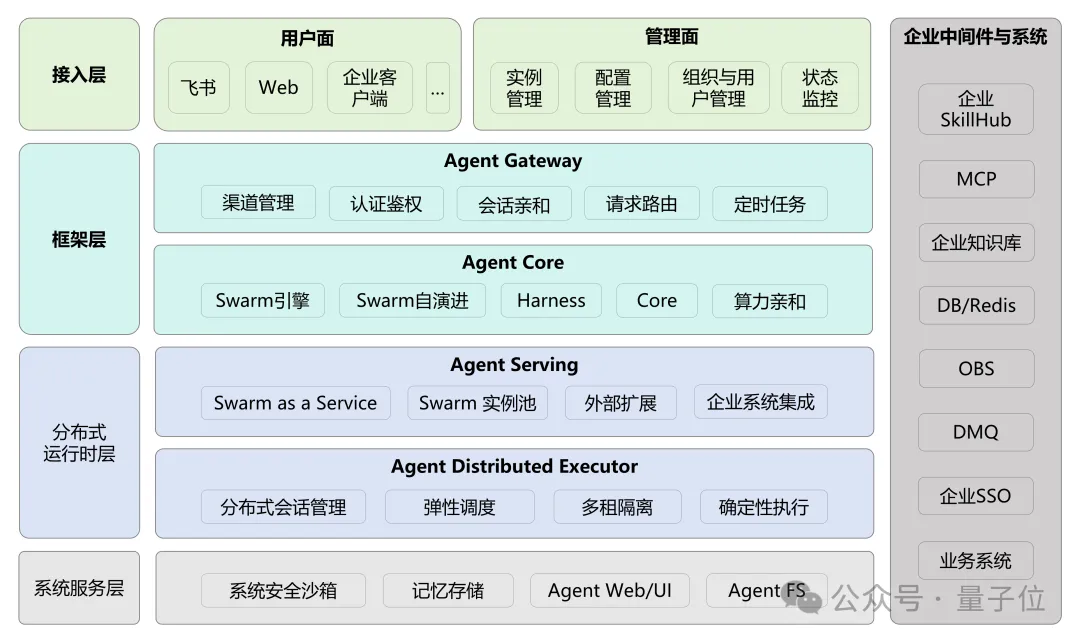
- Architecture extends single-machine JiuwenSwarm to a distributed cluster with four layers (access, framework, distributed runtime, system services), targeting four stated barriers: scale, cost, governance, and security.
- A "compute affinity" (算力亲和) design binds agents to Ascend/Kunpeng infrastructure, keeping context and KV cache resident to reduce cache invalidation in long-running sessions, plus unified scheduling of general/AI compute for lower latency and token spend.
- Deployment model: JiuwenSwarm Gateway integrates with existing enterprise SSO; agents run as per-user containers or shared department clusters (single agent or TeamLeader + Teammates), each with an isolated workspace; skills/tools execute in a sandboxed resource pool with full-chain audit trails.
- PSBC production use cases are smart office (meeting scheduling, minutes), intelligence monitoring, and risk alerting, integrated with existing SkillHub and legacy systems without changing permission boundaries. Code is open-sourced on GitHub/AtomGit; no benchmark or quantitative performance data is provided.
Sources (1)
openJiuwen发布业界首个企业级分布式蜂群架构,联合邮储成功落地金融生产环境
Public signals
N/A
TL;DR — Huawei-backed open-source platform openJiuwen released what it calls the industry's first enterprise-grade distributed "swarm" (蜂群) agent architecture, and China Postal Savings Bank has put it into live financial production — a signal that multi-agent systems are moving from pilots to regulated, at-scale deployment.
- Architecture extends single-machine JiuwenSwarm to a distributed cluster with four layers (access, framework, distributed runtime, system services), targeting four stated barriers: scale, cost, governance, and security.
- A "compute affinity" (算力亲和) design binds agents to Ascend/Kunpeng infrastructure, keeping context and KV cache resident to reduce cache invalidation in long-running sessions, plus unified scheduling of general/AI compute for lower latency and token spend.
- Deployment model: JiuwenSwarm Gateway integrates with existing enterprise SSO; agents run as per-user containers or shared department clusters (single agent or TeamLeader + Teammates), each with an isolated workspace; skills/tools execute in a sandboxed resource pool with full-chain audit trails.
- PSBC production use cases are smart office (meeting scheduling, minutes), intelligence monitoring, and risk alerting, integrated with existing SkillHub and legacy systems without changing permission boundaries. Code is open-sourced on GitHub/AtomGit; no benchmark or quantitative performance data is provided.