频发高温故障!特斯拉FSD升级事故,看清中美智驾监管根本差异
Ranking
Overall
36
Content
30
Popularity
N/A
No observed public metrics; popularity remains neutral/archived.
Merged summary
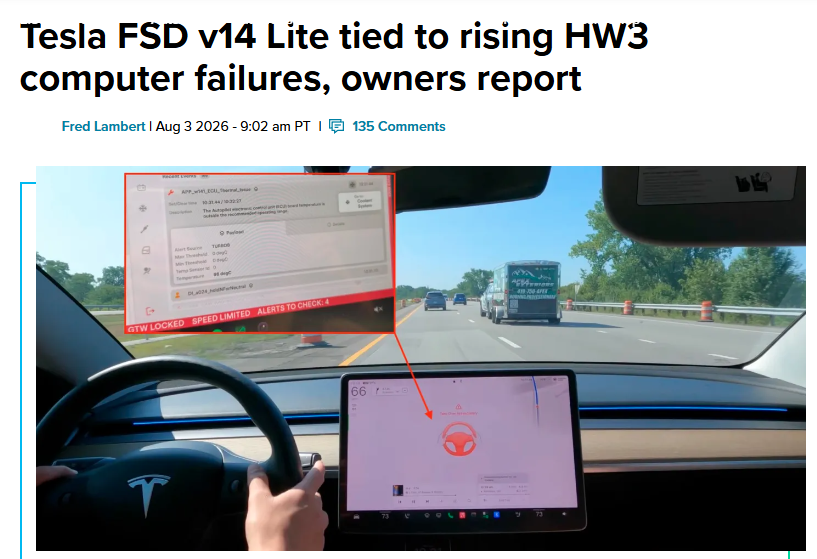
TL;DR - Tesla's FSD V14 Lite OTA push to ~4M older HW3 vehicles reportedly drove autopilot ECU boards to ~96°C, triggering overheat alarms, forced FSD shutdowns and some burned-out computers, which the article uses to contrast US post-hoc oversight with China's new pre-approval mandatory standards.
- Reported failure mode: the higher-load V14 model saturated legacy HW3 compute, causing thermal throttling/shutdown mid-drive and out-of-warranty owners paying for full hardware replacement; the update also allegedly regressed reverse-driving perception (missed pedestrians/obstacles).
- Root cause framed as economics plus regulation: no US mandate requires per-hardware-generation lightweight algorithm variants or graded load-stability testing, so no separate low-load build was made for HW3.
- China's GB 47955—2026 (L2 combined driving assistance) and GB 44721—2026 (L3/L4 automated driving), effective 2027, require pre-filing and functional-safety assessment for any OTA touching perception logic, compute scheduling, thermal strategy or operational boundaries, plus simulation + closed-course + on-road validation with retained test records.
- Standards also mandate layered overheat/perception fallbacks (no abrupt cutoff), ban removing existing safety features to fit weaker hardware, ban misleading terms like "full self-driving," require lifecycle telemetry monitoring with recall triggers, and name the automaker as first-line liable party.
Sources (1)
频发高温故障!特斯拉FSD升级事故,看清中美智驾监管根本差异
Public signals
N/A
TL;DR - Tesla's FSD V14 Lite OTA push to ~4M older HW3 vehicles reportedly drove autopilot ECU boards to ~96°C, triggering overheat alarms, forced FSD shutdowns and some burned-out computers, which the article uses to contrast US post-hoc oversight with China's new pre-approval mandatory standards.
- Reported failure mode: the higher-load V14 model saturated legacy HW3 compute, causing thermal throttling/shutdown mid-drive and out-of-warranty owners paying for full hardware replacement; the update also allegedly regressed reverse-driving perception (missed pedestrians/obstacles).
- Root cause framed as economics plus regulation: no US mandate requires per-hardware-generation lightweight algorithm variants or graded load-stability testing, so no separate low-load build was made for HW3.
- China's GB 47955—2026 (L2 combined driving assistance) and GB 44721—2026 (L3/L4 automated driving), effective 2027, require pre-filing and functional-safety assessment for any OTA touching perception logic, compute scheduling, thermal strategy or operational boundaries, plus simulation + closed-course + on-road validation with retained test records.
- Standards also mandate layered overheat/perception fallbacks (no abrupt cutoff), ban removing existing safety features to fit weaker hardware, ban misleading terms like "full self-driving," require lifecycle telemetry monitoring with recall triggers, and name the automaker as first-line liable party.