Predicting cyclones accurately can help save lives - and every hour of lead time counts. Published…
Ranking
No observed public metrics; popularity remains neutral/archived.
Merged summary
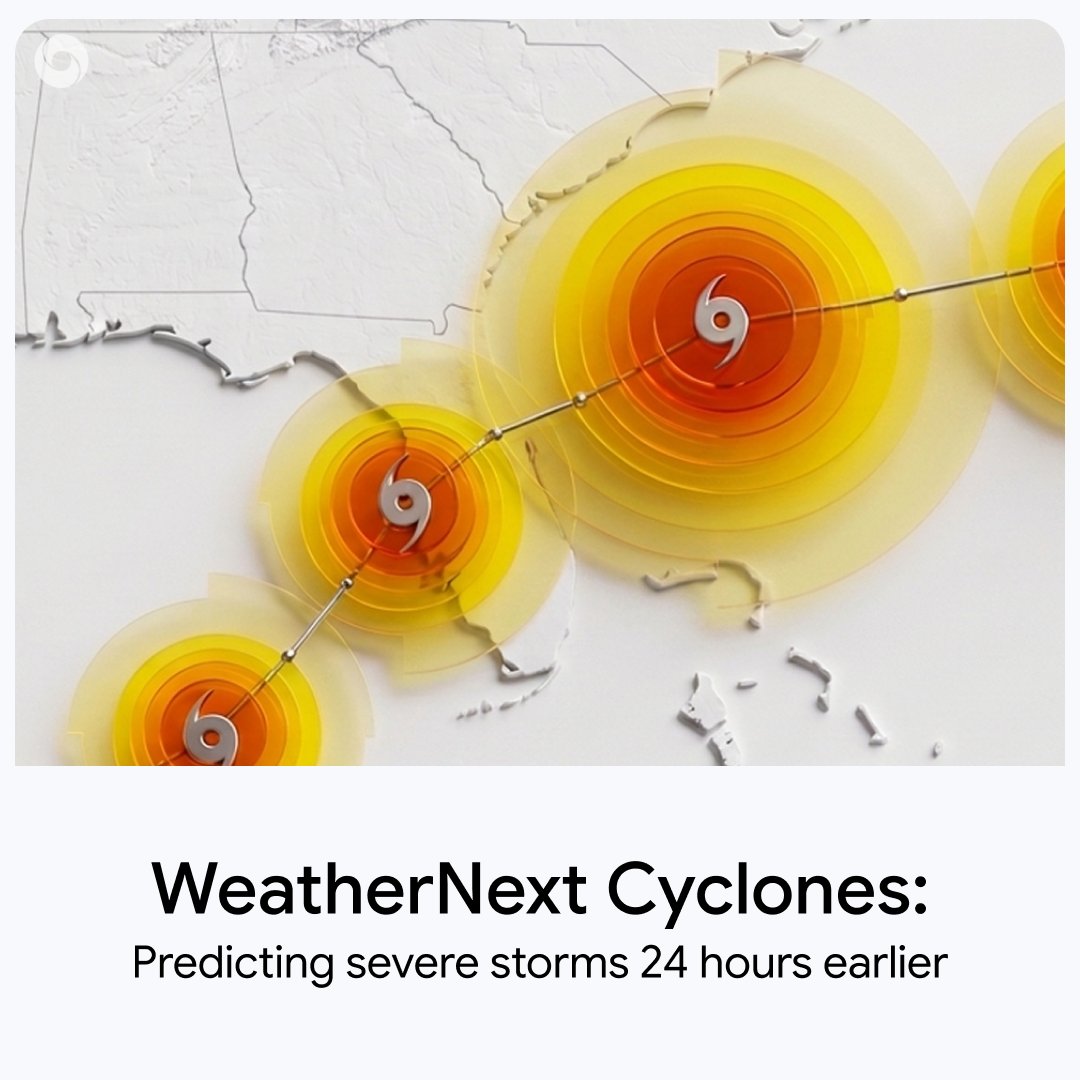
TL;DR - Google DeepMind announced WeatherNext, an AI cyclone-forecasting model published in Nature that reportedly sets state-of-the-art accuracy on storm track and intensity prediction. It matters because the claimed ~24 hours of extra average lead time directly translates into more evacuation and preparation time for populations in a storm's path.
- Company announcement (official DeepMind account) of a model whose results are published in Nature, so it straddles product news and research, but is framed as an organizational launch.
- Claims state-of-the-art performance on both cyclone track (where it goes) and intensity (how strong it gets) — historically two separate, hard forecasting problems.
- Headline operational metric: roughly 24 additional hours of lead time on average versus prior baselines, positioned as a public-safety benefit rather than a benchmark score.
- Content is thin (a thread-opening tweet): no architecture details, training data, baselines, or evaluation protocol are given here — those would be in the linked Nature paper.
Sources (1)
Predicting cyclones accurately can help save lives - and every hour of lead time counts. Published…
TL;DR - Google DeepMind announced WeatherNext, an AI cyclone-forecasting model published in Nature that reportedly sets state-of-the-art accuracy on storm track and intensity prediction. It matters because the claimed ~24 hours of extra average lead time directly translates into more evacuation and preparation time for populations in a storm's path.
- Company announcement (official DeepMind account) of a model whose results are published in Nature, so it straddles product news and research, but is framed as an organizational launch.
- Claims state-of-the-art performance on both cyclone track (where it goes) and intensity (how strong it gets) — historically two separate, hard forecasting problems.
- Headline operational metric: roughly 24 additional hours of lead time on average versus prior baselines, positioned as a public-safety benefit rather than a benchmark score.
- Content is thin (a thread-opening tweet): no architecture details, training data, baselines, or evaluation protocol are given here — those would be in the linked Nature paper.