MerchantBench Benchmarking LLM Agents for Long-Term Coherence in E-Commerce Operations paper…
Ranking
No observed public metrics; popularity remains neutral/archived.
Merged summary
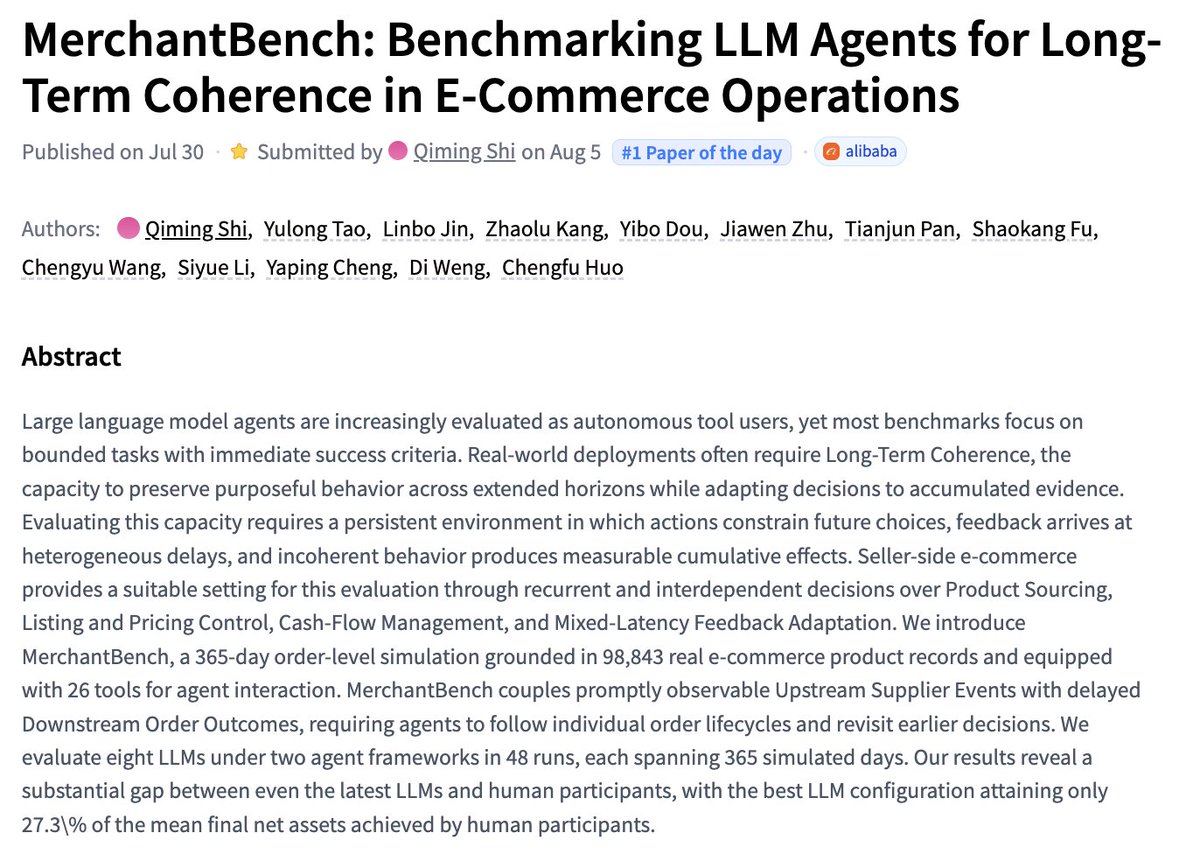
TL;DR - A shared preprint announcement (via AK) for "MerchantBench," a benchmark evaluating whether LLM agents maintain long-term coherence while running e-commerce operations. It matters because most agent benchmarks test short, single-shot tasks, while real business operations demand consistent decisions over extended horizons.
- Content is thin — only the paper title and a Hugging Face papers link were provided, so the following are inferences from the title, not reported results.
- Target domain is e-commerce operations (merchant-side workflows such as pricing, inventory, listings, and customer handling), implying a simulated or long-running environment rather than static QA.
- The stated evaluation axis is "long-term coherence": consistency of an agent's decisions, memory, and strategy across many sequential steps, a known failure mode for LLM agents due to context drift and error accumulation.
- Framed as a benchmark contribution, it likely supplies tasks, an environment/simulator, and metrics for comparing agent architectures (planning, memory, tool use) rather than proposing a new model.
Sources (1)
MerchantBench Benchmarking LLM Agents for Long-Term Coherence in E-Commerce Operations paper…
TL;DR - A shared preprint announcement (via AK) for "MerchantBench," a benchmark evaluating whether LLM agents maintain long-term coherence while running e-commerce operations. It matters because most agent benchmarks test short, single-shot tasks, while real business operations demand consistent decisions over extended horizons.
- Content is thin — only the paper title and a Hugging Face papers link were provided, so the following are inferences from the title, not reported results.
- Target domain is e-commerce operations (merchant-side workflows such as pricing, inventory, listings, and customer handling), implying a simulated or long-running environment rather than static QA.
- The stated evaluation axis is "long-term coherence": consistency of an agent's decisions, memory, and strategy across many sequential steps, a known failure mode for LLM agents due to context drift and error accumulation.
- Framed as a benchmark contribution, it likely supplies tasks, an environment/simulator, and metrics for comparing agent architectures (planning, memory, tool use) rather than proposing a new model.