RT by @huggingface: every 3D mesh is kind of a compiled binary: printable, usable, but frozen. you…
Ranking
Overall
54
Content
55
Popularity
N/A
No observed public metrics; popularity remains neutral/archived.
Merged summary
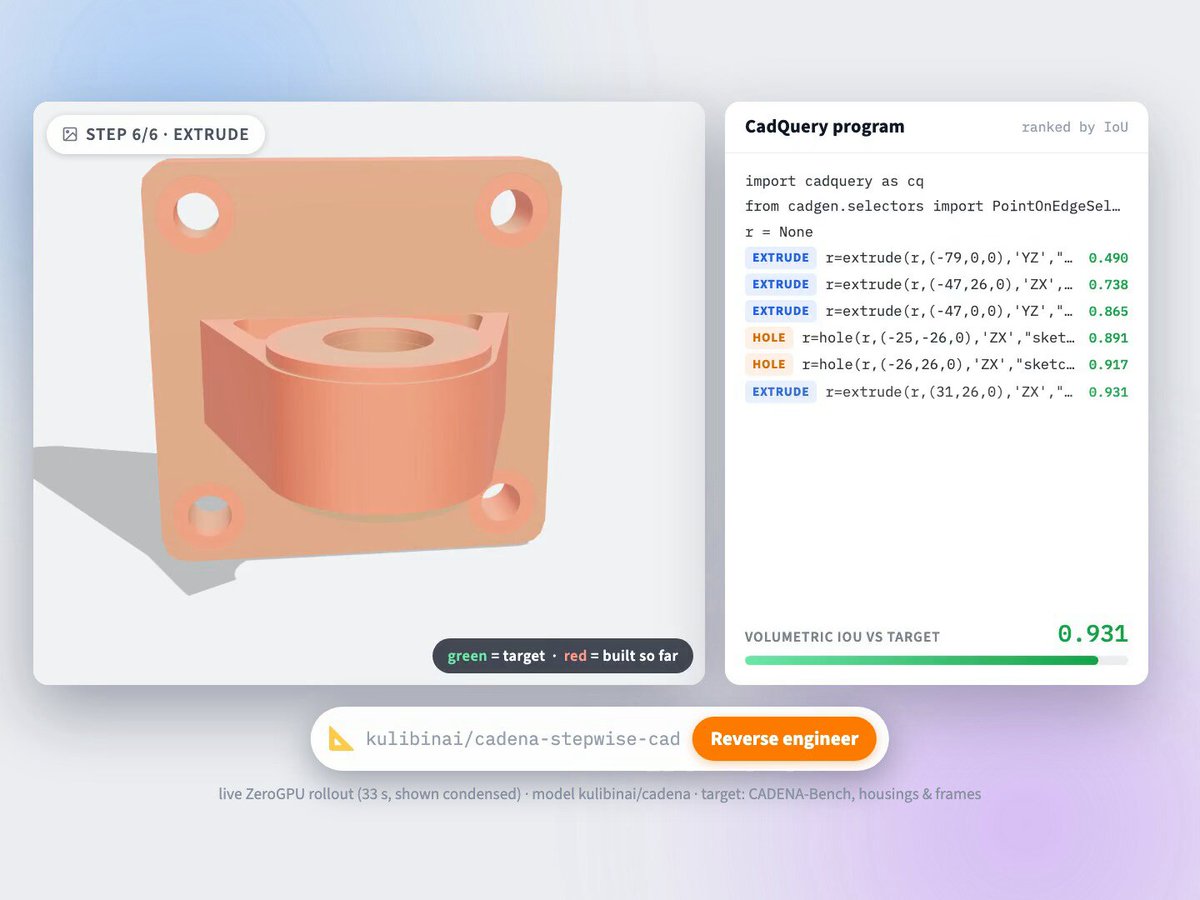
TL;DR - Hugging Face is highlighting Cadena, a tool that "decompiles" static 3D meshes into editable, step-by-step CAD programs, with a demo hosted on HF Spaces. It matters because mesh outputs from scanning or generative 3D are effectively frozen artifacts, and recovering parametric CAD history restores editability.
- Frames the core problem as an analogy: a mesh is like a compiled binary — usable and printable, but not modifiable at the level of design intent (e.g. "make this hole 2mm wider").
- Cadena's stated output is not just a cleaned mesh but a CAD program reconstructed step by step, implying reverse-engineering of parametric modeling operations rather than surface fitting alone.
- Distribution is via a Hugging Face Space (huggingface.co/spaces/kulibi…), i.e. an interactive browser demo, with a video shown in the post.
- Content is thin — a promotional post with no benchmarks, model architecture, dataset, or accuracy claims; technical details would require the linked Space or paper.
Sources (1)
RT by @huggingface: every 3D mesh is kind of a compiled binary: printable, usable, but frozen. you…
Public signals
N/A
TL;DR - Hugging Face is highlighting Cadena, a tool that "decompiles" static 3D meshes into editable, step-by-step CAD programs, with a demo hosted on HF Spaces. It matters because mesh outputs from scanning or generative 3D are effectively frozen artifacts, and recovering parametric CAD history restores editability.
- Frames the core problem as an analogy: a mesh is like a compiled binary — usable and printable, but not modifiable at the level of design intent (e.g. "make this hole 2mm wider").
- Cadena's stated output is not just a cleaned mesh but a CAD program reconstructed step by step, implying reverse-engineering of parametric modeling operations rather than surface fitting alone.
- Distribution is via a Hugging Face Space (huggingface.co/spaces/kulibi…), i.e. an interactive browser demo, with a video shown in the post.
- Content is thin — a promotional post with no benchmarks, model architecture, dataset, or accuracy claims; technical details would require the linked Space or paper.