魔幻灵巧手:半年200亿热钱,3大路线,贵到几十万一只
Ranking
Overall
40
Content
35
Popularity
N/A
No observed public metrics; popularity remains neutral/archived.
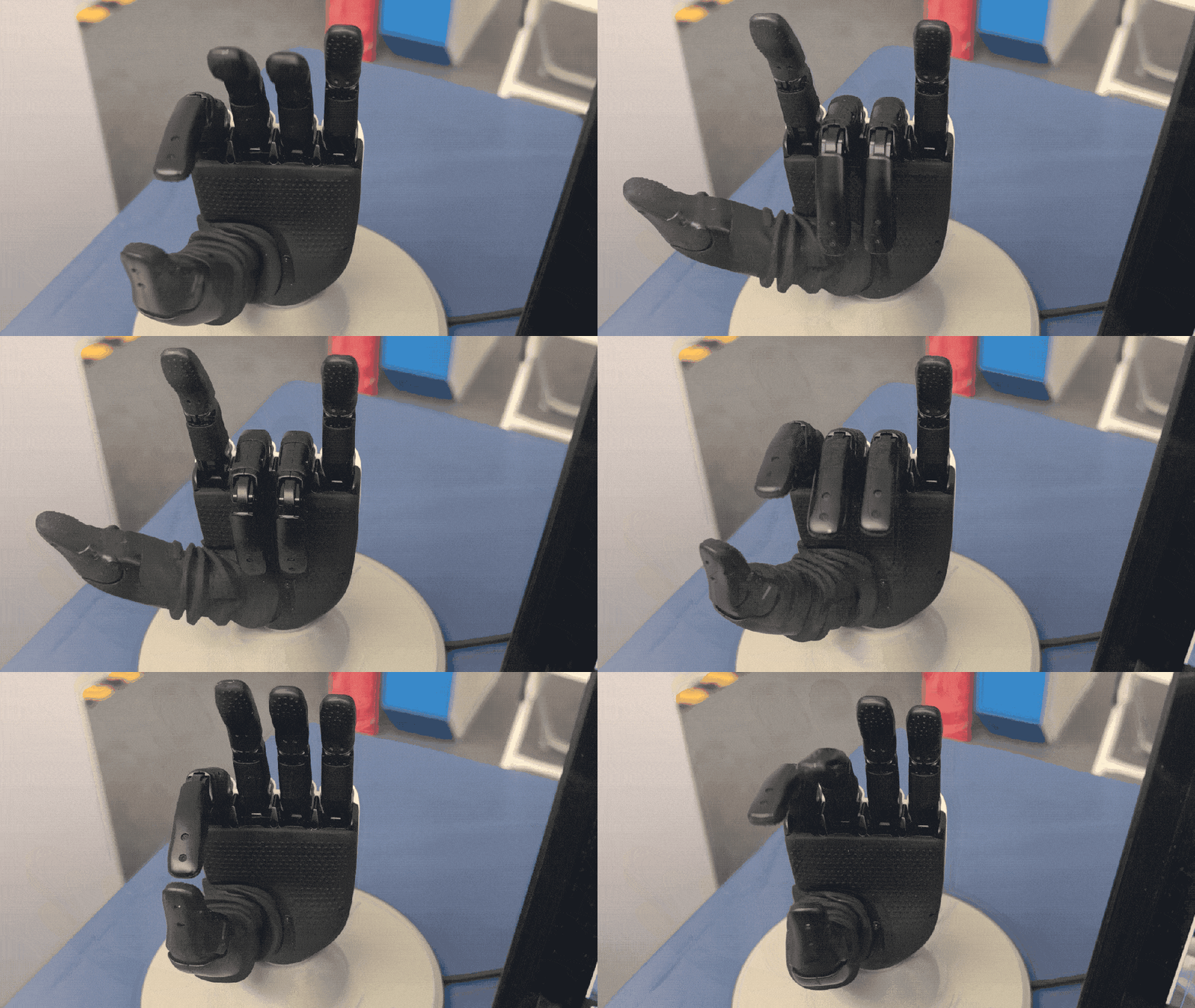
Merged summary
TL;DR — A 量子位 industry report on China's dexterous-robot-hand boom: over ¥20B raised in H1 2026, 510+ registered companies, and units priced from a few thousand to several hundred thousand RMB — but hardware reliability and manufacturing remain far from production-ready.
- Capital surge: ~¥8B new funding across 10 leading hand-focused firms in H1, combined post-money valuation >¥75B; 灵心巧手 reportedly valued at $6B. Players span whole-robot OEMs (优必选/智元/宇树), motor & sensor firms (兆威/帕西尼/强脑), pure-play startups (因时/傲意/舞肌), and big tech (小米/腾讯).
- Cost structure: three transmission routes — tendon-driven, direct-drive, and linkage. Slotless brushless coreless motors account for ~50–60% of hand cost (excluding sensors); adding tactile sensing adds a 20–50% price premium (e.g. 智元 OminiHand ¥14.8k→¥19.8k, 强脑 Revo 1 ¥35k→¥50k).
- DoF is a weak price/value proxy: a linear regression of price vs. total DoF gave low Pearson r and R². Practitioners argue "opposition workspace" matters more — many nominal 20+ DoF hands deliver only 6–10 effective control dimensions, underperforming industrial grippers.
- Core bottleneck is a hardware/algorithm deadlock: hands reportedly fail weekly, with top-tier units lasting only ~50 hours under 5 kg load — too unreliable for large-scale real-robot data collection, while simulation can't yet model contact physics well enough for sim-to-real. Most assembly is still manual ("一机一样"), and many OEMs (银河通用, 逐际动力, 智平方) still buy rather than build.
Sources (1)
魔幻灵巧手:半年200亿热钱,3大路线,贵到几十万一只
Public signals
N/A
TL;DR — A 量子位 industry report on China's dexterous-robot-hand boom: over ¥20B raised in H1 2026, 510+ registered companies, and units priced from a few thousand to several hundred thousand RMB — but hardware reliability and manufacturing remain far from production-ready.
- Capital surge: ~¥8B new funding across 10 leading hand-focused firms in H1, combined post-money valuation >¥75B; 灵心巧手 reportedly valued at $6B. Players span whole-robot OEMs (优必选/智元/宇树), motor & sensor firms (兆威/帕西尼/强脑), pure-play startups (因时/傲意/舞肌), and big tech (小米/腾讯).
- Cost structure: three transmission routes — tendon-driven, direct-drive, and linkage. Slotless brushless coreless motors account for ~50–60% of hand cost (excluding sensors); adding tactile sensing adds a 20–50% price premium (e.g. 智元 OminiHand ¥14.8k→¥19.8k, 强脑 Revo 1 ¥35k→¥50k).
- DoF is a weak price/value proxy: a linear regression of price vs. total DoF gave low Pearson r and R². Practitioners argue "opposition workspace" matters more — many nominal 20+ DoF hands deliver only 6–10 effective control dimensions, underperforming industrial grippers.
- Core bottleneck is a hardware/algorithm deadlock: hands reportedly fail weekly, with top-tier units lasting only ~50 hours under 5 kg load — too unreliable for large-scale real-robot data collection, while simulation can't yet model contact physics well enough for sim-to-real. Most assembly is still manual ("一机一样"), and many OEMs (银河通用, 逐际动力, 智平方) still buy rather than build.