深度拆解 DeepSeek Harness 架构:AGI 的自进化,终于有了「后悔药」
Ranking
No observed public metrics; popularity remains neutral/archived.
Merged summary
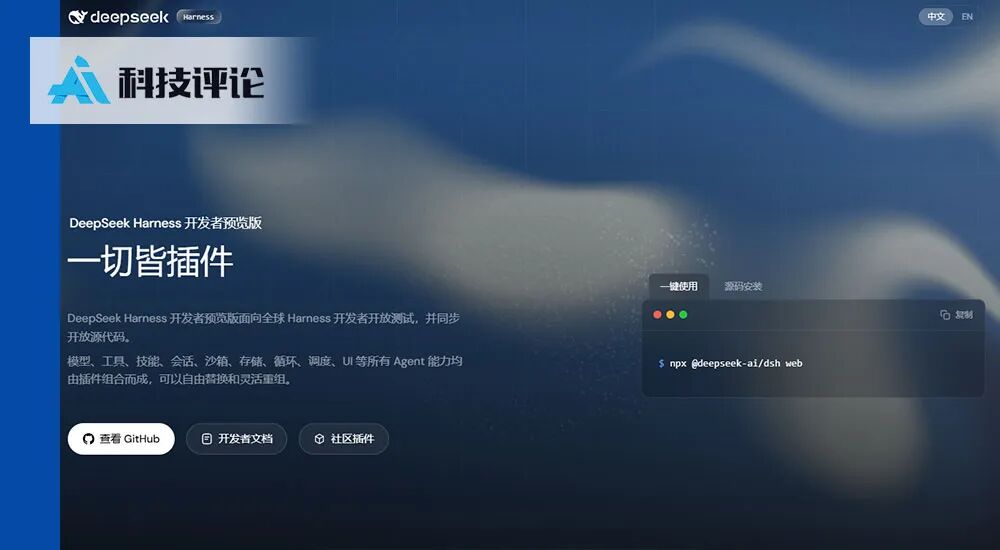
TL;DR — DeepSeek Harness v0.1 是一个开源编码智能体运行时,模型、循环、工具、记忆、沙箱、界面和日志均可替换。其 Cordis 框架通过可回滚副作用与响应式依赖管理,为智能体安全修改、自我演化运行时提供基础。
- Cordis 为运行时操作记录逆操作,使插件及其副作用可在卸载时回滚,并在服务出现、消失或替换时自动调整依赖组件。
- 提供完整编码工作流、程序化工具调用、最小模型评测和自定义智能体四种模式。
- 程序化工具调用将工具封装为 TypeScript SDK,可减少模型往返,并避免中间数据占用上下文。
- 追加式事件日志支持重放和恢复;内置子智能体编排还可调用本地 Codex 与 Claude Code,早期测试展现出较强的并行协调与可观测性。
- 目前仍存在多步 API 成本较高、插件交互复杂度可能呈二次增长、UI 缺陷及长文本生成局部一致性不足等风险。
侧重点差异: 雷峰网更关注 Cordis 的可逆自进化机制与复杂度风险,夕小瑶科技说更强调使用模式、工具调用效率、编排体验及生态潜力。
Sources (2)
DeepSeek Harness,是今年最有野心的一次Agent开源
TL;DR - DeepSeek released the developer preview of DeepSeek Harness, an open-source agent framework whose models, loops, tools, memory, sandboxes, and interfaces are replaceable plugins. Its modular architecture could support a broader ecosystem of customizable agents rather than a single coding product.
- Four modes cover full coding workflows, programmatic tool calling, minimal model evaluation, and custom agent creation.
- Programmatic tool calling packages tools as a TypeScript SDK, reducing model round trips and keeping intermediate data out of context.
- Append-only event logs enable replay and recovery, while built-in subagent orchestration can invoke local Codex and Claude Code installations.
- Early testing showed strong parallel task coordination and observability, but also UI bugs and weaker local consistency in long-form generation.
深度拆解 DeepSeek Harness 架构:AGI 的自进化,终于有了「后悔药」
TL;DR - DeepSeek released Harness v0.1, a coding-agent runtime whose core components—including its agent loop, model adapters, tools, and session logs—are all replaceable plugins. Its Cordis framework aims to make agent-driven runtime modifications reversible and dependency-safe, enabling experimentation without permanently corrupting system state.
- Cordis records inverse operations for runtime effects, allowing plugin changes and their side effects to be rolled back on removal.
- Reactive dependency handling activates or deactivates components as required services appear, disappear, or are replaced.
- The architecture targets self-evolving agents that can inspect and modify their own runtime while converging to a clean, equivalent final state.
- Key risks include higher multi-step API costs and potentially quadratic growth in integration complexity as plugin counts and interactions increase.