英伟达 Cosmos 3 深度拆解:它想做具身智能时代的「安卓系统」| RSS 2026
Ranking
Overall
75
Content
85
Popularity
N/A
No observed public metrics; popularity remains neutral/archived.
Merged summary
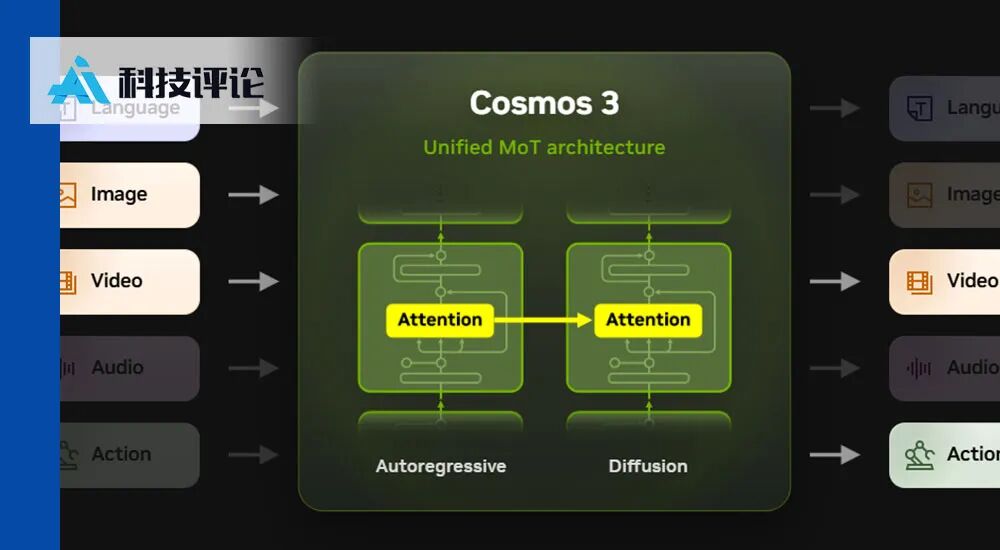
TL;DR - Nvidia introduced Cosmos 3, an open world foundation model that unifies text, images, video, audio, and robot actions for physical AI. Its edge-optimized version aims to bring real-time perception, simulation, and control onto Jetson-class devices.
- A single MoE architecture combines a reasoning component with a multimodal generator and supports world understanding, forward and inverse dynamics, and policy generation.
- Training spans dynamics, inverse-dynamics, and policy modes, with synchronized positional encoding for time-aligned video, audio, and action data.
- The family includes 4B Edge, 16B Nano, and 64B Super variants; Edge drops audio to meet on-device resource and latency constraints.
- Nvidia reports that action conditioning improved future-visual prediction in robotics-specific domains, but does not yet claim strong global evidence across all video domains.
Sources (1)
英伟达 Cosmos 3 深度拆解:它想做具身智能时代的「安卓系统」| RSS 2026
Public signals
N/A
TL;DR - Nvidia introduced Cosmos 3, an open world foundation model that unifies text, images, video, audio, and robot actions for physical AI. Its edge-optimized version aims to bring real-time perception, simulation, and control onto Jetson-class devices.
- A single MoE architecture combines a reasoning component with a multimodal generator and supports world understanding, forward and inverse dynamics, and policy generation.
- Training spans dynamics, inverse-dynamics, and policy modes, with synchronized positional encoding for time-aligned video, audio, and action data.
- The family includes 4B Edge, 16B Nano, and 64B Super variants; Edge drops audio to meet on-device resource and latency constraints.
- Nvidia reports that action conditioning improved future-visual prediction in robotics-specific domains, but does not yet claim strong global evidence across all video domains.