探索RSI,生数新世界模型让机器人开始自我进化
Ranking
Overall
68
Content
75
Popularity
53
Observed public metrics from 1 member.
Merged summary
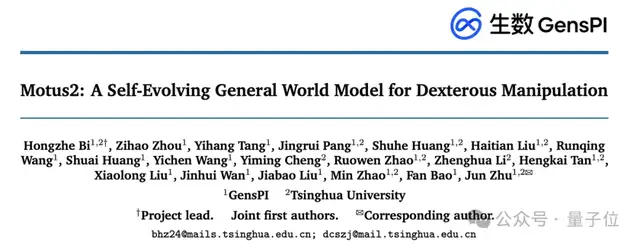
TL;DR - ShengShu Technology introduced Motus2, a multimodal world-action model that enables robots to act, predict outcomes, evaluate results, and improve their policies in a closed loop. It is an early exploration of recursive self-improvement for embodied agents, not unrestricted autonomous learning.
- Motus2 combines action generation, an action-conditioned world model, and a value model; Best-of-N planning simulates and scores candidate actions before execution.
- Model-based reinforcement learning converts those scores into policy updates while freezing prediction and evaluation components. Planning plus policy learning raised average success on two real-robot tasks from 65% to 75%.
- Tactile input improved average success on cup extraction and paper tearing from 60% to 72.5%, while retained observation history supported tasks requiring memory.
- Training uses roughly 130,000 hours of first-person human video plus robot and human-robot alignment data; robot-domain intermediate training increased five-task average success from 51% to 84%.
Sources (1)
探索RSI,生数新世界模型让机器人开始自我进化
Public signals
Hugging Face upvotes 5
TL;DR - ShengShu Technology introduced Motus2, a multimodal world-action model that enables robots to act, predict outcomes, evaluate results, and improve their policies in a closed loop. It is an early exploration of recursive self-improvement for embodied agents, not unrestricted autonomous learning.
- Motus2 combines action generation, an action-conditioned world model, and a value model; Best-of-N planning simulates and scores candidate actions before execution.
- Model-based reinforcement learning converts those scores into policy updates while freezing prediction and evaluation components. Planning plus policy learning raised average success on two real-robot tasks from 65% to 75%.
- Tactile input improved average success on cup extraction and paper tearing from 60% to 72.5%, while retained observation history supported tasks requiring memory.
- Training uses roughly 130,000 hours of first-person human video plus robot and human-robot alignment data; robot-domain intermediate training increased five-task average success from 51% to 84%.