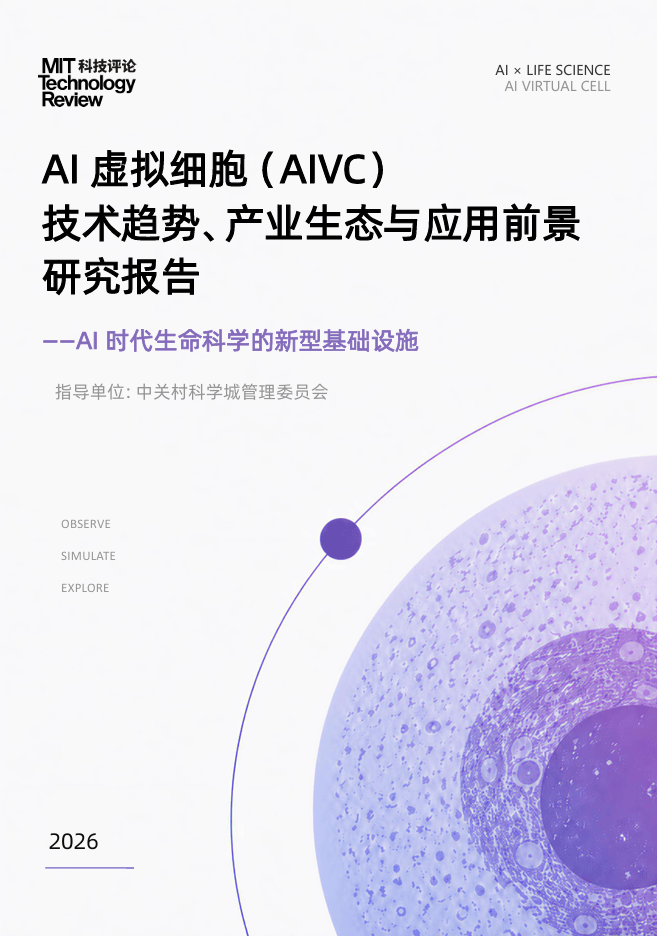
百曜科技发起,《AI虚拟细胞(AIVC)技术趋势、产业生态与应用前景研究报告》正式发布
Ranking
No observed public metrics; popularity remains neutral/archived.
Merged summary
TL;DR - Baiyao Technology launched an industry report positioning AI virtual cells as reusable infrastructure for simulating cellular responses in drug discovery and life-science research. It argues that commercialization will depend less on model scale alone and more on integrated data, modeling, and experimental-validation capabilities.
- AIVC aims to create computational “digital mirrors” of cells that predict responses to interventions such as gene knockouts, drugs, and environmental changes.
- The report highlights generalization and task adaptation—not just parameter or dataset growth—as key model-development priorities, including world-model and JEPA-style approaches to cell-state transitions.
- High-quality proprietary perturbation, clinical, time-series, and multimodal data are presented as strategic advantages over public datasets.
- Industrial adoption requires a closed loop spanning data generation, model prediction, wet-lab validation, and experimental feedback; Baiyao cites applications including patient stratification, CAR-T optimization, and anti-aging target discovery.
Sources (1)
百曜科技发起,《AI虚拟细胞(AIVC)技术趋势、产业生态与应用前景研究报告》正式发布
TL;DR - Baiyao Technology launched an industry report positioning AI virtual cells as reusable infrastructure for simulating cellular responses in drug discovery and life-science research. It argues that commercialization will depend less on model scale alone and more on integrated data, modeling, and experimental-validation capabilities.
- AIVC aims to create computational “digital mirrors” of cells that predict responses to interventions such as gene knockouts, drugs, and environmental changes.
- The report highlights generalization and task adaptation—not just parameter or dataset growth—as key model-development priorities, including world-model and JEPA-style approaches to cell-state transitions.
- High-quality proprietary perturbation, clinical, time-series, and multimodal data are presented as strategic advantages over public datasets.
- Industrial adoption requires a closed loop spanning data generation, model prediction, wet-lab validation, and experimental feedback; Baiyao cites applications including patient stratification, CAR-T optimization, and anti-aging target discovery.