亮出“中国最强AI芯片”还不够,平头哥又甩出一手开源
Ranking
No observed public metrics; popularity remains neutral/archived.
Merged summary
TL;DR — 阿里巴巴平头哥进一步开源面向真武 AI 芯片的 T-Head SAIL 软件栈,通过兼容主流框架和开发语言降低模型迁移、算子开发及性能优化成本,补齐国产 AI 芯片从硬件性能走向规模化应用所需的软件生态。
- 此次开放 PyTorch-for-sail、Sailify、Triton-for-sail、DeepGEMM-for-sail 和 FlashAttention-for-sail,覆盖框架接入、代码迁移、自定义算子与关键计算加速。
- SAIL 连接 PyTorch 等框架与真武硬件,并支持开发者使用熟悉的 C++、Triton 和 TileLang 工作流直接优化负载。
- 平头哥称真武芯片已服务超过 650 家客户、覆盖 20 多个行业;小鹏、蚂蚁集团和小红书已将 SAIL 用于训练、推理、迁移及优化。
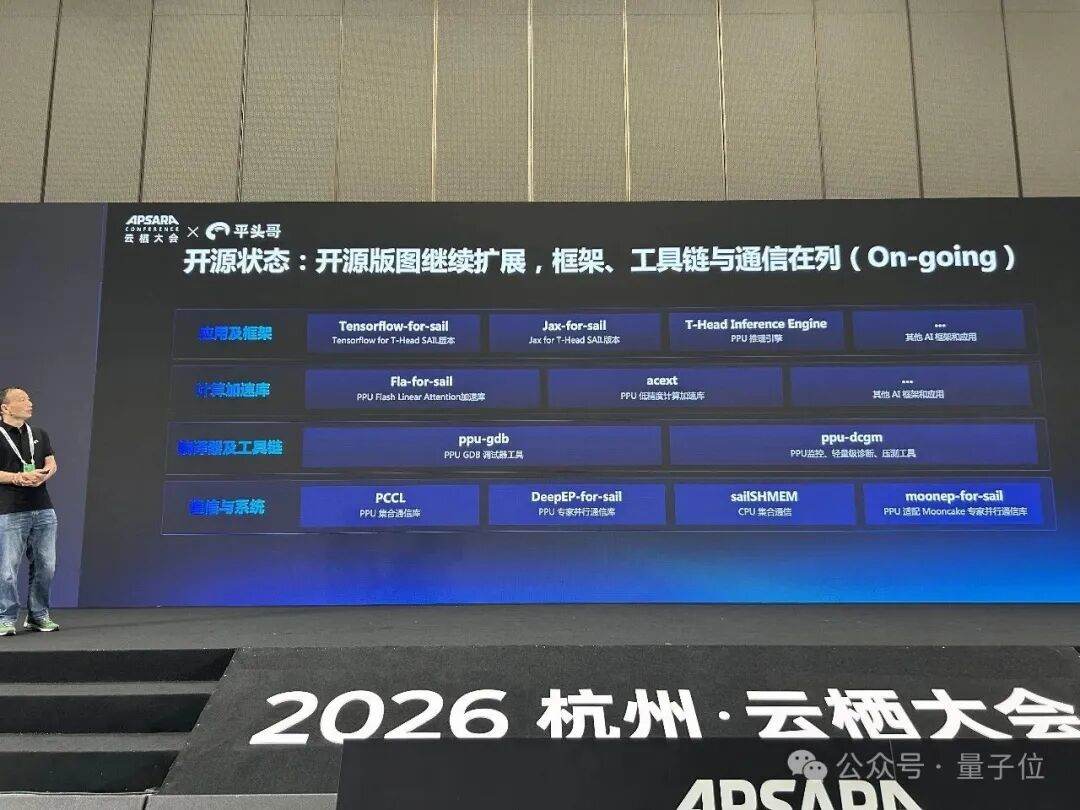
- 后续计划补充 TensorFlow、JAX、推理与通信组件以及更多调试工具,并通过向上游社区贡献代码降低维护成本、加快新模型适配。
注:第二则来源实际介绍的是蔚来 MM-Future 自动驾驶世界—动作模型,与平头哥 SAIL 开源工作并非同一项目,因此未强行合并,以免产生事实混淆。
Sources (2)
亮出“中国最强AI芯片”还不够,平头哥又甩出一手开源
TL;DR - Alibaba’s T-Head expanded the open-source T-Head SAIL software stack for its Zhenwu AI chips, aiming to reduce model-porting costs and let developers optimize workloads directly. The CUDA-like ecosystem is critical to making China’s AI hardware practical across existing frameworks, models, and production systems.
- Newly opened components include PyTorch-for-sail, Sailify, Triton-for-sail, DeepGEMM-for-sail, and FlashAttention-for-sail, covering framework integration, code migration, custom operators, and acceleration.
- SAIL connects frameworks such as PyTorch to Zhenwu hardware and supports familiar C++, Triton, and TileLang development workflows.
- T-Head reports that Zhenwu chips serve more than 650 customers across over 20 industries; Xiaopeng, Ant Group, and Xiaohongshu are using SAIL for training, inference, migration, and optimization.
- Planned releases include TensorFlow and JAX support, inference and communication components, and additional debugging tools, while upstream contributions should reduce maintenance overhead and accelerate support for new models.
时隔十年,AI大牛署名新论文
TL;DR - NIO researchers introduced MM-Future, a world–action model that jointly simulates multiple paired driving actions and future scenes before selecting a trajectory. It improves planning benchmarks by modeling how each candidate action could change the environment, though compute cost and extreme-scenario robustness remain limitations.
- MM-Future generates multiple paired scene–action hypotheses with bidirectional interaction, rather than predicting trajectories and future scenes sequentially or producing only one joint outcome.
- Gaussian-mixture action noise, independent scene noise, and Best-of-Many supervision preserve diverse candidates; compact MM-Tokens reduce the cost of representing multi-camera, multi-frame futures.
- The model achieved 94.0 PDMS on NAVSIM-v1 and 91.5 EPDMS on NAVSIM-v2; ablations showed gains from additional modes, joint scene–action generation, and future-conditioned candidate scoring.
- Sampling 64 candidates took about 233 ms on one NVIDIA H800, while implicit scene representations, route completion, and extreme-scenario performance require further improvement.