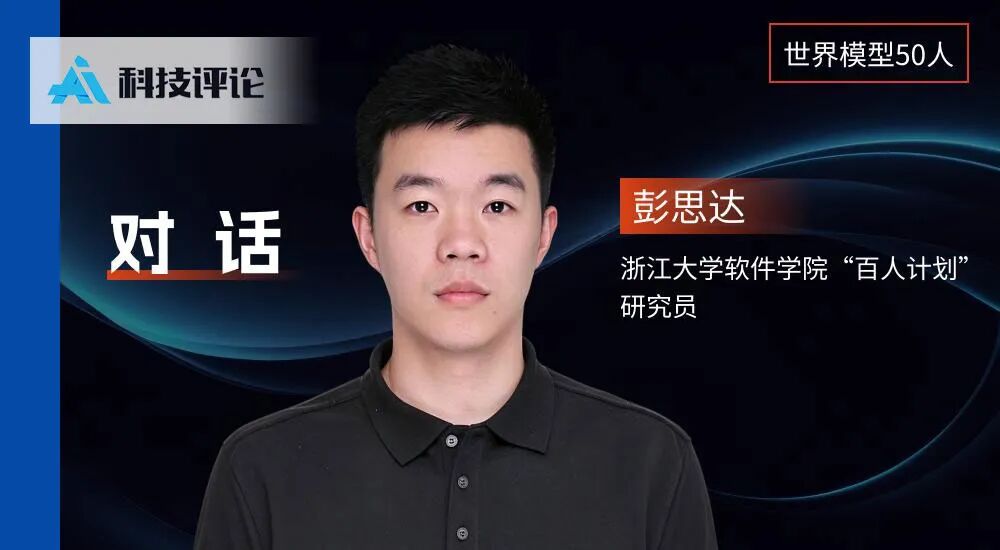
浙大彭思达:从元宇宙到具身智能,一个三维视觉研究者的八年 | 世界模型50人
Ranking
Overall
61
Content
65
Popularity
N/A
No observed public metrics; popularity remains neutral/archived.
Merged summary
TL;DR - An interview profiles Zhejiang University researcher Peng Sida’s shift from 3D reconstruction to autonomous-driving simulation and embodied navigation. He argues practical robots should combine general multimodal agents for reasoning with specialized, high-frequency models for control.
- SuperNav handles planning and decision-making, while ScaleNav executes navigation commands as a specialized “cerebellum.”
- Peng says end-to-end VLM control can degrade general capabilities and cannot meet the roughly 50 Hz interaction rate needed for manipulation.
- His earlier work spans Neural Body and 4K4D for volumetric video, plus Street Gaussians for autonomous-driving simulation.
- He views vision as supporting both reasoning and control, while text drives high-level intelligence and action trajectories are central to embodied skills.
Sources (1)
浙大彭思达:从元宇宙到具身智能,一个三维视觉研究者的八年 | 世界模型50人
Public signals
N/A
TL;DR - An interview profiles Zhejiang University researcher Peng Sida’s shift from 3D reconstruction to autonomous-driving simulation and embodied navigation. He argues practical robots should combine general multimodal agents for reasoning with specialized, high-frequency models for control.
- SuperNav handles planning and decision-making, while ScaleNav executes navigation commands as a specialized “cerebellum.”
- Peng says end-to-end VLM control can degrade general capabilities and cannot meet the roughly 50 Hz interaction rate needed for manipulation.
- His earlier work spans Neural Body and 4K4D for volumetric video, plus Street Gaussians for autonomous-driving simulation.
- He views vision as supporting both reasoning and control, while text drives high-level intelligence and action trajectories are central to embodied skills.