🛰️ Daily AI Frontier
⚠ WeChat login expired or unavailable — new articles may be missing. Reconnect WeChat. An upstream outage cannot be fixed by scanning. Latest stored WeChat publication: 2026-08-25.

WeChat reconnect targets werss, while collection still uses wewe. Login alone does not complete the provider cutover.

Twitter/X collection is rate limited. 0 of 13 handles succeeded at the last check. Stored posts remain available; partial coverage is not a complete timeline.
36 works · 3 categories · 12 topics · blog 12 journal 10 arxiv 15 generated 2026-09-30 14:43:18 UTC
Top highlights — Research

LLM Agents 1

Representative image for Context Language Models

Context Language Models

Rank 84 · Content 95 · Popularity 59

TL;DR - Context Language Models let models manage context directly as editable files, replacing externally controlled context strategies and extending naturally to multi-agent systems. Across long-horizon benchmarks, this approach improves performance while reducing compute.

  • Zero-shot CLMs achieved 11.4% higher BrowseComp-Plus accuracy with 21.5% fewer FLOPs and 5% higher EdgeBench scores with 59% fewer FLOPs.
  • File-based contexts support multiple coexisting agent contexts and both in-context and parametric learning of management strategies.
  • Instruction optimization improved held-out context-management accuracy by up to 35.9 points; online reinforcement learning improved Qwen3.5-9B by 47.6% with 12% fewer FLOPs.
  • Suffix Cache Reuse reduced server-side compute by another 35% versus standard SGLang at matched performance.

Medical/Healthcare AI 2

Restoring hearing in people with a rare form of deafness

Rank 76 · Content 90 · Popularity 43

TL;DR - Nature traces the decades-long research effort behind the first gene therapy for deafness caused by a rare genetic mutation. The brief provided does not specify the therapy’s mechanism, trial design, or clinical results.

  • The treatment targets an inherited form of deafness linked to a specific mutation.
  • It represents the first gene therapy developed for this condition.
  • The article emphasizes the long path from genetic research to a potential hearing-restoration therapy.
  • Detailed efficacy, safety, and patient-outcome data are not included in the supplied content.

Is exposomics the key to making personalized medicine a reality?

Rank 58 · Content 65 · Popularity 43

TL;DR - This Nature article examines whether exposomics—the comprehensive study of lifelong environmental exposures—could enable truly personalized disease treatment. The provided excerpt presents the premise but does not report specific methods or results.

  • Personalized medicine may require environmental-exposure data alongside biological and clinical information.
  • Exposomics aims to characterize exposures accumulated across a person’s lifetime.
  • Comprehensive exposure assessment could help tailor disease treatments to individuals.
  • The excerpt does not specify how exposures are measured, analyzed, or translated into clinical decisions.

Bioinformatics AI 1

CytoVI: deep generative modeling of antibody-based single cell data

Rank 83 · Content 100 · Popularity 43

TL;DR - CytoVI is a deep generative model for statistically rigorous analysis of antibody-based single-cell data. It aims to improve computational analysis of measurements used to characterize heterogeneous cell populations.

  • Published online in Nature Methods on September 30, 2026.
  • Applies deep generative modeling to antibody-derived single-cell measurements.
  • Emphasizes statistically rigorous analysis, though the provided abstract snippet does not specify methods, benchmarks, or quantitative results.

LLMs & Foundation Models 4

Learning Beyond What You Sample: Off-Policy-Aware Cross-Model Trajectory Exchange for RLVR

Rank 83 · Content 90 · Popularity 67

TL;DR - GRAFT is an off-policy-aware RLVR framework that lets heterogeneous models exchange complementary reasoning trajectories when one model’s rollout group contains no successes. It improves mathematical reasoning performance under the same per-model rollout budget, without requiring a designated stronger teacher.

  • Replaces all-fail GRPO groups with informative peer-generated groups to restore a reward-based learning signal.
  • Transfers both successful and unsuccessful peer responses along with peer-computed advantages.
  • Controls cross-model policy mismatch using sequence-level compatibility weighting and token-level importance-ratio clipping.
  • Across three model pairs and five math benchmarks, GRAFT improved both models by 2.1 points on average and up to 4.5 points; stored trajectories retained a 1.8-point average gain without simultaneous co-training.

Alpha Diffusion Language Models: Factorization Alone Is Not the Problem

Rank 79 · Content 100 · Popularity 30

TL;DR - AlphaDLM replaces standard token-level cross-entropy with a sequence-level alpha loss to improve joint consistency during parallel generation. It offers a better accuracy-computation trade-off for factorized diffusion language models using fewer denoising steps.

  • The alpha loss approaches cross-entropy as alpha vanishes and targets the joint mode at alpha one.
  • Intermediate alpha values can preserve multiple valid completions while excluding inconsistent token combinations under identified conditions.
  • On TinyGSM, AlphaDLM achieves 34.6% GSM8K accuracy with four model evaluations.
  • Experiments scale the method to SDAR-1.7B and assess it on code and mathematics benchmarks.

Pretraining Latent Information Feedback Transformers with Teacher Supervision

Rank 75 · Content 95 · Popularity 30

TL;DR - LIFT augments Transformers with recurrent latent states that carry deep-layer information across generation steps, trained through teacher-supervised state prediction without sacrificing parallel pretraining. Models from 135M to 1B parameters outperform standard Transformers on language modeling, reasoning, and procedural tasks under matched token budgets.

  • Each token is paired with a precomputed, information-dense state derived from a pretrained teacher model’s next-token distribution.
  • LIFT jointly predicts the next token and next latent state, then feeds its own predicted states back during inference.
  • Precomputed states preserve parallel training across positions, while inference adds minor overhead that decreases relative to model size.
  • On a controlled state-tracking task, a tiny LIFT surpassed same-size Transformers trained on eight times more data—even with supervision from a teacher that failed the task.

Towards foundation-style models for energy-frontier heterogeneous neutrino detectors via self-supervised pretraining

Rank 69 · Content 80 · Popularity 43

TL;DR - This study applies self-supervised pretraining to foundation-style models for heterogeneous neutrino detectors. The approach improves event interpretation and data efficiency while supporting transfer across detector technologies.

  • Targets complex neutrino-event classification and reconstruction tasks.
  • Uses self-supervised pretraining to reduce reliance on labeled detector data.
  • Improves classification, reconstruction, and overall data efficiency.
  • Demonstrates transfer across different neutrino detector technologies.

Multimodal & Generative 3

Representative image for LongLive-Plug: Once-for-All Distillation for Video Generation

LongLive-Plug: Once-for-All Distillation for Video Generation

Rank 82 · Content 95 · Popularity 53

TL;DR - LongLive-Plug distills reusable video-generation capabilities into LoRA adapters that can be deployed across compatible downstream diffusion models without retraining. This could eliminate repeated per-model distillation for faster sampling, classifier-free guidance, and long-video generation.

  • Provides LoRAs for single-pass classifier-free guidance, few-step sampling, and long-context error correction in autoregressive generation.
  • Supports guidance-strength control through the CFG LoRA’s inference weight, despite training at a fixed guidance scale.
  • Combines CFG and few-step LoRAs while preserving both sampling efficiency and guidance controllability.
  • Demonstrates training-free deployment across 54 downstream models spanning three backbone families and eight task categories.

OmniTaskonomy: When Does Visual Generation Improve Visual Understanding?

Rank 82 · Content 90 · Popularity 64

TL;DR - OmniTaskonomy studies when image-generation supervision improves visual understanding, showing that carefully selected image-to-image tasks can boost related image-to-text capabilities. Its transfer map and gradient-alignment analysis offer a practical basis for choosing effective multimodal training curricula.

  • The taxonomy covers 19 image-to-image generation tasks and 25 image-to-text understanding capabilities.
  • Downstream understanding improves under the appropriate training recipe, with gains increasing as generation-training data grows.
  • Transfer is selective: depth prediction aids metric 3D reasoning, object pointing aids counting, and jigsaw reconstruction aids 2D ordering.
  • Stronger gradient alignment between generation and understanding tasks is associated with larger transfer gains.
Representative image for SoL-Refiner: Speed-of-Light One-Step Refinement for High-Resolution Video

SoL-Refiner: Speed-of-Light One-Step Refinement for High-Resolution Video

Rank 80 · Content 90 · Popularity 56

TL;DR - SoL-Refiner converts low-resolution generated videos into 4K output with a single denoising step. It aims to remove the costly second sampling bottleneck in high-resolution video generation while improving quality and delivering an 8.91× refinement-latency speedup over a three-step baseline.

  • Training combines high-resolution continual training, reinforcement-learning post-training, and one-step distillation.
  • Refiner-Bench evaluates refiners on outputs from multiple video generators using a shared-input protocol.
  • At roughly 2K resolution, SoL-Refiner leads external refiners on average VBench and UniPercept scores.
  • At 3840×2176, it improves both metrics over the three-step LTX-2.3 Refiner.

Efficiency & Systems 5

Representative image for STEPQuant: When and Where Errors Matter in Delta-Rule Recurrent State Quantization

STEPQuant: When and Where Errors Matter in Delta-Rule Recurrent State Quantization

Rank 88 · Content 95 · Popularity 70

TL;DR - STEPQuant is a post-training quantization method that allocates precision across the spatial and temporal dimensions of Delta-rule recurrent states. It closely matches FP32-state accuracy at a nominal 6-bit budget while cutting recurrent-state memory by over 5× and total serving memory by up to 68.7%.

  • Prioritizes errors by both their expected lifetime and their location within recurrent states.
  • Jointly fits key-row and value-column scales using state distributions and each key row’s effect on output error.
  • On Qwen3.8-27B and Kimi-Linear-48B-A3B-Instruct, the 4-bit configuration outperforms uniform INT8 quantization.
  • An SGLang integration provides optimized GPU kernels for practical concurrent serving.

WUSH-KV: KV Cache Quantization with Data-Adaptive Transforms

Rank 82 · Content 95 · Popularity 50

TL;DR - WUSH-KV is a data-adaptive transformation method for low-bit KV-cache quantization that reduces memory and bandwidth costs during long-context LLM inference. At 2-bit precision, it matches or outperforms the OSCAR transform across all evaluated models and downstream tasks.

  • Builds separate key and value transforms from calibration-data statistics to reduce quantization error.
  • Folds the value transform into model weights and applies the key transform after rotary positional encoding (RoPE).
  • With QuEST INT quantization, WUSH-KV achieves the lowest end-to-end perplexity among the tested transforms.
  • An SGLang integration uses OSCAR-style percentile-clipped affine quantization for end-to-end evaluation.

Delta-Matching: Closing the Final Gap of Native 8-bit Training for LLMs

Rank 79 · Content 100 · Popularity 30

TL;DR - Delta-Matching addresses numerical inconsistencies in FP8 attention that destabilize large-scale LLM training. It enables native block-scaled FP8 across all attention-core matrix multiplications while matching mixed-precision training loss and overall downstream performance.

  • Forward-backward inconsistencies create a stale delta that increasingly degrades training at 1.67B and 5.29B parameters.
  • QK normalization, NoPE, and lower learning rates during context extension delay or reduce degradation but do not eliminate it.
  • Delta-Matching restores the softmax gradient’s zero-row-sum invariant under the paper’s numerical assumptions.
  • The method requires no architectural changes, smaller global batches, or auxiliary forward outputs.

Scaling Influence Functions in LLMs through Eigenbasis-Corrected One-Bit Gradient Projection

Rank 79 · Content 100 · Popularity 30

TL;DR - EOGP compresses per-example LLM training gradients using dimensionality reduction, PCA-based directions, and one-bit quantization while preserving useful influence estimates. It enables scalable training-data attribution with substantially lower storage requirements.

  • A worst-case analysis characterizes the optimal fixed-dimensional linear representation for future influence queries.
  • EOGP combines EK-FAC dimensionality reduction with PCA learned from training gradients, then one-bit quantizes the resulting coordinates.
  • On GPT-2, it predicted retraining outcomes more accurately than evaluated baselines using one-sixteenth of their per-example storage.
  • On OLMo 2 SFT models from 1B to 32B parameters, it remained competitive with baselines given over 100 times more storage per example.

LeapQuant: Efficient Linear Attention with Accurate Recurrent State Quantization

Rank 78 · Content 95 · Popularity 37

TL;DR - LeapQuant is a training-free method for 8-bit quantization of recurrent states in linear-attention LLMs, maintaining near-FP32 accuracy while reducing inference memory and compute costs. It reports kernel-level speedups of 2.05–3.70× and a 1.47× end-to-end speedup across several NVIDIA GPUs.

  • Per-window quantization limits accumulated rounding error by quantizing the recurrent state only once after each token window.
  • High-precision buffered updates preserve output quality within each window while the fixed state remains low-bit.
  • “Compensator Tokens” retain the largest state outliers at high precision, while smoothing makes the residual easier to quantize.
  • Experiments span Qwen, Kimi, and GLM model families and NVIDIA B200, RTX PRO 6000, and RTX 5090 GPUs.

Robot Learning 2

Representative image for Counterfactual Video Generation Enables Scalable Humanoid Loco-Manipulation

Counterfactual Video Generation Enables Scalable Humanoid Loco-Manipulation

Rank 81 · Content 95 · Popularity 47

TL;DR - PRISM is a real-to-sim-to-real framework that expands a few real interaction videos into diverse synthetic training data for humanoid loco-manipulation. It enables a real robot to handle unseen object instances without real-world fine-tuning.

  • Video-to-video generation creates hundreds of counterfactual human-object interaction clips from a small set of exemplars.
  • A contact-anchored reconstruction pipeline converts imperfect generated videos into physically plausible human and object trajectories.
  • Intra-class variation supports a single policy that generalizes across novel objects, sizes, and initial configurations.
  • Using onboard depth observations, the humanoid picks up, carries, and drops boxes, barrels, bins, and balls.

Rethinking Representations for World-Action Modeling

Rank 78 · Content 95 · Popularity 37

TL;DR - ReWAM is a representation-centric world-action model that structures pre-trained DINO features into compact states for jointly learning robot control and future-observation prediction. It shows that task-aligned representations—not reconstruction quality or perceptual features alone—are critical for effective policy learning.

  • Feature Calibration and a Temporal Representation Bottleneck adapt DINO features for compact dynamics modeling.
  • Action-Grounded Representation Shaping sends only action-loss gradients to the bottleneck, allowing the policy to determine what state information matters while the world model learns its evolution.
  • Without generative video pre-training, ReWAM reaches 93.6% success on RoboTwin 2.0.
  • With roughly 600 hours of embodied pre-training data, it scores 12.29 on average and achieves an 8.28% success rate on RoboDojo.

Robotics AI 1

Representative image for EVO-WAM: Evolving World Action Models through Video-Action Verification

EVO-WAM: Evolving World Action Models through Video-Action Verification

Rank 81 · Content 90 · Popularity 61

TL;DR - EVO-WAM adapts world action models to unseen robotic tasks using their own generated video-action trajectories, without new expert demonstrations or external execution feedback. Verification of task completion and action consistency substantially improves simulated and real-world success rates.

  • Adds state prediction and anchored multi-frame context to support complete autoregressive rollouts.
  • Uses a vision-language model to select task-completing prefixes and an inverse dynamics model to verify video-action consistency.
  • Iteratively retrains on verified prefixes, raising success on seven unseen RoboTwin 2.0 tasks from 26.9% to 68.0% for Cosmos3 and from 28.5% to 46.4% for DreamZero.
  • On three real-world long-horizon tasks, Cosmos3 improves from 20.0% to 76.7% average success.
Top highlights — Industry & News

LLM Agents 4

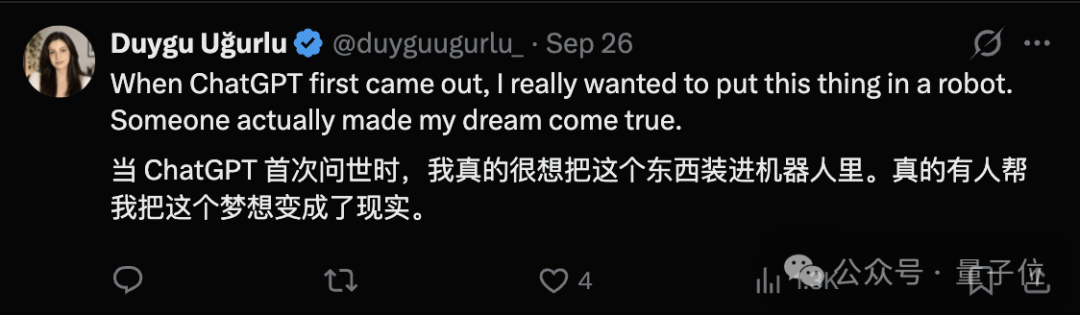
Representative image for 刚刚,GPT-6 Astra接上宇树G1,把厨房收拾了!

刚刚,GPT-6 Astra接上宇树G1,把厨房收拾了! 🔗 2 sources

Rank 75 · Content 85 · Popularity N/A

TL;DR — GPT-6 Astra has been demonstrated coordinating both a Unitree G1 humanoid in an unfamiliar kitchen and complex desktop workflows. The examples suggest stronger long-horizon planning, tool use, memory, and self-correction, while still requiring substantial infrastructure and human oversight.

  • Stanford’s HomeBody system lets Astra plan multi-step household tasks and invoke reusable robot skills—including navigation, grasping, placing, opening drawers, and object retrieval—while lower-level modules handle motion planning and control.
  • Using camera, LiDAR, SLAM, and pose data, the robot builds spatial memory and a geometry-constrained Isaac Sim digital twin, allowing Astra to find objects outside its current view and chain actions such as retrieving medicine from a drawer and handing it over.
  • In informal computer-use tests, Astra operated tools including Blender, Final Cut Pro, and Unreal Engine, creating 3D assets and environments, editing media, reading errors, inspecting results, and iteratively correcting its work.
  • Long-running deployments remain demanding: HomeBody relies on pretrained perception and control components, an RTX 4090 laptop, remote inference, environment reconstruction, and hardware-reliability management.
  • Astra can also drift in scope, overfocus on details, stall, or declare completion prematurely, so extended creative projects still benefit from a human “manager loop” that sets priorities and stopping criteria.

Note: 量子位 emphasizes embodied robotics and HomeBody’s technical architecture, while 雷峰网 focuses on informal desktop-computer and long-duration creative-work tests rather than standardized benchmarks.

Representative image for 全网最硬核 OpenClaw 2.0 实测:从 ToC 到 ToB 的试探,Agent 网关能重塑工作流边界吗?

全网最硬核 OpenClaw 2.0 实测:从 ToC 到 ToB 的试探,Agent 网关能重塑工作流边界吗?

Rank 71 · Content 80 · Popularity N/A

TL;DR - OpenClaw 2.0 reframes the open-source project as a self-hosted, model-neutral Agent gateway for persistent, collaborative, and auditable workflows. Comparative testing found better long-task continuity and delivery transparency, but installation complexity and enterprise multi-tenancy limitations remain.

  • OpenClaw 2.0 connects messaging channels, coding assistants, browsers, terminals, remote machines, plugins, memory, credentials, and approval controls within one workflow.
  • In the same roughly 106-minute task, 2.0 used 46 LLM requests and 65 tool results versus 74 and 100 for 1.x, while carrying substantially more input context per request.
  • The newer version completed the task without context compression, exposed clearer progress and artifact paths, and produced more decision-oriented output.
  • It still requires command-line setup and operational expertise; its gateway trust model currently suits individuals or mutually trusted small teams better than enterprise multi-tenant deployments.
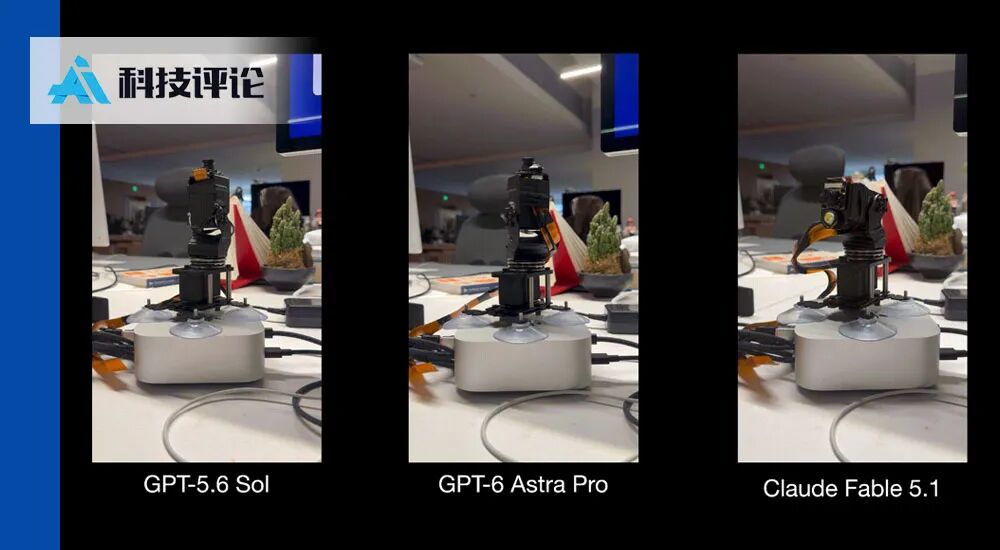
Representative image for 我们让 GPT‑6 Astra、Fable 5.1 和 Sol 控制同一台机器人:谁真的把活干完了?

我们让 GPT‑6 Astra、Fable 5.1 和 Sol 控制同一台机器人:谁真的把活干完了?

Rank 71 · Content 80 · Popularity N/A

TL;DR - A physical-robot benchmark compared GPT-6 Astra, Claude Fable 5.1, and GPT-5.6 Sol on an ambiguous full-range gimbal task. All moved the robot successfully, but differed substantially in motion coverage, safety, verification rigor, reusability, and cost.

  • Astra used seven conservative movements and required three consecutive feedback readings within 3° before declaring each target reached; it cost $23.43 across the broader test session.
  • Sol and Fable used 12-step paths that included all four corner positions, providing more complete combined-axis coverage than Astra’s independent-axis sweep.
  • Fable ran fastest and produced a reusable Python script, but its script reported success even when feedback was missing or questionable; Fable later acknowledged this validation flaw.
  • The test shows that physical agents need explicit, evidence-based completion criteria: issuing commands or maximizing visible coverage does not establish that hardware actually reached its targets.
Representative image for 拆解 WorkBuddy、千问办公和豆包工作,它们其实不是同一种产品

拆解 WorkBuddy、千问办公和豆包工作,它们其实不是同一种产品

Rank 71 · Content 80 · Popularity N/A

TL;DR - A hands-on comparison of WorkBuddy, QwenWork, and Doubao Work finds that China’s leading office agents follow distinct platform, ecosystem-entry, and enterprise-context strategies. All three can produce spreadsheets, presentations, and research reports, but inconsistent business assumptions and verification methods leave humans responsible for validating results.

  • On the same messy sales dataset, the agents reported quarterly totals differing by up to 57.7% because each handled anomalous and incomplete records differently without asking the user.
  • Their error-control approaches diverged: QwenWork created tests and minimal reproductions, WorkBuddy used a main agent to independently check sub-agent work, and Doubao Work mainly checked consistency across generated outputs.
  • Missing-file behavior also varied: WorkBuddy searched locally and produced a fill-in template, QwenWork stopped for DingTalk Drive authorization, and Doubao searched several sources before requesting the file.
  • Static inspection showed different execution architectures: WorkBuddy emphasizes skills and connectors, QwenWork inherits coding-agent-style validation, and Doubao Work bundles a Chromium-based environment while relying on cloud services for document understanding.

Medical/Healthcare AI 1

How to spend $25 billion on science: OpenAI’s staggeringly rich research charity gets under way

Rank 72 · Content 85 · Popularity 43

TL;DR - OpenAI’s research charity is beginning work with a reported US$25-billion budget and ambitions to help cure disease. The available excerpt is an interview preview and provides no technical program details or research results.

  • Jacob Trefethen leads life sciences at the OpenAI Foundation.
  • The initiative is focused on disease research and potentially other scientific programs.
  • Its unusually large funding could make it a significant force in biomedical research.
  • Specific diseases, AI methods, funding mechanisms, and timelines are not provided.

Multimodal & Generative 2

Representative image for 从海拉鲁到现实世界:视频模型如何理解「变化」

从海拉鲁到现实世界:视频模型如何理解「变化」

Rank 71 · Content 80 · Popularity N/A

TL;DR - 雷峰网通过三组图生视频任务,将 HiDream-O1-Video-1.0 与 Seedance 2.5、MiniMax H3 对比,考察动作因果、物理状态变化和音画同步。结果显示 HiDream 整体更能生成连续且因果一致的事件,但冰块数量错误和声音提前等问题表明它仍不能被视为完整的世界模型。

  • 测试覆盖爆炒、鼓手演奏和冰可乐 ASMR,重点不是单帧画质,而是动作顺序、对象一致性、物理变化及声音是否由正确事件触发。
  • HiDream 在面条流动、低黏度液体晃动、连续运镜和鼓点音色对应方面总体表现最佳,并较完整地执行了多步骤提示。
  • Seedance 的视听表现成熟,但出现火焰遮挡事件、冰块凭空增加和动作遗漏;MiniMax 则暴露出硬切、音色错配、时序滞后及物体材质不稳定。
  • 文章认为“先理解、再生成”的多模态规划有助于减少遗漏和因果错误,但视频输出只能提供有限证据,尚不足以证明模型形成了可泛化的物理认知。
Representative image for 越大越强,不再是 LLM 的专利:PixVerse R2 攻克实时世界模型 Scaling 难题

越大越强,不再是 LLM 的专利:PixVerse R2 攻克实时世界模型 Scaling 难题

Rank 71 · Content 80 · Popularity N/A

TL;DR - PixVerse R2 is a newly launched real-time world model that turns AI video from discrete files into persistent, interactive sessions. Its two-layer architecture aims to scale generation quality, long-term consistency, and multimodal control while retaining low-latency operation.

  • Omni Causal AR unifies text, images, audio, and high-frequency action inputs while tracking long-term context, recent dynamics, and object states.
  • A separate acceleration layer uses same-source distillation, sparse computation, and few-step generation to bring the model’s capabilities into a real-time operating range.
  • Product testing observed eight prompts and 3,355 action frames in one roughly 120-second session, with actions transmitted at about 33.4 Hz and a median prompt-update latency of 1.33 seconds.
  • R2 supports both freely controlled worlds and Director-managed interactive narratives, though cold starts, long-session stability, resource scheduling, and compute efficiency remain open challenges.

Efficiency & Systems 5

Representative image for Kimi 和 DeepSeek,为什么出现在同一张模型架构图里?

Kimi 和 DeepSeek,为什么出现在同一张模型架构图里?

Rank 78 · Content 90 · Popularity N/A

TL;DR - The article traces how leading models are replacing or combining full attention with linear and sparse mechanisms to balance long-context capability, retrieval accuracy, and compute cost. GLM-5.3-Flash’s mix of Kimi-style KDA and DeepSeek-style sparse attention illustrates a broader shift from company-specific “routes” toward modular attention architectures.

  • Linear attention cheaply maintains compressed long-range state but can lose token-level details needed for exact retrieval.
  • Sparse attention retains token-level history while selectively attending to relevant portions, making it complementary to linear attention.
  • MiniMax’s progression from hybrid linear/full attention to full attention and then sparse attention reflects changing constraints from scaling and long-running agent workloads.
  • Open-source implementations, shared communities, and researcher mobility are accelerating the reuse and recombination of attention techniques across companies.
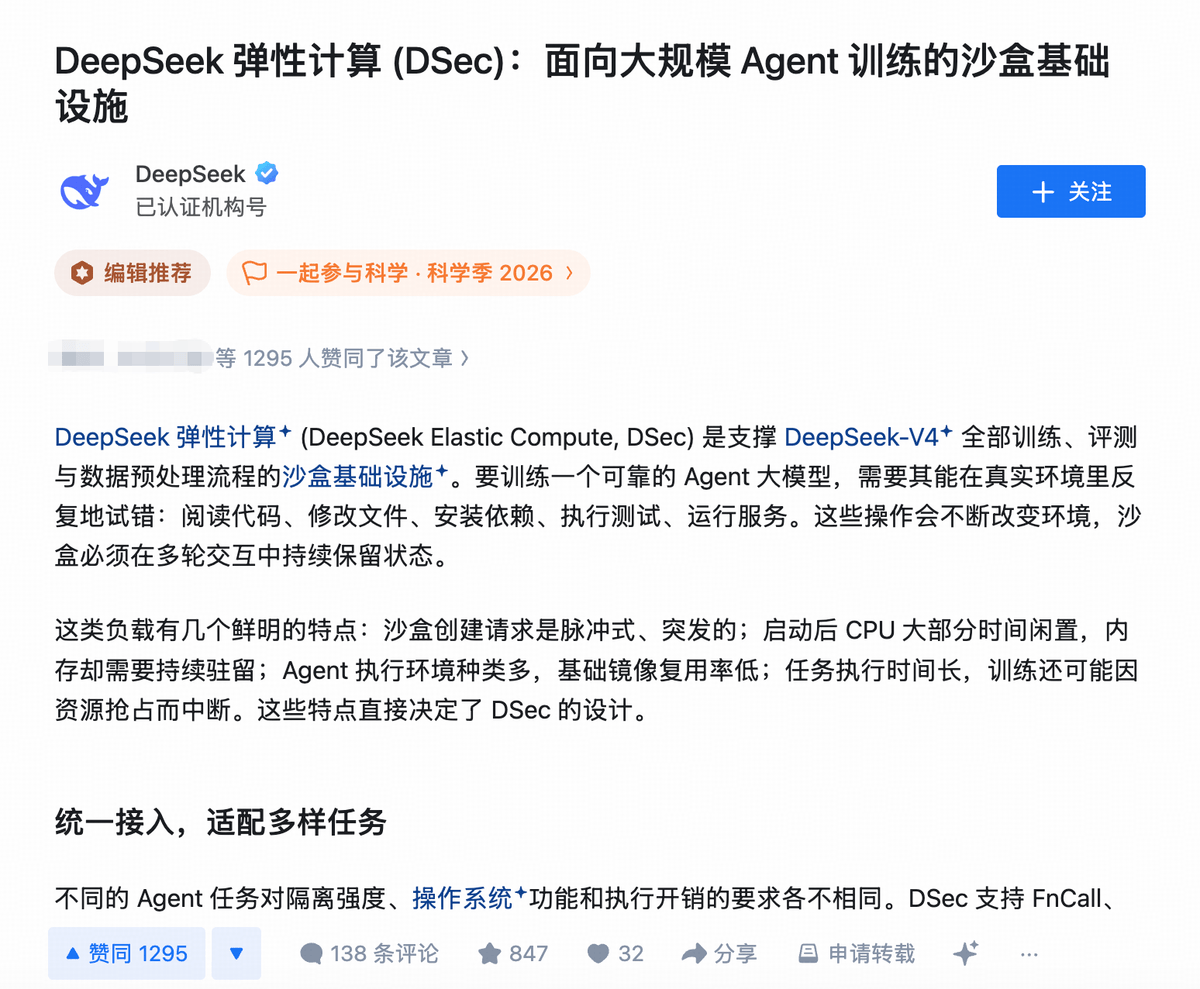
Representative image for DeepSeek知乎独家发文,首次公开V4.1 Agent训练“大本营”DSec

DeepSeek知乎独家发文,首次公开V4.1 Agent训练“大本营”DSec

Rank 78 · Content 90 · Popularity N/A

TL;DR - DeepSeek unveiled DSec, the sandbox infrastructure underpinning DeepSeek-V4.1’s agent training, evaluation, and data preprocessing. It enables millions of stateful agent environments through layered, on-demand storage, aggressive resource sharing, and execution that survives interruptions to GPU training.

  • DSec unifies function calls, containers, MicroVMs, and full VMs behind one Python SDK, matching isolation and operating-system capabilities to each workload.
  • Composable EROFS layers and on-demand image loading reduced an 8,192-container provisioning test from over 60 minutes to about 35 minutes while cutting disk writes by roughly 57%.
  • Because most sandboxes use little CPU while retaining memory state, DSec supports CPU oversubscription above 50× and uses shared caches, memory reclamation, and workload-aware scheduling to improve density.
  • Each production shard reportedly serves about 3 million sandboxes daily, exceeds 380,000 concurrent instances, and can create more than 5,000 sandboxes per second.
Representative image for DeepSeek 开源算子工具大礼包,联手华为昇腾,手撕 CUDA 绑定!

DeepSeek 开源算子工具大礼包,联手华为昇腾,手撕 CUDA 绑定!

Rank 71 · Content 80 · Popularity N/A

TL;DR - DeepSeek has extended its open-source TileLang operator-development stack and five core compute and communication libraries to Huawei Ascend 950 NPUs. The move aims to reduce CUDA dependence by enabling high-performance LLM kernels to run across NVIDIA, AMD, Huawei, and other hardware with a shared programming model.

  • TileLang uses TVM-based multi-level tiling and separates hardware-specific target backends from common compilation and execution infrastructure.
  • Developers can explicitly control memory placement, thread scheduling, and software pipelining through Python-like abstractions, reducing the amount of low-level kernel code required.
  • The Ascend release also covers DeepGEMM, DeepEP, FlashMLA, TileKernels, and DeepSelect, targeting key LLM workloads such as GEMM, attention, sparse routing, and distributed communication.
  • The article reports strong NVIDIA and AMD benchmarks, but notes that achieving CUDA-level maturity on Ascend still requires kernel validation, NCCL-to-HCCL migration, and sufficient hardware supply.
Representative image for 5500颗光引擎如何撑起4096卡超节点?华为NPO的故事还没讲完

5500颗光引擎如何撑起4096卡超节点?华为NPO的故事还没讲完

Rank 71 · Content 80 · Popularity N/A

TL;DR - Huawei plans to deploy 5,500 Hi-ONE near-packaged optical engines in a 4,096-accelerator Ascend 960 supernode, replacing 48,000 pluggable 800G optical modules. The design targets higher bandwidth and integration with shorter electrical paths, though key architectural details remain undisclosed.

  • Each Hi-ONE provides up to 7.2 Tbps through 36 bidirectional 200G channels and uses integrated shared multi-wavelength light sources and silicon photonics.
  • NPO shortens high-speed electrical links to roughly 5 cm, seeking a balance among signal integrity, latency, bandwidth, serviceability, and integration.
  • Huawei says its inter-rack Lingqu equipment supports 176 1.6T ports and about 280T of all-optical bandwidth per device, but Hi-ONE’s channel allocation and redundancy remain unclear.
  • Huawei is also advancing OPEN NPO standards, while competing specifications may coexist because scale-up supernodes are relatively closed systems.
Representative image for 对比 Codex,免费的 AgnesCode 也能在底层算子优化任务中打得有来有回

对比 Codex,免费的 AgnesCode 也能在底层算子优化任务中打得有来有回

Rank 71 · Content 80 · Popularity N/A

TL;DR - A benchmark compared the free AgnesCode + Agnes 3.0 Flash coding agent with Codex + GPT-5.6 Sol on optimizing a DeepSeek-V3 inference operator across eight AI chips. AgnesCode was slower and passed fewer platforms, but produced higher speedups on four of the five chips both systems supported, showing that free agents can deliver competitive low-level systems work when given clear tools and automated evaluation.

  • Codex completed the task in 8m57s and passed seven chips; AgnesCode took 20m36s after prompting and passed six.
  • AgnesCode achieved higher acceleration on four shared platforms, including 4.81× versus Codex’s 3.71× on one international chip.
  • Only AgnesCode passed the Kunlun chip test, recording a 2.56× speedup.
  • The experiment highlights remaining agent reliability issues in cross-platform coverage and submission details despite competitive kernel performance.
Top highlights — Opinions

Medical/Healthcare AI 1

AI-powered medical devices must be tested in real-world settings

Rank 72 · Content 75 · Popularity 64

TL;DR - This Nature commentary argues that AI-powered medical devices influencing clinical decisions need rigorous testing in real-world settings. Such evaluation matters because their approval should meet safety and effectiveness standards comparable to those for drugs and self-driving cars.

  • Real-world clinical assessments are necessary beyond controlled development or validation environments.
  • Testing should evaluate tools in the settings and workflows where clinicians and patients will actually use them.
  • The article calls for approval processes with rigor comparable to other safety-critical technologies.
  • The provided excerpt does not specify particular devices, evaluation methods, or study results.

Digital Governance 1

How to put people first in cyberspace

Rank 41 · Content 40 · Popularity 43

TL;DR - Computer scientist Francine Berman argues that stronger safeguards are needed to ensure digital technologies serve the public interest. The provided excerpt offers a high-level viewpoint rather than specific technical proposals or research findings.

  • Digital technologies increasingly influence everyday life and public welfare.
  • Berman advocates a people-first approach to governing cyberspace.
  • Stronger protections are presented as necessary to mitigate societal risks.
  • The excerpt does not specify particular safeguards, methods, or empirical results.

Drug Resistance 1

Tuberculosis treatment has advanced — now we need to stop drug resistance dragging us backwards

Rank 69 · Content 80 · Popularity 43

TL;DR - This Nature commentary argues that the next major advance in tuberculosis treatment could come from understanding how and why drug resistance emerges, rather than solely from developing new medicines. Preventing resistance is essential to preserve recent treatment gains.

  • Tuberculosis treatment has advanced, but drug resistance threatens to reverse that progress.
  • The article prioritizes research into the mechanisms and drivers of resistance.
  • The provided excerpt does not describe specific studies, methods, or results.

Organoid Ethics 1

Lab-grown brain organoids: time for international oversight

Rank 48 · Content 50 · Popularity 43

TL;DR - A Nature commentary argues that international oversight is needed for research involving lab-grown brain organoids. It highlights biosafety, ethics, and meaningful participation by patient groups and the public as core priorities.

  • Brain-organoid research raises concerns that extend beyond individual institutions and national regulations.
  • The piece supports international coordination on governance and oversight.
  • Biosafety and ethical safeguards should remain central as the field advances.
  • Patient groups and the wider public should be involved in shaping research practices and policy.

Research Integrity 1

Beware sham scientific societies: the research community must be more vigilant

Rank 44 · Content 45 · Popularity 43

TL;DR - A Nature commentary warns that AI-generated content is making fraudulent scientific societies harder to identify. It argues for stronger scrutiny of research organizations while preserving trust in legitimate institutions.

  • Sham societies can use AI to appear more credible and professional.
  • Researchers and institutions need greater vigilance when evaluating scientific organizations.
  • Safeguards should target deception without broadly undermining confidence in the research community.
  • The provided excerpt does not specify particular detection methods or policy proposals.