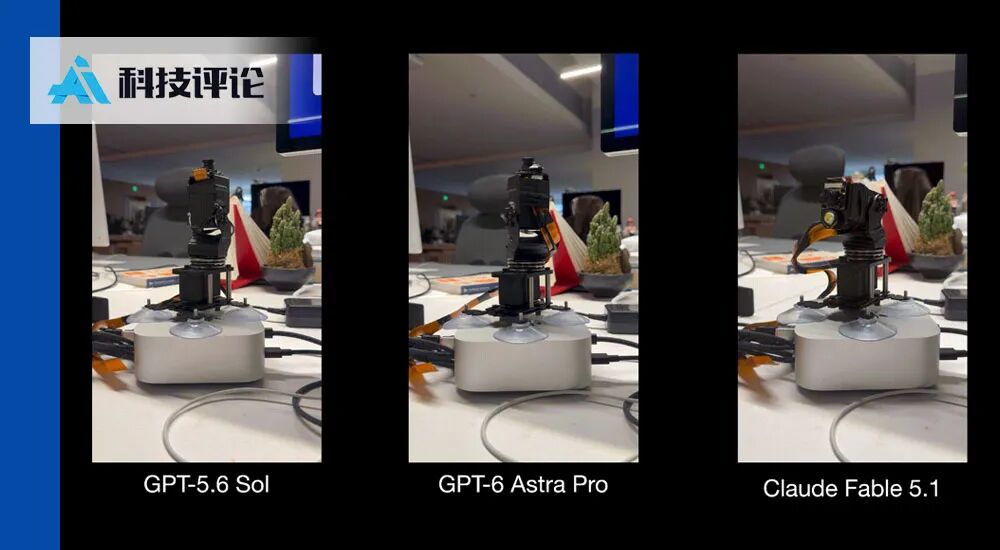
我们让 GPT‑6 Astra、Fable 5.1 和 Sol 控制同一台机器人:谁真的把活干完了?
Ranking
Overall
71
Content
80
Popularity
N/A
No observed public metrics; popularity remains neutral/archived.
Merged summary
TL;DR - A physical-robot benchmark compared GPT-6 Astra, Claude Fable 5.1, and GPT-5.6 Sol on an ambiguous full-range gimbal task. All moved the robot successfully, but differed substantially in motion coverage, safety, verification rigor, reusability, and cost.
- Astra used seven conservative movements and required three consecutive feedback readings within 3° before declaring each target reached; it cost $23.43 across the broader test session.
- Sol and Fable used 12-step paths that included all four corner positions, providing more complete combined-axis coverage than Astra’s independent-axis sweep.
- Fable ran fastest and produced a reusable Python script, but its script reported success even when feedback was missing or questionable; Fable later acknowledged this validation flaw.
- The test shows that physical agents need explicit, evidence-based completion criteria: issuing commands or maximizing visible coverage does not establish that hardware actually reached its targets.
Sources (1)
我们让 GPT‑6 Astra、Fable 5.1 和 Sol 控制同一台机器人:谁真的把活干完了?
Public signals
N/A
TL;DR - A physical-robot benchmark compared GPT-6 Astra, Claude Fable 5.1, and GPT-5.6 Sol on an ambiguous full-range gimbal task. All moved the robot successfully, but differed substantially in motion coverage, safety, verification rigor, reusability, and cost.
- Astra used seven conservative movements and required three consecutive feedback readings within 3° before declaring each target reached; it cost $23.43 across the broader test session.
- Sol and Fable used 12-step paths that included all four corner positions, providing more complete combined-axis coverage than Astra’s independent-axis sweep.
- Fable ran fastest and produced a reusable Python script, but its script reported success even when feedback was missing or questionable; Fable later acknowledged this validation flaw.
- The test shows that physical agents need explicit, evidence-based completion criteria: issuing commands or maximizing visible coverage does not establish that hardware actually reached its targets.