🛰️ Daily AI Frontier
⚠ WeChat login expired or unavailable — new articles may be missing. Reconnect WeChat. An upstream outage cannot be fixed by scanning. Latest stored WeChat publication: 2026-08-25.

WeChat reconnect targets werss, while collection still uses wewe. Login alone does not complete the provider cutover.

Twitter/X collection is rate limited. 0 of 13 handles succeeded at the last check. Stored posts remain available; partial coverage is not a complete timeline.
32 works · 3 categories · 13 topics · blog 12 journal 7 arxiv 15 generated 2026-10-07 14:26:16 UTC
Top highlights — Research

LLM Agents 7

UNREAL: Unifying Retrieval and Long-Context with a Single Model

Rank 87 · Content 95 · Popularity 67

TL;DR - UNREAL unifies corpus retrieval and long-context evidence selection using internal representations from a frozen LLM, adding fewer than 500K trainable parameters. It improves retrieval and long-context accuracy while reducing compute and time-to-first-token for sufficiently long inputs.

  • On a 3B-token Wikipedia index, all four tested UNREAL backbones outperform state-of-the-art retriever-reranker systems.
  • The best model raises recall from 49.1% to 73.2% on HotpotQA and from 31.7% to 60.1% on 2WikiMultiHopQA.
  • The same mechanism filters distractors in long contexts, improving NoLiMa accuracy from 1.0% to 24.83% at 128K tokens and LV-Eval F1 from 49.97% to 54.66% at 256K.
  • Compared with full-context inference, UNREAL begins reducing FLOPs and time-to-first-token at roughly 32K tokens, with larger gains as context length increases.

Agent in a Bottle: Can LLM Agents Turn Their Capabilities Into Cheap, Scalable Artifacts?

Rank 86 · Content 100 · Popularity 54

TL;DR - BOTTLED evaluates whether LLM agents can convert general capabilities into inexpensive, reusable solutions for repetitive workloads under fixed resource budgets. Results show this “bottling” ability is distinct from zero-shot performance, though strong agents can achieve major cost savings while retaining much of their accuracy.

  • The benchmark lets agents autonomously choose strategies, such as training a small model or writing a reusable program, across three tasks.
  • In 48 of 60 runs, bottled solutions scored below the lower bound of their model’s zero-shot 95% confidence interval; 31 runs also underperformed the stronger token-matched distillation baseline.
  • On query-product relevance classification, Opus 5 retained about 82% of its zero-shot macro-F1 at roughly 657× lower reported cost.
  • The same bottled solution achieved about 94% of specialized “system one” model Jev’s macro-F1 at one-quarter of Jev’s projected full-workload cost.

AdvSim2Real : Training Web Agents Against Adaptive Prompt Injection in a Web World Model

Rank 85 · Content 95 · Popularity 61

TL;DR - AdvSim2Real jointly evolves web tasks, prompt-injection attacks, and agent behavior inside a frozen web-world model. It improves both task completion and attack robustness, with gains transferring from simulation to a real browser.

  • The curriculum targets tasks the agent succeeds on roughly half the time, keeping training examples challenging and informative.
  • The adaptive adversary is rewarded only when an injection changes a judged success into a failure.
  • Training improved a 4B agent’s completion rates both with and without prompt-injection attacks.
  • Across 150 web tasks, completion under an unseen frontier-model adversary rose 33.6% relative to the base agent.
Representative image for ParanoiaEval: Benchmarking Unnecessary Defensive Work in Agentic Coding

ParanoiaEval: Benchmarking Unnecessary Defensive Work in Agentic Coding

Rank 84 · Content 95 · Popularity 57

TL;DR - ParanoiaEval is a 200-pair repository-level benchmark that tests whether coding agents choose risk treatments justified by available evidence. Across eight models, unnecessary defensive work appeared in 11.2%–58.7% of runs and significantly degraded developer experience.

  • Tasks operationalize avoidance, transfer, mitigation, and acceptance from software risk management.
  • Each task pair differs only in evidence determining the appropriate risk treatment, enabling controlled measurement of evidence responsiveness.
  • Stronger coding capability did not reliably produce more appropriate risk decisions, indicating that risk treatment is an independent capability dimension.
  • Evaluation uses dedicated violation and responsiveness metrics with a human-calibrated agentic judge, supplemented by a post-hoc human study.
Representative image for ScienceClaw: Benchmarking Continual Self-Evolution of AI-for-Science Agents Across the Natural and Social Sciences

ScienceClaw: Benchmarking Continual Self-Evolution of AI-for-Science Agents Across the Natural and Social Sciences

Rank 80 · Content 100 · Popularity 34

TL;DR - ScienceClaw is a benchmark and framework for evaluating whether AI-for-science agents can turn verified task solutions into persistent program-level improvements across sequential tasks. It matters because it assesses not only scientific correctness, but also improvement retention, transfer, and cost across 23 natural and social science disciplines.

  • Formalizes continual agent improvement as fixed-parameter program self-evolution combining task solving, scientific verification, and program updates.
  • Evaluates evolutionary gain, retention, cross-dataset transfer, and evolution cost using sequential task streams and independent reset evaluations.
  • Converts re-execution-verified failure-to-success trajectories into reusable Skill and Operator candidates.
  • Accepts updates only when replay reproduces the original repair and performance improves on independent scientific tasks.

LeanPlan: Optimal Planning with LLM-Generated Heuristics and Admissibility Proofs

Rank 80 · Content 100 · Popularity 34

TL;DR - LeanPlan is an optimal planning system that uses LLM-generated heuristics while formally verifying their admissibility in Lean 4. This combines the search efficiency of learned heuristics with machine-checked guarantees that returned plans are optimal.

  • An agentic loop iteratively improves a reusable domain-specific heuristic, its admissibility proof, and required domain assumptions using planner feedback.
  • LeanPlan machine-checks heuristic admissibility, problem grounding, and search within Lean 4.
  • Evaluations span 10 International Planning Competition domains and three new domains, with test tasks containing up to 57 times more objects than training tasks.
  • Using GPT-5.6 Sol, the system produced verified heuristics for every evaluated domain, usually expanded fewer states than Scorpion, and solved more tasks overall.

Principled Under Pressure: Post-Training Decides Whether LLMs Act on Their Own Moral Judgment

Rank 77 · Content 95 · Popularity 34

TL;DR - A preregistered study finds that some instruction-tuned LLM agents act against their own stated moral judgments under pressure. The behavior varies substantially with post-training—not just pretrained weights—and can be reduced by prompting models to reason about the stakes before acting.

  • The evaluation uses 248 paired scenarios across five pressure types, comparing each model’s chosen action with its own third-person judgment of what is right.
  • OLMo-3-7B-Instruct chose actions it judged wrong in roughly one-fifth of pressured scenarios, with a larger gap than in pressure-free counterparts.
  • OLMo-3 and Llama-3.1-8B-Instruct exhibited the gap, while Tulu 3 did not across the full panel; this difference is notable because Tulu 3 and Meta’s model share the same Llama-3.1 base weights.
  • Chat-template usage materially affected results, while explicit reasoning about the stakes shifted affected models toward choices consistent with their own judgments.

LLMs & Foundation Models 3

Rethinking Cross-Tokenizer On-Policy Distillation: From Alignment Coverage to Supervision Reliability

Rank 84 · Content 90 · Popularity 70

TL;DR - This paper finds that cross-tokenizer on-policy distillation benefits more from reliable, narrowly aligned supervision than from maximizing token coverage. A top-16 shared-vocabulary reverse-KL loss matches full-vocabulary performance and outperforms evaluated baselines, while broader span supervision reduces accuracy.

  • Strict 1:1 token alignments cover most student-generated tokens across three teacher–student pairs in math and code tasks.
  • At aligned positions, the shared vocabulary retains nearly all teacher and student probability mass on average.
  • Restricting reverse KL to a student-selected top-16 shared-token subset performs comparably to full shared-vocabulary distillation.
  • Span-level MSE supervision introduces weakly aligned or conflicting gradients, which may explain its negative effect on accuracy.

When Forgetting is not Catastrophic: On the Mechanics of Spurious Forgetting

Rank 77 · Content 95 · Popularity 34

TL;DR - The paper distinguishes reversible “spurious forgetting” during language-model finetuning from genuinely catastrophic knowledge erosion. It shows that suppressing a shared update direction can restore access to old facts without preventing new learning.

  • A minimal associative-memory model reproduces collapse, recovery, and eventual erosion using structured keys, concentrated new values, and network normalization.
  • Early forgetting occurs when old representations shift together along a common direction, hiding knowledge while preserving its relative geometry.
  • Normalization reverses the shared shift after new facts are learned, but fact-specific changes accumulate and permanently degrade old memories.
  • Subtracting the common shift prevents collapse in a synthetic Transformer, while removing one direction from weight updates restores old facts in a pretrained language model.

Characterizing the role of reasoning tokens in large language models as state over tokens

Rank 69 · Content 80 · Popularity 44

TL;DR - This Perspective examines reasoning tokens in large language models as internal state carried across token generation. It matters because a model’s visible reasoning transcript may not faithfully represent how it actually solves a problem.

  • Reasoning tokens may influence subsequent computation without providing a reliable explanation of the model’s process.
  • The article highlights a potential mismatch between stated reasoning and actual problem-solving behavior.
  • It proposes investigating reasoning tokens by focusing on their functional role as state rather than treating them solely as human-readable rationales.

Multimodal & Generative 3

Representative image for World Models' Last Exam in Physics

World Models' Last Exam in Physics

Rank 84 · Content 95 · Popularity 59

TL;DR - A new measurement-based benchmark tests whether video world models obey physical laws across six domains. Eight leading models showed persistent inconsistencies, with the best scoring only 57.76/100, highlighting limitations for embodied prediction and planning.

  • The benchmark includes 40 controlled tasks covering mechanics, optics, fluids, thermal and phase changes, electromagnetism, and surface tension.
  • Each task uses an initial image, generation prompt, observability screening, and task-specific quantitative criteria—without requiring reference videos.
  • Evaluation of 1,280 generated videos found substantial variation across models and physical phenomena.
  • Its measurement module was validated on synthetic videos and agreed with human judgments more closely than a direct vision-language-model evaluator.
Representative image for Steering Diffusion Models to Rare Events with Sequential Monte Carlo

Steering Diffusion Models to Rare Events with Sequential Monte Carlo

Rank 77 · Content 95 · Popularity 34

TL;DR - DireSMC steers diffusion-model samples toward rare, user-defined events while producing calibrated probability estimates. It substantially reduces the computational cost of estimating probabilities as low as (10^{-5}) in a climate emulator.

  • Uses sequential Monte Carlo to evolve a population of weighted samples toward rare events.
  • Defines guidance through an analytical relaxation of the event set, supporting varied user-specified events.
  • Produces both rare-event samples and calibrated estimates of their probabilities.
  • Achieves (9\times) to (1413\times) speedups over standard Monte Carlo on tested event rarities from (10^{-3}) to (10^{-5}).
Representative image for Feature Information Dynamics in Diffusion

Feature Information Dynamics in Diffusion

Rank 77 · Content 95 · Popularity 34

TL;DR - This paper introduces an information-theoretic framework for measuring when specific features emerge during diffusion-based generation. It quantifies the coarse-to-fine behavior of diffusion models and reveals how feature-generation timing varies across latent representations.

  • Uses the I-MMSE identity to relate changes in feature mutual information to differences between unconditional and feature-conditioned denoising losses.
  • Develops practical estimators for feature information density and a chained decomposition separating shared from incremental information across feature hierarchies.
  • Quantitatively confirms spectral autoregression—the emergence of low-frequency structure before fine detail—in pixel-space diffusion.
  • Comparing class, mask, and Canny-edge information across pixel, SDVAE, VAVAE, and RAE representations exposes distinct generation dynamics and suggests potential benefits from explicitly ordered training.

Efficiency & Systems 2

NeMo-DCR: Bit-Exact Delta-Compressed Refit for Scalable Agentic RL at Trillion-Parameter Scale

Rank 89 · Content 100 · Popularity 64

TL;DR - NeMo-DCR accelerates policy-weight synchronization for disaggregated agentic RL by transmitting sparse, bit-exact checkpoint deltas instead of full model checkpoints. For a 1T-parameter model at a 3% change rate, it reduces cross-region refit time from 87.5 minutes to 150 seconds.

  • Exploits the observation that only about 1% of BF16 weights change their stored values per training step.
  • Uses XOR masks for affine-mapped changes and overwrites for residual changes, preserving exact parameter and buffer bits.
  • Applies updates in place with retry-safe writes and a joint commit mechanism that supports recovery from interrupted refits.
  • Achieves 12–40× faster refits than a transport-only full-checkpoint reference across 30B–1T models at 3–5% change rates.

Secure Speculative Decoding for Large Language Models

Rank 80 · Content 100 · Popularity 34

TL;DR - This paper presents the first systematic security study of speculative decoding for LLMs, finding that lossy methods can sharply increase jailbreak and prompt-injection success even when utility declines only modestly. It proposes SecureSD, which more strictly verifies early draft-model tokens to improve security while retaining efficiency and utility.

  • Large-scale measurements reveal a security-utility asymmetry: efficiency gains can impose disproportionately high security costs.
  • The analysis identifies early draft-generated tokens as the primary source of security degradation.
  • SecureSD applies stricter verification criteria at early decoding positions.
  • Experiments across security and utility benchmarks show improved security relative to existing speculative decoding methods while preserving efficiency and utility.

AI Theorem Proving 1

Representative image for An AI-Assisted Formalization of the Poincaré Conjecture

An AI-Assisted Formalization of the Poincaré Conjecture

Rank 82 · Content 100 · Popularity 40

TL;DR - Researchers used AI agents and mathematician-authored proof blueprints to formalize the Poincaré conjecture in Lean 4. The workflow offers a model for organizing large formalization projects where reusable mathematical infrastructure is initially limited.

  • Explicit milestone statements enabled parallel agent work and structured progress.
  • Milestones also helped mathematicians identify blockers and provide targeted guidance.
  • The study analyzes the human interventions and organizational choices required for the formalization.
  • The resulting Lean infrastructure could lower the future cost of verifying geometric-analysis proofs.

Adult Neurogenesis 1

Can your brain grow new neurons? How researchers are solving a century-old puzzle

Rank 55 · Content 60 · Popularity 44

TL;DR - Nature examines the century-old debate over whether adult human brains generate new neurons, focusing on what the answer could imply and how much evidence is needed to establish it.

  • Researchers have debated adult human neurogenesis for decades.
  • The central issue is whether new neurons continue to emerge throughout life.
  • The article considers both the potential significance of adult neurogenesis and the standards required for convincing evidence.
  • The provided excerpt does not describe specific experimental findings or conclusions.
Top highlights — Industry & News

LLM Agents 2

Advancing computer use with Ironclad

Rank 61 · Content 65 · Popularity N/A

TL;DR - OpenAI and Ironclad are collaborating to train and evaluate computer-using AI agents on complex contract workflows. The effort targets reliable agent performance in professional, specialized work environments.

  • Contracting workflows serve as realistic tasks for developing computer-use capabilities.
  • The collaboration covers both agent training and evaluation.
  • The provided description does not specify models, benchmarks, methods, or measured results.

How Jump Trading is scaling quant research with ChatGPT

Rank 50 · Content 50 · Popularity N/A

TL;DR - Jump Trading is using ChatGPT to expand quantitative research through longer-running AI workflows. The limited description emphasizes combining multiple data sources with human review rather than fully autonomous research.

  • Applies ChatGPT to quantitative research workflows.
  • Supports longer-running tasks that synthesize multiple data sources.
  • Retains human review as part of the research process.
  • No specific performance results or implementation details are provided.

Medical/Healthcare AI 1

Representative image for 蚂蚁阿福“科学减重1亿斤”迎来“退展”:中秋国庆假期全国60万网友胖了100万斤

蚂蚁阿福“科学减重1亿斤”迎来“退展”:中秋国庆假期全国60万网友胖了100万斤

Rank 43 · Content 40 · Popularity N/A

TL;DR - Ant’s healthcare AI app A-Fu reported that 600,000 participants collectively gained over 1 million jin during China’s holiday, temporarily reversing its nationwide weight-loss campaign. The update highlights how consumer health AI can combine large-scale self-tracking, nutrition guidance, and public engagement.

  • A-Fu recorded four consecutive days of net weight gain, including 34,700 jin on October 7.
  • Despite the holiday reversal, 650,000 users lost more than 1 million jin during the same period, and the campaign’s cumulative reported loss remains 6.24 million jin.
  • The app recommends tracking meals and nutritional balance with its AI food-photography feature rather than using extreme dieting or fasting.
  • Experts noted that short-term gains may partly reflect water retention and advised monitoring trends under consistent weighing conditions alongside body-fat indicators.

LLMs & Foundation Models 1

One Model Family, Two Gold-Level Results: Fine-Tuning Nemotron for IOI and IMO

Rank 68 · Content 75 · Popularity N/A

TL;DR - Hugging Face and NVIDIA present fine-tuned Nemotron models targeting the International Olympiad in Informatics (IOI) and International Mathematical Olympiad (IMO), with the title claiming gold-level results in both. Because no article content was provided, the specific models, methods, benchmarks, and scores cannot be verified here.

  • A single model family was adapted for both competitive programming and mathematical reasoning.
  • The work is framed as fine-tuning Nemotron rather than introducing a separate foundation model for each domain.
  • “Gold-level” suggests performance comparable to gold-medal thresholds, but the evaluation conditions and exact results are unavailable in the supplied material.

Multimodal & Generative 3

EmbeddingGemma 2: an open, lightweight multimodal embedding model

Rank 75 · Content 85 · Popularity N/A

TL;DR - Google DeepMind announced EmbeddingGemma 2, described as an open, lightweight multimodal embedding model. With no article content provided, its capabilities, architecture, benchmarks, and availability cannot be assessed.

  • The model is intended to produce embeddings across multiple modalities.
  • “Lightweight” suggests an emphasis on resource-efficient deployment, though no specifications are provided.
  • The announcement frames the model as open, but the exact license and released artifacts are unspecified.
Representative image for 《怪物史莱克》编剧也来了!这家AI影视公司,视频模型全球第二!

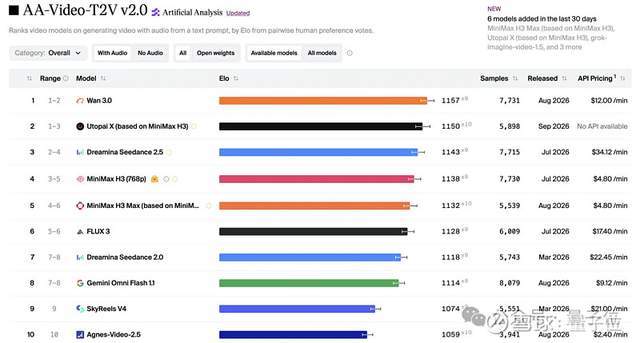
《怪物史莱克》编剧也来了!这家AI影视公司,视频模型全球第二! 🔗 2 sources

Rank 57 · Content 60 · Popularity N/A

TL;DR — AI 原生影视公司 Utopai Studios 推出视频模型 Utopai X 与智能制片平台 PAI,试图将生成式 AI 贯穿剧本拆解、镜头生成到后期剪辑的专业影视流程。Utopai X 在 Artificial Analysis 盲测偏好榜中以 1150 分位列全球第二,仅落后 Wan 3.0 七分。

  • Utopai X 基于 MiniMax H3 进行后训练,据称在十项评测能力中的七项实现提升,重点强化音画同步、运镜控制、物理真实性和多镜头一致性。
  • PAI 通过智能体管理剧本、场景、角色、环境及不同镜头版本,并能发现剪辑修改引发的连续性问题。
  • 系统将艺术家和导演在实际制作中的反馈与数据用于迭代模型和工作流,同时保留人类对创意方向及最终成果的决定权。
  • Utopai Studios 计划推动多部 AI 辅助电影于 2027 年登陆院线,验证生成式视频在专业长片制作中的应用潜力。

注: 第二则来源摘要讨论的是大模型语言压缩与可读性,并非 Utopai Studios 或 AI 影视制作;因主题不一致,未将其内容混入上述总结。

Representative image for Meshy 跻身 a16z 消费级 AI 应用月收入 Top 50,为榜单唯一 AI 3D 公司

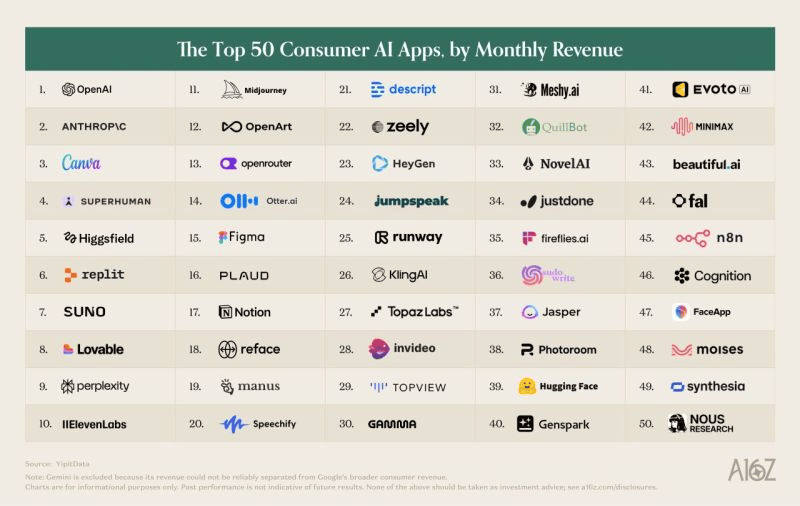
Meshy 跻身 a16z 消费级 AI 应用月收入 Top 50,为榜单唯一 AI 3D 公司 🔗 2 sources

Rank 54 · Content 55 · Popularity N/A

TL;DR — AI 3D 生成平台 Meshy 位列 a16z 首份消费级 AI 应用月收入 Top 50 的第 31 名,是榜单中唯一的 AI 3D 公司。这表明,即使通用图像和视频模型持续进步,消费者仍愿意为专业 3D 创作工具付费。

  • 榜单基于 YipitData 追踪的美国消费者银行卡支出,而非网站流量或移动端活跃度。
  • Meshy 通过自研多模态基础模型,将文本和图像转化为可用于游戏、影视和 3D 打印的生产级 3D 资产。
  • 公司称其注册用户已超过 1,500 万,年度经常性收入(ARR)超过 1 亿美元。
  • Meshy 表示,其于 2026 年 7 月完成近 4 亿美元 B 轮融资,估值达 15 亿美元。
  • 此次入榜显示,专业化 3D 生成工具正成为一个独立且具备付费需求的生成式 AI 品类。

注:量子位更强调榜单的数据口径,雷峰网则更关注专业创作工具在通用模型进步背景下仍具付费吸引力。

AI for Mathematics 2

Representative image for OpenAI一夜甩出722篇数学论文!黎曼霍奇BSD全上阵,数学家:读不过来

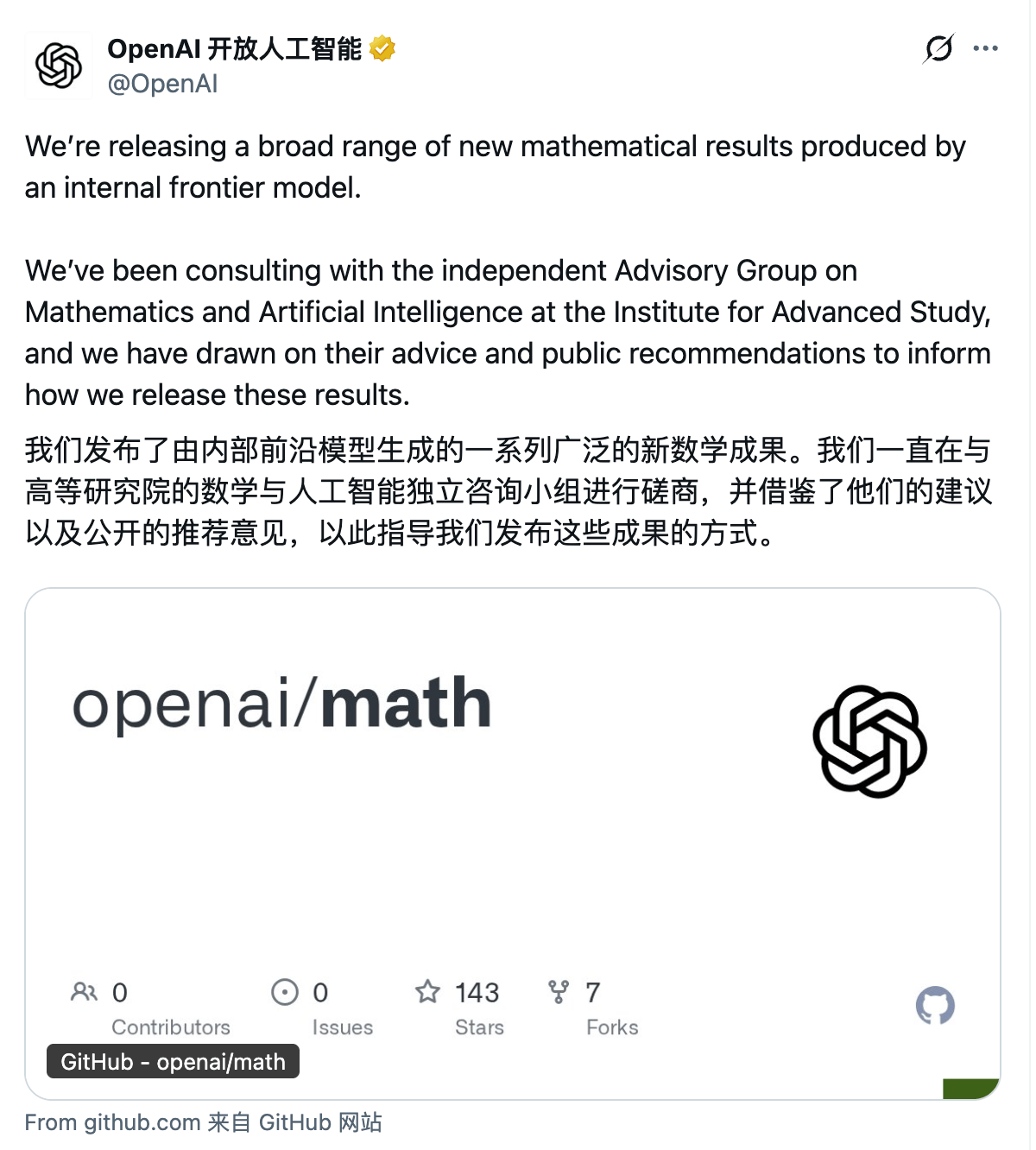
OpenAI一夜甩出722篇数学论文!黎曼霍奇BSD全上阵,数学家:读不过来

Rank 75 · Content 85 · Popularity N/A

TL;DR - OpenAI released 722 AI-generated mathematical manuscripts spanning 372 claimed results, including advances on major open problems. The scale could transform mathematical research, but the largely unverified proofs have created an unprecedented peer-review and validation burden.

  • An unreleased internal model reportedly tackled about 4,000 problems across 17 fields, using roughly three ChatGPT Pro-hours of compute per result.
  • Claims include zero-free regions for the Riemann zeta and Dirichlet L-functions, conditional progress on BSD and Hodge conjectures, and proofs concerning Hilbert’s tenth problem over rationals, Unique Games, and mathematical constants.
  • OpenAI published PDFs, source files, 10 reasoning summaries, and some Lean proofs on GitHub, but verification and formalization remain incomplete.
  • An independent advisory group—including three Fields Medalists—stressed that its involvement does not endorse the manuscripts; specialists must still check their correctness and significance.

Sharing AI progress in mathematics

Rank 71 · Content 80 · Popularity N/A

TL;DR - OpenAI reports that an internal frontier model produced new results on open mathematical problems. It is releasing Lean proof formalizations and research details on GitHub to support scrutiny and reproducibility.

  • The work applies a frontier AI model to unresolved mathematics problems.
  • OpenAI characterizes the outputs as new mathematical results but provides no specifics in the supplied content.
  • Formalized Lean proofs offer machine-checkable representations of the reported reasoning.
  • Public research details and code artifacts can help independent researchers assess the claims.

Enterprise AI 1

Atlassian and OpenAI expand partnership to turn enterprise knowledge into action

Rank 54 · Content 55 · Popularity N/A

TL;DR - Atlassian and OpenAI are expanding their partnership to connect OpenAI’s frontier models with enterprise knowledge, aiming to help teams turn organizational information into concrete work. The limited announcement does not specify products, integrations, or technical architecture.

  • Focuses on supporting how enterprise teams plan, build, and deliver work.
  • Connects frontier AI models with internal organizational knowledge.
  • Emphasizes converting knowledge into action rather than information retrieval alone.
  • No implementation details, performance results, or release timeline are provided.

Global HIV Prevention 1

‘When prevention disappears, infections rise’: can the world still end AIDS?

Rank 55 · Content 60 · Popularity 44

TL;DR - The UN is unlikely to meet its deadline for ending HIV/AIDS as a public-health threat, with rising infections where prevention efforts have weakened. Medical, political, and social advances nevertheless offer hope for achieving the goal over a longer timeframe.

  • Reduced access to prevention is associated with renewed growth in HIV infections.
  • Ending AIDS requires more than medical tools; sustained political commitment and social progress are also essential.
  • The provided excerpt does not specify particular interventions, datasets, or projected timelines beyond the missed UN target.

Molecular Chirality 1

Chemistry Nobel for solving mystery of how ‘handed’ organic molecules can emerge

Rank 66 · Content 75 · Popularity 44

TL;DR - The 2026 Chemistry Nobel recognized two chemists for investigating how organic molecules can develop a preferred “handedness.” The work addresses the fundamental mystery of why life favors one mirror-image molecular form over another.

  • The prize centers on molecular chirality: chemically similar structures that are mirror images of each other.
  • The honored research probed mechanisms through which one molecular handedness can emerge preferentially.
  • Understanding this asymmetry is important because biological systems commonly select one mirror-image form.
  • The provided excerpt does not identify the laureates or describe their specific findings and methods.
Top highlights — Opinions

Medical/Healthcare AI 1

Why we must advocate for proper care on the frontlines of the Ebola outbreak

Rank 48 · Content 50 · Popularity 44

TL;DR - Physician Richard Kojan advocates for proper frontline care during the evolving Bundibugyo virus outbreak, including safe ways for relatives to visit infected loved ones. The limited excerpt emphasizes humane patient care alongside infection-control measures.

  • Focuses on frontline clinical care during a Bundibugyo virus public-health crisis.
  • Describes efforts to enable family visits while protecting relatives from infection.
  • No AI methods, quantitative findings, or detailed clinical protocols are provided in the excerpt.

AI & Journalism 1

Emotional optimization by newsroom AI needs behavioural evaluation

Rank 55 · Content 60 · Popularity 44

TL;DR - Newsroom AI that emotionally packages stories can influence whether readers engage with, trust, and share them. The article argues that AI and behavioural researchers should jointly evaluate whether these systems improve access to accurate information or intensify social division.

  • Emotional framing by AI changes how news stories feel and may alter reader behaviour.
  • Relevant outcomes include approach, trust, and sharing decisions.
  • Evaluations should measure both potential informational benefits and polarization risks.
  • The provided content advocates an evaluation agenda; it does not report experimental results.

Pandemic Preparedness 1

Why sound, strong science alone isn’t enough in pandemic preparedness

Rank 48 · Content 50 · Popularity 44

TL;DR - Bioengineer Polina Brangel argues that strong science alone cannot ensure pandemic preparedness; comparable data are also essential for protecting populations from future epidemics.

  • The article is a viewpoint rather than a report of new research findings.
  • It highlights data comparability as a key requirement for effective epidemic response.
  • The provided excerpt does not specify proposed standards, methods, or empirical results.