🛰️ Daily AI Frontier
⚠ WeChat login expired or unavailable — new articles may be missing. Reconnect WeChat. An upstream outage cannot be fixed by scanning. Latest stored WeChat publication: 2026-08-25.

WeChat reconnect targets werss, while collection still uses wewe. Login alone does not complete the provider cutover.

Twitter/X collection is rate limited. 0 of 13 handles succeeded at the last check. Stored posts remain available; partial coverage is not a complete timeline.
35 works · 3 categories · 11 topics · blog 12 journal 8 arxiv 15 generated 2026-10-28 14:28:43 UTC
Top highlights — Research

LLM Agents 9

Representative image for Understanding the limits of latent world models

Understanding the limits of latent world models

Rank 88 · Content 100 · Popularity 61

TL;DR - This paper formalizes faithful latent world models and introduces latent rollout consistency (LRC) to measure action-conditioned latent prediction. Evaluated state-of-the-art models achieved tasks without faithfully learning the environment’s underlying dynamics.

  • Defines faithfulness as equivariance between environmental transitions and learned latent dynamics.
  • LRC evaluates whether latent rollouts consistently predict action-conditioned transitions.
  • None of the studied models faithfully captured the environment dynamics.
  • Task performance alone may therefore overstate a world model’s predictive fidelity.

Your Policy Is Secretly a Harness: The Decision Geometry of Agent Interfaces

Rank 86 · Content 95 · Popularity 64

TL;DR - This paper argues that agent policies internalize preferences specific to their training harness, making fixed-model harness comparisons misleading. Separating a harness’s performance ceiling from policy mismatch better predicts post-training gains.

  • Under KL-regularized control, optimal-policy log odds encode how strongly the harness favors actions.
  • Reordering observation fields preserved optimal decisions but reduced MiniWoB++ success from 85.0% to 19.2%.
  • Harnesses rejected in fixed-model tests later outperformed the original after harness-specific retraining when they offered higher ceilings.
  • On Terminal-Bench Lite, estimated ceiling minus mismatch reproduced coding-harness accuracy rankings; neither component alone did.
Representative image for Can LLMs Uncover Hidden Physical Laws through Free Exploration?

Can LLMs Uncover Hidden Physical Laws through Free Exploration?

Rank 86 · Content 95 · Popularity 64

TL;DR - LongChang tests whether autonomous LLM agents can discover hidden physical laws through unguided experimentation in simulated worlds. Results show this capability remains weak: only GPT-6-Astra discovered any altered laws, with a 16.7% success rate.

  • Agents freely manipulate objects and build tools without predefined research questions or hints.
  • Multiple LLM agents automate scene generation, tool review, report evaluation, and iterative world evolution.
  • Eleven of the 12 evaluated models achieved a 0% discovery rate.
  • Exploration logs showed missed anomalies and only partial identification of changed laws.

MLE-World: Predicting Machine Learning Experiment Outcomes with a Learned World Model

Rank 85 · Content 95 · Popularity 63

TL;DR - MLE-World predicts ML program outcomes without executing expensive training runs, enabling research agents to explore more candidates efficiently. It improves agent performance while reducing real executions.

  • Fine-tuned from Qwen3.5-4B to predict errors, training logs, validation scores, and confidence.
  • Matches real terminal outputs on 77.9% of held-out programs, versus 41.1% for larger prompted models.
  • Supports five test-time scaling policies, including Best-of-N, candidate fusion, and confidence-aware UCB.
  • Achieves up to 22.1% higher observed mean performance across 17 MLE-bench Lite tasks.

How Much Can Best-of-N Help a World Action Model? Measuring Selectable Headroom and Realizing It in Closed Loop

Rank 85 · Content 100 · Popularity N/A

TL;DR - This paper introduces a denoised protocol for measuring how much best-of-N action selection can improve world action models. A failure-gated selector uses that headroom to boost closed-loop success on both training and unseen tasks.

  • Standard single-execution estimates substantially overstate selectable headroom because they conflate action quality with downstream randomness.
  • Structured action perturbations create up to 16 percentage points of selectable headroom.
  • Action-conditioned imagined futures retain candidate-outcome information comparable to real futures, but Cosmos Policy’s value head does not fully exploit it.
  • The selector improves success from 76.9% to 81.6% on held-out training-task episodes and from 62.6% to 69.8% on unseen tasks.

Scaling Laws for Tool-Use Agents via Controllable Environment Synthesis

Rank 83 · Content 100 · Popularity 42

TL;DR - SynthAPI generates controllable tool-use environments and reveals scaling laws linking synthetic data composition to agent generalization. At larger data budgets, diversifying tools and databases—and increasing complexity—works better than merely adding tasks.

  • Evaluates 458,752 tasks across 849 models in four sizes.
  • Controls environment diversity along tool, task, and database axes.
  • Derives a scaling law predicting downstream tool-use generalization.
  • Resulting agents outperform prior synthetic-data approaches across four benchmarks.

LiveSearch: Questions as Executable Verifier Code for a Live Benchmark of Professional-Source Financial Search Agents

Rank 83 · Content 100 · Popularity 42

TL;DR - LiveSearch is a financial-search benchmark whose answers are generated at evaluation time by executable verifier programs using professional data. This keeps questions current and tests agents’ real tool-use and analysis abilities rather than memorization.

  • Questions remain fixed, while daily automated execution refreshes their gold answers without human or model intervention.
  • Six tool-calling models achieved 70.9%–76.7% accuracy using general web search.
  • Across three days, 70% of served questions changed answers; reusing prior snapshots failed on most questions within one day.
  • Per-question tracking reveals changing correctness that aggregate accuracy can obscure.
Representative image for FeatureArc: Benchmarking Coding Agents on Evolving Features

FeatureArc: Benchmarking Coding Agents on Evolving Features

Rank 81 · Content 100 · Popularity 37

TL;DR - FeatureArc benchmarks coding agents on multi-stage feature development, testing whether their earlier implementations remain correct as requirements evolve. Whole-feature success drops sharply because agents frequently inherit and overlook defects from prior stages.

  • Evaluates 10 coding agents on 73 reviewed tasks spanning 2–10 stages and four programming languages.
  • Pooled success falls from 62.7% on the first stage to 28.5% for the complete feature.
  • Inherited defects occur in 72.9% of failed later stages.
  • After a failure, agents overlook the earlier error about 95% of the time and rarely retest prior stages.

Does Your Generalist Skill Optimizer Really Incentivize Agentic Tasks? Rethinking Skill Optimization via Bipartite Attribution

Rank 81 · Content 100 · Popularity 37

TL;DR - BiPA evaluates whether skill optimizers genuinely improve long-horizon agents or merely exploit noisy development-set selection. Across three optimizers, benchmarks, and two models, optimized skills provided negligible test improvement while increasing input-token usage by about 16%.

  • Learned skills averaged only 0.1 percentage points higher success than hand-written seeds.
  • Development gains disappeared on test and could be reproduced by selecting unchanged candidates on small task sets.
  • Optimizers typically added rules that caused extra turns and repeatedly resent the full conversation.
  • BiPA attributes token costs through turn-to-text graphs and recommends selection-adjusted gains plus turn-based cost accounting.

Medical/Healthcare AI 4

OpenGray: a benchmark for evaluating the decisions of radiotherapy planning agents

Rank 88 · Content 100 · Popularity 61

TL;DR - OpenGray evaluates whether LLM-based radiotherapy planning agents correctly submit plans or escalate problems, not merely the dose achieved. Strong aggregate accuracy masked failures to recognize infeasible constraints and stop for human review.

  • Terra-based systems achieved 95.4% and 92.1% decision accuracy.
  • They escalated only 50% and 25% of anatomy-dependent overlap contradictions.
  • All systems submitted feasible controls, but 24% of those plans missed a hard goal met by a stored reference plan.
  • Clinical SAGE logs showed agents could repeatedly identify a failed goal yet lacked an explicit action to stop and request review.
Representative image for M4Bench: Evaluating Procedural Specification for Clinical EHR Derivation Agents

M4Bench: Evaluating Procedural Specification for Clinical EHR Derivation Agents

Rank 83 · Content 100 · Popularity 42

TL;DR - M4Bench evaluates AI coding agents on 28 clinical EHR derivation tasks, finding that clinician-reviewed skills improve performance mainly by providing complete operational specifications. However, strict task completion remains rare, highlighting substantial reliability gaps.

  • Skills improved Codex reward by 0.136, with gains on 26 of 28 tasks.
  • Operational specifications explained most improvement; skill formatting added no statistically distinguishable benefit.
  • Schema obfuscation and restructuring retained 86% and 70% of skill gains, respectively.
  • Only 25 of 280 skilled Codex runs passed every strict check, versus 13 of 280 without skills.

The grand plan to transform psychiatry — by personalizing mental-health care

Rank 65 · Content 75 · Popularity 43

TL;DR - Nature examines efforts to personalize psychiatric care using biological, neuroimaging and digital-behavioural data. The provided excerpt poses this as a possibility and reports no demonstrated results.

  • Potential inputs include blood biomarkers, brain scans and smartphone data.
  • The aim is to tailor mental-health treatment to individual patients.
  • The excerpt does not specify methods, clinical evidence or outcomes.

Gene therapy that led to boy’s death had limited efficacy

Rank 55 · Content 60 · Popularity 43

TL;DR - A HuidaGene gene therapy that showed promise in animal studies had limited efficacy and triggered a fatal reaction in a child, underscoring the risks of translating preclinical results into human treatment.

  • The therapy was pioneered by Chinese biotechnology firm HuidaGene.
  • Animal studies had indicated potential benefit.
  • Human use produced limited efficacy and a fatal adverse reaction.
  • The provided excerpt does not specify the disease, treatment mechanism, or clinical data.

Bioinformatics AI 2

Aptamer-mediated multivalent endogenous ADAR1 recruitment for highly efficient RNA editing

Rank 79 · Content 95 · Popularity 43

TL;DR - MARRS is an RNA-editing platform that recruits endogenous ADAR1 for precise adenosine-to-inosine editing. It achieves high editing rates across diverse RNA targets while maintaining high specificity.

  • Uses aptamer-mediated multivalent recruitment of endogenous ADAR1.
  • Achieves up to 100% editing in vitro.
  • Reaches up to 84% editing in vivo.
  • Demonstrates high specificity across diverse RNA targets.

Thyra: bridging mass spectrometry imaging and SpatialData for unified multimodal analysis

Rank 74 · Content 80 · Popularity 59

TL;DR - Thyra is a Nature Methods publication introducing a bridge between mass spectrometry imaging and SpatialData for unified multimodal analysis. Only the title and publication metadata are provided, so specific methods and results cannot be assessed.

  • Integrates mass spectrometry imaging data with the SpatialData framework.
  • Targets unified analysis across spatially resolved data modalities.
  • Published online on October 28, 2026, with DOI 10.1038/s41592-026-03305-5.

LLMs & Foundation Models 2

Representative image for Follow the Gradient: Tracing Safety Degradation Back to Training Data

Follow the Gradient: Tracing Safety Degradation Back to Training Data

Rank 91 · Content 100 · Popularity 69

TL;DR - SimpleLoRIF uses scalable gradient attribution to identify benign-looking fine-tuning data associated with unsafe LLM behavior. Filtering this data reduced adversarial attack success while largely preserving model capabilities.

  • Scales gradient embedding to roughly one million examples by backpropagating through only the final four transformer blocks.
  • Linked insecure-code data to emergent harmful behavior with AUC up to 0.865.
  • SafeTulu removes the 20% of Tulu 3 examples most gradient-aligned with unsafe responses.
  • SafeTulu reduced GCG attack success by up to 22% across Qwen, Llama, and Olmo.
Representative image for Heads of Security: Learned Attention Gates Improve Prompt Injection Robustness

Heads of Security: Learned Attention Gates Improve Prompt Injection Robustness

Rank 81 · Content 100 · Popularity 37

TL;DR - Heads of Security uses learned per-head attention gates to separate trusted instructions from untrusted data, improving prompt-injection resistance while preserving model utility.

  • HoS lets models reason over untrusted content without obeying injected instructions.
  • RL-Hammer achieved only 10% attack success against HoS, versus 97% on GPT-OSS-20B and 85% on SecAlign.
  • An enhanced white-box attack required 3× more FLOPs to reach the same attack success rate against HoS.
  • HoS retained base-model benchmark utility and matched SecAlign on static agentic attacks, while ASIDE struggled with tool use.

Multimodal & Generative 1

Representative image for Uncovering Shortcut Amplification in Video RLVR through the Lens of Perceptual Uncertainty Collapse

Uncovering Shortcut Amplification in Video RLVR through the Lens of Perceptual Uncertainty Collapse

Rank 81 · Content 100 · Popularity 37

TL;DR - This paper finds that video RLVR can amplify reliance on textual priors while reducing the model’s use of visual evidence. It proposes Bifocal Self-distillation Policy Optimization (BSPO) to improve video reasoning while preserving visual faithfulness.

  • Identifies “perceptual uncertainty collapse”: predictions become sharper even as visual evidence contributes progressively less to uncertainty reduction.
  • Gradient analysis attributes this confidence gain increasingly to text-prior compression rather than visually grounded reasoning.
  • BSPO identifies reasoning-sensitive tokens from correct and incorrect rollouts and penalizes predictions insensitive to weakened task-relevant visuals.
  • Experiments report improved video reasoning performance and stronger visual grounding.

Efficiency & Systems 1

EnergyCal: Taming Loss Spikes in Muon-Family Optimizers for Sparse MoE Training

Rank 83 · Content 100 · Popularity 42

TL;DR - EnergyCal is a lightweight update-scaling rule that stabilizes Muon-family optimizers during sparse MoE language-model training. On a 4B-parameter MoE, it sharply reduced loss spikes while modestly improving final perplexity.

  • Scales routed-expert updates using normalized squared Frobenius norms of finite-step Newton–Schulz directions.
  • Adds no persistent optimizer state and leaves Muon’s spectral transform unchanged.
  • EnergyCal-MuonH reduced mean thresholded loss-spike burden by 99.51% and geometric-mean perplexity by 4.06% versus a tuned lower-learning-rate MuonH recipe.
  • With plain Muon, it reduced mean spike burden by an average of 95.98% across two tested exponents, with small endpoint gains and modest throughput cost.

Bioimage Analysis 1

CopilotJ: a conversational multi-agent system for intelligent and efficient bioimage analysis

Rank 86 · Content 95 · Popularity 63

TL;DR - CopilotJ is a conversational multi-agent system for intelligent, efficient bioimage analysis. Only the title and publication metadata are provided, so its methods and results cannot be assessed.

  • Published online in Nature Methods on October 28, 2026.
  • Uses a conversational interface and multiple agents for bioimage-analysis workflows.
  • The provided content reports no architecture details, benchmarks, datasets, or quantitative findings.

Evolutionary Genomics 1

Barn owls’ ancestors made a transatlantic flight

Rank 48 · Content 50 · Popularity 43

TL;DR - Genomic analysis indicates that barn owl ancestors migrated from Eurasia across the Atlantic to the Caribbean before colonizing the rest of the Western Hemisphere. This clarifies the species’ historical dispersal route.

  • Genomic evidence supports a Eurasian origin for the migrating owl lineage.
  • The Caribbean appears to have been the first foothold in the Western Hemisphere.
  • Barn owls subsequently spread from the Caribbean across the Americas.
  • The provided summary does not specify genomic methods, dates, or sample sizes.

Neuroimaging 1

Cellular-resolution three-photon ultra-deep imaging (TrUDI) of neuronal population activity at 2-mm depth in the mammalian brain

Rank 76 · Content 90 · Popularity 43

TL;DR - TrUDI is an optimized three-photon method for cellular-resolution structural and functional imaging as deep as 2 mm in the mouse brain. It enables observation of neuronal population activity in previously difficult-to-access deep brain regions.

  • Supports both structural imaging and functional neuroactivity measurements.
  • Achieves cellular resolution at depths up to 2 mm.
  • Demonstrated in the mammalian brain using mice.
  • Further performance details are not provided in the supplied abstract.
Top highlights — Industry & News

LLM Agents 4

Representative image for 豆包工作能力升级:操作电脑可录制成技能,锁屏后也能继续任务

豆包工作能力升级:操作电脑可录制成技能,锁屏后也能继续任务

Rank 71 · Content 80 · Popularity N/A

TL;DR - Doubao Work upgraded its computer-use agent with faster, more accurate interaction, reusable skills recorded from user demonstrations, and continued task execution while a Mac is locked.

  • Users can teach workflows by recording mouse, keyboard, window, and spoken instructions.
  • Recorded demonstrations become reusable personal skills for recurring, multi-step tasks.
  • With authorization, tasks can continue on a locked, awake, networked Mac running the Doubao client.
  • Users can remotely assign tasks and review results from a phone, then retake control after unlocking the Mac.
Representative image for Personal Agent走向真实任务,蚂蚁百灵开源 Ling-3.1-flash-1019

Personal Agent走向真实任务,蚂蚁百灵开源 Ling-3.1-flash-1019

Rank 68 · Content 75 · Popularity N/A

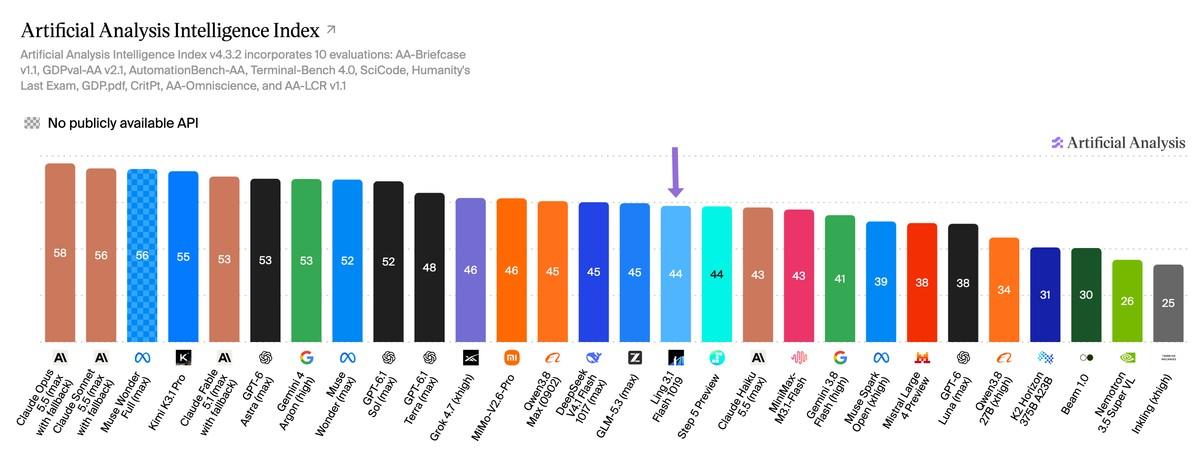
TL;DR - Ant Group open-sourced Ling-3.1-flash-1019 and its base model, targeting personal agents that execute long-running, multi-step workflows. The release improves benchmark performance in knowledge work, automation, and scientific problem-solving.

  • Ling-3.1-flash-1019 scored 44 on Artificial Analysis Intelligence Index v4.3.2, three points above its predecessor.
  • AutomationBench-AA rose from 62% to 68%, while AA-Briefcase improved from roughly 1400 to 1524 Elo.
  • The 560B-parameter hybrid linear MoE base model activates about 25B parameters per token and is released as BF16 weights under the MIT license.
  • Training emphasizes goal-following, tool use, long-context reasoning, and multi-step execution for persistent personal-assistant tasks.
Representative image for GPT-6.1 Terra首批网友实测来了!1折价格获得Astra级电脑操作能力

GPT-6.1 Terra首批网友实测来了!1折价格获得Astra级电脑操作能力

Rank 68 · Content 75 · Popularity N/A

TL;DR - OpenAI launched GPT-6.1 Terra as a faster, lower-cost model focused on computer-use workflows, offering near-flagship benchmark performance at substantially lower API prices.

  • API pricing starts at $1 per million input tokens and $5 per million output tokens, half GPT-5.6 Terra’s standard rates.
  • Terra reportedly matched GPT-6 Astra on Agents’ Last Exam at one-tenth the token price and exceeded its predecessor on OSWorld 2.1.
  • Terminal-Bench 4.0 performance rose from GPT-5.6 Terra’s 21.5% to 50.3% at Terra’s maximum reasoning setting.
  • Early tests suggest strong speed and cost efficiency for interface tasks, although higher-end models remain preferable for the hardest reasoning and coding workloads.
Representative image for 千问办公接入乐奇AI眼镜,一句话发起任务

千问办公接入乐奇AI眼镜,一句话发起任务

Rank 64 · Content 70 · Popularity N/A

TL;DR - Rokid integrated Qwen Office into its AI glasses, enabling users to launch workplace agents by voice and view results hands-free. The integration extends agentic workflows to meetings, field visits, and travel.

  • Qwen Office interprets voice, images, and task intent, manages context, orchestrates tools, and generates outputs.
  • Users can initiate research tasks, receive status notifications, and view completed reports on the glasses.
  • Visual input from the glasses supports contextual analysis and follow-up questions about nearby documents or scenes.
  • The agent can trigger DingTalk actions such as messaging, scheduling, creating tasks, and organizing documents.

Multimodal & Generative 5

Representative image for 模态缺失、噪声干扰怎么办?天津大学张长青:给多模态融合加上「可信度量尺」| CNCC 2026

模态缺失、噪声干扰怎么办?天津大学张长青:给多模态融合加上「可信度量尺」| CNCC 2026

Rank 71 · Content 80 · Popularity N/A

TL;DR - A CNCC 2026 talk presented Tianjin University’s work on robust multimodal fusion, spanning modality-specific representations, uncertainty-aware evidence fusion, and the general-purpose Fusion Anything Model (FAM). The goal is to handle missing or noisy modalities while reducing adaptation costs for new tasks.

  • TMC uses Dirichlet uncertainty modeling and Dempster–Shafer evidence theory to dynamically weight information sources by reliability.
  • FAM combines intra-modality, cross-modality, and sample-level attention to learn from labeled context examples without task-specific parameter updates.
  • FAM is pretrained on synthetic tasks generated by structural multimodal causal models to cover diverse modality relationships.
  • Reported evaluations span 18 real datasets, 12 modalities, and 11 prediction tasks, with uneven results across datasets despite competitive average performance.
Representative image for KV Cache被压成常数!OCR开源新王:页数没上限,缓存砍96%

KV Cache被压成常数!OCR开源新王:页数没上限,缓存砍96%

Rank 71 · Content 80 · Popularity N/A

TL;DR - Baidu released and open-sourced Unlimited OCR 2, a vision-language OCR model designed to parse extremely long, multi-page documents while keeping per-step computation and KV-cache usage bounded.

  • Sparse Reference Sliding Window Attention selects relevant pages and visual tokens, delivering up to 7× faster per-token decoding than full attention in reported tests.
  • Chunked decoding reuses boundary-page and recent text caches, reducing peak KV cache from 47GB to 1.77GB—about 96%.
  • Reported 16-way throughput rose from 360 to 1,315 tokens/second, while benchmark scores reached 84.59 on MPDocBench and 77.06 on MarathonDocBench.
  • The model reportedly processed an 884-page book in roughly 43 minutes and is available on GitHub and Hugging Face.
Representative image for Genie 4: A new generation of world simulation

Genie 4: A new generation of world simulation

Rank 68 · Content 75 · Popularity N/A

TL;DR - Google DeepMind announced Genie 4, a new world model aimed at highly realistic, real-time simulation. The limited excerpt provides no architectural details, benchmarks, or availability information.

  • Described as a new generation of world simulation technology.
  • Emphasizes unprecedented realism and real-time operation.
  • No specific technical results or capabilities are included in the provided content.
Representative image for OXR强势开源!1.3B横扫全球三榜第一,速度快过Paddle、MinerU,RSI让它卷出新高度

OXR强势开源!1.3B横扫全球三榜第一,速度快过Paddle、MinerU,RSI让它卷出新高度

Rank 68 · Content 75 · Popularity N/A

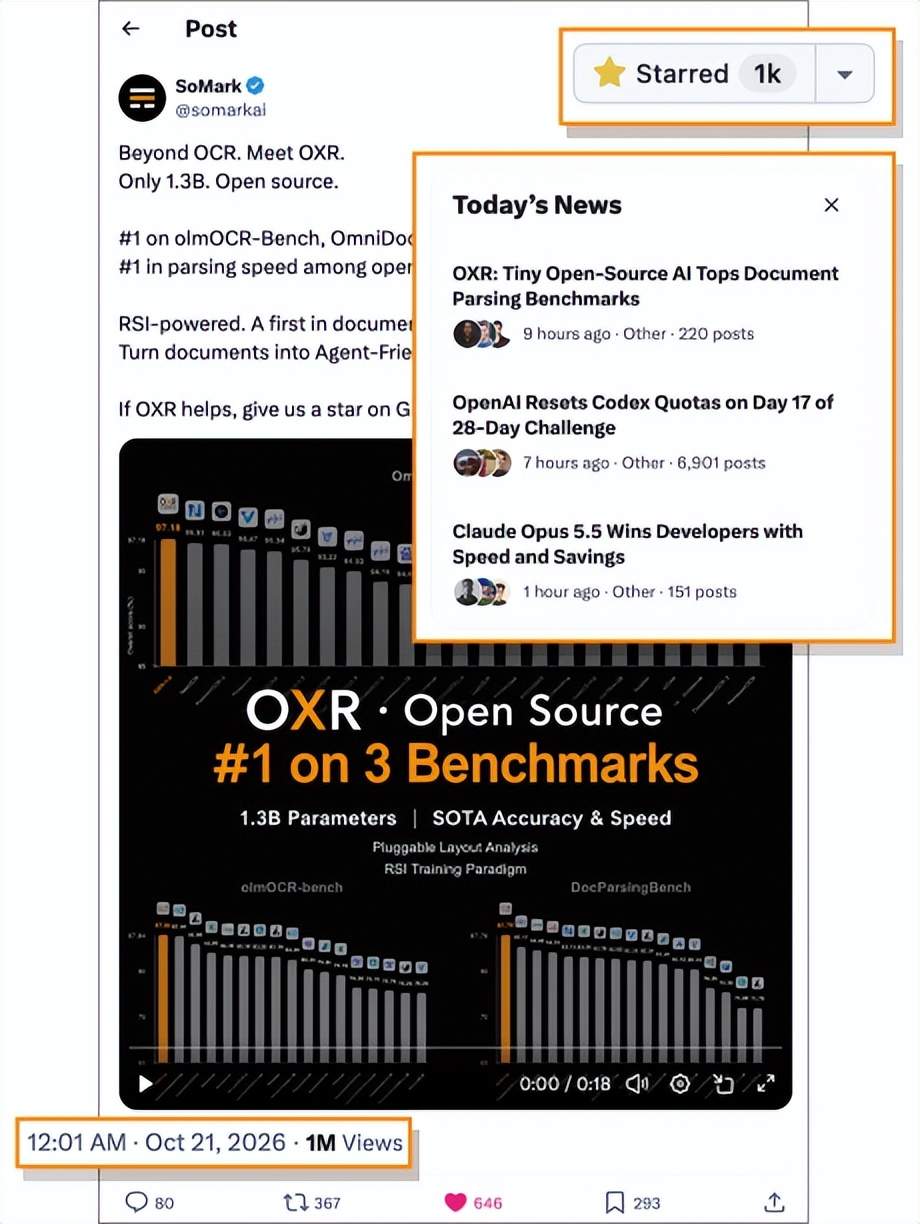
TL;DR - SoMark open-sourced OXR, a 1.3B-parameter document-parsing model that reportedly tops three benchmarks while outperforming larger competitors in parsing speed. It converts complex documents into structured, agent-ready Markdown or JSON.

  • Parses 13 element types, including text, tables, formulas, chemical structures, and code, while preserving reading order and coordinates.
  • Reported scores are 97.18 on OmniDocBench, 87.84 on olmOCR-Bench, and 87.76 on DocParsingBench.
  • Parsed a 100-page sample in about 101 seconds on an RTX PRO 6000 Blackwell, versus 145 seconds for PaddleOCR-VL-1.6 and 255 seconds for MinerU2.5-Pro.
  • Its post-training RSI loop identifies weak outputs, clusters errors, and generates targeted training data without manual annotation.
Representative image for 国产AI 3D大模型Hi3D来了!开源可商用,PK干掉GPT-6

国产AI 3D大模型Hi3D来了!开源可商用,PK干掉GPT-6

Rank 61 · Content 65 · Popularity N/A

TL;DR - Hi3D released its commercially usable V1.0 image-to-3D model as open source and introduced V3.0 plus an agent-driven creation workflow. The system targets production-ready, high-resolution 3D generation, editing, and export.

  • V1.0 builds on Sparc3D, scales training from 500,000 to roughly 2 million curated 3D assets, and supports geometry extraction up to 1536³ resolution.
  • Its report claims leading multiview fidelity (0.75) and detail richness (0.841) among listed baselines, plus a 90% 3D-print slicing success rate.
  • Hi3D V3.0 reportedly supports 2048³ geometry, while Hi3D Agent handles intent interpretation, planning, iterative editing, optimization, and delivery.
  • Source code and weights are available through GitHub and Hugging Face; MCP interfaces enable integration with external agents and applications.

AI Code Security 1

GPT-6.1 Sol helps CodeRabbit strengthen security across complex codebases

Rank 68 · Content 75 · Popularity N/A

TL;DR - CodeRabbit is using OpenAI’s GPT-6.1 Sol to investigate security risks in complex codebases and assist developers in reviewing findings and proposed fixes.

  • Powers CodeRabbit’s security-focused code analysis.
  • Targets security risks spanning complex codebases.
  • Keeps developers involved in evaluating findings and suggested remediations.
  • No performance metrics or implementation details were provided.

Embodied AI 2

Representative image for Physical RSI第一站!便利店打工“人”自己进化,物理AI飞轮启动了

Physical RSI第一站!便利店打工“人”自己进化,物理AI飞轮启动了

Rank 64 · Content 70 · Popularity N/A

TL;DR - AgiBot unveiled Genie Master, an embodied-agent framework designed to let deployed robots diagnose failures, practice autonomously, and improve in real convenience-store workflows. It targets faster adaptation to long-tail physical tasks with less engineering intervention.

  • Its Embodied Execution Protocol connects agent reasoning with robot capabilities, spatial guidance, execution feedback, and multi-robot task continuity.
  • Harness RSI improves prompts, memory, and execution rules without changing model weights, preserving successful recovery strategies for reuse.
  • Policy RSI turns execution, human-takeover, and recovery data into updated action policies through supervised, imitation, or reinforcement learning.
  • AgiBot reports integrating picking, restocking, cleaning, failure recovery, and multi-robot coordination into one workflow, with a six-robot live store trial planned.
Representative image for 具身智能军备竞赛,胜负手在工程生态

具身智能军备竞赛,胜负手在工程生态

Rank 62 · Content 65 · Popularity 54

TL;DR - FluxVLA Engine is an open-source engineering platform that unifies data, training, evaluation, inference, and robot deployment across diverse vision-language-action models. It aims to make embodied-AI development more reusable while closing practical gaps between simulation and real-world execution.

  • A configuration and component registry supports heterogeneous models—including OpenVLA, π0.5, GR00T, and API-only strategies—through shared pipelines.
  • CUDA Graph and operator optimizations raised inference on AGX Orin from 3.2 to 7.4 Hz for GR00T and from 1.4 to 4.4 Hz for π0.5.
  • Real-Time Chunking and trajectory post-processing address action discontinuities, timing mismatches, and physical motion constraints during deployment.
  • Optional RLinf integration enables online reinforcement-learning loops; reported SmolVLA gains were 10 points on LIBERO-10 and 15.4 points on RoboTwin Clean.
Top highlights — Opinions

Medical/Healthcare AI 1

How personalization and psychedelics are revitalizing psychiatry

Rank 48 · Content 50 · Popularity 43

TL;DR - This Nature commentary welcomes personalization and psychedelic therapies as potential ways to revitalize psychiatry, while stressing rigorous application. The provided excerpt does not describe specific methods or results.

  • Psychiatry is characterized as a field where progress has been rare.
  • Personalization and psychedelics are presented as promising new directions.
  • The piece emphasizes rigorous evaluation and implementation.
  • No technical evidence, clinical outcomes, or AI-specific methods are provided.