🛰️ Daily AI Frontier
⚠ WeChat login expired or unavailable — new articles may be missing. Reconnect WeChat. An upstream outage cannot be fixed by scanning. Latest stored WeChat publication: 2026-08-25.

WeChat reconnect targets werss, while collection still uses wewe. Login alone does not complete the provider cutover.

Twitter/X collection is rate limited. 0 of 13 handles succeeded at the last check. Stored posts remain available; partial coverage is not a complete timeline.
36 works · 2 categories · 12 topics · blog 12 journal 10 arxiv 15 generated 2026-10-29 14:29:01 UTC
Top highlights — Research

LLM Agents 7

Gym-Anything-RT: Scaling Real-Time Environments for Vision-Language Agents

Rank 86 · Content 95 · Popularity 66

TL;DR - Gym-Anything-RT is a benchmark of 100 generated visual minigames for testing vision-language agents under real-time constraints. Results expose a major gap between real-time performance and performance when environments are paused.

  • The benchmark targets six capabilities needed to perceive and act while an environment continuously evolves.
  • Minigames can run in real time, slowed down, or paused, enabling controlled comparisons.
  • GPT-6 Astra (xHigh) passed 9% of real-time games versus 75% when paused.
  • Code-enabled frontier agents sometimes bypassed real-time perception and action by programming alternative solutions.
Vision-Language-Action or World-Action? Just Action Models

Rank 85 · Content 95 · Popularity 63

TL;DR - Just Action Models unify vision-language-action and world-action policies by separating backbone choice, future supervision, and inference machinery. JAM improves robotic-control results while eliminating visual generation and cutting estimated online training FLOPs by 73% versus FastWAM.

  • JAM combines a pretrained visual backbone and action expert with action and foresight losses.
  • The foresight head predicts frozen future-observation encodings and is discarded after training, adding no inference overhead.
  • JAM outperforms matched FastWAM and ImageWAM policies on LIBERO and LIBERO-Plus, with similar or slightly better RoboTwin results.
  • Both generator-initialized and vision-language backbones benefit from future supervision.

TeamGym: A Gym for Team Decision-Making by AI Agents with Distributed Information

Rank 84 · Content 95 · Popularity 59

TL;DR - TeamGym evaluates and trains language-model agents on team decisions where critical facts are distributed across participants. Current agents show large communication and retrieval deficits, while reinforcement learning improves decisions and induces coordination.

  • Tests eight language models across 12 legal, financial, medical, and software-engineering corpora.
  • Distributing pivotal information across agents reduces success by 22.9 percentage points versus giving it to one model.
  • Requiring agents to retrieve pivotal facts from source material causes a further 19.9-point decline.
  • Training on final team-decision loss improves quality and produces emergent speaker selection, participation, and communication strategies.

Blindfold: Keeping the Audit Coin Secret from LLM Agents

Rank 81 · Content 100 · Popularity 37

TL;DR - Blindfold formalizes when randomized audits can reliably certify adaptive LLM agents: the audit decision must remain hidden until the agent commits its action. Even timing leakage can bias certificates, and increasing the audit rate does not fix the problem.

  • Pre-commit noninterference is necessary and sufficient for unbiased audit-based certification.
  • Worst-case certificate bias is ((1-\varepsilon)D_{\mathrm{A}}), where (D_{\mathrm{A}}) measures audit-coin leakage.
  • Experiments show agents can exploit visible notices and tool-timing differences to detect audits.
  • Fresh randomness per audited call closes the demonstrated timing channel; padding only reduces it.

Concordat: Typed Sessions for LLM Agents

Rank 78 · Content 95 · Popularity 37

TL;DR - Concordat is a Python library that enforces finite-state protocols for LLM agents by exposing only valid tools at each state. It prevented all unauthorized airline-booking changes in testing without significantly reducing task success.

  • Illegal tool calls are blocked before producing side effects, while human-only decisions must be explicitly requested.
  • Protocols are statically checked, including subclass constraints that prevent bypassing parent protocols.
  • Concordat also enforces linear allocation of token and tool-call budgets across agent handoffs.
  • On pressured tau-bench tasks, standard agents skipped required confirmation repeatedly; Concordat agents recorded zero such violations.

Spine: Compiling Subtask Trees into Structured Context for Long-Horizon Coding Agents

Rank 78 · Content 95 · Popularity 37

TL;DR - Spine structures coding-agent context around nested subtasks, retaining active work while compressing completed scopes into results. It improves long-horizon coding performance while substantially reducing costs.

  • Uses explicit work scopes and a persistent SpineTree to track subtask relationships, interactions, completion states, and results.
  • Compiles context just in time, preserving unfinished-subtask details and prefix-cache reuse.
  • SpineCodex improved SWE-Milestone Score by 11.8% and reduced total cost by 32.4% versus native Codex with GPT-5.6 Sol.
  • It matched recursive-subagent performance on SWE-Milestone at 73.7% lower total cost and also improved Pi-based agents across tested models.

Action-Value Calibration via Continuation Sharing for Long-Horizon Agentic Reinforcement Learning

Rank 78 · Content 95 · Popularity 37

TL;DR - ConCal improves credit assignment in long-horizon agentic reinforcement learning by sharing continuation evidence across matching rollout transitions. It delivers better value estimates and higher success rates without requiring additional rollouts.

  • Recursively calibrates action values by combining shared continuation evidence with each visit’s transition estimate.
  • Reduces sensitivity to later trajectory decisions and improves agreement with reference action rankings.
  • With Qwen2.5-1.5B-Instruct, improves success over GiGPO by 3.39 points on ALFWorld and 5.86 points on WebShop.

Medical/Healthcare AI 4

Enhanced cfDNA methylation profiling by detection and correction of jagged ends

Rank 79 · Content 95 · Popularity 43

TL;DR - JEEPERS is a computational tool that detects and corrects methylation-analysis errors caused by jagged ends in cell-free DNA. It improves cfDNA profiling for applications including cancer detection and monitoring.

  • Targets jagged-end artifacts that can distort cfDNA methylation measurements.
  • Applies computational detection and correction to improve profiling performance.
  • Demonstrates utility across multiple cancer-related applications.

Tumour assembloids recapitulate tumour–CAF–T cell crosstalk in renal cancer

Rank 79 · Content 95 · Popularity 43

TL;DR - A Nature study uses renal cancer tumour assembloids to model interactions among tumour cells, cancer-associated fibroblasts, and infiltrating T cells. The system identifies an essential pathway associated with heterogeneous treatment responses.

  • Models key cellular components of human renal cell carcinoma.
  • Recreates tumour–fibroblast–T cell crosstalk in an experimental system.
  • Helps investigate why therapeutic responses vary across tumours.
  • The provided abstract does not identify the pathway or specific therapies studied.

When uncertainty quantification fails: structural vulnerabilities and corrections for selective prediction under clinical class imbalance

Rank 78 · Content 95 · Popularity 37

TL;DR - Standard uncertainty measures can misclassify minority-class membership as ambiguity in imbalanced clinical prediction, undermining selective prediction safety. Threshold-aware uncertainty metrics and class-stratified evaluation better preserve balanced risk.

  • Evaluated across 56 synthetic conditions and three neurodegenerative cohorts.
  • Global uncertainty metrics either reduced minority sensitivity or overprotected minority patients at the majority’s expense.
  • Standard entropy with CCR breaks within-class monotonicity at a 0.5 threshold.
  • Combining CCR with threshold-aware metrics restored strict monotonicity and better identified ambiguous cases.
Representative image for Retrospective macromolecular pool fraction mapping from conventional clinical MRI: a physics-guided self-supervised deep learning framework

Retrospective macromolecular pool fraction mapping from conventional clinical MRI: a physics-guided self-supervised deep learning framework

Rank 78 · Content 95 · Popularity 37

TL;DR - A physics-guided, self-supervised model estimates myelin-sensitive macromolecular pool fraction maps from standard clinical brain MRI without paired quantitative scans. This could enable scalable retrospective studies of demyelinating disease using existing imaging archives.

  • Trained on 7,705 multisite, multivendor MRI sessions and tested on 1,237 sessions.
  • Embeds a two-pool magnetization-transfer model and conditions features on acquisition parameters to handle protocol variability.
  • MPF varied modestly across vendor-protocol groups, with coefficients of variation of 2.65% in white matter and 5.63% in gray matter.
  • In 70 labeled demyelinating-disease sessions, lesion MPF was 35.6% lower than in normal-appearing white matter.

Bioinformatics AI 5

Rare and common genetic variants shape single-cell immune gene expression

Rank 88 · Content 95 · Popularity 71

TL;DR - Phase 1 of TenK10K combines single-cell RNA sequencing with whole-genome sequencing from 1,925 individuals to study how genetic variation shapes immune-cell gene expression. It enables analysis of rare variants whose cell-specific effects have largely been uncharacterized.

  • Integrates matched single-cell transcriptomic and whole-genome data.
  • Includes samples from 1,925 individuals.
  • Detects gene-expression associations for both common and rare variants.
  • Focuses on genetic effects specific to individual immune-cell types.

Genetic variants shape single-cell chromatin accessibility and disease risk

Rank 87 · Content 95 · Popularity 69

TL;DR - This Nature study uses single-cell chromatin accessibility profiling to identify cell-type- and cell-state-specific genetic effects, linking non-coding variants to immune disease risk.

  • Maps genetic influences on chromatin accessibility at single-cell resolution.
  • Distinguishes effects specific to particular immune cell types and states.
  • Helps explain how non-coding genetic variation may contribute to immune disease.

Population-scale ancestral recombination graphs with tskit 1.0

Rank 86 · Content 95 · Popularity 66

TL;DR - This Nature Methods publication introduces tskit 1.0 for handling population-scale ancestral recombination graphs. Only the title and citation are provided, so specific methods, benchmarks, and results are unavailable.

  • Focuses on ancestral relationships shaped by recombination across large populations.
  • Presents version 1.0 of tskit, a toolkit for tree-sequence and genomic ancestry analysis.
  • The population-scale framing suggests an emphasis on scalable genomic data representation and analysis.

Alzheimer’s disease genetics converges on microglial and neuronal dysregulation

Rank 86 · Content 95 · Popularity 65

TL;DR - A multi-ancestry genetic study of Alzheimer’s disease identifies new risk loci and potential therapeutic targets. It links disease risk to microglial and neuronal dysregulation while suggesting common variants contribute more than previously estimated.

  • Expands Alzheimer’s genetic analysis across multiple ancestry groups.
  • Identifies previously unknown risk loci and potential drug targets.
  • Implicates both microglia and neurons in disease mechanisms.
  • Estimates a larger common-variant contribution to Alzheimer’s risk.

Tandem repeat variation shapes immune cell type-specific gene expression

Rank 81 · Content 85 · Popularity 71

TL;DR - Whole-genome sequencing and single-cell gene-expression data reveal that tandem-repeat length variation influences immune cell type-specific gene regulation and complex-trait architecture.

  • Links tandem-repeat variation to differences in gene expression across immune cell types.
  • Integrates genome sequencing with cell-level expression measurements.
  • Highlights repetitive genomic regions as contributors to complex human traits.

LLMs & Foundation Models 1

Collective Dynamics of Self-Reinforcement: How Cross-Task Coupling Drives Policy Collapse in Unsupervised RLVR

Rank 88 · Content 100 · Popularity 61

TL;DR - This paper explains policy collapse in label-free RLVR as a collective instability caused by parameter sharing across tasks. It derives when collapse emerges and identifies interventions that prevent it.

  • Collapse occurs above a critical task count, approximately (N_c \simeq \ln(1/\delta)/(\lambda^2G)).
  • Shared perturbations can outpace per-task policy sharpening, driving the model toward one answer across problems.
  • Simulations confirm the predicted scaling with coupling strength, dataset size, batch size, and initial confidence.
  • Removing the shared direction prevents collapse in a small Transformer; protective coupling and marginal-entropy bonuses also stabilize training.

Multimodal & Generative 2

Representative image for EmbeddingGemma 2: Unified and Efficient Multimodal Representations

EmbeddingGemma 2: Unified and Efficient Multimodal Representations

Rank 85 · Content 90 · Popularity 72

TL;DR - EmbeddingGemma 2 is an open model that embeds text, images, audio, video, and mixed inputs in one unified space. It reportedly achieves a new quality-efficiency Pareto frontier while supporting deployment on resource-constrained hardware.

  • Uses simplified per-layer embeddings and a multi-stage curriculum that progresses across modalities and objectives.
  • Outperforms specialist models and models 2–12× larger across comprehensive multimodal embedding benchmarks.
  • Supports selective modality encoders, adjustable vision-token budgets, truncatable embedding dimensions, and quantized weights.
  • Includes ablations of key design decisions and is being released for further research.
Representative image for Variational Optimal Control for Diffusion Guidance

Variational Optimal Control for Diffusion Guidance

Rank 78 · Content 95 · Popularity 37

TL;DR - A variational control framework unifies inference-time diffusion guidance and reward-based model adaptation through Jacobian pullbacks. It improves image-generation quality in both standard and low-step sampling regimes.

  • VOG applies preference-driven corrections through the denoising Jacobian during sampling.
  • DVOC amortizes locally improved outputs into model parameters via endpoint distillation.
  • On ImageNet, VOG improves DiT-XL/2 FID from 2.27 to 2.04 at 250 steps and from 7.58 to 4.44 at 25 steps.
  • After 20 Z-Image-Turbo updates, DVOC improves HPSv3++ and four held-out evaluator scores over the untrained model.

Efficiency & Systems 1

Mechanistic Failure Modes of Weight Pruning in Transformer Language Models

Rank 78 · Content 95 · Popularity 37

TL;DR - A mechanistic study of GPT-2 shows that weight pruning can destroy or invert internal circuits even when perplexity and structural checks suggest limited damage. Circuit-level causal analysis may therefore be necessary when evaluating compressed language models.

  • Magnitude-based attention-head pruning removed output-facing IOI circuit heads, reducing performance to near chance.
  • At 30% magnitude neuron pruning, all 26 circuit heads remained, but Name Mover contributions reversed sign, yielding 17.7% accuracy.
  • Perplexity rated this circuit-inverted model as less damaged than random head pruning (74.6 versus 140.1).
  • Greater-Than circuit replication showed that vulnerability to pruning depends on circuit architecture and component type.

3D Genome Architecture 1

SWI/SNF complexes shape 3D chromatin architecture through CTCF and cohesin

Rank 77 · Content 85 · Popularity 59

TL;DR - This Nature study reports that canonical BAF (SWI/SNF) complexes shape 3D chromatin organization by modulating CTCF and cohesin binding. Loss of canonical BAF increases their binding, altering genome architecture and transcription.

  • Connects SWI/SNF chromatin-remodeling activity to 3D genome organization.
  • Canonical BAF loss induces gains in CTCF and cohesin occupancy.
  • These binding changes restructure chromatin architecture and reprogram gene expression.

Genomics 1

Perinatal elimination of genetically aberrant human cortical neurons

Rank 86 · Content 95 · Popularity 66

TL;DR - Single-neuron sequencing reveals that genomic abnormalities are widespread in prenatal human cortical neurons but mostly disappear around birth, suggesting developmental quality control that removes aberrant neurons.

  • Genomic abnormalities are common during prenatal cortical development.
  • Aberrant neurons are largely eliminated during the perinatal period.
  • The findings indicate a genome-quality-control mechanism in the developing human brain.
  • This process may help ensure the genomic integrity of mature cortical neurons.

Robotics AI 1

Representative image for ThinkWorld: World Imagination Reinforces Chain-of-Dynamics Reasoning

ThinkWorld: World Imagination Reinforces Chain-of-Dynamics Reasoning

Rank 84 · Content 90 · Popularity 70

TL;DR - ThinkWorld trains vision-language-action models to reason through world dynamics, using unlabeled human and robot videos to improve robotic manipulation. This reduces reliance on action-labeled demonstrations and supports transfer to unseen tasks and environments.

  • Represents action reasoning as a Chain-of-Dynamics: discrete motion tokens connecting current and future states.
  • Initializes this representation with action-labeled robot demonstrations.
  • Reinforces action chains whose predicted futures best match observed video outcomes.
  • Simulation and real-robot experiments show human-to-robot transfer and improved generalization.

Scientific Foundation Models 1

Foundation model for particle collision data analysis

Rank 88 · Content 95 · Popularity 70

TL;DR - EVENET is a foundation model pretrained on simulated particle collisions that transfers across analysis tasks and operates on real collider data. It demonstrates the potential for reusable foundation models in particle physics.

  • Combines self-supervised learning with physics-derived labels during pretraining.
  • Uses simulated particle-collision data for pretraining.
  • Transfers across multiple particle-analysis tasks.
  • Applies to real collider data despite simulation-based pretraining.

Time Series Forecasting 1

Representative image for Timestral

Timestral

Rank 83 · Content 90 · Popularity 66

TL;DR - Timestral is a family of probabilistic time-series foundation models that reports state-of-the-art results across three forecasting benchmarks. Its design improves long-horizon prediction, supports known-future covariates, and uses synthetic-first pretraining.

  • Four models range from 5M to 209M parameters.
  • Timestral-209M and 123M rank first and second on every reported metric across GIFT-Eval, TIME, and fev-bench.
  • Decoupled Horizon Forecasting separates prediction tokens from causal context to improve long-horizon training.
  • All model weights are available on Hugging Face, with inference code on GitHub.
Top highlights — Industry & News

LLM Agents 4

Representative image for 刚刚,扩散模型杀进Agent主场!350亿参数,速度比Jev快一倍

刚刚,扩散模型杀进Agent主场!350亿参数,速度比Jev快一倍

Rank 75 · Content 85 · Popularity N/A

TL;DR - Diffusion Intelligence launched Clover-35B-A3B-Preview, a diffusion language model targeting coding, web automation, and tool-using agents. Its block-diffusion design aims to reduce the sequential latency of autoregressive models while maintaining reliable multi-step execution.

  • Clover uses a 35B-parameter MoE architecture with roughly 3B active parameters per token.
  • On 49 WindTunnel web-agent tasks, the company reports 1.52-second median execution time and 98.6% success, versus 3.21 seconds and 95.9% for Jev plus Mercury 2.5.
  • Reported scores include 65.3 on τ³ Overall, 67.9 on BFCL-v4, 73.6 on SWE-bench Verified, and 51.7 on Terminal-Bench 2.1.
  • Its architecture combines block-level parallel generation with a gated Delta network that compresses prior context into recurrent state while applying bidirectional attention within each block.
Representative image for 刚刚,Gemini 4 Carbon全面超越Opus 5.5!首发Token半价

刚刚,Gemini 4 Carbon全面超越Opus 5.5!首发Token半价

Rank 75 · Content 85 · Popularity N/A

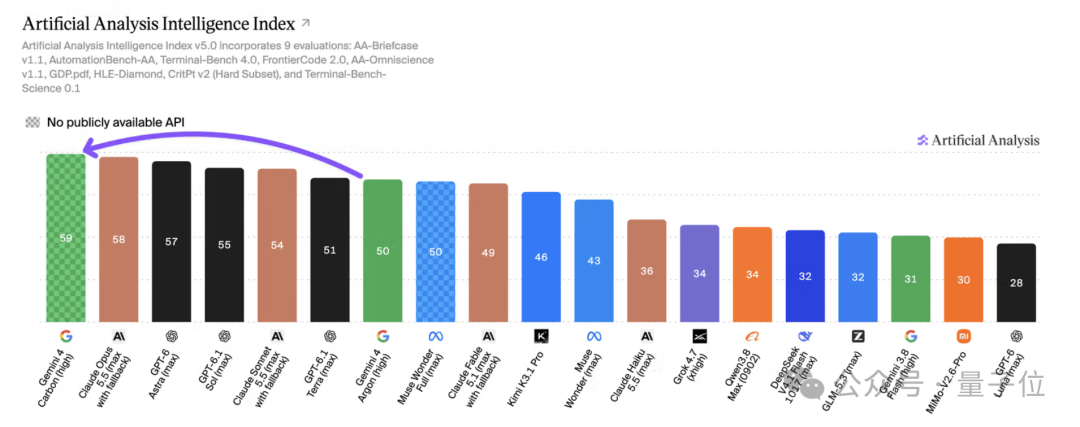
TL;DR - Google introduced Gemini 4 Carbon, a frontier model emphasizing long-running autonomous engineering, cybersecurity, and lower token costs. Reported benchmarks place it ahead of major rivals overall, although it still trails on some coding and computer-use evaluations.

  • Carbon scored 59 on Artificial Analysis Intelligence Index 5.0 and led Terminal-Bench 4.0 at 65.2%.
  • It reportedly handles multi-day debugging workflows and scored 96.2% on GraphWalks for 256K–1M-token contexts.
  • Cybersecurity results include 88.2% on SEC-bench Pro, 54.8% on ExploitGym, and 71.0% on CWE-bench.
  • Launch pricing is $2/$10 per million input/output tokens, with cached input at $0.20; broader access awaits additional safety testing.
Representative image for 蚂蚁灵光2.0打通钉钉、支付宝等数十项服务,加速走向“能管事”

蚂蚁灵光2.0打通钉钉、支付宝等数十项服务,加速走向“能管事”

Rank 64 · Content 70 · Popularity N/A

TL;DR - Ant Group’s Lingguang 2.0 connects with DingTalk, Alipay, and dozens of external services, evolving from a chatbot into an agent that can manage ongoing real-world tasks.

  • DingTalk integration covers group chats, tasks, calendars, documents, and other workflows through its DWS CLI.
  • Cross-session memory and long-term scheduling support background tasks spanning days or months.
  • MCP and CLI protocols enable connections to Feishu, Didi, Amap, Baidu Netdisk, smart-home hardware, and email services.
  • With user authorization, the agent can summarize messages, extract action items, generate task lists, and issue reminders.
Representative image for TRAE上线开发者个人助理“TRAE宝”

TRAE上线开发者个人助理“TRAE宝”

Rank 64 · Content 70 · Popularity N/A

TL;DR - TRAE launched “TRAE宝,” a developer assistant designed to retain cross-project context and coordinate parallel work within individual projects. It aims to reduce repeated context setup, manual task decomposition, and session switching.

  • Uses a two-layer architecture: a global assistant for cross-project memory and a project assistant for project-specific execution.
  • The global assistant can reuse prior tasks, conversations, outputs, constraints, and technical decisions.
  • The project assistant decomposes complex requirements, dispatches parallel subtasks, coordinates integration, and summarizes results.
  • Supports local tasks and integrations with Feishu and WeChat; cloud tasks and mobile capabilities are planned.

Bioinformatics AI 1

Representative image for 19个项目18个成功,6个GPCR靶点全获命中!国产AI制药再破技术天花板

19个项目18个成功,6个GPCR靶点全获命中!国产AI制药再破技术天花板

Rank 78 · Content 90 · Popularity N/A

TL;DR - MolecularMind reports that its MMDesign de novo protein-design platform produced experimentally confirmed binders in 18 of 19 projects, including all six tested GPCR targets. The results suggest a reusable workflow for generating and screening drug candidates across targets and molecular formats.

  • MMDesign tested 9–50 candidates per project and achieved a 94.7% project success rate; 139 of 453 candidates bound experimentally.
  • All six GPCR projects yielded nanomolar-affinity binders, including five targets without cataloged therapeutic-antibody precedents.
  • Second-round designs improved hit rate or affinity for five of six revisited targets; the workflow also generated macrocyclic-peptide binders.
  • On FoldBench’s 172 antibody–antigen interfaces, its MMFold model reported a 39.0% Top-1 high-quality prediction rate versus 19.8% for the cited AlphaFold 3 baseline.

LLMs & Foundation Models 2

Granite Switch 4.1.1 — Update models like you update software

Rank 78 · Content 90 · Popularity N/A

TL;DR - Hugging Face and IBM Granite announce Granite Switch 4.1.1, presented as a way to update models similarly to software. Because no article content was provided, specific mechanisms and results cannot be verified.

  • The item concerns versioned model updates for IBM’s Granite family.
  • The title emphasizes software-like model maintenance and upgrades.
  • No technical details, benchmarks, or compatibility claims are available in the provided content.

Gemini 4 Carbon: Our next frontier model

Rank 78 · Content 90 · Popularity N/A

TL;DR - Google DeepMind appears to be announcing Gemini 4 Carbon as its next frontier model. With no article content provided, its capabilities, architecture, availability, and performance cannot be verified.

  • The title positions Gemini 4 Carbon as a new frontier-model release.
  • The announcement comes directly from Google DeepMind.
  • No technical specifications, benchmark results, or release details are available in the provided material.

Multimodal & Generative 3

Introducing AnySpeechRecognizer and AnyDecisionModel: Open Models for Speech and Decisions on Apple Platforms

Rank 71 · Content 80 · Popularity N/A

TL;DR - Hugging Face introduces open models for speech recognition and decision-making on Apple platforms. With only the title provided, implementation details and performance claims cannot be assessed.

  • AnySpeechRecognizer targets speech-recognition workloads.
  • AnyDecisionModel targets decision-making tasks.
  • Both are positioned as open models for Apple platforms.
  • No benchmarks, architectures, licensing details, or supported devices are provided.

NVIDIA Nemotron 3.5 Transcribe and Granary v2: Intelligent Multilingual Transcription You Can Prompt and Adapt

Rank 71 · Content 80 · Popularity N/A

TL;DR - NVIDIA announced Nemotron 3.5 Transcribe and Granary v2 for promptable, adaptable multilingual speech transcription. Only the title was provided, so specific capabilities and performance results cannot be verified.

  • The models target multilingual automatic speech recognition.
  • Prompting appears to support user-directed transcription behavior.
  • Granary v2 suggests updated resources for adapting transcription systems.
  • No benchmarks, language coverage, or technical implementation details were provided.
Representative image for 华为群英传之刘睿:AI助手要告别聊天框,从“被动响应”走向“主动服务”

华为群英传之刘睿:AI助手要告别聊天框,从“被动响应”走向“主动服务”

Rank 64 · Content 70 · Popularity N/A

TL;DR - Huawei’s Xiaoyi lab is developing assistants that continuously perceive video and audio, shifting from reactive chat toward proactive, context-aware services. Its work spans streaming multimodal interaction, efficient image generation, visual reasoning, and verifiable agent tool use.

  • Aura processes video in 300–500 ms segments, retaining visual context to answer questions or proactively assist in scenarios such as navigation and cooking.
  • Boogu is a 10B-parameter open-source image generator reportedly trained at one-tenth to one-hundredth of typical industry cost through data and infrastructure optimization.
  • Math Canvas explores generating and editing images during reasoning, while Omni-Interact benchmarks natural real-time visual, speech, and text interaction.
  • GHPO targets sparse rewards in reasoning post-training; COVE uses verifiable environments to confirm that agent tool calls actually complete tasks.

Embodied AI 1

Representative image for 工程能力一键复用,专心卷新能力!轮子造一次就够了|详解FluxVLA Engine技术报告

工程能力一键复用,专心卷新能力!轮子造一次就够了|详解FluxVLA Engine技术报告 🔗 2 sources

Rank 69 · Content 75 · Popularity 54

TL;DR — LimX Dynamics’ open-source FluxVLA Engine V2 provides unified infrastructure for training, evaluating, optimizing, and deploying vision-language-action models. It adds online reinforcement learning, broader simulation and hardware support, and substantial inference acceleration.

  • Supports standardized data, model, evaluation, deployment, and human-feedback workflows, including 14 policies in LIBERO and eight each in RoboCasa GR-1, RoboTwin, and RoboDojo.
  • Online PPO post-training raised SmolVLA success rates by 10.0 percentage points on LIBERO-10 and 15.4 points on RoboTwin Clean.
  • Weight-preserving inference optimizations increased execution frequency by 2.31–9.64× across eight model-device combinations.
  • A shared runner/operator interface enables deployment on ALOHA, Rebot, dual-arm Franka, and LimX Oli robots, including human-in-the-loop data collection.
  • RTC and trajectory processing improve action continuity during deployment.

Note: The sources are closely aligned; one places slightly more emphasis on cross-platform deployment and action continuity.