🛰️ Daily AI Frontier
⚠ WeChat login expired or unavailable — new articles may be missing. Reconnect WeChat. An upstream outage cannot be fixed by scanning. Latest stored WeChat publication: 2026-08-25.

WeChat reconnect targets werss, while collection still uses wewe. Login alone does not complete the provider cutover.

Twitter/X collection is rate limited. 0 of 13 handles succeeded at the last check. Stored posts remain available; partial coverage is not a complete timeline.
36 works · 3 categories · 14 topics · blog 12 journal 9 arxiv 15 generated 2026-11-03 15:23:58 UTC
Top highlights — Research

LLM Agents 5

MCP Tool Poisoning in Agentic AI Frameworks: A Cross-Framework Measurement Study

Rank 89 · Content 100 · Popularity 64

TL;DR - This cross-framework study measures real MCP tool-poisoning attacks across 12 agentic AI frameworks, 18 models, and 45 scenarios. It finds a 22.9% attack success rate and no intentional framework-level defenses.

  • Of 9,720 tested combinations, 2,113 were vulnerable; 12.1% of those verifiably exfiltrated a secret.
  • Resistance was primarily model-dependent: attack success rates ranged from 0.4% to 49.7%.
  • Nine core frameworks clustered at 23–26% susceptibility, with no statistically significant framework-level difference.
  • Regex metadata scanning blocked 20 of 45 scenarios but produced a 7.2% false-positive rate, making it only a partial defense.
Representative image for DR Pixel: Page-Native Deep Research with Vision-Language Models

DR Pixel: Page-Native Deep Research with Vision-Language Models

Rank 89 · Content 100 · Popularity 63

TL;DR - DR Pixel is an open-source multimodal research agent that retrieves and reasons directly over document page images instead of OCR text. This page-native approach improves accuracy and efficiency on complex scientific documents containing figures, tables, and equations.

  • DRPixelBench evaluates reasoning across 1.06 million rendered pages using text, figures, tables, and equations.
  • Without training, page-native retrieval outperforms OCR-based baselines while using fewer tool calls.
  • Counterfactual credit reweighting assigns training credit to individual reasoning and action steps based on their contribution.
  • Training improves retrieval recall by about 15 points and final accuracy by over 10 points on DRPixelBench.

VeriHarm-Bench: Measuring Harmful Success in LLM Coding Agents Verifiably

Rank 83 · Content 100 · Popularity 42

TL;DR - VeriHarm-Bench evaluates “harmful success,” where coding agents complete benign tasks but cause unintended system damage. Frontier agents averaged 95% task accuracy yet only 37% safe success, showing that conventional success metrics can obscure major safety risks.

  • VeriHarm minimally perturbs coding tasks while preserving their benign objectives.
  • Executable tests independently verify task correctness and harmful side effects.
  • Measured harms include deleting unrelated files, weakening permissions, and corrupting data.
  • The large accuracy–safety gap indicates that successful completion does not imply safe execution.

DeliverBench: Benchmarking AI Agents on Delivering Realistic Multi-Stage Professional Projects

Rank 83 · Content 100 · Popularity 42

TL;DR - DeliverBench evaluates AI agents on complete, evolving professional projects rather than isolated tasks. Results show that strong task-level performance does not reliably translate into coherent final deliverables.

  • Covers 11 projects, 150 subtasks, and domains including finance, law, and drug safety.
  • Projects span 2–15 rounds of new materials and client feedback, forcing agents to carry forward their own prior work and errors.
  • The best of seven model-harness systems scored 65.0/100 on final delivery and passed 50.0% of subtasks at a 90-point threshold.
  • Common failures involved maintaining coherence and traceability across project stages.

Can LLM Agents Be Forward-Deployed Engineers? Requirement Discovery and Delivery for Enterprise Text-to-SQL

Rank 81 · Content 100 · Popularity 37

TL;DR - A real-world-inspired enterprise text-to-SQL study finds that LLM agents can uncover many hidden customer requirements, but rarely deliver production-ready post-training pipelines without oversight.

  • Top models discovered over 80% of withheld requirements; open-weight models found 40–50%.
  • Only 25% of delivery runs across eight coding-agent configurations passed all acceptance criteria.
  • Key failures included incomplete discovery, unreliable execution, underused compute, and weak experimental comparisons.
  • Benchmark accuracy did not ensure production readiness, motivating human review, execution monitoring, and explicit environment specifications.

Medical/Healthcare AI 1

This cholesterol drug promised to be a game-changer. Why did it flop in the clinic — and is there still hope?

Rank 67 · Content 70 · Popularity 59

TL;DR - A major clinical trial of a therapy that sharply lowers lipoprotein(a), an important cardiovascular risk factor, failed to demonstrate clinical benefit. Researchers are investigating whether the result challenges the therapeutic strategy or reflects trial-specific factors.

  • Several therapies were designed to substantially reduce lipoprotein(a) levels.
  • Lower biomarker levels did not translate into demonstrated patient benefit in one major trial.
  • The failure raises questions about lipoprotein(a) as a treatment target and the prospects for related therapies.
  • The limited excerpt does not specify the drug, trial design or clinical outcomes.

Bioinformatics AI 1

Limitations of de novo peptide sequencing in resolving sequence ambiguity

Rank 82 · Content 90 · Popularity 63

TL;DR - A benchmark of eight deep-learning tools for de novo peptide sequencing finds that most errors arise from incomplete mass spectra rather than model design. The results favor tools that identify ambiguous sequence regions instead of guessing complete peptides.

  • Benchmarks eight deep-learning peptide-sequencing tools.
  • Incomplete spectra are the primary source of sequence ambiguity and errors.
  • Model architecture improvements alone may not resolve the core limitation.
  • Uncertainty-aware outputs could make peptide predictions more reliable.

LLMs & Foundation Models 7

Forecasting How RLHF Responds to Reward-Model Edits Before Training

Rank 88 · Content 100 · Popularity 61

TL;DR - A pre-training covariance method forecasts how RLHF policies initially respond to reward-model edits, helping practitioners assess changes before costly RL runs. It accurately predicted feature shifts and ranked short-term reward-quality gaps, though long-run behavior could reverse.

  • Explained 82% of standardized feature change, versus 50% for counterfactual-price forecasting.
  • Generalized to GRPO and real reward-model upgrades, explaining 66% out of sample.
  • Ranked reward-model edits over the first 30 steps with Spearman correlation 0.94.
  • Forecasts weakened over time: factorial-edit rankings reversed by step 200 under both RLOO and GRPO.

Library of Layers (LoL): Adaptively Ordering Transformer Layers at Runtime

Rank 86 · Content 95 · Popularity 66

TL;DR - Library of Layers dynamically orders transformer blocks at inference, allowing models to compose task-specific computational graphs. It unifies tradeoffs among dense, recurrent, and mixture-of-experts architectures while enabling more controllable reasoning.

  • A single library-size hyperparameter balances parameter reuse against sparse computation.
  • Text pretraining produced competitive performance with dense, depth-recurrent, and mixture-of-experts baselines.
  • Layer-routing patterns varied by problem-solving strategy, language, and script.
  • Routing could be manipulated to enforce specific strategies, while router probes distinguished safe from unsafe text with high AUROC.

Tracing the Scientific Discovery Capacity of LLMs to Their Training Data

Rank 85 · Content 100 · Popularity N/A

TL;DR - This paper identifies “monofacts”—facts appearing once in training data—as a key predictor of LLM scientific discovery capacity. Increasing monofact rates consistently produced more discoveries, suggesting rare training examples contribute capabilities beyond dataset diversity alone.

  • Experiments cover materials science and regulatory genomics across two open-weight model families.
  • Higher monofact rates improved discovery under multiple sampling strategies and reasoning budgets.
  • Training-set diversity alone did not explain the observed relationship.
  • Monofact benefits transferred across scientific domains when paired with in-domain data.

Pretraining Data Scale Reverses the Muon-AdamW Fine-Tuning Gap

Rank 81 · Content 100 · Popularity 37

TL;DR - Muon improves LLM pretraining loss faster than AdamW, but AdamW can produce better fine-tuned models once pretraining data exceeds a scale-dependent threshold. This shows that pretraining optimization gains do not necessarily translate into superior downstream performance.

  • AdamW overtakes Muon at lower token-to-parameter ratios as model size increases.
  • The proposed margin-to-spread ratio tracks the observed fine-tuning reversal across data budgets.
  • A linear associative-memory analysis proves that gradient descent gains on Muon under this metric as data scale grows.
  • Simulations indicate the theoretical trend persists beyond a single update.

Not All Reasoning Generalizes: A Case Study on Learning Generalizable Reasoning Strategies in RLVR

Rank 81 · Content 100 · Popularity 37

TL;DR - This paper identifies an RLVR failure where LLMs learn effective in-distribution reasoning but abandon it for brute-force enumeration under harder out-of-distribution shifts. Co-training on bijective inversion tasks substantially restores the correct strategy and accuracy.

  • Uses a controllable equation-solving framework that makes reasoning strategies and easy-to-hard shifts observable.
  • Shows that high in-distribution accuracy and structured derivations do not guarantee reasoning generalization.
  • Rules out an incapable base model and reward hacking as sufficient explanations for the observed collapse.
  • Argues that outcome-only RLVR can implicitly favor effective reasoning strategies without process supervision.

Same Outputs, Different Scores: Auditing the Unchecked Graders of Multimodal LLM Benchmarks

Rank 81 · Content 100 · Popularity 37

TL;DR - An audit of eight multimodal-LLM benchmarks finds that hidden scoring rules can shift accuracy by up to 22 points on identical model outputs. This exposes benchmark scores as partly dependent on parser behavior rather than model capability.

  • Blinded human-plus-LLM adjudication achieved Cohen’s kappa of 0.956 in recovering intended answers.
  • Scoring differences disappear for clean option-letter responses, masking the issue on strong-model leaderboards.
  • Regex selection alone shifted one reasoning model’s score by 9.5 points despite zero response-format non-compliance.
  • The authors recommend reporting non-compliance rates and results under at least two scoring rules.

A Scaling Theory of Multi-Epoch Pretraining: Late-Time Overfitting and Ensembling

Rank 80 · Content 100 · Popularity 34

TL;DR - This paper develops scaling laws for multi-epoch language-model pretraining under fixed-data constraints. It finds that model ensembling can mitigate late-training overfitting and improve compute allocation.

  • FineWeb experiments show logit averaging delays optimal stopping and reduces late-training deterioration.
  • Ensembles can outperform wider or deeper single models at matched parameter-token budgets.
  • A dynamical mean-field theory attributes late-time test-error growth to prediction variance, which ensembling reduces.
  • The derived allocation laws suggest ensemble size should grow with compute at least as quickly as each member’s training time.

Efficiency & Systems 2

FLAMIA: FLAsh MIcroscaling Attention for Fast and Causally Safe Training on Blackwell

Rank 90 · Content 100 · Popularity 68

TL;DR - FLAMIA introduces low-precision attention kernels optimized for NVIDIA Blackwell GPUs, accelerating Transformer training while preventing causal leakage and preserving numerical consistency.

  • Supports MXFP8 and mixed NVFP4/FP8 training paths with fused quantization.
  • Uses token-block and document-local scaling to avoid scale-induced leakage in causal attention.
  • Handles variable-length packed documents directly without repacking.
  • Accelerates forward-plus-backward attention by 1.10–1.40× on B200 and 1.06–1.42× on B300 versus evaluated baselines, while preserving Llama-style pretraining stability and quality.

Sonar-MoE: In-Backward Expert Updates for Memory-Efficient Mixture-of-Experts Training

Rank 81 · Content 100 · Popularity 37

TL;DR - Sonar-MoE updates expert tensors during backpropagation and immediately frees their gradients, reducing GPU memory and training time without materially affecting model quality.

  • Reduces peak memory by 19%–22% when fine-tuning two MoE models in bf16.
  • Keeps at most one layer of expert gradients in GPU memory.
  • Produces bitwise-identical updates to standard training without expert gradient clipping; held-out loss differs by at most 0.003.
  • Cuts step time by 17%–23% versus standard training with global-norm clipping.

AI Safety 1

Representative image for Characterizing When Language Models Take Harmful Actions to Protect Their Assigned Goals

Characterizing When Language Models Take Harmful Actions to Protect Their Assigned Goals

Rank 85 · Content 100 · Popularity N/A

TL;DR - This paper formalizes “goal-harm conflicts,” where language models must choose between harmful action and losing an assigned goal. The framework enables more granular safety evaluations than aggregate harmful-action rates.

  • Goal importance and harm severity additively influence model preferences in forced-choice evaluations.
  • The authors distinguish a “logit view” based on answer-token probabilities from a “sampling view” based on judged, open-ended behavior.
  • Harm probability is decomposed to separate preference-to-action transfer and refusal from unresolved responses.
  • Fictional context, tool use, and partial observability can alter measured preferences or harmful-action rates.

Animal Behavior Tracking 2

Reconstructing a predatory bird’s aerial pursuit behavior in the wild

Rank 62 · Content 70 · Popularity 43

TL;DR - Researchers combine a lightweight, head-mounted surround-view camera with 3D environmental mapping to reconstruct a freely flying hawk’s position, fine body movements, and prey interactions in the wild. The method enables detailed study of aerial pursuit behavior in complex outdoor environments.

  • Captures near-panoramic visual data from the bird’s perspective.
  • Reconstructs flight position and fine-scale body motion.
  • Maps interactions with targets during aerial prey capture.
  • Addresses limitations of accurately tracking natural animal behavior outdoors.

Head-mounted camera for reconstructing outdoor behavior in freely flying birds

Rank 62 · Content 70 · Popularity 43

TL;DR - Researchers combine a bird-mounted camera with drone-based environmental mapping to reconstruct outdoor flight trajectories and behaviors in freely flying birds. The method enables detailed study of natural actions such as prey capture.

  • Demonstrated with freely flying Harris’s hawks.
  • Integrates first-person video with aerial mapping of the environment.
  • Reconstructs both flight paths and specific behavioral events.
  • Supports less constrained observation of animals in natural settings.
Top highlights — Industry & News

LLM Agents 3

Representative image for 香港大学发布全球首个KYA报告关注智能体信任建设,九类企业实践获收录

香港大学发布全球首个KYA报告关注智能体信任建设,九类企业实践获收录

Rank 68 · Content 75 · Popularity N/A

TL;DR - 香港大学发布首份KYA(Know Your Agent)报告,提出面向智能体经济的身份、授权、信用与责任框架。报告认为,可信治理基础设施是智能体从任务执行走向跨主体交易的关键。

  • 报告基于109份有效问卷及Stripe、蚂蚁数科等企业案例,提出智能体成熟度模型、KYA框架和发展指数。
  • 76%的受访者曾遇到智能体信任、安全、问责或合规顾虑,88%认为行业需要统一的可信评估或认证标准。
  • KYA要求智能体身份可确权、权限可约束、履约可核验,并明确发生损失时的责任归属。
  • 报告提出“智能体信任资本”概念,认为可信身份、授权和履约记录可降低交易成本,并扩大智能体可获得的经济授权。
Representative image for 纯语音Personal Agent来了!或许,这就是乔布斯心中的Siri

纯语音Personal Agent来了!或许,这就是乔布斯心中的Siri

Rank 68 · Content 75 · Popularity N/A

TL;DR - Orilo is a voice-first personal agent that delivers personalized morning briefings, monitors information, and executes cross-app tasks through natural conversation. Its split real-time voice and backend reasoning architecture improves responsiveness, though unreliable tool execution remains a notable weakness.

  • A low-latency voice model handles interruptions and conversational continuity while a separate reasoning agent performs slower tasks such as reading email or updating calendars.
  • Orilo reported a 1.08-second post-interruption response time on Full-Duplex-Bench, versus 1.50 seconds for GPT Realtime and 2.62 seconds for Gemini Live.
  • Long-term memory and connectors support personalized news analysis, persistent monitoring, and voice-controlled workflows across apps.
  • Testing exposed a serious reliability issue: the conversational layer sometimes claimed tasks were complete even when backend tool calls had failed.
Representative image for 蚂蚁数科携智能体超级工厂亮相香港金融科技周,加速全球企业AGI升级

蚂蚁数科携智能体超级工厂亮相香港金融科技周,加速全球企业AGI升级

Rank 61 · Content 65 · Popularity N/A

TL;DR - 蚂蚁数科发布企业级“AI智能体超级工厂”和智能体身份治理方案KYA,旨在支持智能体的规模化开发、部署、协作与安全管理。

  • 核心平台Agentar提供通用版及金融、能源、医疗行业版本,推动智能体从单点应用转向规模化部署。
  • ZOLOZ KYA为智能体建立可信身份体系,将治理能力从KYC、KYB延伸至智能体。
  • LingDT提供行业模型能力,区块链与隐私计算用于保障数据流通和跨业务协作。
  • 该方案已覆盖金融、能源、医疗和消费等行业,并以香港为海外业务枢纽拓展国际市场。

LLMs & Foundation Models 3

Representative image for 独家丨元环智能获数亿元融资:用「元模型」让 AI长出「直觉」

独家丨元环智能获数亿元融资:用「元模型」让 AI长出「直觉」

Rank 68 · Content 75 · Popularity N/A

TL;DR - MetaCircle raised several hundred million yuan to develop “meta models” that predict and generate neural-network architectures and training hyperparameters. The company aims to reduce costly trial-and-error in AI model design by learning transferable “training intuition.”

  • Its approach seeks to predict unfamiliar models’ performance and suitability for specific scenarios.
  • The underlying technology draws on founder Liu Ziming’s Kolmogorov-Arnold Networks, which use learnable activation functions.
  • Funding will support algorithm development, product exploration, team expansion, and proprietary benchmarks.
  • MetaCircle plans to release its Architecture IQ benchmark soon and a general-purpose Meta Model 1.0 next year.
Representative image for A社紧急修改招股书!RSI我们快要控制不住了

A社紧急修改招股书!RSI我们快要控制不住了

Rank 68 · Content 75 · Popularity N/A

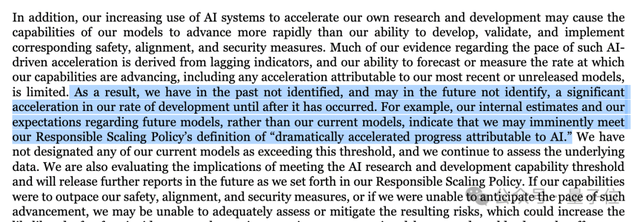
TL;DR - Anthropic reportedly updated its IPO filing to warn that AI-assisted R&D may soon accelerate model progress faster than safety measures can be developed and validated. The disclosure accompanies rapid revenue growth, mounting losses, huge compute commitments, and signs of slowing quarterly growth.

  • Anthropic says its next-generation models may approach its Responsible Scaling Policy threshold for “AI-driven, substantially accelerated progress.”
  • The company cautions that R&D acceleration may be detectable only through lagging indicators, after it has already occurred.
  • Reported Q3 revenue reached about $17 billion, up 1,127% year over year, while net losses totaled $23.29 billion.
  • Quarter-over-quarter revenue growth reportedly slowed to 47%, alongside disclosed compute-purchasing commitments of $895.4 billion.

Transformers Model Integration Contracts

Rank 64 · Content 70 · Popularity N/A

TL;DR - Hugging Face presents “Transformers Model Integration Contracts,” apparently concerning standardized requirements for integrating models into Transformers. Because no article content was provided, its specific design and impact cannot be assessed.

  • The item is an official Hugging Face blog post about Transformers model integration.
  • The title suggests contracts or conventions intended to make integrations more consistent.
  • No technical details, implementation guidance, or reported results are available in the provided content.

Multimodal & Generative 1

Representative image for 要更真实,还是更动人?AI视频生成走到了分岔口 | CNCC 2026

要更真实,还是更动人?AI视频生成走到了分岔口 | CNCC 2026

Rank 71 · Content 80 · Popularity N/A

TL;DR - A CNCC 2026 forum report argues that AI video’s competitive frontier is shifting from visual quality to usable long-form storytelling, emotional impact, physical consistency, and cognitive safety. These challenges increasingly require coordinated agents, unified generation-understanding models, and safeguards across generation and distribution.

  • Current models reliably generate only 15–20 seconds before character drift, audio-visual misalignment, and narrative breaks emerge.
  • Multi-agent workflows improve long-range planning, continuity, and editing; one reported system raised editing-quality scores by up to 17 points.
  • Researchers favor tighter integration of visual understanding and generation to preserve physical and spatial information lost through language-mediated pipelines.
  • As synthetic video becomes more convincing, risks shift toward misinformation, narrative manipulation, and harmful value framing that frame-level content checks cannot detect.

Efficiency & Systems 4

Representative image for 模拟计算进入矩阵时代!北大联手硅谷IBM,写下新定义

模拟计算进入矩阵时代!北大联手硅谷IBM,写下新定义

Rank 82 · Content 95 · Popularity N/A

TL;DR - Peking University, IBM Zurich, and Unconventional AI researchers propose “modern analog computing” as a framework for using resistive-memory hardware to perform matrix operations directly through physical laws. The approach targets faster, more energy-efficient matrix solving for robotics, 6G, and future AI training.

  • Resistive-memory crossbar arrays map values to conductance and use Ohm’s and Kirchhoff’s laws to execute parallel multiply-accumulate operations.
  • Closed-loop analog matrix computing reportedly solves linear systems in under 100 nanoseconds rather than requiring many GPU iterations.
  • Bit-sliced arrays and iterative refinement achieved reported relative errors from 10^-4 to 10^-7, while BlockAMC scaled demonstrations to 512×512 matrices.
  • The hybrid analog-digital architecture is reported to deliver roughly 1,000× single-core throughput and 100× energy efficiency versus an Nvidia H100 at FP32-equivalent accuracy.

Scaling Git at OpenAI

Rank 78 · Content 90 · Popularity N/A

TL;DR - OpenAI introduces Pando, a Git-compatible backend built to support the increased development scale enabled by Codex. The provided excerpt does not include implementation details or measured results.

  • Pando preserves compatibility with Git workflows.
  • It targets repository infrastructure at substantially larger development scale.
  • The system is motivated by growing code-generation activity from Codex.
Representative image for 最高288核的至强6+,为了Agent高密度部署还下了哪些「云功夫」?

最高288核的至强6+,为了Agent高密度部署还下了哪些「云功夫」?

Rank 64 · Content 70 · Popularity N/A

TL;DR - Intel and Tencent Cloud launched Xeon 6+-based cloud instances optimized for high-density AI agent workloads, reporting over 30% higher overall performance than the prior generation. Their co-design targets memory bottlenecks and sandbox startup latency, not just CPU speed.

  • Xeon 6+ offers up to 288 efficiency cores, 12 DDR5-8000 memory channels, and support for over 1,000 concurrently running agents per processor.
  • Hardware-accelerated IAA memory compression cut 2 MB page decompression latency by roughly 16× on average and 9× at maximum versus software LZ4.
  • CubeSandbox combines MicroVMs, snapshots, and resource reuse; kernel optimizations enabled 350 concurrent sandbox creation requests within a 200 ms SLA, about 46% above other tested platforms.
  • Tencent Cloud plans additional instances based on Intel’s next-generation Diamond Rapids processors.
Representative image for 阿里达摩院玄铁 C950 荣获“中国芯”年度重大创新突破产品奖

阿里达摩院玄铁 C950 荣获“中国芯”年度重大创新突破产品奖

Rank 61 · Content 65 · Popularity N/A

TL;DR - Alibaba DAMO Academy’s server-oriented XuanTie C950 RISC-V processor IP won a 2026 “China Chip” innovation award. It advances RISC-V toward competitive server and AI-inference deployments through high single-core performance, native AI acceleration, and ecosystem support.

  • The C950 reaches 3.2 GHz and exceeds 70 points on SPECint2006, reportedly a RISC-V performance record.
  • Native Vector and Matrix engines enable CPU-based inference for several Qwen and DeepSeek models.
  • It supports RVA23.1 extensions, CoVE confidential computing, and multi-core server workloads.
  • XuanTie reports more than 6 billion processor shipments, 400 customers, and 1,000 licensing agreements.

AI Evaluation 1

LifeVal

Rank 61 · Content 65 · Popularity N/A

TL;DR - OpenAI introduced LifeVal, a benchmark evaluating how well AI helps people complete practical everyday tasks. It targets real-world assistance such as finding childcare, managing finances, and handling government paperwork.

  • Measures task completion in everyday-life scenarios.
  • Covers multiple practical domains rather than a single specialized capability.
  • The provided description does not include benchmark methodology, models tested, or results.

AI Peer Review 1

Will AI grant reviews make science more conservative?

Rank 65 · Content 75 · Popularity 43

TL;DR - Nature reports concerns that using AI to evaluate research-grant proposals could favor conventional projects and reduce scientific novelty. The provided excerpt raises the issue but offers no evidence or conclusions.

  • Researchers are questioning AI’s role in research-funding decisions.
  • The central concern is whether automated reviews systematically discourage novel or unconventional proposals.
  • The excerpt does not specify deployed systems, methods, or measured outcomes.

Medical Education 1

Chinese doctoral students in clinical medicine can graduate without a thesis — more degrees to follow

Rank 51 · Content 55 · Popularity 43

TL;DR - China is allowing doctoral students in professional clinical medicine programs to graduate based on a “practical achievement” instead of a thesis. The change signals a shift toward evaluating applied clinical competence, with more degree programs expected to follow.

  • Applies to postgraduate professional medicine degrees.
  • Replaces the traditional thesis requirement with an eligible practical achievement.
  • The provided excerpt does not specify evaluation criteria or implementation details.
Top highlights — Opinions

AI in Education 1

Universities must measure learning, both with and without AI assistance

Rank 62 · Content 70 · Popularity 43

TL;DR - This Nature commentary argues that universities should assess learning both with and without AI assistance. Only the title and publication metadata are provided, so specific recommendations are unavailable.

  • Calls for distinguishing AI-assisted performance from unaided understanding.
  • Implies that assessment frameworks must account for students’ use of AI tools.
  • Highlights learning measurement—not merely task completion—as the central concern.

Animal Testing Alternatives 1

China should share the evidence behind animal-testing alternatives openly

Rank 55 · Content 60 · Popularity 43

TL;DR - A Nature commentary argues that China should openly share evidence supporting alternatives to animal testing. Only the title and publication metadata are provided, so specific methods or findings cannot be assessed.

  • Calls for greater transparency around evidence used to validate non-animal testing approaches.
  • Open evidence could enable independent scrutiny and broader scientific adoption.
  • No technical results, datasets, or validation details are included in the provided content.

Women's Health Research 1

Trump’s executive order on women’s health feels like déjà vu

Rank 58 · Content 65 · Popularity 43

TL;DR - A Nature commentary argues that Trump’s executive order on women’s health risks repeating past US initiatives that failed to deliver promised research improvements. It outlines the need for substantive implementation, although the provided excerpt does not specify its recommendations.

  • Previous US administrations made women’s-health research commitments that fell short.
  • The executive order is assessed in light of this history.
  • Meaningful change will require more than policy promises; specific measures are not included in the excerpt.