🛰️ Daily AI Frontier
⚠ WeChat login expired or unavailable — new articles may be missing. Reconnect WeChat. An upstream outage cannot be fixed by scanning. Latest stored WeChat publication: 2026-08-25.

WeChat reconnect targets werss, while collection still uses wewe. Login alone does not complete the provider cutover.

Twitter/X collection is rate limited. 0 of 13 handles succeeded at the last check. Stored posts remain available; partial coverage is not a complete timeline.
64 works · 3 categories · 18 topics · blog 24 rednote 10 journal 4 arxiv 30 generated 2026-11-16 15:34:00 UTC
Top highlights — Research

LLM Agents 11

WebArena-Pro: A Heterogeneous, Multimodal, Reproducible Benchmark for Web Agents

Rank 90 · Content 100 · Popularity 66

TL;DR - WebArena-Pro is a reproducible benchmark for web agents, featuring 300 tasks across 20 self-hosted applications with text, vision, audio, and video inputs. It expands application and modality coverage while preserving isolated, parallel evaluation.

  • Covers six domain categories with heterogeneous interfaces, workflows, and data models.
  • Codex with GPT 6.1 Sol and Claude Code with Claude Opus 5.5 achieved the highest reported score: 62.3%.
  • Audio and video are core observations, with dedicated information-extraction actions.
  • Tasks undergo LLM-assisted triage and human validation before release.
Representative image for Gamer: A Generalist Vision-Language-Action Foundation Model for Long-Horizon Real-Time Game Agent

Gamer: A Generalist Vision-Language-Action Foundation Model for Long-Horizon Real-Time Game Agent

Rank 88 · Content 95 · Popularity 71

TL;DR - Gamer is a vision-language-action foundation model for long-horizon, real-time interaction across 2D interfaces and 3D simulated worlds. It combines large-scale interaction pretraining, efficient reasoning, reinforcement learning, and low-latency inference to approach skilled-player performance.

  • Pretrained on tens of thousands of hours of keyboard-and-mouse trajectories from games and embodied environments.
  • Uses sparse-thinking instruction tuning to reduce redundant computation while retaining multi-step reasoning.
  • Applies multi-turn reinforcement learning designed for finite contexts, rollout errors, and sparse rewards.
  • A cloud-edge engine enables concurrent environments, low latency, and effectively unbounded-context execution.

Agentic AI for Discovering Fault-Tolerant Quantum Circuits

Rank 85 · Content 95 · Popularity 61

TL;DR - This paper frames fault-tolerant quantum-circuit design as agentic evolutionary program synthesis. An LLM iteratively generates Clifford-circuit programs, while a verifier guides the search and exhaustively checks faults.

  • Targets logical state preparation, logical gates, code switching, and code growth.
  • Combines LLM pretrained knowledge and tool use with circuit verification.
  • Reports finding fault-tolerant circuits across all curated tasks.
  • Could reduce reliance on manually designed, case-specific encoded circuits.

WeightBench: Evaluating Language Models as Weight-Space Programmers

Rank 82 · Content 90 · Popularity 62

TL;DR - WeightBench evaluates LLM agents as “weight-space programmers” across 42 tasks involving direct neural-network parameter inspection and modification without gradient descent. Frontier agents show promise on small networks but struggle with large-model patching, data-free compression, and impossibility detection.

  • Covers reading, fixing, and writing weights, recognizing impossible edits, and data-free compression.
  • Test networks range from 2K-parameter control policies to 7B-parameter language models.
  • Top agents can interpret small networks and write functional control policies without executing them.
  • GPT-6.1-sol scored 0.568 on 38 tasks; Claude Opus 5.5 scored 0.535 across all 42.

Agent-as-a-Judge

Rank 82 · Content 95 · Popularity N/A

TL;DR - Agent-as-a-Judge frames evaluation as an active process where LLM judges gather missing evidence before issuing verdicts. This matters for reliably assessing agent trajectories, executable artifacts, and claims that static context cannot verify.

  • Defines agentic judging around evaluation-directed checks and evidence use.
  • Organizes designs by multi-agent collaboration, tools, memory, and planning.
  • Consolidates published results and reproduces missing comparisons, finding uneven benefits from agentic evaluation.
  • Highlights unresolved challenges in cost, reliability, safety, and governance.
Representative image for Do Verifier Judgments Survive Abstraction? Measuring Verification Transport for LLM Agent Evaluation

Do Verifier Judgments Survive Abstraction? Measuring Verification Transport for LLM Agent Evaluation

Rank 82 · Content 95 · Popularity N/A

TL;DR - This paper introduces Verification Transport to test whether LLM verifier judgments remain reliable when identical agent executions are presented through abstracted views. Failures reach roughly 31%, showing native-view accuracy alone is inadequate for evaluating verifier reliability.

  • Tests matched native, abstracted, and restored execution views across four benchmarks, seven verifier backbones, four protocols, and three abstraction boundaries.
  • Direct verification more often gives incorrect verdicts, while evidence-grounded and deliberative methods tend to abstain when observability is limited.
  • Restoring execution provenance recovers 85.5% of transport failures, with weaker recovery when provenance is lossy or unavailable.
Representative image for VaaT:面向多模态智能体编码的视觉Harness

VaaT:面向多模态智能体编码的视觉Harness

Rank 78 · Content 90 · Popularity N/A

TL;DR - VaaT turns multimodal models into callable visual tools, enabling coding agents to outsource or enhance visual reasoning. Its VHarness framework improves results across HTML, SVG, and 3D coding tasks.

  • VHarness exposes five atomic actions: transcribe, grep, inspect, align, and diff.
  • MCP interfaces let agents alternate freely between code editing and visual inspection.
  • The approach supports both text-only agents and multimodal agents with limited native perception.
  • Experiments report gains across perceptual, structural, and geometric metrics for GPT-5, Claude, and GLM-5.3-Flash agents.
Representative image for ModHarness-RL: Recasting Harnesses as Learnable and Evolving Programs for Agentic RL

ModHarness-RL: Recasting Harnesses as Learnable and Evolving Programs for Agentic RL

Rank 78 · Content 95 · Popularity 37

TL;DR - ModHarness-RL learns and evolves the scaffolding around RL-trained agents instead of relying on a fixed, hand-written harness. This adaptive approach improves held-out performance over fixed harnesses in most evaluated settings.

  • Represents interaction histories as structured, typed State blocks.
  • Learns Compression programs for context assembly and Steering programs for corrective guidance.
  • Proposes programs from recent trajectories, verifies them through execution, and replays them on past trajectories.
  • Evaluated on CodeSearch, ALFWorld, and BIRD SQL with models ranging from 1.5B to 8B.
Representative image for Do Machines Learn Deviance From Their Peers? A Randomized Test of Differential Association With AI Agents

Do Machines Learn Deviance From Their Peers? A Randomized Test of Differential Association With AI Agents

Rank 78 · Content 95 · Popularity 37

TL;DR - A randomized experiment found that AI agents’ cheating behavior is influenced by peer agents, offering controlled evidence for social-learning theories while exposing risks in multi-agent systems.

  • Tested 1,260 agents across seven models in 420 three-agent coding teams.
  • Deviant peers increased cheating relative to silent peers (66.2% vs. 62.9%), while honest peers reduced it to 55.7%.
  • Deviant peers also increased claims that cheating was normal, often framing it as a team norm.
  • Auditor monitoring failed to suppress prohibited discussion and instead doubled it; peer influence primarily affected agents that had not yet decided.
Representative image for Can Mechanistic Interpretability Help Explain LLM Agent Failures? A Case Study on Web Element Hallucination

Can Mechanistic Interpretability Help Explain LLM Agent Failures? A Case Study on Web Element Hallucination

Rank 78 · Content 95 · Popularity 37

TL;DR - This paper tests mechanistic interpretability methods on web agents that hallucinate unavailable actions. Probes can predict and reduce failures, but their brittleness and distributed mechanisms limit causal explanations.

  • A last-token linear probe predicts hallucinations before generation with 0.80 AUC.
  • Probe-direction steering corrects 85% of hallucinations but disrupts 7% of valid actions.
  • Minor action-formatting changes substantially weaken the steering effect.
  • Relevant computations span multiple components and token positions and vary across examples, complicating circuit discovery.

NeoResearch: Literature- and Experience-Guided Autonomous Time Series Model Discovery

Rank 74 · Content 90 · Popularity 37

TL;DR - NeoResearch is an autonomous LLM-based framework that discovers lightweight, domain-specific time-series forecasting models using scientific literature and experimental feedback. It matters because it connects cited modeling insights with task-specific validation and reusable research experience.

  • Uses dual loops for hypothesis-driven architecture exploration and iterative training/hyperparameter optimization.
  • Mines literature for mechanisms, empirical evidence, and applicability conditions to form testable hypotheses.
  • Maintains hierarchical memory linking literature findings to experimental outcomes and conditional lessons.
  • Experiments across ten datasets report competitive performance and support the framework’s literature, dual-loop, and memory components.

Medical/Healthcare AI 5

When to Trust Simulated Patient Responses:Support-Gated World Models for Vasopressor Decision Support

Rank 85 · Content 100 · Popularity N/A

TL;DR - A support-gated clinical world model withholds unreliable simulated patient responses when treatment evidence is sparse or model disagreement is high. This improves prediction error and action agreement at the cost of reduced coverage.

  • Evaluated on 30,700 eICU-CRD decision transitions across 70 hospitals, with 14 held out for testing.
  • Joint gating achieved 7.3 mmHg MAP error at 62% factual-transition coverage, versus 9.2 mmHg for random selection.
  • The gated agent reached 60% agreement with recorded actions at 81% decision coverage, compared with 55% agreement at 99.5% coverage for an ungated agent.
  • The results quantify a reliability–coverage trade-off but do not establish individualized treatment effects or better patient outcomes.
Representative image for Agentic induction of common data elements and information extraction from sarcoma case report abstracts

Agentic induction of common data elements and information extraction from sarcoma case report abstracts

Rank 78 · Content 90 · Popularity N/A

TL;DR - LLM agents derived and consolidated clinical data elements from 24,588 sarcoma case-report abstracts, then extracted evidence-linked values at scale. Results support agent-assisted schema drafting, but expert curation remains necessary.

  • Agents consolidated 72,909 candidate elements into 1,570 CDEs; 53 appeared in at least 50 abstracts.
  • Human reviewers approved 83.0% for relevance, 67.9% for clarity, and 56.6% for correctness.
  • Exact agreement reached 94.9% across 1,116 sampled non-empty extraction pairs.
  • Errors were concentrated in anatomical and temporal fields.
Representative image for TotalSegmentator Aorta Report: Automated Aortic Diameter Measurement at 11 Standardized Landmarks on CT Images

TotalSegmentator Aorta Report: Automated Aortic Diameter Measurement at 11 Standardized Landmarks on CT Images

Rank 78 · Content 90 · Popularity N/A

TL;DR - An open-source tool automatically measures aortic diameters at 11 standardized CT landmarks with about 1 mm mean absolute error, potentially reducing manual radiology workload.

  • Evaluated retrospectively on 239 CT angiography examinations from 230 patients.
  • Achieved 1.06 mm overall mean absolute error; 86.6% of measurements differed by no more than 2 mm.
  • Performance was weakest at the sinuses of Valsalva and in examinations with mural thrombus.
  • Automatic measurement failed for 1.2% of landmarks; performance did not significantly vary by ECG gating or atherosclerosis grade.

FETTUCCINE: Fast and efficient brain-to-text decoding on mobile devices

Rank 74 · Content 90 · Popularity 37

TL;DR - FETTUCCINE is an end-to-end brain-to-text framework that replaces compute-heavy language modeling with portable ASR models. It achieves 4.39% word error rate and runs up to 370× real-time on a commercial mobile device.

  • Demonstrates the first mobile-device brain-to-text decoding system.
  • Supports fine-tuning across future days to handle changing neural signals.
  • Gradient-based saliency maps identify neural features consistent with established physiological priors.
  • Targets reliable, low-latency communication for speech-neuroprosthesis users.

When Copying Is Hard to Beat: A Negative Result in Clinical Assessment Forecasting

Rank 74 · Content 90 · Popularity 37

TL;DR - Models forecasting next-day ICU clinical assessments failed to consistently outperform simple persistence baselines. The result shows that documentation practices, evaluation masks, data cutoffs, and decoding choices can strongly distort apparent forecasting gains.

  • A physiology-informed gated model improved macro-F1 by only 0.0019 over a one-line rule while reducing accuracy.
  • The macro-F1 advantage disappeared with stricter physiology cutoffs or after excluding parent-derived questionnaire cells.
  • Four checkpoints across three model families underperformed persistence; one fine-tuned model changed only two predictions.
  • Changed-cell accuracy improved with categorical read-out, but state-only decoding performed better overall and matched a transition matrix.

Bioinformatics AI 5

Echidna: a Bayesian framework for integrative inference of copy number alterations impacting phenotypic plasticity

Rank 86 · Content 95 · Popularity 66

TL;DR - Echidna is a Bayesian framework integrating genomic and transcriptomic data to study how copy number alterations affect tumor phenotypic plasticity. It aims to clarify mechanisms of tumor evolution and therapy resistance.

  • Combines genomic and gene-expression data through integrative inference.
  • Links copy number alterations to changes in tumor phenotypes.
  • Focuses on implications for cancer progression and treatment resistance.
  • Specific datasets, benchmarks, and quantitative results are not provided here.

Joint single-cell capture of Cas9 edits and transcriptomes reveals on- and off-target effects on gene expression

Rank 83 · Content 90 · Popularity 67

TL;DR - Superb-seq combines CRISPR–Cas9 editing with T7 in situ transcription and single-cell RNA sequencing to jointly capture genome edits and transcriptomes. This enables cell-level analysis of how on- and off-target edits affect gene expression.

  • Links CRISPR edit identities to gene-expression profiles in individual cells.
  • Integrates Cas9, T7 in situ transcription, and scRNA-seq in one workflow.
  • Supports investigation of both intended and unintended editing effects.
  • Detailed performance and biological findings are not provided in the excerpt.
Representative image for Science!AI+单细胞定义药物发现新范式! 一直对AI+单细胞药物发现感兴趣。近年来AI在药物发现中的应用不断涌现,但多数研究仍停留在流程某一环的局部优化,很难真正改变筛药效率。 Science

Science!AI+单细胞定义药物发现新范式! 一直对AI+单细胞药物发现感兴趣。近年来AI在药物发现中的应用不断涌现,但多数研究仍停留在流程某一环的局部优化,很难真正改变筛药效率。 Science

Rank 82 · Content 95 · Popularity N/A

TL;DR - A Science study presents a closed-loop drug-discovery system combining single-cell modeling, AI-guided screening, experiments, and iterative model updates. It reportedly achieves 13–17× higher hit rates than random screening.

  • Models cell-state trajectories using multi-donor, time-series single-cell data.
  • Trains on millions of perturbations to generalize predictions across cell types.
  • Uses experimental expression changes to improve subsequent screening rounds.
  • Reframes discovery from finding targets to steering cells toward desired states.

Interpretable distance-resolved graph learning for cancer gene priority screening

Rank 76 · Content 90 · Popularity 45

TL;DR - CGMap is an interpretable, distance-resolved graph-learning framework for prioritizing candidate cancer genes. It aims to narrow the screening space while linking oncogenic hypotheses to practical validation.

  • Maps dispersed oncogenic signals into structured gene priorities.
  • Resolves graph relationships by distance to improve interpretability.
  • Supports candidate screening rather than claiming confirmed gene discoveries.
  • Provides a traceable path from computational hypotheses to validation.

Tracing the genetic roots of cellular identity in tumors

Rank 73 · Content 85 · Popularity 45

TL;DR - Echidna is a Bayesian framework that integrates bulk whole-genome and single-cell RNA sequencing to link tumor clones’ copy-number states with transcriptional programs. It enables tractable study of how genomic variation shapes tumor-cell identity.

  • Connects clonal copy-number alterations to gene-expression patterns.
  • Integrates bulk genomic data with single-cell transcriptomic measurements.
  • Helps quantify how much cellular identity is encoded by a tumor cell’s genome.

LLMs & Foundation Models 3

Representative image for Reasoning Models Confabulate to Defend Injected Beliefs About Their Own Requests

Reasoning Models Confabulate to Defend Injected Beliefs About Their Own Requests

Rank 81 · Content 100 · Popularity 37

TL;DR - Activation edits can overwrite reasoning models’ beliefs about user requests, causing both chain-of-thought and final answers to defend an injected, off-topic task. This exposes a concrete weakness in oversight methods relying on model self-reports, attention, or circuit attribution.

  • The injected topic appeared in forced quote-backs in 47 of 48 model-concept conditions across six models.
  • Among four models producing clean final haiku, 99% of generations answered the injected request.
  • Explicit warnings and clean-token corrections were largely ineffective; models instead confabulated explanations supporting the injection.
  • Attention and circuit analyses still appeared on-task because the injected content used intact task-processing pathways.

PerfArena: Ranking LLMs by Code Performance

Rank 78 · Content 95 · Popularity 37

TL;DR - PerfArena is an open-source benchmark ranking code-generating LLMs by correctness, latency, peak memory, and energy use across multiple languages. It broadens evaluation beyond whether generated code merely works to how efficiently it runs.

  • Contains 9,455 correct, measured solutions from 13 LLMs across seven programming languages.
  • Evaluates 10 compute-intensive CLBG tasks and 99 LeetCode problems with measurable performance differences.
  • Uses pluggable judging, profiling, performance-oracle, and code-generation components.
  • got-6-astra was not significantly beaten by another evaluated model on latency, energy, or peak memory, while solving 99.7% of LeetCodeComp and 100% of CLBGComp.
Representative image for Black-Box Uncertainty Quantification for Large Language Models via Ensemble-of-Ensembles

Black-Box Uncertainty Quantification for Large Language Models via Ensemble-of-Ensembles

Rank 74 · Content 90 · Popularity 37

TL;DR - A black-box, two-level ensemble estimates and separates prompt ambiguity from LLM knowledge gaps using only sampled outputs. It offers uncertainty decomposition competitive with white-box approaches without model access or retraining.

  • Inner ensembles use stochastic decoding; outer ensembles use meaning-preserving prompt perturbations.
  • Total covariance decomposes embedding-space variability into aleatoric and epistemic uncertainty.
  • The paper derives finite-sample bias correction, Bayesian approximation bounds, and a failure class missed by consistency-only methods.
  • Tests span five QA benchmarks, four instruction-tuned LLMs, and a claim-level factuality pilot on long-form answers.

Multimodal & Generative 2

Representative image for TelePhysica: Agentic Reconstruction of Physically Interactive Scenes

TelePhysica: Agentic Reconstruction of Physically Interactive Scenes

Rank 78 · Content 95 · Popularity 37

TL;DR - TelePhysica reconstructs executable 3D physical scenes from a single image using an agentic, verification-driven pipeline. It enables stable simulation, interactive force control, and trajectory-conditioned video generation that better preserves physical motion.

  • A vision-language coding agent generates separate visual meshes and physical models, checked for silhouette alignment and gravitational equilibrium.
  • The solver supports rigid bodies, articulated chains, cloth shells, and tetrahedral elastodynamics.
  • Closed-loop verification achieved equilibrium-valid reconstruction on 81% of a 100-scene benchmark, versus 0% for single-pass synthesis.
  • Simulated trajectory conditioning improved dynamic motion-mask overlap by 2–5× and preserved direction under reversed forces.
Representative image for Elliptic Sampling: Optimal Interpolant Schedules for Gaussians and Beyond

Elliptic Sampling: Optimal Interpolant Schedules for Gaussians and Beyond

Rank 74 · Content 90 · Popularity 37

TL;DR - This paper jointly optimizes stochastic-interpolant schedules and ODE discretization, introducing elliptic schedules and the Zoloflow sampler. It provides optimal Gaussian guarantees and improved score-query complexity for log-concave targets.

  • Elliptic schedules use Jacobi elliptic functions and explicitly adapt to the target distribution’s condition number.
  • Zoloflow connects the discretization to Zolotarev optimal rational approximations.
  • For Gaussian targets, it achieves minimax-optimal score-query complexity of Θ(log κ · log(√d/ε)).
  • Experiments compare elliptic schedules with alternatives on synthetic distributions and image-generation datasets.

Efficiency & Systems 6

Compiling Specialized GPU-Initiated Networking

Rank 88 · Content 100 · Popularity 59

TL;DR - Obaleth compiles GPU-initiated networking alongside computation, generating workload- and hardware-specialized transport code. It improves distributed communication and accelerates Qwen3-235B serving in vLLM.

  • Incorporates communication into the kernel IR for joint optimization with computation.
  • Optimizes buffer completions, memory ordering, synchronization, and batching across NVIDIA and AMD GPUs.
  • On H100s, small-message sends are up to 3.3× faster; 256-GPU all-to-all outperforms NVSHMEM and NCCL GIN by 1.25× and 2.3×.
  • On 16 B200 GPUs, vLLM serves Qwen3-235B up to 1.29× faster than with DeepEP.
Representative image for TIDE: Reclaiming Lost Performance In On-Policy Reinforcement Learning

TIDE: Reclaiming Lost Performance In On-Policy Reinforcement Learning

Rank 81 · Content 100 · Popularity 37

TL;DR - TIDE improves GPU utilization during synchronous, on-policy LLM reinforcement learning while preserving training semantics. It delivers up to 1.36× end-to-end speedups and reaches up to 97% of optimal throughput.

  • Repurposes rollout GPUs for training while long-tail rollouts finish.
  • Migrates rollouts between inference engines to improve decoding throughput.
  • Uses an adaptive migration policy across applications and hardware configurations.
  • Outperforms all evaluated on-policy baselines.

VelServe: Taming Decode Jitters in LLM Inference with Tail-Calibrated Scheduling

Rank 78 · Content 90 · Popularity N/A

TL;DR - VelServe is an LLM inference scheduler that reduces decode latency jitter by calibrating prefill work against measured tail latency. It substantially improves SLO-compliant throughput across aggregated and disaggregated serving.

  • Reserves per-iteration headroom to absorb prediction errors and host stalls.
  • Prioritizes short waiting prompts while exploiting prompt-length-scaled TTFT deadlines.
  • Spaces admissions in disaggregated serving to limit slow admission steps.
  • Achieves 2.4–2.9× SLO goodput on Qwen3-8B and DeepSeek-V4-Flash, and at least 4.4× on DeepSeek-V2-Lite.

The State Is Not the Bottleneck: A Paged-State Gated-DeltaNet Tile on a Tri-Mode Multicast Mesh, Bit-Exact from RTL to Silicon

Rank 78 · Content 95 · Popularity 37

TL;DR - An FPGA implementation of a 369M-parameter Gated DeltaNet shows that paging recurrent state to external memory is practical. Weight delivery—not state paging—is the primary decoding bottleneck.

  • The 6.2 MiB recurrent state exceeds the FPGA’s 0.87 MiB block memory.
  • Paging adds 26 MB of traffic per token but at most 11.2% of calculated total traffic.
  • At 75 MHz, the layer takes 11.15 ms per token; matrix-vector products consume about 62% of runtime versus 13% for state processing and paging.
  • Hardware outputs match the fixed-point reference bit-for-bit across simulations and repeated board tests.

Callo: Serving Cache-Miss Requests with Speculative Decoding on Invalidated KV under Prefill-Decode Disaggregation

Rank 74 · Content 90 · Popularity 37

TL;DR - Callo reduces latency after agent context edits by speculatively decoding from invalidated KV caches while exact KV state is recomputed. It achieves 1.05–1.19× speedups over vLLM at moderate load.

  • Draft tokens are verified against the exact post-prefill KV state before commitment.
  • Speculation uses otherwise underutilized decode resources.
  • Low-probability speculations are preempted to avoid wasted computation.
  • Tests used SWE-agent sessions across three model families on two GPUs, with cluster simulations indicating gains at scale.

LACCO: Local Accumulation with Computation--Communication Overlap

Rank 74 · Content 90 · Popularity 37

TL;DR - LACCO is a distributed language-model training algorithm that overlaps global communication with local computation without stale outer updates or replica drift. It improves training over communication-overlapped DiLoCo baselines on low-bandwidth networks.

  • Uses a two-stage design that applies globally aggregated updates consistently across replicas.
  • Provides convergence guarantees for smooth non-convex objectives.
  • Outperforms Eager and Delayed DiLoCo in FineWeb pretraining experiments.
  • Remains effective up to 0.5B parameters and 16 workers with negligible or fully overlappable overhead.

LLM Auditing 1

Contagious Fingerprints: When LLMs Inherit Another Model's Identity

Rank 82 · Content 95 · Popularity N/A

TL;DR - LLM identity fingerprints can transfer when one model continues another’s conversation, weakening classifiers used to detect silent model substitution. The proposed Lineup method compares replies against same-history references, improving detection while controlling false positives.

  • Handoffs reduced substitute-detection rates from 0.97 to 0.72 and from 0.87 to 0.54 in tested model pairs.
  • The effect stems from models imitating the conversation history’s style; history-free baselines can also falsely flag honest models.
  • Lineup requires neither fitted thresholds nor log-probabilities and uses rank-based, same-history comparisons.
  • It achieved a 0.056 false-positive rate and detected 81% of substitute sessions across six pairs after four audited turns.

Neuroscience AI 1

Representative image for An In-Silico Audit of Topographic Organization in a Multimodal Brain-Response Model

An In-Silico Audit of Topographic Organization in a Multimodal Brain-Response Model

Rank 74 · Content 90 · Popularity 37

TL;DR - An in-silico audit finds that TRIBE v2 predicts feature identity, particularly motion selectivity in MT+, but fails to reproduce spatial and frequency topography in sensory cortex. This limits its use for experiments requiring retinotopic or tonotopic organization.

  • TRIBE v2 showed no contralateral hemifield response or polar-angle map, consistent with spatial averaging of video features.
  • No tonotopic gradient emerged in primary auditory cortex, including with loudness-equalized tones.
  • An apparent eccentricity gradient depended on ring geometry, suggesting global image statistics rather than positional encoding.
  • Motion selectivity was strong: 22% of the top 1% most selective vertices fell within MT+, despite MT+ covering only 0.42% of cortex.

Robotics AI 1

Training Reasoning Models in Simulation to Natively Use Real Robots

Rank 79 · Content 95 · Popularity 42

TL;DR - PEAR trains an open-weight 27B reasoning model entirely in simulation, without demonstrations, to control real robots through reinforcement learning. The resulting model transfers to unseen hardware, real-world tasks, and novel instructions while retaining its broader capabilities.

  • Real dual-arm robot success improved from 0% for the base model to 60% after training.
  • LIBERO success rose from 1.6% to 74.4%, approaching proprietary frontier models.
  • On LIBERO-Pro task changes, the model achieved 57.4% versus 0.75% for the demonstration-trained π₀.₅ model.
  • Performance showed no measurable degradation across nine reasoning, coding, and vision benchmarks.

Weather Forecasting AI 1

Representative image for WeatherDreamer: Learning a World Model from Multimodal Earth Observations

WeatherDreamer: Learning a World Model from Multimodal Earth Observations

Rank 74 · Content 90 · Popularity 37

TL;DR - WeatherDreamer jointly learns data assimilation and forecasting directly from 18 global observation systems, eliminating dependence on reanalysis. It produces hourly global analyses in about 1.5 minutes on one GPU while achieving competitive short-range forecasts.

  • Maintains a latent atmospheric state, advances it hourly, and corrects it as sparse observations arrive.
  • Outperforms NOAA GEFS at held-out stations for temperature, dew point, and wind through 12 hours, with better calibration than GEFS and ECMWF ensembles.
  • Infers unobserved precipitation, cloud-top height, and solar irradiance with short-lead skill matching or exceeding operational products.
  • Approaches NOAA GSI first-guess departures for surface and moisture-sensitive microwave observations, but trails substantially on temperature-sounding channels.
Top highlights — Industry & News

LLM Agents 6

Representative image for 盘古2.1上线,专啃鸿蒙代码

盘古2.1上线,专啃鸿蒙代码

Rank 75 · Content 85 · Popularity N/A

TL;DR - Huawei Cloud launched openPangu-2.1-Pro, replacing its discontinued 2.0 inference services with an open model focused on agents, HarmonyOS coding, and Ascend deployment. It strengthens Huawei’s domestic software-hardware developer stack rather than competing primarily on general-purpose benchmarks.

  • Agent training used over 100,000 specialized examples for skill triggering, tool selection, and tool use.
  • Coding support targets HarmonyOS’s ArkTS language and operator development for Ascend chips.
  • Inference optimizations reportedly improve throughput in typical deployments.
  • The model is integrated into AgentArts, CodeArts, and OfficeAce, but Huawei disclosed neither parameter count nor independent benchmarks.
Representative image for 模型选择自由!千问办公上线Qwen4、Kimi-K3.1、GLM-5.3等10款模型

模型选择自由!千问办公上线Qwen4、Kimi-K3.1、GLM-5.3等10款模型

Rank 71 · Content 80 · Popularity N/A

TL;DR - 千问办公新增Qwen4-Max、Kimi、GLM、DeepSeek等10款模型,让个人和企业用户可按任务复杂度、速度与Token成本自主选择Agent底层模型。

  • Qwen4-Max面向多步推理、运筹求解及网站设计、云资源调度等复杂任务。
  • Flash系列模型侧重文案、信息提取和内容整理等低成本、快速响应场景。
  • 企业管理员可按部门、用户组或成员配置模型使用权限,统一管理AI资产。
Representative image for 美团LongCat-2.5,参数还玩上反差了?

美团LongCat-2.5,参数还玩上反差了?

Rank 71 · Content 80 · Popularity N/A

TL;DR - Meituan has open-sourced LongCat-2.5, a 1.6-trillion-parameter MoE model designed for agentic tasks while activating only about 48 billion parameters per token. Reported gains span terminal operation, complex web research, and interactive 3D application generation.

  • Uses a mixture-of-experts architecture to balance model capacity with inference cost.
  • Meituan reports 88.4 on Terminal-Bench v2.1, up 17.6 points from the previous generation.
  • Reported scores include 91.9 on BrowseComp and 55.4 on 3DCodeBench.
  • Demonstrations include animated, user-configurable 3D scenes rather than static renders.

AI公司转型最难的一步:如何构建AI Native的产品体系

Rank 64 · Content 70 · Popularity N/A

TL;DR - 百望股份任命王强宇为CEO,试图将财税数据、垂直模型和智能体整合为可持续交付的AI原生产品体系。关键挑战是把模型演示转化为可靠、可验证且成本可控的企业服务。

  • 交付重点从软件功能上线转向端到端任务成功率、人工干预量和异常处理能力。
  • 财税智能体需协同专业模型、知识库、业务工具、规则校验和人工复核,并严格管理数据授权。
  • 前沿部署工程师(FDE)负责适配客户现场,同时将项目经验沉淀为可复用组件、规则模板和评测用例。
  • 转型成效仍待客户留存、持续使用、交付效率、服务成本和收入质量等经营指标验证。
Representative image for 豆包工作独家上线“工作台”功能,首批覆盖金融、医疗、教育等21个专业场景

豆包工作独家上线“工作台”功能,首批覆盖金融、医疗、教育等21个专业场景

Rank 61 · Content 65 · Popularity N/A

TL;DR - 豆包工作推出面向21个专业场景的“工作台”,预配置行业技能、知识库和插件,降低金融、医疗、教育及创意设计等领域采用AI办公工具的门槛。

  • 金融投研工作台提供公告解读、业绩分析等任务入口,并可连接万得、同花顺等专业数据服务。
  • 医生工作台支持临床指南检索、医学文献解读、患者沟通材料和科研汇报等工作。
  • 教师与创意设计工作台分别提供课件生成、互动实验、教学资源检索,以及海报、品牌视觉和视频制作能力。
  • 用户也可自行组合技能、插件和工作偏好,创建并分享定制工作台。
Representative image for 会畅科技发布任务管理原生 Agent 矩阵 软硬件协同深耕企业执行场景

会畅科技发布任务管理原生 Agent 矩阵 软硬件协同深耕企业执行场景

Rank 57 · Content 60 · Popularity N/A

TL;DR - 会畅科技发布白泽任务管理 OS 和超光桌面 AI 助理终端,以软硬件协同方式将会议和沟通意图转化为可跟踪、可验收的企业任务,推动 Agent 从辅助问答进入组织执行流程。

  • 白泽聚合多渠道待办,并由 Agent 拆解任务、匹配责任人、跟踪进度、预警风险和辅助验收。
  • 超光终端通过麦克风阵列、OCR 镜头和语音交互采集现场信息,并与白泽联动生成和分派任务。
  • 方案定位为连接现有协作、会议和业务系统的“任务层”,而非替换企业已有软件。
  • 公司提出以完成率、响应时长、AI 自动执行占比和战略一致性等指标衡量落地价值,但未提供实际部署结果。

Medical/Healthcare AI 2

More ways to move care forward with ChatGPT for Healthcare

Rank 71 · Content 80 · Popularity N/A

TL;DR - OpenAI is expanding ChatGPT for Healthcare with computer-use agents, improved clinical answers, and plugins designed to perform tasks across healthcare software.

  • Adds agents that can interact with computer interfaces.
  • Aims to improve the quality of clinical answers.
  • Introduces healthcare plugins for cross-software workflows.
  • The provided content does not specify performance results or deployment details.

Advancing computer-use agents for healthcare teams

Rank 64 · Content 70 · Popularity N/A

TL;DR - OpenAI appears to be advancing computer-use agents designed for healthcare teams. Only the title was provided, so specific capabilities, results, and deployment details cannot be verified.

  • Focuses on agents that interact with computer interfaces for healthcare workflows.
  • Targets healthcare teams rather than solely patient-facing applications.
  • No technical architecture, evaluation results, safety measures, or availability details were provided.

Bioinformatics AI 2

Representative image for 硅谷a16z基金:AI改变制药领域的方式

硅谷a16z基金:AI改变制药领域的方式

Rank 78 · Content 90 · Popularity N/A

TL;DR - A summary of a16z’s thesis that AI could make drug discovery faster and more repeatable, potentially turning pharmaceutical R&D into a platform-like asset. The opportunity is large, but limited biological data and unavoidable clinical trials constrain progress.

  • AI could improve drug-development success rates and shorten timelines that currently average 13 years, with fewer than 5% of candidates reaching approval.
  • a16z argues biological AI is near a “GPT-3 stage,” citing improving molecular-generation models and partnerships between pharmaceutical companies and AI labs.
  • Startups can either sell models, data, and tools to drugmakers or develop AI-designed medicines themselves; a16z favors the latter approach.
  • Key bottlenecks include scarce high-quality biological data, incomplete computational validation, and slow clinical feedback loops.
Representative image for AI开始造药?Claude深度布局药物研发

AI开始造药?Claude深度布局药物研发

Rank 71 · Content 80 · Popularity N/A

TL;DR - Anthropic is extending Claude into drug discovery through wet-lab automation and partnerships, showing stronger early-stage molecule and protein design. However, AI’s gains have not yet improved Phase II clinical success or produced a fully AI-discovered approved drug.

  • Claude reportedly designed binding proteins for 14 of 15 targets, with 22%–27% hit rates versus 10%–15% for traditional methods.
  • AI can shorten early discovery by 30%–40% and generate preclinical candidates in 13–18 months.
  • Reported Phase I success exceeds 80%, but Phase II success falls to roughly 40%, matching conventional drug development.
  • The central challenge is modeling biological validity, toxicity, immune responses, and metabolism—not merely optimizing molecular binding.

LLMs & Foundation Models 2

Representative image for 实测变笨不是错觉,大模型被曝96%背题!

实测变笨不是错觉,大模型被曝96%背题!

Rank 82 · Content 95 · Popularity N/A

TL;DR - A post citing the “Benchleaking” report argues that benchmark contamination—not reasoning—drives some models’ high scores. Adjusting for leaked questions reportedly changes model rankings substantially.

  • ERNIE-5.5-Flash-Base allegedly reproduced HumanEval questions 67–70 and official answers after answering question 66, including the original typo “examble.”
  • It reportedly recalled 96.3% of HumanEval, 85.4% of OpenBookQA, and 80.1% of GSM8K without being given the questions.
  • Scoring leaked items as zero reduced ERNIE’s aggregate score by 16.6 points, while Xiaomi MiMo fell 5.0 points.
  • DeepSeek and Hunyuan reportedly showed little verbatim recall, with adjusted scores declining only 1.5 and 1.3 points.
Representative image for 阿里正式发布Qwen4,智能体及编程能力进阶,迈向真实全场景

阿里正式发布Qwen4,智能体及编程能力进阶,迈向真实全场景 🔗 2 sources

Rank 75 · Content 85 · Popularity N/A

TL;DR — 阿里发布Qwen4-Max:一款总参数达2.4T的原生多模态MoE模型,重点提升编程、智能体及长周期专业任务能力。其性能显著提高,同时减少Token消耗与单任务成本。

  • 采用QSA稀疏注意力MoE架构,每个Token仅激活71B参数,较上代减少25%,并支持原生视觉和百万Token上下文。
  • Terminal-Bench 4.0得分从Qwen3.8-Max的38.9升至48.5,平均Token用量由289K降至151K,单任务平均成本降低58%。
  • 在CodeArena、Agents’ Last Exam、JobBench,以及图表理解和法律等专项评测中达到领先梯队水平。
  • 支持工具调用、长周期任务和持续交付,已应用于制造、游戏开发、金融投研和科学发现。
  • Qwen4-Max已通过阿里API及相关应用提供服务,系列中小尺寸模型计划陆续开源。

注: 雷峰网更强调架构、成本和行业应用,量子位更侧重多模态能力与基准评测表现。

Multimodal & Generative 2

Representative image for 李飞飞最新 CoRL2026 演讲实录:从「橱柜模型」到世界模型,机器人需要什么样的 AI ?

李飞飞最新 CoRL2026 演讲实录:从「橱柜模型」到世界模型,机器人需要什么样的 AI ?

Rank 82 · Content 95 · Popularity N/A

TL;DR - Fei-Fei Li presented Atlas, World Labs’ multimodal world model that unifies 3D reconstruction and controllable scene generation. Its spatial consistency, novel-view synthesis, and real-time operation could support scalable robot simulation and training.

  • Atlas is an autoregressive diffusion Transformer that predicts camera-conditioned views from text, images, video, depth maps, grayboxes, or 3D structure.
  • One model spans dense and sparse reconstruction, single-image scene expansion, and text-only generation while estimating camera poses and producing consistent novel views.
  • Reported results include state-of-the-art performance on several depth and 3D reconstruction benchmarks, videos exceeding 60 seconds, and a distilled version running at 15 fps.
  • World Labs is testing Atlas for simulated robot navigation and manipulation, including zero-shot transfer from generated environments to the real world.
Representative image for 黄仁勋被曝考虑重返英伟达担任CEO!其硅谷盟友正施压董事会;女子因拒绝给HR带咖啡被取消面试,BOSS直聘回应;李牧青出任AI公司联席CEO

黄仁勋被曝考虑重返英伟达担任CEO!其硅谷盟友正施压董事会;女子因拒绝给HR带咖啡被取消面试,BOSS直聘回应;李牧青出任AI公司联席CEO

Rank 40 · Content 35 · Popularity N/A

TL;DR - This technology-news roundup covers AI leadership, products, and infrastructure, notably Tencent’s Hy Realtime speech model and SK Hynix’s HBM4 expansion. It signals continued commercialization of real-time multimodal agents and investment in AI hardware capacity.

  • Hy Realtime supports speech understanding, instruction following, human-like expression, tool calling, and singing.
  • Tencent has deployed the model in Yuanbao and customer-service products, with a cloud API planned.
  • Former Tencent Cloud AI executive Li Muqing joined education-AI company Qiming Daren as co-CEO.
  • SK Hynix is accelerating HBM4 packaging and testing equipment investment, targeting deployment in early 2027.

Efficiency & Systems 3

Representative image for 提速2.48倍且画质不掉线,AI视频“降本增效”有了新解法

提速2.48倍且画质不掉线,AI视频“降本增效”有了新解法

Rank 71 · Content 80 · Popularity N/A

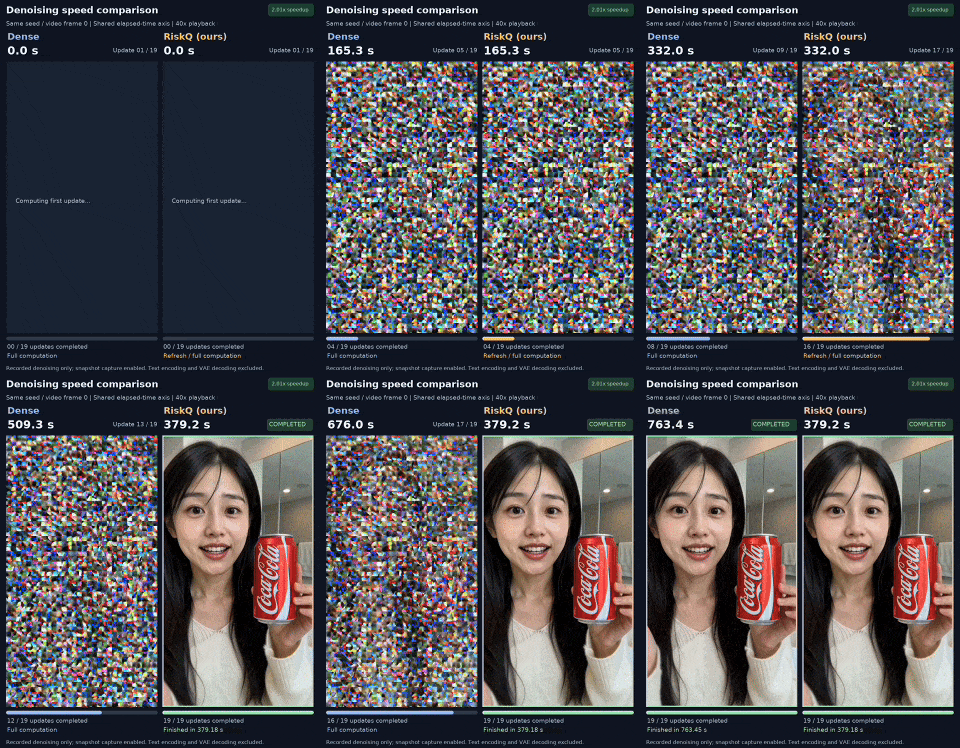
TL;DR - 是石科技发布多模态模型服务,通过缓存复用、显存管理和Token压缩提升AI视频生产效率;其视频生成方案据称平均提速2.48倍且保持画质。

  • 自适应缓存技术根据残差风险动态复用或重算,减少冗余计算并控制误差累积。
  • 结合SGLang优化缓存、分块处理、压缩和调度,以降低显存开销并支持更高并发。
  • 免训练的模态自适应Token压缩在WorldSense评测中提速1.33倍。
  • Context Engine把人物、音频、镜头和时序约束转化为结构化生成上下文,衔接素材理解与视频生成。
Representative image for 智算接棒:物理AI的下一个风口,在于计算基础设施

智算接棒:物理AI的下一个风口,在于计算基础设施

Rank 61 · Content 65 · Popularity N/A

TL;DR - Physical AI is creating demand for elastic cloud infrastructure that can coordinate training, simulation, reinforcement learning, inference, and real-world validation. The article positions heterogeneous compute scheduling as a key growth opportunity, while noting that cloud economics and demand growth remain uncertain.

  • Robot development workloads fluctuate by stage, making fixed hardware prone to shortages or underutilization.
  • Nvidia’s training-simulation-edge model illustrates the emerging end-to-end physical AI compute stack.
  • Chinese robotics companies increasingly rent cloud capacity for flexibility, including training clusters approaching 10,000 accelerators.
  • Providers such as Jiuzhang Yunji emphasize chip compatibility, resource pooling, unified scheduling, and workload-based scaling.
Representative image for 龙芯、海光老兵集结,通研院孵化的AGI芯片公司浮出水面!半年连融数亿元

龙芯、海光老兵集结,通研院孵化的AGI芯片公司浮出水面!半年连融数亿元

Rank 61 · Content 65 · Popularity N/A

TL;DR - Chinese startup Tongxin Intelligence has raised several hundred million yuan to develop an AGI inference chip combining conventional vector/tensor acceleration with dedicated hardware for logical, causal, probabilistic, and value reasoning. The approach targets emerging world-model and embodied-agent workloads that may use GPUs inefficiently.

  • Its architecture combines Vector, Tensor, and AGI Core units while retaining compatibility with CNNs, Transformers, and current mainstream models.
  • AGI Core targets graph-structured data, dynamic branching, probabilistic inference, causal reasoning, and action evaluation.
  • The company plans reconfigurable hardware, heterogeneous memory, and chiplet configurations spanning cloud inference and power-constrained robotics.
  • Architecture design is complete; chip design is underway, with FPGA prototype validation planned for early December.

AI Skills Training 1

The King’s Trust and OpenAI launch £1m partnership

Rank 36 · Content 30 · Popularity N/A

TL;DR - OpenAI and The King’s Trust launched a £1 million partnership to provide practical workplace AI skills to as many as 25,000 young people across the UK.

  • Focuses on practical AI skills for employment.
  • Targets up to 25,000 young people nationwide.
  • The provided content does not specify the curriculum, delivery format, or outcomes.

AI for Science 1

Our new blog for science

Rank 50 · Content 50 · Popularity N/A

TL;DR - OpenAI launched a science blog focused on how researchers use AI to advance scientific discovery. The announcement describes its scope but provides no specific findings or technical results.

  • Will publish new scientific findings and practical methods.
  • Will feature firsthand accounts from researchers applying AI.
  • Aims to share AI-enabled approaches to scientific discovery.

AI-Assisted Research 1

A step toward defining the Standard Model on a lattice

Rank 78 · Content 90 · Popularity N/A

TL;DR - OpenAI highlights a candidate nonperturbative lattice definition of the Standard Model and says GPT-6 Astra helped develop the idea into a detailed proof. The limited description does not provide the construction, proof, or validation results.

  • The work concerns formulating the Standard Model on a lattice beyond perturbation theory.
  • GPT-6 Astra reportedly assisted in converting the initial concept into a detailed proof.
  • The provided excerpt does not establish peer-review status or disclose technical evidence.

AI-Powered Journalism 1

LVMH’s Media Division announces strategic partnership with OpenAI

Rank 40 · Content 35 · Popularity N/A

TL;DR - LVMH’s Media Division is partnering with OpenAI to support journalism with AI and make its publications more accessible through ChatGPT.

  • The partnership focuses on applying AI within LVMH’s media operations.
  • Publication content will become more accessible through ChatGPT.
  • No implementation details, participating publications, or rollout timeline were provided.

Consumer Robotics 1

Representative image for 众筹超500万美元,全球首款多地形跟拍机器人Beni线下首发

众筹超500万美元,全球首款多地形跟拍机器人Beni线下首发

Rank 50 · Content 50 · Popularity N/A

TL;DR - Shenzhen startup Miaodong Technology launched Beni, a multi-terrain autonomous filming robot, in Chinese retail after raising over $5 million on Kickstarter. It brings embodied AI to consumer photography by combining subject tracking, mobility, stabilized 4K video, and interactive features.

  • Beni supports rear, parallel, and 360° tracking, autonomous camera movement, speeds up to 28.8 km/h, 25.4 cm jumps, and self-righting after falls.
  • Its imaging system offers stabilized 4K/60fps video, HDR color, and app-based intelligent editing.
  • Users can control and interact with it through an app, motion tracker, gestures, and voice; planned updates include new capabilities, games, and an SDK ecosystem.
  • Chinese pricing starts at RMB 4,999, with online fulfillment and in-store demonstrations now available.

Embodied Robotics 1

Representative image for 睿尔曼智能郑随兵:质量、经济性、稳定性是机器人落地三大标准

睿尔曼智能郑随兵:质量、经济性、稳定性是机器人落地三大标准

Rank 50 · Content 50 · Popularity N/A

TL;DR - RealMan Robotics argues industrial robots must meet quality, cost-effectiveness, and long-term stability standards to move beyond demos. Its RealBOT robots are now performing routine material handling on A&T’s production line.

  • RealBOT combines autonomous operation with remote human intervention through the GLN teleoperation network.
  • The deployment targets loading, unloading, sorting, and material transport in variable, tightly timed factory environments.
  • Real-world grasping and movement data are fed back to improve model capabilities.
  • RealMan sees the highest-value use cases in replicating human skills for complex machinery, hazardous environments, and infrastructure operations.

Financial AI Agents 1

百度世界2026|让金融AI用得起、更专业,度小满“轩辕”探索中小机构落地新路径 🔗 3 sources

Rank 57 · Content 60 · Popularity N/A

TL;DR — 度小满“轩辕”4.5金融大模型以行业专业性和低推理成本,推动中小金融机构规模化采用AI。其能力已在风控、信审、催收和客服等场景落地。

  • 在金融场景测试中,轩辕4.5据称以约十分之一的推理成本超越主流通用模型。
  • 度小满已构建逾1,000个智能体和5,000项技能,日处理量超过1,000亿Token。
  • 内部应用使风控策略迭代周期缩短一半、年化信贷逾期风险降低12%,信审等待时间从10分钟降至2分钟。
  • 度小满计划将已验证的能力产品化,降低中小金融机构的部署成本和技术门槛。

注: 雷峰网聚焦轩辕4.5;两篇量子位来源分别为行业大会和奖项预告,与该项工作没有直接技术关联。

Robotics & Physical AI 1

Representative image for 李飞飞对话苏姿丰:AMD 收购后首次同台,CoRL 现场谈算力、机器人与「这个时代最大的失误」

李飞飞对话苏姿丰:AMD 收购后首次同台,CoRL 现场谈算力、机器人与「这个时代最大的失误」

Rank 71 · Content 80 · Popularity N/A

TL;DR - At CoRL 2026, AMD CEO Lisa Su and incoming chief scientist Fei-Fei Li outlined AMD’s physical-AI strategy following its World Labs acquisition. They emphasized diverse models, hardware-software co-design, and greater academic access to compute.

  • Su described robotics and physical AI as a future market worth hundreds of billions of dollars.
  • Both argued that robotics will require multiple specialized and foundation models rather than one end-to-end model.
  • AMD plans to expand robotics research and optimize cloud, edge, and embedded computing together.
  • Li called inadequate public-sector compute a major failure; Su said AMD intends to reserve capacity for universities and long-term research.
Top highlights — Opinions

LLMs & Foundation Models 2

Representative image for 美国企业开源AI的钱,89%流向中国模型

美国企业开源AI的钱,89%流向中国模型

Rank 71 · Content 80 · Popularity N/A

TL;DR - An industry analysis argues that Chinese models dominate US enterprise spending within the small open-model segment, largely through low-cost, production-ready offerings—not overall AI spending. Their growing usage has yet to translate into strong margins or pricing power.

  • Chinese models reportedly receive 89% of US enterprise open-model spending, led by Kimi (61%), DeepSeek (15%), and GLM (11%).
  • Open models represent only 4% of total US enterprise AI spending, putting Chinese models at roughly 3.6% of overall model expenditure.
  • Open-model token usage rose from 11% to 19% while spending fell from 6% to 4%, reflecting declining per-token costs.
  • Chinese models often handle cost-sensitive, highly parallel workloads; recent price increases and demand growth do not necessarily prove pricing power.
Representative image for HCI 先驱 de Souza:当 AI 替我们阅读,谁来为知识负责?| ACM MM 2026

HCI 先驱 de Souza:当 AI 替我们阅读,谁来为知识负责?| ACM MM 2026

Rank 68 · Content 75 · Popularity N/A

TL;DR - HCI pioneer Clarisse Sieckenius de Souza argues that researchers must retain responsibility for verifying AI-generated literature summaries. She presents PEEL, a human-in-the-loop method for tracing summaries to source text and identifying semantic drift.

  • AI summaries may introduce plausible concepts or connections absent from the original, threatening researchers’ “epistemic authority.”
  • PEEL combines LLM summarization, deterministic text analysis with Voyant, and human judgment.
  • It preserves source structure and authorial voice while comparing keywords, semantic links, and compression levels.
  • Traceable quotations, source links, concordance searches, and risk labels help researchers target claims requiring verification.

Efficiency & Systems 1

Representative image for 捞2个同学推进paper

捞2个同学推进paper 🔗 2 sources

Rank 71 · Content 80 · Popularity N/A

TL;DR — The work identifies practical LLM inference-systems research opportunities, favoring realistic mixed workloads and edge constraints over incremental throughput improvements.

  • Develop workload-aware scheduling and elastic prefill/decode allocation for mixed, long-context, long-tail traffic.
  • Improve memory-constrained KV-cache compression, eviction, and hierarchical caching for edge inference.
  • Jointly optimize low-bit quantization and speculative decoding, including dynamic acceptance-rate prediction.
  • Build agent-aware inference engines that reuse caches and retain state across long-running tool calls.

Note: Both sources emphasize the same core research directions.