🛰️ Daily AI Frontier
⚠ WeChat login expired or unavailable — new articles may be missing. Reconnect WeChat. An upstream outage cannot be fixed by scanning. Latest stored WeChat publication: 2026-08-25.

WeChat reconnect targets werss, while collection still uses wewe. Login alone does not complete the provider cutover.

Twitter/X collection is rate limited. 0 of 13 handles succeeded at the last check. Stored posts remain available; partial coverage is not a complete timeline.
49 works · 3 categories · 18 topics · rednote 10 blog 12 journal 8 arxiv 15 generated 2026-11-17 15:39:13 UTC
Top highlights — Research

LLM Agents 6

Representative image for System 1 agents: a method for local, reliable and fast agentic AI

System 1 agents: a method for local, reliable and fast agentic AI

Rank 89 · Content 100 · Popularity 64

TL;DR - System 1 agents use deterministic compilation and a one-pass decision model to call local tools without generating text, reducing privacy and hallucination risks. Across biomedical-tool requests, they outperformed tested local LLM-agent configurations while eliminating invented call content.

  • Selected or declined tools correctly on 97.0% of 1,952 requests across 157 tools.
  • Correctly filled 97.0% of 6,056 explicitly stated argument values.
  • Produced no invented content, versus 5.5–19.7% of local LLM calls.
  • The framework is available as open-source software.
Representative image for Sage S2.1 Flash Technical Report

Sage S2.1 Flash Technical Report

Rank 84 · Content 90 · Popularity 70

TL;DR - Sage S1.5 Flash is a 320B-parameter mixture-of-experts model combining scientific multimodal reasoning with verifiable agent capabilities. It shows strong performance on document, spreadsheet, machine-learning, desktop, and browser tasks.

  • Uses specialized encoders for molecular graphs, biological sequences, and spectra alongside text and images.
  • Trains agent skills in verifiable environments for tool use, search, coding, and scientific workflows.
  • Ranks first on OfficeQA Pro, MLE-bench Lite, Harvey LAB, and SpreadsheetBench 2 among five baselines.
  • Achieves second place on OSWorld-Verified, WebArena-Verified, and DeepResearch Bench II.

Procedure without Judgment: What Small Language Models Learn under an Exact Verifier

Rank 82 · Content 95 · Popularity N/A

TL;DR - Exact verification helps small language models learn reliable procedures for explaining blocked tool calls, but those procedures generalize poorly. A 4B model achieved 92% accuracy on its training policy yet often failed to produce minimal explanations on unseen policies.

  • Frontier models found exact minimal reasons roughly half the time; a simple instruction to shrink answers raised Haiku 4.5 from 58% to 75%.
  • Algorithm-generated training traces consistently outperformed frontier-model traces at matched data sizes.
  • On three unseen public policies, the 4B model retained 94% sufficiency but only 48% minimality, suggesting it learned a fixed checking schedule rather than transferable judgment.
  • Exact-reward reinforcement learning did not improve held-out accuracy and shifted behavior toward exhaustive sufficiency checks instead of policy probing.
Representative image for When Tool Names Are Not Identities: Measuring Provider Misbinding in MCP-Based AI Agents

When Tool Names Are Not Identities: Measuring Provider Misbinding in MCP-Based AI Agents

Rank 81 · Content 100 · Popularity 37

TL;DR - This paper identifies tool-provider misbinding in MCP-based agents, where attacker-controlled tools can be selected instead of an intended legitimate provider. It matters because tool metadata alone does not reliably establish provider identity.

  • Tests across five LLM-based clients found provider-binding weaknesses without compromising hosts, servers, models, or network channels.
  • Exact-name collisions were most effective when combined with task-aligned descriptions and compatible schemas.
  • Authority-signaling descriptions and compatible schemas could trigger misbinding or ambiguity even without name collisions.
  • Clients exhibited failures through attacker-controlled selection, clarification requests, and inconsistent provider resolution.

SciResearch-Eval: Evaluating Scientific Judgment in Autonomous Experimental Agents

Rank 81 · Content 100 · Popularity 37

TL;DR - SciResearch-Eval tests whether autonomous agents can design experiments and remain statistically calibrated when given flawed scientific simulators. Most models were confidently wrong under missing physics, while stronger models mitigated errors through better experiment design or substantially more reasoning.

  • The benchmark covers 93 held-out tasks, nine models, and 2,511 episodes involving thermal-property estimation with 95% intervals.
  • Under flawed physics, most models achieved only 20–62% interval coverage, versus 94% for GPT-6 Astra and 99% for Claude Fable 5.2.
  • Astra and Fable often selected gentle-heating experiments where the flawed simulator remained accurate, rather than merely diagnosing its defect.
  • Maximum reasoning effort improved Claude 5.5 Opus more than tenfold, but required 13–31× more reasoning; older and open-weight models did not improve.
Representative image for NDSS'27:让大模型智能体指挥模糊测试

NDSS'27:让大模型智能体指挥模糊测试

Rank 78 · Content 90 · Popularity N/A

TL;DR - AHFUZZ uses an LLM agent to actively coordinate fuzzing and symbolic execution based on global testing progress. It reports substantially higher branch coverage and finds 13 previously unknown vulnerabilities.

  • Tracks repository state, cumulative coverage, and seed mappings through summaries and on-demand tools.
  • Sets semantic testing goals, reflects on prior rounds, and redirects effort when returns diminish.
  • Assigns complex constraint clusters to symbolic execution and local exploration to AFL++ fuzzing.
  • Exceeded six baselines’ branch coverage in 7.93 hours on average, with 84%–166% gains; 9 of 13 vulnerabilities were confirmed or fixed.

Medical/Healthcare AI 2

Representative image for Open-fMIND: A Large-Scale Open-Access fMRI Corpus for Pretraining Brain Foundation Models

Open-fMIND: A Large-Scale Open-Access fMRI Corpus for Pretraining Brain Foundation Models

Rank 88 · Content 100 · Popularity 60

TL;DR - Open-fMIND is an open, uniformly processed fMRI corpus designed to support self-supervised pretraining of brain foundation models. Its scale and standardization help overcome fragmented access to neuroimaging data.

  • Aggregates 322 OpenNeuro studies covering 11,379 subjects and 45,731 functional runs.
  • Uses fMRIPrep and 52 atlases across 14 families to produce 2.4 million parcellated timeseries.
  • Includes denoised and quasi-raw outputs, connectivity matrices, confounds, provenance, and motion metadata.
  • Pretraining achieves downstream performance comparable to training with UK Biobank data.

InclusionMed: Benchmarking AI for Inclusive Healthcare

Rank 88 · Content 95 · Popularity 71

TL;DR - InclusionMed is an open initiative for evaluating medical AI across healthcare roles and capabilities. Its results show that frontier LLM performance varies substantially by clinical context, reinforcing the need for broader benchmarks and task-specific model selection.

  • The initial Atlas includes five benchmarks covering three of nine planned role–capability combinations.
  • Frontier LLMs scored 17.5–49.1 out of 100, with rankings shifting across roles and capabilities.
  • The ten highest-ranked models performed better on patient communication than clinical decision-making.
  • Similarly scoring models differed substantially in estimated inference cost.

Bioinformatics AI 1

Secrets of the vampires: genomes reveal how these bats live off blood alone

Rank 59 · Content 65 · Popularity 45

TL;DR - Genomic research helps explain how vampire bats survive exclusively on blood. Adaptations include expandable stomachs and fluid-handling genes that may enable rapid processing of large liquid meals before flight.

  • Vampire bats can greatly expand their stomachs to consume substantial volumes of blood.
  • Genomic findings identify fluid-handling genes associated with managing the resulting liquid load.
  • These adaptations help the bats process blood efficiently enough to fly home after feeding.

LLMs & Foundation Models 3

Optimistic Verifiers Get Hacked: Reward Hacking Under an Exact Process Oracle

Rank 85 · Content 100 · Popularity N/A

TL;DR - This paper uses exact process-level reward oracles to measure reward hacking under degraded verifiers. It finds that optimistic verifiers encourage models to exploit false-positive gaps, while verifier audits can predict failure modes before training.

  • Tested seven verifier degradations across 124,416 authorization-policy contexts.
  • Sufficiency-based rewards were hacked through padding: proxy reward reached 0.940 while held-out faithfulness fell from 0.731 to 0.667.
  • Outcome-only verifiers saturated, noise weakened learning signals, and ranking-preserving verifier gaps caused no harm.
  • The qualitative failure patterns replicated across multiple frameworks, model vendors, adapter sizes, precisions, initializations, and seeds, though damage magnitude did not.
Representative image for The Price of Choosing Examples: Context Overfitting in Adaptive In-Context Learning

The Price of Choosing Examples: Context Overfitting in Adaptive In-Context Learning

Rank 81 · Content 100 · Popularity 37

TL;DR - This paper formalizes context overfitting caused by adaptively selecting in-context examples and derives generalization guarantees based on how much information prompt construction extracts from the data store.

  • Proves a finite-sample generalization bound of order $\sqrt{\kappa/k}$ for context capacity $\kappa$ and $k$ selected examples, plus a matching lower bound.
  • Introduces two PAC-Bayesian retrieval rules: a first-order Gibbs rule and a self-normalized second-order rule.
  • On Banking77, certificates held across 24,000 resampled selection events and frequently certified lower risk than zero-shot prompting.
  • Shows that relevant or longer contexts help reliably only when their selection process is sufficiently stable.

Anytime-Valid PAC-Bayes Certificates for Adaptive Test-Time Scaling

Rank 81 · Content 100 · Popularity 37

TL;DR - This paper introduces time-uniform PAC-Bayes certificates for reliably reporting risk and compute after adaptively selecting test-time scaling strategies. It prevents misleadingly optimistic validation bounds caused by repeatedly tuning inference recipes on the same calibration data.

  • The certificate covers all calibration times, posterior mixtures, and data-dependent stopping rules.
  • Finite searches over budgets and verifiers incur a generally unavoidable (\log M/n) penalty.
  • Self-consistency improves exponentially only when the correct answer is the generator’s unique mode; otherwise, extra sampling can amplify errors.
  • Audits on GSM8K and MATH-500 show conventional selected-best error bars can under-cover, while the proposed certificate remains valid.

Multimodal & Generative 6

Representative image for BLIP-Live: Balancing Timeliness & Firing Precision in Proactive Streaming Video Agents

BLIP-Live: Balancing Timeliness & Firing Precision in Proactive Streaming Video Agents

Rank 90 · Content 100 · Popularity 65

TL;DR - BLIP-Live is a framework for proactive streaming-video agents that balances fast responses against premature or excessive firing. Its Qwen-based model achieves state-of-the-art results across four benchmarks, improving over baselines by up to 44%.

  • Introduces BLIP-Live-780K, with human annotations for both response content and timing.
  • Proposes PAUC-F, combining response timeliness with firing precision.
  • Sliding visual windows, online interaction memory, and structured outputs consistently perform best.
  • The framework supports both model-agnostic inference harnesses for offline VLMs and dedicated training pipelines.

ViRA: Toward Ultra-High-Resolution Visual Agents via Cross-Input Relative Policy Optimization

Rank 89 · Content 100 · Popularity 62

TL;DR - ViRA introduces CrossRPO, an RL method that trains visual agents to inspect evidence in ultra-high-resolution images rather than guess from prior knowledge. It improves contrast-set accuracy over GRPO using only about 3,500 training items per model.

  • CrossRPO rewards correctly solving entire contrast sets whose images differ only in a small evidence-bearing region.
  • ViRA-Train and ViRA-Bench cover edited images from 21–120 megapixels; ViRA-Bench-Real uses photographed changes to avoid editing artifacts.
  • CrossRPO reaches 63.3% set accuracy at maximum resolution versus 59.3% for GRPO.
  • ViRA-9B leads comparable open models, while ViRA-27B reportedly outperforms Claude Haiku 5.5 and GPT-6-Luna on most tested benchmarks.
Representative image for MovieRoll: A Systematic Framework for Rolling Out Long-Form Videos

MovieRoll: A Systematic Framework for Rolling Out Long-Form Videos

Rank 83 · Content 90 · Popularity 66

TL;DR - MovieRoll is a framework for generating long-form streaming video beyond its training horizon while controlling quality degradation and memory costs. Its distilled model leads compared methods on HeliosBench for videos up to 60 seconds.

  • Window-wise teacher forcing builds a robust multi-step base model using causal history and bidirectional within-window attention.
  • Hierarchical KV-cache compression cuts cache memory by up to 78% while improving generation quality.
  • Long-rollout distribution-matching distillation efficiently trains a few-step generator using gradients aggregated across temporal positions.
  • KV recomputation and guidance annealing stabilize generation beyond the training horizon.
Representative image for 智源悟界·PhysCapBench:首个跨领域的世界模型“物理数据量尺”

智源悟界·PhysCapBench:首个跨领域的世界模型“物理数据量尺”

Rank 79 · Content 90 · Popularity 55

TL;DR - PhysCapBench is a 1,500-video cross-domain benchmark for evaluating how accurately captions preserve physical dynamics. It links physically grounded descriptions to improved video generation and robot policy learning.

  • Covers third-person scenes, egocentric manipulation, and handheld-gripper demonstrations, with 500 sequences per domain.
  • Evaluates captions across seven dimensions covering motion, contact, interactions, state changes, and temporal structure.
  • Physical captions reduced video reconstruction perceptual differences by up to 30.88% on LPIPS and 28.09% on PVCS.
  • Enhanced training instructions raised π0.5’s RoboTwin 2.0 success rate from 37.5% to 45.0% in a controlled experiment.

Seen but Unsaid: Locating and Repairing Cross-Image Comparison in Vision-Language Models

Rank 78 · Content 95 · Popularity 37

TL;DR - Vision-language models often encode cross-image correspondences but fail to propagate or read them out correctly. Fine-tuning only key attention heads’ query/key projections—about 0.02% of parameters—substantially repairs this failure.

  • Probes outperformed calibrated outputs by 15–25 points, indicating that exact-match answers exist internally but are not decoded.
  • Semantic correspondences remain in visual tokens without reaching the answer layer.
  • Just 16–32 attention heads carry critical cross-image comparison signals across several VLM families.
  • Targeted tuning improved SPair-71k accuracy by 28.3 points for Qwen3-VL-8B and 25.1 points for InternVL3.5-8B, with transfer to HPatches and BLINK.
Representative image for ACM MM|给大模型装上“捕捉小动作”的眼睛

ACM MM|给大模型装上“捕捉小动作”的眼睛

Rank 71 · Content 80 · Popularity N/A

TL;DR - GMoT enhances multimodal LLMs’ sensitivity to subtle, short-lived gestures in video through motion-aware tokenization and gated feature fusion. It matters because conventional models often over-rely on static appearance and miss fine-grained motion cues.

  • Frame differences generate motion heatmaps, enabling fine-grained encoding only in motion-salient regions.
  • Separate static-appearance and motion-token branches are adaptively combined through a gating mechanism.
  • Semi-supervised human-region annotations and reward-guided optimization align reasoning with the action’s spatial location.
  • The plug-in module can augment existing multimodal LLMs without pretraining them from scratch.

Efficiency & Systems 1

CertiSum: Bitwise-Identical MXFP4 Training Across Platforms and Parallelism Layouts

Rank 81 · Content 100 · Popularity 37

TL;DR - CertiSum enables bitwise-identical MXFP4 training across GPU vendors and parallelism layouts by certifying exact native accumulation and selectively recomputing uncertain results. This improves reproducibility and auditability while retaining potential speedups over deterministic BF16.

  • Preserved Qwen3-8B training states exactly across AMD MI350X, NVIDIA GB200, and multiple parallelism configurations.
  • Keeps quantization blocks layout-invariant and merges partial sums without rounding, including for attention and weight gradients.
  • Added 11.8–60.5% step latency versus non-exact MXFP4 at larger tested input sizes.
  • Reached up to 1.24× BF16 and 1.70× deterministic-BF16 speedups.

Genomics 1

Genetic variant that reshaped the human brain was inherited from Neanderthals

Rank 66 · Content 75 · Popularity 45

TL;DR - A Neanderthal-derived genetic variant is linked to smaller brain regions and might reduce schizophrenia risk. The provided excerpt does not specify the variant, affected regions, or evidence.

  • The variant entered modern humans through Neanderthal ancestry.
  • It might influence the size of parts of the human brain.
  • It could have a protective association with schizophrenia.
  • Detailed methods and effect sizes are not provided.

Neuroscience 1

The world’s most precious brain samples — and what they teach us about being human

Rank 55 · Content 60 · Popularity 45

TL;DR - This Nature article examines rare living-human brain samples used to study how neurons behave in their native environment. The provided excerpt does not report specific findings.

  • Living tissue can reveal neuronal behavior under more natural conditions than standard laboratory models.
  • Such samples are exceptionally scarce and require highly precise handling.
  • The work aims to improve understanding of distinctly human brain function.

Recommender Systems 1

Representative image for 【人大×阿里】生成式推荐推理优化新框架

【人大×阿里】生成式推荐推理优化新框架

Rank 71 · Content 85 · Popularity 39

TL;DR - GainReason optimizes reasoning in generative recommendation by rewarding each sentence according to how much it improves the target item’s likelihood. It reports average gains of 5.0% over the strongest baseline and 5.2% from enabling reasoning across public datasets.

  • Predictive Gain measures sentence-level changes in the target SID’s log-likelihood, providing continuous credit assignment.
  • PGRO trains models to produce prediction-helpful reasoning; PGRU trains them to use that reasoning during prediction.
  • Custom causal attention computes gains for every reasoning prefix in one forward pass.
  • Training adds about 1% per-step cost versus rule-based GRPO; sentence-level PG adds 4.8% overhead over passage-level PG.

Structural Biology 1

Architecture of a portal complex embedded in the poxvirus core

Rank 62 · Content 70 · Popularity 45

TL;DR - A Nature paper reports the architecture of a portal complex embedded within the poxvirus core. The provided excerpt contains only bibliographic details, so its specific structural findings and biological implications cannot be assessed.

  • Published online in Nature on 16 November 2026.
  • Focuses on a protein complex associated with poxvirus core architecture.
  • The title suggests a structural characterization, but no methods, resolution, composition, or functional results are provided.
Top highlights — Industry & News

LLM Agents 7

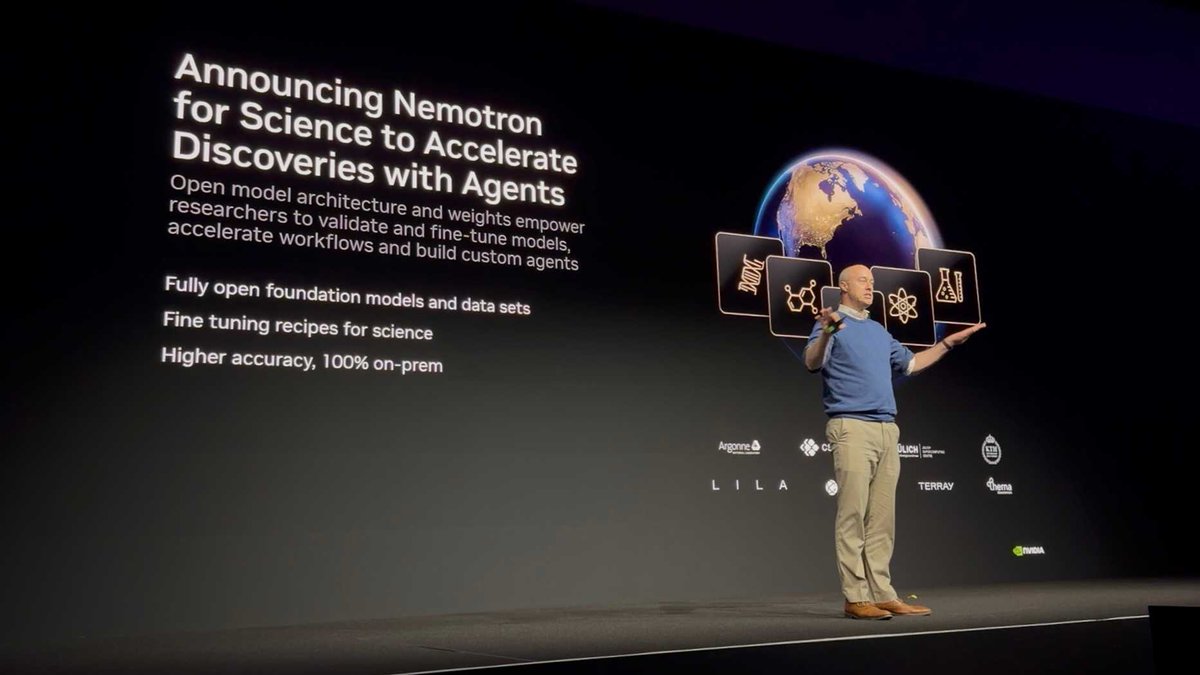
Representative image for Introducing NVIDIA Nemotron for Science, just announced at #SC26 by Ian Buck, our VP of Hyperscale…

Introducing NVIDIA Nemotron for Science, just announced at #SC26 by Ian Buck, our VP of Hyperscale…

Rank 78 · Content 90 · Popularity N/A

TL;DR - NVIDIA announced Nemotron for Science, a collection of open models, datasets, tools, and post-training recipes for building more accurate and efficient scientific AI agents.

  • Supports agents that plan tasks, run simulations, verify results, and iteratively adjust.
  • Packages multiple development resources rather than a single model.
  • Targets scientific research workflows and high-performance computing.
  • The announcement provides no benchmarks or specific performance results.
Representative image for RT by @huggingface: Announcing harness adapters for @Alibaba_Qwen Qwen3.8-27B on Pi harness! We're…

RT by @huggingface: Announcing harness adapters for @Alibaba_Qwen Qwen3.8-27B on Pi harness! We're…

Rank 75 · Content 85 · Popularity N/A

TL;DR - Hugging Face announced a harness-specific LoRA adapter that improves Qwen3.8-27B’s performance and efficiency as an agent within the Pi harness.

  • SWE-Bench Pro Hard-51 pass@1 reportedly rises from 29% to 63%.
  • Terminal-Bench 2.1 pass@1 improves from 40% to 56%.
  • The adapted model uses 55–62% fewer tool calls per task.
  • Additional harness-specific adapters are planned.
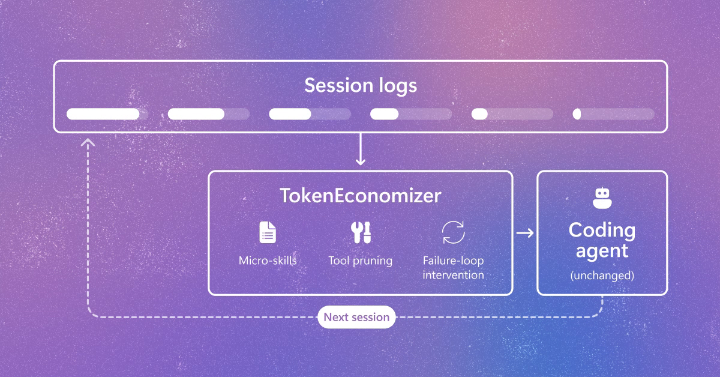
Representative image for AI coding agents can waste time and tokens relearning the same lessons. TokenEconomizer builds on…

AI coding agents can waste time and tokens relearning the same lessons. TokenEconomizer builds on…

Rank 71 · Content 80 · Popularity N/A

TL;DR - Microsoft Research released TokenEconomizer, an open-source GitHub plugin that helps coding agents reuse lessons from past sessions to reduce token and computation costs while preserving task success.

  • Targets repeated problem-solving across coding-agent sessions.
  • Uses prior-session experience to make future computation more efficient.
  • Aims to lower costs without sacrificing task completion.
  • The provided content does not specify implementation details or quantitative results.

闲鱼亮相联合国气候变化大会:AI加速闲置流转,低碳融入日常 🔗 2 sources

Rank 57 · Content 60 · Popularity N/A

TL;DR — 闲鱼借助千问大模型和平台交易数据部署买卖双方 AI Agent,降低二手商品及非标准服务的交易门槛,推动循环经济与日常减碳。

  • AI 覆盖商品发布、搜索和交易管理,可识别商品、补充成色与配件信息,并提供价格参考。
  • 买方 Agent 将用途、预算等自然语言需求转化为搜索条件,辅助筛选商品和询问细节。
  • AI 还用于撮合维修、设计、陪诊和 AI 编程等服务;过去一年服务订单增长 87%,其中 AI 相关服务订单增长 157%。
  • 闲鱼称,用户在 2026 财年通过闲置交易与回收避免约 1,278 万吨碳排放。

注: Abit 摘要涉及 INFevo 的科研发现与自动化实验平台,与本工作主题明显不符,故未合并。

Representative image for 阿里云连续六年香港IaaS第一,企业客户AI渗透率达95%

阿里云连续六年香港IaaS第一,企业客户AI渗透率达95%

Rank 57 · Content 60 · Popularity N/A

TL;DR - Alibaba Cloud announced expanded enterprise AI offerings in Hong Kong, where it says over 95% of its enterprise customers now use AI services. The update highlights agent tooling, privacy controls, and deployments across insurance, government, media, and education.

  • New capabilities include AgentCore for AI agent development and management, AI-BAS for security testing, and Zero Data Retention for privacy protection.
  • Prudential’s AI underwriting system reportedly exceeds 95% accuracy and moved from concept to production in under three months.
  • An English-learning platform using Qwen reduced analysis, lesson design, and grading for 10 students from 25–35 hours to about 10 minutes.
  • Alibaba Cloud also introduced Qwen4-Max and announced AI training plans targeting 30,000 Hong Kong youths over two to three years.

谁来帮助企业走向「智能组织」?

Rank 57 · Content 60 · Popularity N/A

TL;DR - Baidu Intelligent Cloud unveiled a full-stack AI cloud and partner alliance aimed at helping enterprises restructure workflows around agents rather than merely adopting standalone AI tools. The strategy targets measurable business gains by connecting agents with corporate data, systems, tools, and permissions.

  • Baidu offers general-purpose, specialized, and customizable agents for office work, software development, quality inspection, marketing, and proprietary workflows.
  • Upgraded Qianfan Agent Infra supports bursty agent workloads with million-scale concurrency and rapid sandbox startup; Baige AI Infra strengthens large-scale reinforcement learning and heterogeneous compute support.
  • Baidu’s partner alliance provides FDE training, reusable agent infrastructure, certification, sales channels, and implementation opportunities to address deployment and go-to-market gaps.
  • One cited customer connected three agents to ERP, OA, and enterprise messaging, reducing over 100 weekly staff-hours to less than two person-hours and projecting quarterly profit gains of several million yuan.

独家丨腾讯优图实验室研究总监孙星离职

Rank 50 · Content 50 · Popularity N/A

TL;DR - Tencent Youtu Lab research director Sun Xing has departed after nearly a decade. His work spanned medical imaging AI and, more recently, multimodal models, agents, and RAG.

  • Sun joined Tencent Youtu Lab in 2016 after earning a PhD from the University of Hong Kong.
  • His early research included lung cancer detection and diabetic retinopathy screening for Tencent Miying.
  • He later led or contributed to Video-MME, VITA, Youtu-VL, Youtu-Agent, and Youtu-GraphRAG.
  • His next position has not been disclosed.

Bioinformatics AI 1

Representative image for Google DeepMind 发布新一代基因组模型!

Google DeepMind 发布新一代基因组模型!

Rank 82 · Content 95 · Popularity N/A

TL;DR - Google DeepMind’s AlphaGenome 2 models how DNA variants affect gene regulation across specific cell types and states, improving detection and interpretation of disease-relevant noncoding variants.

  • Trained on over 107 million single-cell profiles spanning 68 human and mouse tissues.
  • On TenK10K immune-cell data, causal-variant identification rose from 16% to 30%, while effect-direction accuracy increased from 23% to 43%.
  • It can generalize to unseen single-cell data from only dozens of cells and infer unmeasured properties such as chromatin accessibility.
  • Precomputed resources include enhancer–gene maps for 640 cell conditions and effect scores for roughly 6.8 million variants across 510 human cell and tissue contexts.

LLMs & Foundation Models 3

Representative image for 华为openPangu-2.1-Pro,国产大模型添新玩家

华为openPangu-2.1-Pro,国产大模型添新玩家

Rank 71 · Content 80 · Popularity N/A

TL;DR - Huawei Cloud launched openPangu-2.1-Pro, emphasizing agentic tool use, ecosystem-specific coding, and cheaper long-context inference. Full benchmark results, model weights, and a technical report have not yet been published.

  • Trained on over 100,000 specialized examples for skill triggering, tool selection, function calling, and complex-task planning.
  • Optimized for HarmonyOS ArkTS generation, app development, and Ascend operator generation.
  • Supports a 512K context window, deep reasoning, function calling, and prefix caching.
  • Output pricing is listed at RMB 3.2 per million tokens—about 78% below the previous generation’s short-input tier.

Broadening access to AI for scientists

Rank 54 · Content 55 · Popularity N/A

TL;DR - OpenAI is expanding its ChatGPT for Academic Researchers program, giving 200,000 researchers worldwide free access to its frontier models. This broadens access to advanced AI tools for academic research.

  • The initiative targets academic researchers globally.
  • Participants receive free access to OpenAI’s frontier models.
  • The provided announcement does not specify eligibility, model availability, or technical results.

Hugging Face and OpenRouter join forces to make open-weight models easy to run

Rank 50 · Content 50 · Popularity N/A

TL;DR - Hugging Face and OpenRouter announced a collaboration intended to simplify running open-weight models. Only the title is available, so implementation details and capabilities cannot be verified.

  • The collaboration connects two prominent open-model ecosystem platforms.
  • Its stated goal is easier access to and execution of open-weight models.
  • No technical architecture, supported models, pricing, or performance results were provided.

Multimodal & Generative 1

Representative image for 🔥重磅!美团正式发布并开源 LongCat-Video-Avatar 1.6 !仅一张图+一段音频即可生成超10分钟稳定数字人! 开源数字人赛道再被美团 LongCat 团队抬高门槛,1.6 版重点解

🔥重磅!美团正式发布并开源 LongCat-Video-Avatar 1.6 !仅一张图+一段音频即可生成超10分钟稳定数字人! 开源数字人赛道再被美团 LongCat 团队抬高门槛,1.6 版重点解

Rank 71 · Content 80 · Popularity N/A

TL;DR - Meituan released LongCat-Video-Avatar 1.6, an MIT-licensed model that generates stable talking-avatar videos exceeding 10 minutes from an image and audio. It targets long-video degradation while improving lip-sync, motion quality, and deployment efficiency.

  • Supports single- and multi-person generation, audio/text-to-video, image-plus-audio, and video continuation.
  • Reduces autoregressive error accumulation to better preserve identity, facial shape, and body structure.
  • Ranked second in a 33,051-vote arena evaluation with an Elo score of 1068.1, behind OmniHuman-2.0.
  • Offers task-specific LoRA, optional INT8 DiT quantization, and an eight-step fast inference path.

Efficiency & Systems 4

Representative image for Congrats @thinkymachines team on Inkling 2 Small! A 594B model pretrained in just 68 hours with…

Congrats @thinkymachines team on Inkling 2 Small! A 594B model pretrained in just 68 hours with…

Rank 78 · Content 90 · Popularity N/A

TL;DR - Thinking Machines trained the 594B-parameter Inkling 2 Small in 68 hours using NVIDIA NVFP4 hardware, maintaining a native 4-bit forward pass throughout pretraining and reinforcement learning. This demonstrates low-precision training at unusually large scale while targeting faster computation and lower memory use.

  • Ran on NVIDIA GB300 NVL72 racks using the NVFP4 format.
  • Used 4-bit computation from the first pretraining step through the final RL rollout.
  • The main technical challenge was controlling quantization error that could disrupt learning.
  • Thinking Machines published implementation details on making end-to-end low-precision training work at scale.
Representative image for Vera Rubin 推理优化结算画面!

Vera Rubin 推理优化结算画面!

Rank 75 · Content 85 · Popularity N/A

TL;DR - vLLM reported early DeepSeek V4.1 Flash inference results on NVIDIA Vera Rubin NVL72, showing substantially higher per-chip throughput than GB300 on the AgentX benchmark, especially at high interactive generation speeds.

  • At 400 tokens/s per user, Rubin delivered 63.4× GB300’s per-chip aggregate throughput; at 600 tokens/s, the gap reached 93.3×.
  • GB300 throughput reportedly degraded faster as interactive generation speed increased.
  • Optimizations included rewritten kernels and decode paths plus rack-wide GPU sharing of the KV cache.
  • The vLLM team is using AI agents to help optimize its inference code.
Representative image for RT by @huggingface: Export, quantize and run end-to-end every transformers model, on any backend…

RT by @huggingface: Export, quantize and run end-to-end every transformers model, on any backend…

Rank 71 · Content 80 · Popularity N/A

TL;DR - Hugging Face announced tooling to export, quantize, and run Transformers models across different backends through a consistent, drop-in interface.

  • Aims to preserve the same inputs and outputs across supported backends.
  • Combines model export, quantization, and end-to-end execution.
  • The post links documentation, release notes, and a demonstration video.
  • Specific backend coverage and performance results are not provided here.
Representative image for OVH 发布首个自研模型 Olala

OVH 发布首个自研模型 Olala

Rank 71 · Content 80 · Popularity N/A

TL;DR - OVH announced Olala, its first in-house open-weight model family, starting with a sparse 7B model designed for low-cost inference. It highlights Europe’s push toward locally trained, efficient AI models, though performance claims remain unverified.

  • Olala mini 7A1B has 7B parameters but activates roughly 1B, with a 32K-token context window.
  • OVH claims it runs on 8GB GPUs at up to 160 tokens/second on an RTX A4500, or about 50 tokens/second on CPUs.
  • Planned Apache 2.0 distribution includes weights, the base model, and compliance documentation.
  • Qwant reports 20% faster answers and one-third the previous operating cost; 128K context and a 100B-plus model are future plans.

AI Safety 1

Our first phase of embedded assessments

Rank 75 · Content 85 · Popularity N/A

TL;DR - OpenAI is launching the first phase of an embedded assessment program with independent evaluators to examine model alignment, safeguards, and monitoring systems.

  • Partners include Apollo Research, METR, Transluce, and Goodfire.
  • Evaluators will assess models and safety mechanisms from within OpenAI’s development process.
  • The provided content announces the initiative but does not report assessment methods or results.

AI for Science 1

Science at the Frontier: How scientists use ChatGPT

Rank 61 · Content 65 · Popularity N/A

TL;DR - OpenAI reports on how more than 1,800 scientists use ChatGPT in research, focusing on daily workflows, perceived productivity, and expectations for scientific discovery.

  • Examines ChatGPT adoption across scientists’ routine research activities.
  • Covers self-reported productivity effects rather than independently validated gains.
  • Discusses researchers’ expectations for AI’s future role in discovery.
  • The provided excerpt does not include quantitative findings or methodological details.

Climate AI 1

Can AI actually help the climate? Nations want to harness the technology to cut emissions

Rank 52 · Content 55 · Popularity 45

TL;DR - Nations are pledging to use AI to accelerate clean-energy adoption and reduce emissions. The article stresses that AI’s actual climate benefits remain unproven.

  • Governments see AI as a tool for speeding clean-energy deployment.
  • The stated goal is to use AI-driven improvements to help cut emissions.
  • The provided summary offers no technical methods or measured outcomes.
  • Evidence is still needed to establish whether these initiatives deliver net climate benefits.

Cybersecurity AI 1

Strengthening NATO and allied cyber defenses with AI

Rank 50 · Content 50 · Popularity N/A

TL;DR - OpenAI is collaborating with NATO and allied cyber agencies to apply AI to defensive cybersecurity. The effort focuses on helping trusted defenders identify vulnerabilities, validate fixes, and protect critical systems.

  • Targets vulnerability discovery in essential infrastructure.
  • Supports testing and validation of security fixes.
  • Details on specific models, methods, and results are not provided.

Enterprise AI 1

How Revolut raises ambition without lowering the bar

Rank 50 · Content 50 · Popularity N/A

TL;DR - OpenAI highlights Revolut’s use of its models and Codex to accelerate software development and scale financial-crime investigations while maintaining security standards.

  • Revolut reports a 30–60% reduction in coding time.
  • OpenAI models help scale financial-crime investigation workflows.
  • The deployment emphasizes innovation without weakening security controls.

Gene Editing 1

Chinese scientist sacked after child died in gene-editing trial

Rank 62 · Content 70 · Popularity 45

TL;DR - A Chinese scientist was dismissed after a child died during a gene-editing trial. Nature reports that participating institutions and other researchers were also reprimanded, but the provided excerpt lacks technical details.

  • The incident involved an experimental gene-editing trial in China.
  • A child participant died, prompting disciplinary action against the lead scientist.
  • Institutions and additional researchers involved were reprimanded.
  • The excerpt does not identify the editing method, target condition, or cause of death.
Top highlights — Opinions

LLM Agents 1

“BAT 做 Personal Agent,我没那么乐观”

Rank 64 · Content 70 · Popularity N/A

TL;DR - The article argues that Chinese tech giants may struggle to build compelling personal agents despite their vast ecosystems. Internal ownership conflicts, scarce compute, restricted service interfaces, business-model risks, and privacy concerns could outweigh their distribution advantages.

  • ByteDance, Alibaba, and Tencent differ on whether personal agents should live in existing chatbot products, dedicated apps, or super-app ecosystems.
  • Persistent, long-running agents demand substantially more compute than chatbots and must compete with model training, coding agents, and enterprise AI products.
  • Cross-app execution depends on business units sharing APIs, data, payments, and user access despite incentives to protect their own vertical agents and traffic.
  • Aggressive agent behavior could undermine advertising revenue, product simplicity, privacy, and user trust—especially within WeChat.

Multimodal & Generative 1

Representative image for 多模态大模型长描述对齐,找合作者

多模态大模型长描述对齐,找合作者

Rank 71 · Content 80 · Popularity N/A

TL;DR - A researcher highlights how multimodal models lose visual grounding during long-form generation despite strong short-VQA scores, and seeks collaborators on mitigation and evaluation methods.

  • Autoregressive generation increasingly favors language priors, causing hallucinations and progressive image-description drift.
  • Proposed work periodically reinjects visual evidence through sentence-level grounded decoding.
  • Other explored approaches include attention calibration and fine-grained DPO feedback targeting hallucinated sentences.
  • Evaluation would track sentence-level grounding and hallucination rates over generation length rather than rely on short-answer metrics.

Artificial Life 1

Should we move from artificial intelligence to artificial life?

Rank 48 · Content 50 · Popularity 45

TL;DR - This Nature item appears to question whether AI research should shift toward artificial-life approaches. Only the title and publication metadata are provided, so its arguments and conclusions cannot be assessed.

  • Frames artificial life as a possible alternative or extension to artificial intelligence.
  • Likely concerns broader life-like properties rather than intelligence alone, but no technical details are available.
  • No methods, evidence, results, or concrete recommendations are included in the supplied content.

Wearable AI Ethics 1

AI wearables could exploit people’s most vulnerable moments

Rank 55 · Content 60 · Popularity 42

TL;DR - This Nature item warns that AI-enabled wearables could exploit users during vulnerable moments. Only the title and publication metadata are provided, so specific evidence or recommendations cannot be assessed.

  • Focuses on ethical risks from always-on, personalized wearable AI.
  • Highlights potential exploitation when users are emotionally or physically vulnerable.
  • No technical methods, empirical findings, or policy proposals are included in the supplied content.