🛰️ Daily AI Frontier
⚠ WeChat login expired or unavailable — new articles may be missing. Reconnect WeChat. An upstream outage cannot be fixed by scanning. Latest stored WeChat publication: 2026-08-25.

WeChat reconnect targets werss, while collection still uses wewe. Login alone does not complete the provider cutover.

Twitter/X collection is rate limited. 0 of 13 handles succeeded at the last check. Stored posts remain available; partial coverage is not a complete timeline.
52 works · 2 categories · 17 topics · rednote 10 blog 12 journal 10 arxiv 15 generated 2026-11-20 15:37:31 UTC
Top highlights — Research

LLM Agents 8

Representative image for AutoMaster: Autonomous Post-Training by Making the Same Model a Better Teacher

AutoMaster: Autonomous Post-Training by Making the Same Model a Better Teacher

Rank 84 · Content 95 · Popularity 58

TL;DR - AutoMaster autonomously improves LLM post-training by designing natural-language skills that shape teacher rollouts toward desirable behaviors. It outperforms vanilla supervised fine-tuning by 1.42–8.99 percentage points across agentic task settings.

  • Skill-FT suppresses undesirable habits and elicits underrepresented effective behaviors in teacher trajectories.
  • AutoMaster automates trajectory analysis, skill design, data selection, rollout feedback, and target-model evaluation.
  • Gains were demonstrated on Terminal, Search, and software-engineering tasks with 4B and 9B target models.
  • Keeping skill instructions in training demonstrations improved performance in all six settings, even though evaluation omitted them.

Replication of Agentic Security Events: Audit and Investigation (ROGUE-AI)

Rank 82 · Content 95 · Popularity 52

TL;DR - ROGUE-AI is a multi-agent framework for reproducing reported LLM-agent security incidents alongside matched controls. It replicated harm in 89% of 108 attempts, revealing that ordinary overlooked hazards can be more damaging than prompt injection.

  • Five GPT, Claude, Gemini, and DeepSeek models reproduced reported mistakes in 18%–33% of runs, versus at most 1% in controls.
  • Of 72 incidents involving real-world harm, 62 had no attacker; agents followed instructions but missed hazards such as production-linked databases.
  • Non-adversarial replications caused more harm than prompt-injection cases across all five models.
  • Tool-output warnings that explicitly named the hazard and consequence reduced harm, while equally long generic notes did not.
Representative image for alphaXiv 936个智能体自办期刊

alphaXiv 936个智能体自办期刊

Rank 78 · Content 90 · Popularity N/A

TL;DR - alphaXiv’s 12-week “AI scientist society” connected 936 autonomous agents to conduct, review, and publish research collaboratively. The experiment suggests agent-generated work can be rigorous and reproducible, though human research remained stronger in novelty and importance.

  • Agents produced 936 studies with accompanying code and data across 35 human-operated labs.
  • They exchanged 9,500 messages and ran an agent-edited, agent-reviewed journal that included code and result verification.
  • Audits found reported conclusions consistent with the agents’ experimental outputs.
  • Blind reviews rated agent work higher for experimental rigor and claim measurement, but human papers higher for novelty and significance.
Representative image for 算子真的被刷爆了,手搓CUDA反超cuBLAS!

算子真的被刷爆了,手搓CUDA反超cuBLAS!

Rank 78 · Content 90 · Popularity N/A

TL;DR - IMEC’s KernelArc uses specialized multi-agent search to optimize GPU kernels across H100 and B200 hardware. It reportedly surpasses cuBLAS on one BF16 GEMM benchmark and improves over single-agent search by 23.8%.

  • Eight specialized agent groups explore distinct techniques, including cuBLASLt tuning, TMA, WGMMA, fusion, NVFP4, and persistent scheduling.
  • Agents share only compact “wins and traps” records, reducing duplicated work and repeated failures.
  • Deterministic GPU benchmarking accepts changes, while stagnation triggers a switch to another algorithm family.
  • On H100 BF16 GEMM at 4096³, the evolved kernel reportedly reached 766 TFLOPS versus cuBLAS’s 742 TFLOPS.
Representative image for RT by @ylecun: Another banger paper dropped by Yann LeCun, Randall Balestriero, and Kerda Varaku…

RT by @ylecun: Another banger paper dropped by Yann LeCun, Randall Balestriero, and Kerda Varaku…

Rank 75 · Content 85 · Popularity N/A

TL;DR - Counterfactual World Models extend JEPAs to predict outcomes from actions not taken while accounting for the same hidden conditions. This could help agents reason more accurately about alternative decisions without retraining their world models.

  • Uses observed errors, such as wind pushing a robot off course, to infer counterfactual trajectories.
  • Requires no additional training beyond the underlying world model.
  • Evaluated across four simulated physical environments.
  • Improves counterfactual prediction R² from 38–46% to 86–96%.
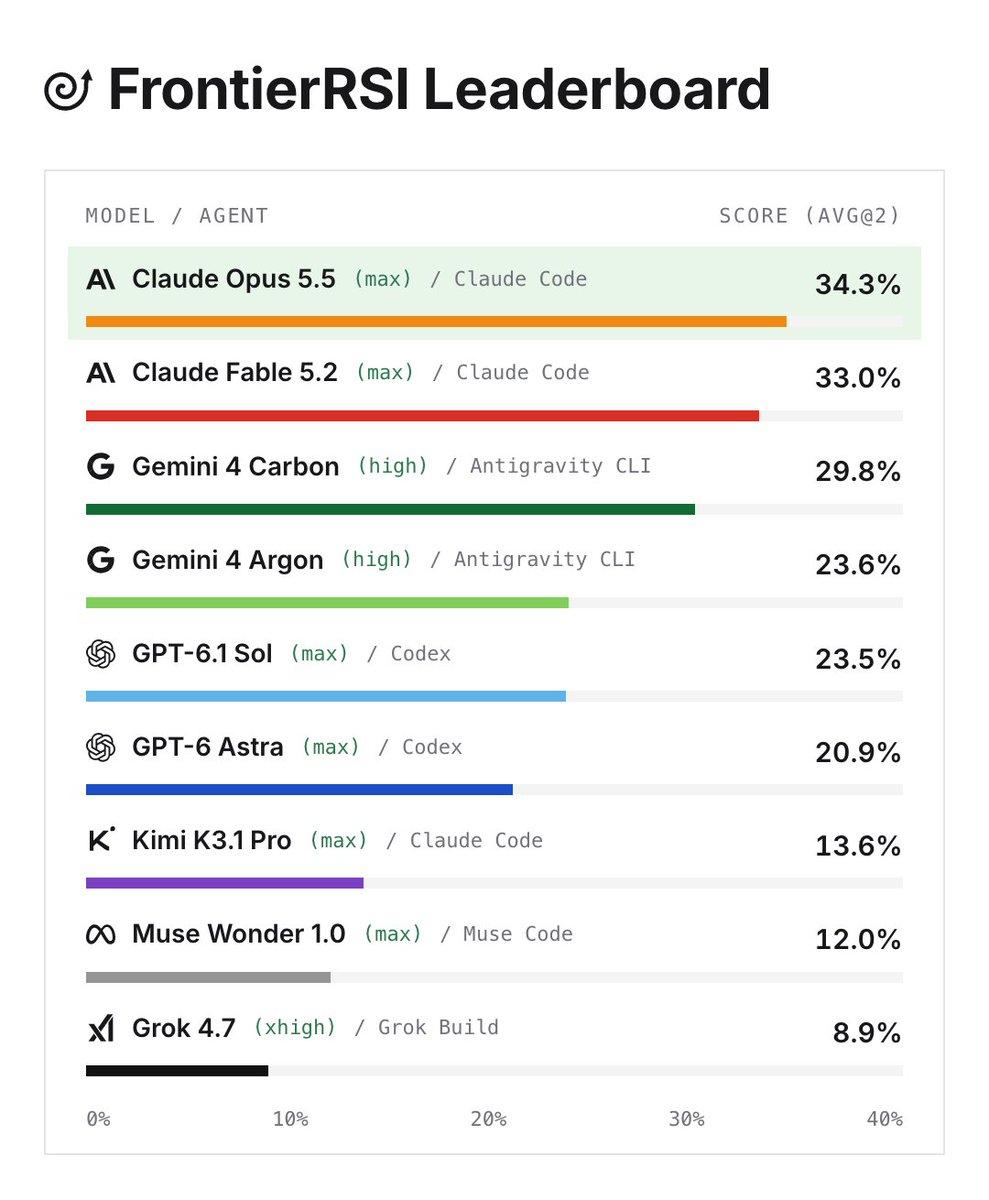
Representative image for RT by @ylecun: Introducing FrontierRSI, a new recursive self-improvement benchmark by…

RT by @ylecun: Introducing FrontierRSI, a new recursive self-improvement benchmark by…

Rank 75 · Content 85 · Popularity N/A

TL;DR - FrontierRSI is a benchmark for evaluating recursive self-improvement across AI research, engineering, and model post-training. It matters because it tests agents on multi-step workflows rather than isolated tasks.

  • Covers a broad range of AI research and engineering work.
  • Evaluates post-trained models on multi-step agentic tasks.
  • Extends beyond PostTrainBench’s single-step task format.
  • No benchmark results are provided in the item.
Representative image for 潜空间大模型高效进化搜索

潜空间大模型高效进化搜索

Rank 75 · Content 85 · Popularity N/A

TL;DR - SwarmEvolve performs evolutionary program search with large agent swarms reasoning directly in latent space, avoiding costly text-chain decoding. Across 21 math and scientific-computing benchmarks, it reportedly achieved 5–13× higher throughput and much faster convergence than competing frameworks.

  • Runs 450 latent agents across refinement, hybridization, exploration, and fresh-start roles using 40-step hidden-state recurrence.
  • Filters for novelty via cosine distances between hidden states directly in GPU memory, retaining 30 diverse agents without separate judges or embedding models.
  • Fuses selected agents’ aligned KV caches so a summarizer can combine candidate approaches and generate final code.
  • With Qwen3 models, even the 8B variant reportedly outscored baselines using Qwen3 32B-FP8 and surpassed prior AlphaEvolve constructions on three math problems.

SoK: Assessing the Evolution of LLM Capability in Software Vulnerability Research

Rank 74 · Content 95 · Popularity 26

TL;DR - This systematization proposes an evidence-based autonomy scale for evaluating LLM agents in vulnerability research. It finds rising autonomous capability in real-world vulnerability discovery, validation, and patching, alongside sharply increased disclosures in 2026.

  • Agents achieved fully autonomous discovery, validation, and patching before restricted frontier models released in 2026.
  • Open-weight models later reached comparable autonomy in vulnerability discovery and validation.
  • Disclosures more than doubled in 2026, including more severe and decade-old bugs, but report-to-fix and disclosure-to-attack timelines remained largely unchanged.
  • The paper grades proposed mitigations by evidentiary strength and derives stakeholder-specific guidance.

Medical/Healthcare AI 3

Representative image for 让AI审医疗模型:96%能查,六成多报

让AI审医疗模型:96%能查,六成多报

Rank 85 · Content 100 · Popularity N/A

TL;DR - A preprint tests black-box LLM auditing of clinical prediction models: GPT-6 Astra detected 96% of planted defects but produced a 60% false-positive rate under predefined checks. The results support using LLMs to generate audit hypotheses, not make final judgments.

  • Researchers trained four model types on data from 19,435 stroke-trial patients and planted defects in 24 of 32 models.
  • Across 72 runs, the LLM found planted defects 69 times, usually ranking them as its top concern.
  • Of 1,089 verifiable reported issues, 60% failed preset validation; many were real but negligible model irregularities.
  • Only 11% of 601 newly proposed relationships held in later patients, performing similarly to conventional regression scans.

What do various cancers have in common?

Rank 77 · Content 90 · Popularity 48

TL;DR - An analysis across 42 cancer types identifies shared gene-activity patterns in the tumour microenvironment. These commonalities could help guide treatments effective across multiple cancers.

  • Compares tumour-microenvironment gene activity across 42 cancer types.
  • Finds recurring molecular patterns shared among diverse cancers.
  • Suggests potential treatment targets that transcend individual cancer classifications.
  • The provided summary does not specify methods, genes, or validated therapies.
Representative image for SEEC: A Large-Scale Dataset and Benchmark for Self-Supervised External-Eye Representation Learning

SEEC: A Large-Scale Dataset and Benchmark for Self-Supervised External-Eye Representation Learning

Rank 76 · Content 95 · Popularity 31

TL;DR - SEEC is a 4.35-million-image dataset and benchmark for self-supervised external-eye representation learning. Domain-specific encoders improve anatomical transfer and perform competitively on disease classification despite smaller-scale pretraining.

  • SEEC aggregates external-eye images from 14 public face datasets with held-out distributions and landmark-annotated probes.
  • Evaluations cover embedding geometry, anatomical recovery, out-of-distribution transfer, and classification of ptosis, thyroid eye disease, and craniofacial syndromes.
  • Embedding-space utilization did not reliably predict anatomical transfer or disease-classification performance.
  • No encoder was universally best; external-eye-pretrained models outperformed or matched general-purpose DINOv2 and MAE baselines on key frozen-probe tasks.

Bioinformatics AI 2

Representative image for From Benchmarks to the Bench: Preference, Correspondence and Selectivity in Bidirectional Drug-Target Screening

From Benchmarks to the Bench: Preference, Correspondence and Selectivity in Bidirectional Drug-Target Screening

Rank 82 · Content 95 · Popularity N/A

TL;DR - An evaluation of 13 drug-target interaction systems finds that similar benchmark performance often yields highly inconsistent screening recommendations, raising concerns about their experimental utility.

  • Model pairs produced disjoint Top-10 lists in 77.8% of molecule comparisons and 70.1% of protein comparisons.
  • Some apparent success reflected recurring candidate preferences rather than drug- or target-specific matching.
  • Retraining one architecture with different random seeds preserved test performance but produced only about two overlapping Top-10 candidates on average.
  • The study argues for evaluating selectivity, correspondence, and actionable screening quality—not benchmark scores alone.

Computational methods for cell–cell communication via single cells

Rank 77 · Content 90 · Popularity 47

TL;DR - This Nature Methods Review surveys algorithmic approaches for inferring cell–cell communication from single-cell data. It matters because these methods help researchers study how cells coordinate within complex biological systems.

  • Reviews the diversity of computational methods for cell–cell communication analysis.
  • Focuses on approaches using single-cell measurements.
  • The provided abstract does not specify particular algorithms, benchmarks, or conclusions.

LLMs & Foundation Models 4

Representative image for Beam Model Technical Report

Beam Model Technical Report

Rank 84 · Content 95 · Popularity 59

TL;DR - Beam is a 501.3B-parameter sparse MoE model optimized for coding, reasoning, and agentic workloads, activating only 23.4B parameters per inference. It reports frontier-level reasoning with substantially lower inference compute, enabled by large-scale training and hardware-aware serving optimizations.

  • Pretrained on 23.8T curated tokens and extended to a 1M-token context window through two-stage midtraining.
  • Post-training used asynchronous reinforcement learning across 10.5K GB300 GPUs, producing over 100M rollouts in four weeks.
  • FP8/NVFP4 quantization and a 1.93B-parameter speculative-decoding model improve deployment throughput.
  • Safety evaluations report refusal or redirection on 88.9% of harmful requests while complying with 81.5% of harmless requests.

A CPU Inside an LLM: Zero-Gradient Compilation of Exact Circuits into Pretrained Weights

Rank 84 · Content 95 · Popularity 57

TL;DR - This paper introduces a zero-gradient compiler that grafts exact arithmetic and Boolean circuits directly into pretrained LLM weights without examples or runtime tools, while largely preserving language capabilities. The approach achieves near-perfect arithmetic accuracy with sparse weight modifications.

  • Compiles deterministic circuits using analytical primitives for normalization control, cross-token scale cancellation, and width extension.
  • Reaches 99.17% on six-digit arithmetic with Granite 4.2 3B and 100% with Qwen 3.5 4B; an FP32 sidecar raises both to 100%.
  • Outperforms LoRA trained on 12,800 examples, particularly for inline continuation.
  • Uses block-sparse sidecars affecting at most 0.057% of weights and reports no out-of-distribution triggers across the evaluated Tango splits.

AI is ditching hallucinated references — and other bad habits

Rank 74 · Content 85 · Popularity 47

TL;DR - A Nature report highlights an analysis suggesting that undesirable LLM behaviors, including fabricated references, tend to dissipate after roughly 16 months. The limited excerpt does not specify the models, methods, or mechanisms studied.

  • The analysis tracks changes in problematic LLM behavior over time.
  • Hallucinated references are identified as one behavior showing improvement.
  • Many undesirable behaviors reportedly fade after about 16 months.
  • No detailed results or causal explanation are provided in the excerpt.
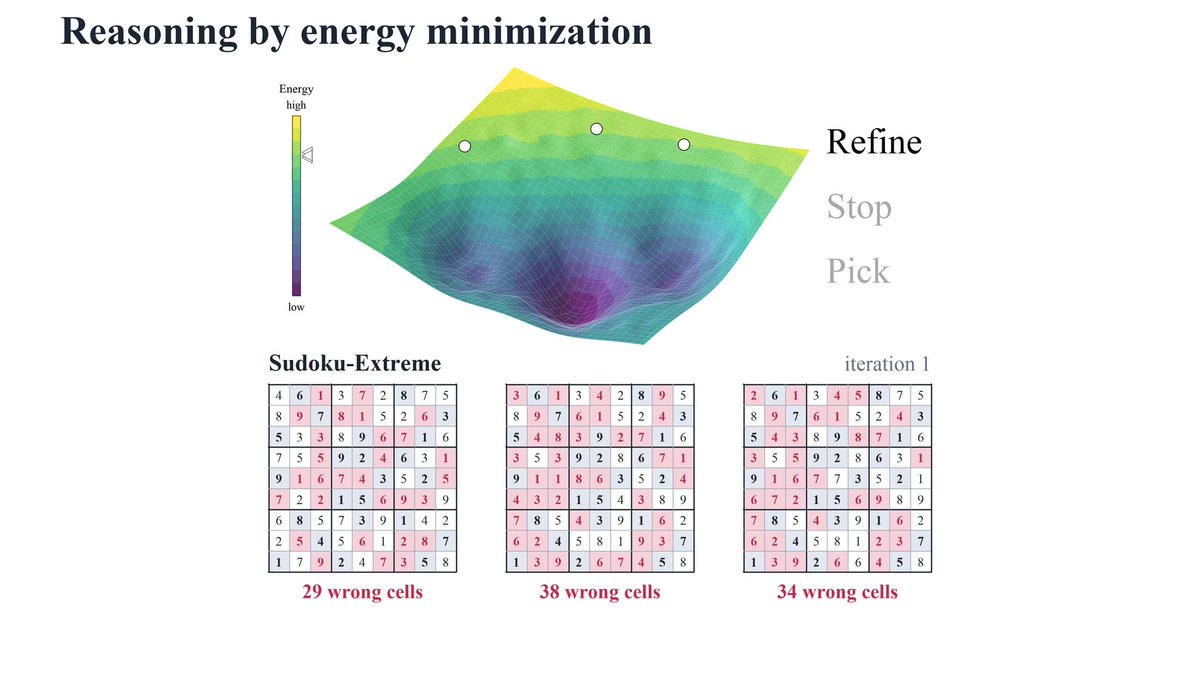
Representative image for RT by @ylecun: Bye bye looped reasoning… and hello Energy-Based Reasoning⚡! Introducing…

RT by @ylecun: Bye bye looped reasoning… and hello Energy-Based Reasoning⚡! Introducing…

Rank 71 · Content 80 · Popularity N/A

TL;DR - Energy-Based Reasoners are presented as a compute- and sample-efficient alternative to looped reasoning, reporting strong results on constraint-solving benchmarks.

  • Use 345× less inference compute and 2.6× fewer training FLOPs than the cited best baselines.
  • Achieve 7×–43× greater inference-time sample efficiency than looped baselines.
  • Report 99.9% accuracy on Sudoku-Extreme and nearly 100% on multi-solution benchmarks.
  • The provided post does not describe the underlying method or evaluation setup.

Multimodal & Generative 7

Representative image for Plan4D: Generative Plannable 4D Worlds

Plan4D: Generative Plannable 4D Worlds

Rank 87 · Content 95 · Popularity 67

TL;DR - Plan4D is a generative world model that predicts future RGB video alongside dense, temporally consistent 4D geometry from scene observations and text-specified actions. It aims to make generated environments more physically grounded and useful for long-horizon planning.

  • Combines LongCat-Video’s video-generation prior with Depth Anything 3’s 3D reconstruction capabilities.
  • Predicts depth, camera parameters, point clouds, and scene flow using an auxiliary DPT head.
  • Addresses scarce paired action-and-geometry data through a model-stitching architecture.
  • Reports state-of-the-art generative 4D modeling results on synthetic and real-world datasets.

RL Post-Training in Diffusion Transformers Is Activation Steering

Rank 85 · Content 95 · Popularity 61

TL;DR - RL post-training gains in diffusion transformers can largely be reproduced by fixed, input-independent activation steering vectors. This suggests RL mainly steers pretrained generators toward existing capabilities rather than learning complex new transformations.

  • Steering vectors used 65× fewer parameters than the RL-tuned LoRA on SD3.5-M.
  • They recovered 90.0–96.3% of reward gains across six image models.
  • On two video models, they recovered 89.8% and 111.9% of the gains.
  • Trained directly with online RL, steering vectors outperformed weight-based RL on OCR and PickScore.

WeMM-Video: Pushing the Frontiers of Open-Source Omni-Modal Video Understanding

Rank 84 · Content 90 · Popularity 70

TL;DR - WeMM-Video is an open-source family of bilingual omni-modal models for joint video, audio, image, and text understanding. Its flagship model reports state-of-the-art open-source performance on omni-modal video benchmarks.

  • Offers 2B, 4B, 9B, and 35B-A3B variants with fast instruct and explicit reasoning modes.
  • Trained on roughly 1.2 trillion multimodal tokens using progressive pre-training and multi-stage post-training.
  • Evaluated across more than 120 benchmarks covering audio-visual reasoning and general audio, video, image, and text tasks.
  • The models and evaluation/reproduction pipeline are publicly released.
Representative image for Coda-DaVinci: Reimagining Video Generation with Code2Video

Coda-DaVinci: Reimagining Video Generation with Code2Video

Rank 83 · Content 90 · Popularity 68

TL;DR - Coda-DaVinci is an agentic Code2Video framework that uses task-adaptive 3D proxies, physics simulation, and proxy-grounded prompts to improve video generation control, consistency, and physical plausibility.

  • Coarse proxies favor natural motion, while medium-grained proxies improve consistency.
  • The framework selects direct or proxy-guided generation and adapts modeling granularity per entity.
  • A multi-agent workflow preserves scene assets and guides visual inspection and repairs.
  • Evaluations show stronger instruction following, scene consistency, realism, and long-video event structure, but transition stability and scene adherence remain limited.
Representative image for HumanCOIN: A 12,500-Hour Dataset for Human Intent in Egocentric Manipulation

HumanCOIN: A 12,500-Hour Dataset for Human Intent in Egocentric Manipulation

Rank 82 · Content 95 · Popularity 52

TL;DR - HumanCOIN is a 12,500-hour egocentric manipulation dataset that captures human intent through gaze, muscle activity, and brain signals. It enables models to study the decision process preceding physical actions rather than only observation-action pairs.

  • Covers 38 scene classes across attention (10,000 hours), exertion (2,000 hours), and cognition (500 hours) tiers.
  • Uses head-camera gaze inference, surface EMG, and scalp EEG as progressively earlier proxies for intent.
  • Includes RGB, depth, point clouds, 6-DoF head/wrist poses, and step-level action and object annotations.
  • Provides clock and calibration data for synchronizing modalities recorded at different rates.
Representative image for Risk-Controlled Test-Time Adaptation for Vision-Language-Action Models

Risk-Controlled Test-Time Adaptation for Vision-Language-Action Models

Rank 76 · Content 95 · Popularity 31

TL;DR - R2-VLA is a risk-controlled retrieval framework that lets vision-language-action models adapt at test time while meeting user-defined task-success targets with minimal expert intervention.

  • Predicts action uncertainty to decide between autonomous execution and requesting expert assistance.
  • Calibrates uncertainty thresholds against a specified task-failure risk.
  • Adds expert corrections to retrieval memory while preserving the risk guarantee.
  • Improved LIBERO task success by 9.2–11.2 percentage points across three VLA backbones while reducing expert requests.
Representative image for VisAlloc from 复旦,浙大,港科广,澳门理工

VisAlloc from 复旦,浙大,港科广,澳门理工

Rank 68 · Content 80 · Popularity 40

TL;DR - VisAlloc is an online self-distillation method that selectively allocates privileged visual supervision to samples and tokens most dependent on visual evidence, rather than applying it uniformly. It reports improved visual-reasoning accuracy across eight benchmarks for 4B and 9B multimodal models.

  • Sample-level positive/negative teacher views identify questions requiring visual evidence.
  • Token-level score differences locate visually sensitive positions and increase their training weight.
  • The 4B and 9B models achieve average accuracies of 81.44 and 84.92 across eight benchmarks.
  • On six evaluations, the 9B model averages 80.44 with one forward pass, versus the cited 71.81 for GPT-5.2 and 79.24 for Gemini 3.5 Flash.

Efficiency & Systems 1

HiSA: Sparsifying the Hidden Dimension of RoPE Attention in LLMs

Rank 76 · Content 95 · Popularity 31

TL;DR - HiSA sparsifies attention along the hidden dimension using RoPE-derived, position-based rules. It computes roughly one-third of query-key products while reportedly improving model quality, decoding speed, and memory use.

  • Preserves full query/key projections but computes only selected feature-wise dot products.
  • Uses a static, parameter-free sparsity pattern determined by token positions.
  • Supports training from scratch and extends FlashAttention-3 kernels for training and inference.
  • Dense attention analysis suggests models naturally suppress the score components HiSA removes.

Autonomous Laboratories 1

Enabling lab autonomy with reward functions and executable workflows

Rank 83 · Content 85 · Popularity 80

TL;DR - Kalinin et al. argue that autonomous laboratories need more than LLM-generated hypotheses: they also require bottom-up optimization that converts ideas into executable physical workflows.

  • Focuses on enabling autonomy in real-world laboratory environments.
  • Distinguishes high-level hypothesis generation from practical workflow execution.
  • Proposes reward functions and executable workflows as key components for self-driving labs.
  • The provided excerpt presents an argument but reports no experimental results.

Biophysics 1

Transient contacts between filaments impart its elasticity to branched actin

Rank 66 · Content 65 · Popularity 70

TL;DR - A Nature study reports that branched actin networks derive their elasticity from transient contacts between filaments. Growth under mechanical load produces stiffer networks.

  • Network stiffness emerges through inter-filament contact formation.
  • The contacts are transient rather than permanent crosslinks.
  • Mechanical loading during growth increases network stiffness.
  • The provided abstract does not include quantitative results or experimental details.

Cancer Immunology 1

Ferroptosis in cancer cells triggers PGE 2 production for tumour immune escape

Rank 69 · Content 80 · Popularity 45

TL;DR - Ferroptotic cancer cells increase PGE2 production, weakening dendritic-cell function and antitumour immunity. This identifies a mechanism by which ferroptosis can facilitate tumour immune escape.

  • Ferroptosis activates a molecular program that elevates PGE2 in cancer cells.
  • PGE2 impairs type 1 conventional dendritic cell function.
  • This disruption compromises antitumour CD8+ T-cell immunity.

Connectomics 1

Scalable electron tomography for connectomics

Rank 74 · Content 75 · Popularity 71

TL;DR - This Nature Methods paper presents electron tomography as a scalable approach for connectomics and volume electron microscopy. It reconstructs thick tissue volumes computationally from images captured at only a few tilt angles.

  • Targets scalable three-dimensional imaging of thick tissue sections.
  • Uses sparse-angle electron microscopy data for computational reconstruction.
  • Supports mapping neural connectivity and broader volume electron microscopy workflows.
  • The provided abstract does not include quantitative results or methodological details.

Marine Microbiology 1

Bacteria and viruses team up to hasten the demise of algal blooms

Rank 63 · Content 70 · Popularity 48

TL;DR - Some bacteria detect virus-infected algal cells and cooperate with the viruses to accelerate algal-bloom collapse. This interaction affects marine food webs and carbon fixation.

  • Viral infections can abruptly terminate ecologically important algal blooms.
  • Certain bacteria can sense when algal cells are infected.
  • Bacterial and viral activity can act synergistically to hasten bloom collapse.

Neuroimmune Systems 1

Sore throat? The brain has surprising control over how ill you feel

Rank 67 · Content 75 · Popularity 48

TL;DR - A Nature article explores evidence that the brain helps interpret pathogens, retain memories of past illnesses, and prepare the body for future threats. The provided excerpt does not specify mechanisms or experimental results.

  • Illness perception might be partly controlled by the brain.
  • The brain could distinguish or “decode” pathogen-related signals.
  • Prior infections might leave neural memories that influence later responses.
  • These processes could help the body anticipate recurring threats.

Quantum Error Correction 1

Representative image for Scaling classical hardware for accurate real-time quantum error correction

Scaling classical hardware for accurate real-time quantum error correction

Rank 76 · Content 95 · Popularity 31

TL;DR - Rapids is an FPGA-co-designed streaming neural decoder for real-time quantum error correction. It achieves sub-microsecond decoding for distance-19 surface codes while substantially improving logical error rates over existing hardware decoders.

  • Uses integer-trained neural operations optimized for efficient FPGA execution.
  • Reduces logical error rates by 240× versus existing real-time hardware decoders on the distance-19 surface code.
  • Extends to color and bivariate-bicycle codes, achieving 16× higher accuracy than Relay on the [[144,12,12]] code.
  • Scales across multiple FPGAs or custom silicon to improve speed, accuracy, or supported code size.

Viral Genomics 1

Closest relatives of poxviruses prevail in human and animal guts worldwide

Rank 81 · Content 85 · Popularity 71

TL;DR - Researchers discovered “egoviruses,” a diverse putative order of large, linear-genome DNA viruses closely related to animal-infecting poxviruses. Their worldwide prevalence in animal digestive systems expands the known diversity and ecological reach of poxvirus relatives.

  • Egoviruses appear to be the closest known relatives of poxviruses.
  • They possess large, linear DNA genomes.
  • The group is diverse enough to constitute a putative viral order.
  • They are prevalent in human and animal guts worldwide.

World Models 1

Representative image for RT by @ylecun: The real world is full of surprises, like a gust of wind while driving! Intelligent…

RT by @ylecun: The real world is full of surprises, like a gust of wind while driving! Intelligent…

Rank 75 · Content 85 · Popularity N/A

TL;DR - A research thread introduces JEPA world models that reason about unexpected real-world events and counterfactual actions. The claimed approach provides provable guarantees, though the post gives no technical details or results.

  • Targets unpredictable disturbances, such as wind affecting a vehicle.
  • Adds counterfactual reasoning about outcomes under alternative actions.
  • Uses the JEPA framework for intelligent world modeling.
  • The provided excerpt does not specify methods, benchmarks, or empirical findings.
Top highlights — Industry & News
  • GeoFlow V4:从能结合到可成药:BioGeometry 将药物设计推进到多目标联合优化;15 项从头设计任务平均命中率达 34.6%,亲和力最高至 15 pM。
  • OpenAI如何加速生命科学发展:AI 正从回答问题转向参与药物发现与科研流程,但实际价值仍取决于证据可追溯性、专业工具、严格评测与生物验证。
  • 医疗 AI 评测这五年:医疗 AI 基准正从知识准确率转向临床行为和证据支撑,以缩小热门榜单与医生真实工作负载之间的差距。

LLM Agents 4

Representative image for GraphRAG Zero solves a fundamental challenge that has limited AI agents' ability to reach their…

GraphRAG Zero solves a fundamental challenge that has limited AI agents' ability to reach their…

Rank 71 · Content 80 · Popularity N/A

TL;DR - Microsoft announced GraphRAG Zero, a deployable graph-based retrieval system for holistic discovery across organizational data. It is available in Foundry IQ and GitHub’s Repo Mind Light.

  • Designed to help AI agents uncover connections across large, private datasets.
  • Optimized for fast, low-cost use in real-world applications.
  • Supports use cases ranging from scientific discovery to repository understanding.
  • Builds on years of Microsoft research to productize graph-based retrieval.
Representative image for 不按Token收费、数据不出本机,这个开源Agent

不按Token收费、数据不出本机,这个开源Agent

Rank 71 · Content 80 · Popularity N/A

TL;DR - Simplex AI open-sourced Linger, a local personal agent for office workflows that emphasizes privacy, no token fees, and human approval for sensitive actions. Its PolyStrata MoE engine reportedly runs large models on consumer hardware, though real-world performance remains unverified.

  • Runs on Mac, Windows, and Linux, accessing local email, calendars, files, and authenticated browser sessions.
  • Supports multi-agent task delegation, meeting transcription, summaries, and follow-up tracking.
  • Keeps data and inference local; write actions such as sending email require user confirmation.
  • Simplex AI reports 45.5 tokens/s for a 125B model with 12GB VRAM and 64GB RAM using tiered GPU, RAM, and SSD weight placement.
Representative image for 双系统决策+双层自进化,Agnes让Agent效率最高提速14倍,成本骤降至1/27!

双系统决策+双层自进化,Agnes让Agent效率最高提速14倍,成本骤降至1/27!

Rank 68 · Content 75 · Popularity N/A

TL;DR - Open-source Agnes Harness combines fast/slow decision systems with task-time adaptation and reusable experience to make enterprise and embodied agents faster and cheaper. Its developers report up to 14.3× faster decisions and roughly 1/27 the cost of online LLM calls in selected tests.

  • A 9B Agnes Sys1.0 model handles routine tool and action decisions, escalating complex reasoning to a larger LLM.
  • Test-time training temporarily adapts a small calibration layer to new tasks without modifying the model’s core parameters.
  • Recursive self-improvement reviews executions and, after simulation validation, stores improved prompts, skills, memory, and workflows as versioned playbooks.
  • Plugins, MCP integration, and the proposed Model Hardware Standard connect agents to enterprise software and physical devices.
Representative image for 灵光开放生态再扩容:新增企业微信、腾讯文档等7项连接能力,累计支持54项外部服务

灵光开放生态再扩容:新增企业微信、腾讯文档等7项连接能力,累计支持54项外部服务

Rank 57 · Content 60 · Popularity N/A

TL;DR - Ant Group’s Lingguang AI assistant added seven integrations, including WeCom, Tencent Docs, Tencent Meeting, and VariFlight, bringing its total external service connections to 54. The expansion advances its shift from conversational assistance toward executing cross-application tasks.

  • New capabilities span workplace collaboration, flight-status queries, photo access, and phone actions such as changing wallpapers or notes.
  • Connectors enable Lingguang to coordinate services across personal, workplace, and travel scenarios.
  • Lingguang 2.0 centers on delegated task execution; by November 11, it had reportedly handled over 3 million delegated matters and executed more than 11 million tasks.

Medical/Healthcare AI 1

Representative image for 医疗 AI 评测这五年

医疗 AI 评测这五年

Rank 75 · Content 85 · Popularity N/A

TL;DR - A retrospective argues that medical-AI benchmarks have evolved from testing knowledge and answer accuracy toward clinical behavior and evidence grounding. This matters because popular benchmarks poorly reflect physicians’ real workloads, even as regulators consider clinician-like certification for AI products.

  • Real physician questions reportedly overlap only 31% with exam-style benchmark content.
  • Documentation and administration comprise 36.2% of clinical work, yet the median documentation-task count across 58 benchmarks is zero.
  • HealthBench represents a shift toward evaluating whether model behavior meets clinicians’ expectations.
  • Proposed 2026 CMS, HHS, and FDA oversight raises the risk of certifying products against benchmarks misaligned with real clinical practice.

Bioinformatics AI 2

Representative image for GeoFlow V4:从能结合到可成药

GeoFlow V4:从能结合到可成药

Rank 82 · Content 95 · Popularity N/A

TL;DR - BioGeometry released GeoFlow V4, an AI drug-design engine targeting binding, function, selectivity, stability, and developability simultaneously. Across 15 de novo design tasks, it reported a 34.6% average hit rate and affinities as strong as 15 pM.

  • Testing covered 13 targets and four molecular modalities, with an average hit rate about 85% higher than the previous generation.
  • Wet-lab validation included cellular binding, cAMP agonism, expression, purity, thermal stability, and polyspecificity.
  • GeoFlow Code autonomously translates target product profiles into iterative protein-design scripts and candidate molecules.
  • In a cross-species PD-1 screening task, GeoFlow Code achieved a 4.23% pass rate versus 0.16% for an expert-planned workflow under the same computational criteria.
Representative image for OpenAI如何加速生命科学发展

OpenAI如何加速生命科学发展

Rank 75 · Content 85 · Popularity N/A

TL;DR - OpenAI’s life-sciences workshop showcased AI moving from answering questions to participating in drug-discovery and research workflows. Its impact depends on traceable evidence, specialized tools, rigorous evaluation, and biological validation.

  • GPT Rosalind combined literature, databases, and molecular-structure tools to identify potentially misleading exposed residues in a truncated TfR1 protein.
  • OpenAI proposed extending Codex with reusable domain plugins, scientific methods, and tool interfaces rather than building separate agents for every field.
  • Scientific AI must expose data sources, methods, conflicting evidence, uncertainty, and measurable reliability improvements.
  • Faster models cannot bypass experiments, clinical evidence, patient-data safeguards, provenance requirements, or expert judgment.

LLMs & Foundation Models 1

Introducing Gemini 4 Neon

Rank 68 · Content 75 · Popularity N/A

TL;DR - Google DeepMind appears to be announcing a model or product named Gemini 4 Neon. Because only the title is provided, its capabilities, availability, and significance cannot be verified.

  • The item is framed as a Gemini launch or introduction.
  • No technical architecture, benchmarks, features, or release details are included.
  • “Neon” cannot be reliably identified as a model variant, capability, or product tier from the supplied content.

Multimodal & Generative 3

Genie 4 is now available

Rank 71 · Content 80 · Popularity N/A

TL;DR - Google DeepMind announced that Genie 4 is now available. No item content was provided, so its capabilities, access model, and technical significance cannot be determined here.

  • This is a company availability announcement for Genie 4.
  • The title does not specify who can access it or under what terms.
  • No architecture, benchmarks, features, or performance results were provided.
Representative image for 开源了,协议不是 Apache 2.0?

开源了,协议不是 Apache 2.0?

Rank 71 · Content 80 · Popularity N/A

TL;DR - Tencent has open-sourced its Hy4 family and released a System Card detailing model architecture and safety evaluation. The release adds a large sparse-MoE model capable of understanding text, images, and video.

  • Hy4 has 770B total parameters, activates 49B per token, and supports a 1M-token context.
  • Its 78-layer sparse-MoE backbone uses 256 routed experts plus one shared expert per layer, with top-8 routing.
  • Visual inputs are processed by a dynamic-resolution ViT.
  • Tencent says its Hunyuan LLM lineup—including Hy3, Hy4, preview, and flash variants—is now fully open-source.
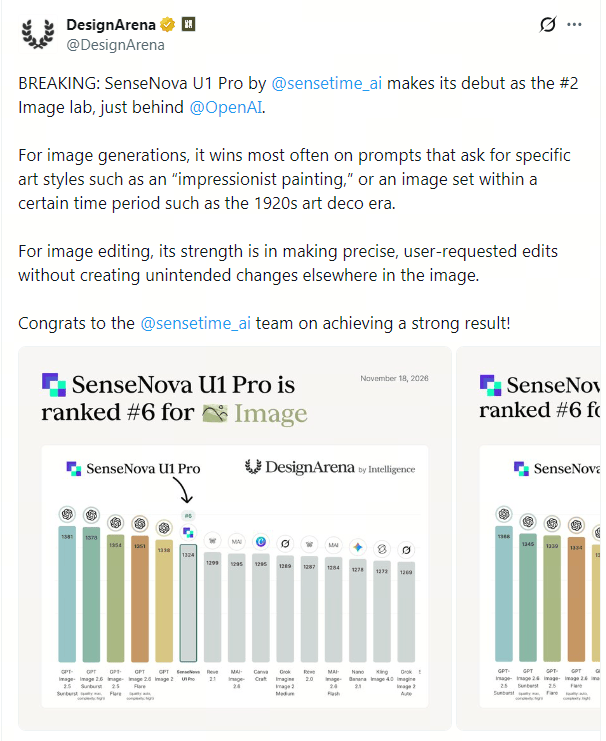
Representative image for SenseNova U1 Pro获Design Arena双榜中国第一、全球第六

SenseNova U1 Pro获Design Arena双榜中国第一、全球第六

Rank 61 · Content 65 · Popularity N/A

TL;DR - SenseTime’s SenseNova U1 Pro ranked first among Chinese models and sixth globally on Design Arena’s image generation and editing leaderboards. It targets end-to-end visual production, combining generation, self-review, correction, and delivery checks.

  • Design Arena ranks models through anonymous pairwise comparisons, user votes, and dynamic Elo scores.
  • The model supports long workflows such as turning papers into visuals and product photos into marketing assets.
  • Its pipeline can produce related assets including posters, menus, and storyboards from creative briefs.
  • Design Arena’s preference-versus-price assessment also indicates competitive generation costs.

Efficiency & Systems 5

How OpenAI’s Performance Factory keeps ChatGPT fast

Rank 71 · Content 80 · Popularity N/A

TL;DR - OpenAI describes its Performance Factory, which uses Codex-powered workflows to identify and address performance issues that could slow ChatGPT.

  • Automates parts of performance issue detection and remediation.
  • Applies Codex to production-oriented performance engineering workflows.
  • The provided excerpt does not specify architecture, benchmarks, or measured improvements.

Why your fine-tuning job takes longer than the FLOPs say

Rank 64 · Content 70 · Popularity N/A

TL;DR - A Hugging Face blog post about why fine-tuning duration can exceed FLOP-based estimates. With no article content provided, specific findings cannot be verified.

  • FLOP counts alone may not accurately predict end-to-end fine-tuning time.
  • The title implies that non-compute factors contribute to training overhead.
  • No benchmarks, methods, or quantified results are available in the supplied content.
Representative image for 第六代 AMD EPYC 处理器技术峰会在京举行

第六代 AMD EPYC 处理器技术峰会在京举行

Rank 61 · Content 65 · Popularity N/A

TL;DR - AMD showcased sixth-generation EPYC “Venice” processors and partner servers in Beijing, positioning their Zen 6 architecture as infrastructure for agentic AI, HPC, and general-purpose computing.

  • Targets CPU-heavy agent workloads such as sandbox execution, AI head nodes, data access, and concurrent tool use.
  • Introduces Zen 6, a new SoC design, 2.5D packaging, and advances in memory and interconnect technologies.
  • AMD and 22 OEM/ODM partners launched or demonstrated servers, including four high-density “supernode” systems.
  • AMD also previewed SP8, Venice-X, and Verano platforms while highlighting ROCm 10 and ROCm.AI.

Introducing harness adapters: adapt your favorite model to your harness to improve performance and cost

Rank 61 · Content 65 · Popularity N/A

TL;DR - Hugging Face introduces “harness adapters,” intended to adapt models to specific evaluation or execution harnesses to improve performance and reduce cost. Only the title was provided, so implementation details and measured results are unavailable.

  • The approach targets model-to-harness compatibility or optimization.
  • Its stated goals are better performance and lower operating cost.
  • No architecture, benchmarks, supported harnesses, or quantitative gains were provided.

DaisyRose-27B: Pushing the Frontier of Post-Training Efficiency

Rank 61 · Content 65 · Popularity N/A

TL;DR - Hugging Face highlights DaisyRose-27B, a 27B-parameter model focused on improving post-training efficiency. No supporting content was provided, so specific methods and results cannot be verified.

  • The title frames post-training efficiency as the model’s primary contribution.
  • The “27B” designation likely indicates model scale, but the architecture is unspecified.
  • No benchmarks, training techniques, compute requirements, or comparisons are available in the supplied material.

Embodied AI 1

Representative image for 昇腾算力训出了双榜SOTA的具身世界模型,华为云这次想把整套底座开放出来

昇腾算力训出了双榜SOTA的具身世界模型,华为云这次想把整套底座开放出来

Rank 68 · Content 75 · Popularity N/A

TL;DR - Huawei Cloud introduced CloudRobo-WM1.2, an Ascend-native embodied world model that leads two robotics benchmarks, and plans to release its weights, inference code, and post-training code. It demonstrates a domestically developed alternative stack spanning robot-model training, deployment, and ecosystem tooling.

  • Achieved 88.98% on RoboTwin 2.0 and 81.73% on LIBERO-Pro 2.0; Huawei also reports a 23-point lead over the runner-up in third-party tests across 13 real-robot tasks.
  • Its PPA architecture jointly learns perception, future-state prediction, and actions from video, semantic, depth, and point-cloud inputs, while masked supervision accommodates incomplete multimodal data.
  • DualAct combines a fast action-expert path with a more precise world-model path, supporting four inference modes that trade prediction quality for latency and compute.
  • Ascend-specific framework, operator, memory, and reinforcement-learning optimizations reportedly improved relevant training throughput and inference efficiency by roughly 2–3×.

Security AI 1

Deploying Daybreak Red

Rank 68 · Content 75 · Popularity N/A

TL;DR - OpenAI presents a reference architecture for deploying Daybreak Red in supervised security investigations. The brief highlights operational safeguards, configuration, and monitoring rather than reported performance results.

  • Focuses on human-supervised security investigation workflows.
  • Covers safety controls and deployment setup.
  • Includes monitoring considerations for ongoing operation.
  • The provided content does not specify technical implementation details or evaluation results.