🛰️ Daily AI Frontier
⚠ WeChat login expired or unavailable — new articles may be missing. Reconnect WeChat. An upstream outage cannot be fixed by scanning. Latest stored WeChat publication: 2026-08-25.

WeChat reconnect targets werss, while collection still uses wewe. Login alone does not complete the provider cutover.

Twitter/X collection is rate limited. 0 of 13 handles succeeded at the last check. Stored posts remain available; partial coverage is not a complete timeline.
47 works · 3 categories · 17 topics · rednote 10 blog 12 journal 10 arxiv 15 generated 2026-11-21 15:23:47 UTC
Top highlights — Research

LLM Agents 3

Representative image for 2篇Google/ICLR高分Agent/多智能体Paper

2篇Google/ICLR高分Agent/多智能体Paper

SR
Rank 85 · Content 100 · Popularity N/A

TL;DR - Two Google papers examine multi-agent systems: DuoDiscover coordinates coding agents to validate performance optimizations, while CLASHarness evaluates whether agents can resolve conflicting information and complete handoffs reliably.

  • DuoDiscover’s four agents achieved a 1.92× geometric-mean gain across four vLLM serving metrics using seven full evaluations.
  • Agents build low-cost “yardstick” evaluators, verify gains with full evaluations, and monitor evaluator drift.
  • CLASHarness contains 600 computer-use conflict scenarios across 20 domains involving stale reports, contradictory instructions, and shared-resource contention.
  • Across 15 models, the best full-pass rate was 28.7%; even strong models failed finalization tasks such as releasing locks and completing handoffs more than 58% of the time.

Representative image for TwinLab-Bench: Evaluating AI Scientists in Agentic Twins of Real Labs

TwinLab-Bench: Evaluating AI Scientists in Agentic Twins of Real Labs

Rank 84 · Content 95 · Popularity 57

TL;DR - TwinLab-Bench evaluates AI scientist agents on designing and executing original experiments through digital twins grounded in real laboratory records. Frontier models struggle substantially, indicating that autonomous scientific experimentation remains an open challenge.

  • Covers 52 tasks across physical sciences, life sciences, and engineering, with more than 100 experimental action types.
  • Lab-specific TwinLab agents execute proposed experiments using recorded materials and calculators, producing consistent, record-grounded readings.
  • Reports are scored against hidden answers derived from real lab records, with closed-book probes controlling for memorization.
  • The strongest evaluated model, Claude Fable 5.2, averaged only 45.0.
Representative image for Training Vision Models for LLM-Driven Weight-Space Programming

Training Vision Models for LLM-Driven Weight-Space Programming

Rank 81 · Content 90 · Popularity 60

TL;DR - This paper benchmarks LLMs directly editing vision-model weights and introduces Edit-Ready Training (ERT), which rehearses closed-form weight edits. ERT substantially improves edit success when conventionally trained models are difficult to modify.

  • Evaluates five LLMs editing CNNs and vision transformers across four vision datasets.
  • Analyzes over 2,600 edits for success, side effects, and held-out accuracy loss.
  • Compares standard training, label smoothing, gradient-based editable training, and ERT.
  • ERT achieves the highest mean score for GPT-6 Astra and Claude Opus 5.5 across evaluated baselines.

Medical/Healthcare AI 3

DeepQuest: From Knowledge Gaps to Scientific Discovery in Alzheimer's Disease

Rank 82 · Content 95 · Popularity N/A

TL;DR - DeepQuest is an AI scientist framework that converts literature-identified knowledge gaps in Alzheimer’s research into testable, data-feasible hypotheses. It reports a 95.24% audit-assessed scientific finding rate, with key associations supported across independent cohorts.

  • Generates 42 feasible hypotheses on OASIS-3 using data screening and groupwise Elo ranking.
  • Separately audits experimental reliability and knowledge contribution against frozen literature corpora.
  • Outperforms leading baselines in 14 of 15 evaluator-dimension comparisons across three language-model reviewers.
  • Representative findings cover dementia risk, amyloid spatial stability, and tau-associated clinical impairment, with support from ADNI and AIBL cohorts.
Representative image for Multi-institutional grading of Barrett's esophagus dysplasia without stain normalization using a pathology foundation model and multiple instance learning

Multi-institutional grading of Barrett's esophagus dysplasia without stain normalization using a pathology foundation model and multiple instance learning

Rank 76 · Content 95 · Popularity 31

TL;DR - A pathology foundation model graded Barrett’s esophagus dysplasia across four institutions without stain normalization, achieving strong diagnostic performance. Its stain robustness could simplify deployment across clinical sites.

  • Evaluated on 969 H&E whole-slide images from four institutions.
  • Combined expert-trained patch classifiers with attribute-aware multiple instance learning for three-class grading.
  • Achieved a 0.96 macro-averaged AUC and 0.83 quadratic-weighted kappa on 130 held-out slides.
  • Binary dysplasia detection reached 98% sensitivity and 81% specificity; no high-grade case was classified as non-dysplastic.

Glucose-powered implant brings devices for treating diabetes a step closer

Rank 62 · Content 70 · Popularity 45

TL;DR - A glucose-powered implant reduced diabetic symptoms in rat models by stimulating a key nerve when blood sugar rose. The early-stage result could advance self-powered, responsive diabetes therapies.

  • The implant targets the main nerve connecting the brain and internal organs.
  • Stimulation is triggered by high blood sugar.
  • Effectiveness has been demonstrated only in rat models so far.
  • Human safety and efficacy are not established by the provided content.

Bioinformatics AI 2

Representative image for 精读:三维打分不必各写一套

精读:三维打分不必各写一套

Rank 78 · Content 90 · Popularity N/A

TL;DR - ShEPhERD-score unifies differentiable 3D molecular similarity scoring and alignment across shape, electrostatics, and pharmacophores. It matches or exceeds open-source baselines while enabling high-throughput virtual screening.

  • Evaluates 18 scoring modes, including 12 new methods and combined representations.
  • On 43 DUDE-Z targets, it performed comparably or better in eight of nine comparisons.
  • Adding non-directional pharmacophores improved mean ROC-AUC from 0.657 to 0.721 over shape alone.
  • GPU throughput ranged from 17,800 to 1.03 million alignments per second on an L40S; optimal scoring modes varied by target.

Poxviruses probably evolved in the digestive system of animals

Rank 62 · Content 70 · Popularity 45

TL;DR - Researchers identified large and giant DNA viruses that are prevalent in human and animal digestive systems, revealing an overlooked component of the gut microbiome. The discovery provides evidence relevant to the evolutionary origins of poxviruses.

  • Such viruses infect unicellular eukaryotes and are abundant environmentally but were rarely detected in gut microbiomes.
  • Their prevalence across human and animal digestive systems suggests the gut was important in poxvirus evolution.
  • The finding expands current understanding of gut microbiome diversity.

LLMs & Foundation Models 5

Representative image for Budget Internalization: Fixed-Budget RLVR Trades Test-Time Scaling for In-Budget Accuracy

Budget Internalization: Fixed-Budget RLVR Trades Test-Time Scaling for In-Budget Accuracy

Rank 83 · Content 95 · Popularity 55

TL;DR - Fixed rollout caps during post-training teach reasoning models to internalize token budgets, improving accuracy near the training limit but weakening test-time scaling beyond it.

  • The effect appears across three model families and transfers from math training to science and coding tasks.
  • Stronger KL regularization and less training-data truncation preserve scaling, but KL reduces in-budget gains.
  • Truncated-trace SFT reproduces the behavior, linking it to length-censored post-training rather than RL-specific objectives.
  • Rollout caps therefore trade low-budget accuracy for poorer performance when more inference compute is available.

Training LLMs to Follow Reasoning Instructions with Minimal Edits

Rank 82 · Content 95 · Popularity N/A

TL;DR - Edit-based training teaches LLMs to follow reasoning instructions by supervising only minimally corrected spans at the first failure point. On Qwen3-32B, it improved instruction compliance while largely preserving unrelated capabilities.

  • Uses localized textual edits instead of imitating full reasoning trajectories.
  • Targets the first identified reasoning failure for more precise credit assignment.
  • Supports offline training and online adaptation to evolving failure modes.
  • Outperformed full-trajectory imitation and trajectory-level reinforcement learning baselines on ReasonIF.

RL Can Only Reinforce What It Sees Succeed

Rank 78 · Content 100 · Popularity 26

TL;DR - Outcome-reward RL can amplify a correct behavior only after observing enough successful examples. Across varied models and training setups, roughly 35 successful attempt groups yielded even odds that rare correct actions would be learned broadly.

  • Base models reflected pretraining uncertainty, while RL converted that uncertainty into reward-favored decisions.
  • Rare correct actions produced all-or-nothing outcomes: runs learned them broadly or failed to learn them.
  • Learning success was predicted by the expected number of attempt groups in which the correct action won.
  • The relationship held across group sizes, optimizers, GRPO variants, learning rates, and models from 1.3M to 85M parameters.

A Statistical Framework for Training Data Auditing of Large Language Models

Rank 76 · Content 95 · Popularity 31

TL;DR - This paper presents a statistical framework for detecting whether documents or collections were used to train an LLM. It supports privacy, copyright, and benchmark-contamination audits while controlling statistical errors.

  • Combines chunk-level membership signals with Cauchy combination to produce document-level scores.
  • Provides calibrated p-values for global collection auditing and suspicious-document identification.
  • Establishes finite-sample validity, type-I error control, and false discovery rate control under exchangeability assumptions.
  • Evaluates the framework on book, scientific-paper, synthetic-text, and medical QA datasets.

Attention Head Specialization: Phase Transitions in Sample Complexity

Rank 76 · Content 95 · Popularity 31

TL;DR - This paper shows that attention-head specialization can emerge as a phase transition when training data crosses critical size thresholds. It helps distinguish data-driven statistical effects from training-dynamics effects in specialized attention heads.

  • Syntactic-relation heads in BERT emerge as dataset size increases.
  • A solvable high-dimensional attention model links specialization to non-analytic changes in test error and other observables.
  • Specialization may follow uninformative head differentiation or cascade through progressively weaker latent features.
  • Online-learning analysis separates statistical sample-complexity transitions from dynamical causes.

Multimodal & Generative 2

Representative image for ForeSeek: Foresight-Driven Reasoning for Long-Form Video Understanding

ForeSeek: Foresight-Driven Reasoning for Long-Form Video Understanding

Rank 82 · Content 95 · Popularity N/A

TL;DR - ForeSeek is a video agent that uses predictive exploration instead of reactive clip retrieval for long-form video understanding. It achieves competitive or better accuracy while examining 2.5–4.4× fewer frames than the strongest search-based agent.

  • Forms visually grounded expectations about unseen video segments and verifies them with targeted observations.
  • Uses failed expectations to guide principled backtracking and refine its temporal search.
  • Employs two-stage training for foresight-guided reasoning and efficient decision-making.
  • Consistently improves the efficiency–accuracy trade-off across five long-video benchmarks.
Representative image for SpecWM: Turning Verification into Refinement for Streaming World Models

SpecWM: Turning Verification into Refinement for Streaming World Models

Rank 80 · Content 90 · Popularity 57

TL;DR - SpecWM is a training-free inference framework that accelerates streaming video world models by turning draft verification into reusable refinement. It improves quality and control while achieving a 1.63× speedup over the target model on WBench Navigation.

  • Uses the target model’s latent velocity field instead of external scorers to verify draft chunks.
  • Applies two thresholds to accept, refine, or reject drafts, avoiding unnecessary target regeneration.
  • Uses one-step refinement for perceptual quality and three-step refinement for camera following and trajectory consistency.
  • Raises the draft model’s WBench NavScore from 75.99 to 85.63 and sustains performance over long, multi-turn rollouts.

Efficiency & Systems 2

FrontierReplay: Split-Free Exact Prefix Caching for Hybrid Language Models

Rank 79 · Content 100 · Popularity 31

TL;DR - FrontierReplay enables exact prefix caching for hybrid language models at predictable structural boundaries without splitting prefill execution. It substantially reduces latency and improves serving capacity while preserving accuracy.

  • Uses a cross-layer, state-only replay kernel that is 6–37× cheaper per token than full recomputation.
  • Reduces median time to first token by 16–89%, with gains up to 8.9×.
  • Improves SLO capacity by up to 1.73× and goodput by up to 4.26×.
  • Outperforms approximate replay by up to 1.54× in goodput while avoiding reported accuracy losses of up to 17% on long contexts.

Complete-SVD: A Functional Norm Approach to Low-Rank LLM Compression

Rank 76 · Content 95 · Popularity 31

TL;DR - Complete-SVD is a post-training low-rank LLM compression method that minimizes output-logit distortion through a tractable weighted SVD approximation. It improves cross-corpus perplexity and instruction-following accuracy over prior output-aware methods.

  • Linearization and Kronecker factorization yield a closed-form weighted SVD solution.
  • Random probes estimate the otherwise intractable output factor unbiasedly, requiring (K) backward passes per sequence regardless of vocabulary or sequence length.
  • Complete-SVD achieved the lowest C4 and PTB perplexity across matched uniform-rank settings and at a 0.7 compression ratio with LEMS rank allocation.
  • A KL-divergence variant improved calibration perplexity and downstream accuracy but worsened cross-corpus perplexity.

Animal Signalling 1

Injury-induced signalling coordinates immunity and cannibalism in locusts

Rank 66 · Content 75 · Popularity 45

TL;DR - A Nature study finds that injury-triggered guaiacol signalling in migratory locusts coordinates both immune protection and cannibalism, with the outcome depending on injury severity.

  • Minor injuries induce guaiacol emission that improves the injured insect’s survival.
  • Beyond an injury-severity threshold, the same volatile attracts cannibalistic attacks.
  • The findings reveal a dual-purpose chemical signal linking individual immunity with population-level feeding behavior.

Cognitive Aging 1

People entering old age now have better memory than their parents did

Rank 63 · Content 70 · Popularity 48

TL;DR - A study of 219,000 adults finds that people entering old age today retain memory function longer than previous generations, suggesting generational improvements in cognitive aging.

  • The analysis included 219,000 adults.
  • It compared memory function across generations of older people.
  • The provided summary does not specify causes, effect sizes, or study methodology.

Embodied AI 1

Representative image for Mind2Act World: A Diagnostic Benchmark for Embodied Mind, Physical Action, and Mind-Action Composition in Robotic Manipulation

Mind2Act World: A Diagnostic Benchmark for Embodied Mind, Physical Action, and Mind-Action Composition in Robotic Manipulation

Rank 81 · Content 85 · Popularity 71

TL;DR - Mind2Act World is a diagnostic benchmark that separates robotic manipulation into reasoning, physical execution, and their closed-loop composition. Results identify integrating reasoning and action through environmental feedback as the primary bottleneck.

  • Covers 30 simulated tasks across five domains, producing 180 configurations with varied difficulty and scene randomness.
  • Its Mind, Act, and Mind2Act views distinguish isolated capability failures from failures to compose capabilities.
  • The strongest agent scored 52.7% on Mind and 39.0% on Act, but only 12.0% on combined Mind2Act episodes.
  • Multimodal agents retained task state but struggled with sustained contact, while end-to-end policies executed familiar motions but retained little state.

Epidemiological Modeling 1

University students are biggest spreaders of COVID

Rank 67 · Content 75 · Popularity 47

TL;DR - A large-scale analysis reports that undergraduates were the earliest group to spread new SARS-CoV-2 genetic variants during the COVID-19 pandemic, highlighting universities’ role in variant transmission.

  • The study analyzed SARS-CoV-2 genetic variants across population groups.
  • Undergraduates were identified as the first group to propagate emerging variants.
  • The finding could inform surveillance and outbreak-control strategies, although methodological details are not provided here.

LLM Evaluation 1

AltRA-Test: An Alternative Annotator Test for LLM Judges Without Shared Annotators

Rank 82 · Content 90 · Popularity 63

TL;DR - AltRA-Test statistically assesses whether an LLM can replace human annotators when items lack a shared annotator pool. It tests whether mixed human–LLM panels preserve human inter-annotator agreement.

  • Uses bootstrap resampling to compare paired all-human and mixed human–LLM panels.
  • Provides a consistent test with asymptotic significance level alpha.
  • Evaluated on 18 LLMs, five prompting methods, and 20 multimodal datasets; roughly 100 items often sufficed.
  • Outperformed baselines in simulations, while LLMs passed only about half of real-world setups, largely depending on the task.

Neurodevelopment Models 1

A two-platform blueprint for modeling human brain development

Rank 60 · Content 65 · Popularity 47

TL;DR - This Nature Methods Perspective outlines a two-platform approach to modeling human brain development, emphasizing experimental and biological barriers alongside ethical considerations.

  • Focuses on complementary platforms for studying human brain development.
  • Discusses limitations that complicate experimental modeling and biological interpretation.
  • Highlights ethical considerations relevant to developing and using these models.
  • The provided abstract does not specify the platforms or report experimental results.
Top highlights — Industry & News

LLM Agents 5

Representative image for 刚刚,DeepSeek V1作者创业项目曝光:开源Agent

刚刚,DeepSeek V1作者创业项目曝光:开源Agent

Rank 78 · Content 90 · Popularity N/A

TL;DR - Simplex AI unveiled Linger, an open-source personal agent that runs locally, operates desktop applications, and learns users’ notification preferences. It combines persistent personal memory with optimized MoE inference intended to run large models on consumer hardware.

  • Linger locally indexes email, calendars, chats, and meetings into a shared personal knowledge base; its developers report 95% accuracy on the LoCoMo long-context memory benchmark.
  • Its “Another Me” system can proactively prioritize notifications, infer preference rules from repeated feedback, and coordinate specialized agents for complex tasks.
  • The agent uses existing browser and application sessions, supports meeting transcription and voice interaction, and can connect to third-party models.
  • Its PolyStrata engine dynamically places MoE experts across GPU memory, system RAM, and SSD; the company claims a 125B Qwen model reaches 45.5 tokens/s on an RTX 3060 with 12GB VRAM and 64GB RAM.
Representative image for 笔记本能跑的智能体模型,美国开源回来了

笔记本能跑的智能体模型,美国开源回来了

Rank 78 · Content 90 · Popularity N/A

TL;DR - Thinking Machines reportedly released Inkling 2 Mini, a commercially usable 26B-parameter agent model designed to run locally on laptops. Its recurrent Transformer architecture improves compute efficiency but may make reasoning less observable.

  • The roughly 20GB model can run on a Mac with 32GB memory and uses an Apache 2.0 license.
  • Its 12 intermediate layers repeat three times, aiming to provide deeper computation within a smaller model.
  • It scored 20.1 on the third-party AA Intelligence Index, reportedly matching Qwen3.8-27B while activating about one-fifth as many parameters.
  • Murati warned that recurrence encourages more internal computation and less written reasoning, potentially weakening human oversight at larger scales.
Representative image for 米哈游发了个VLA论文

米哈游发了个VLA论文

Rank 71 · Content 80 · Popularity N/A

TL;DR - miHoYo introduced Gamer, an 8B-parameter vision-language-action model that uses screen pixels and keyboard/mouse controls to execute long-running game tasks. It demonstrates how real-time control, planning, and memory can be combined for game automation and testing.

  • Gamer builds on Qwen3-VL-8B and uses a three-stage pipeline: cross-game continued pretraining, supervised fine-tuning, and online reinforcement learning.
  • Sparse reasoning and memory summaries reduce latency and context growth during extended tasks.
  • In a roughly 50-hour Honkai: Star Rail evaluation, autonomous operation exceeded 95% of the total runtime.
  • On 40 unseen tasks across seven game categories, performance rose from 3.2% for the base model to 49.7% after reinforcement learning.

Hebbia sees improvements in financial research with GPT-6 Astra

Rank 61 · Content 65 · Popularity N/A

TL;DR - Hebbia reports that prerelease testing of GPT-6 Astra improved its AI-assisted financial research across source coverage, citation relevance, and presentation quality.

  • The evaluation focused on financial research workflows.
  • Tests indicated broader source coverage and more relevant citations.
  • Presentation quality also improved.
  • No quantitative results or methodological details were provided.
Representative image for 解读丨智能戒指红海之外,Elah Ring 正在深入美国腹地

解读丨智能戒指红海之外,Elah Ring 正在深入美国腹地

Rank 57 · Content 60 · Popularity N/A

TL;DR - Everblessed launched the $249 Elah Ring as a faith-focused wearable that combines prayer reminders with plans for an AI “Personal Faith Agent.” It targets underserved U.S. religious communities rather than competing directly with health-centric smart rings.

  • The ring uses vibration and cross-shaped lighting to prompt prayer, reflection, and scripture reading; its first 2,000 units reportedly sold out within two weeks.
  • Everblessed plans to combine users’ voluntarily shared prayers and reflections with wearable signals such as HRV to provide context-aware spiritual support.
  • Its AI system uses a vector database, fixed religious texts, and more than 120 safety scenarios and variants to constrain personalized interpretations.
  • Key challenges include hardware yield, battery life, sizing, supply-chain scaling, privacy, regulatory compliance, and avoiding generic or inappropriate AI guidance.

Bioinformatics AI 2

Representative image for OpenAI考题:高分却难定下一步

OpenAI考题:高分却难定下一步

Rank 82 · Content 95 · Popularity N/A

TL;DR - OpenAI released MedChemBench, a 99-question benchmark testing whether AI can reason over molecular structures and experimental results to prioritize medicinal chemistry experiments. High aggregate scores mask weaker compound-selection and property-prediction performance, limiting conclusions about real-world drug discovery.

  • The benchmark covers 761 molecular structures drawn from 117 published papers and patents, withholding later experimental results for evaluation.
  • Under xhigh reasoning, reported scores ranged from 58.2% for GPT-5.6 Sol to 84.5% for GPT-6.2 Astra.
  • GPT-6 Astra scored 95.4% on structure-related tasks but only about half the available points on compound selection and quantitative property prediction.
  • OpenAI cautions that the benchmark does not demonstrate novel drug discovery or improved laboratory decisions; tests used single attempts without tools, feedback, or new experiments.

Can AI help scientists identify promising drug candidates?

Rank 75 · Content 85 · Popularity N/A

TL;DR - OpenAI introduced MedChemBench, a benchmark for evaluating AI capabilities in early-stage drug discovery. It focuses on molecular interpretation, evidence-based reasoning, and compound selection.

  • Tests models’ understanding of molecular structures.
  • Evaluates reasoning from experimental evidence.
  • Assesses the ability to identify promising drug candidates.
  • No benchmark results or model comparisons are provided here.

LLMs & Foundation Models 3

Representative image for AI观察日报-数学家借助Claude完成黎曼猜想

AI观察日报-数学家借助Claude完成黎曼猜想

Rank 78 · Content 90 · Popularity N/A

TL;DR - This AI news roundup highlights a claimed Claude-assisted Lean formalization of the Riemann hypothesis alongside new OpenAI benchmarks, model safeguards, datasets, and ChatGPT features. The developments show both expanding AI capabilities and important limits on how reported results should be interpreted.

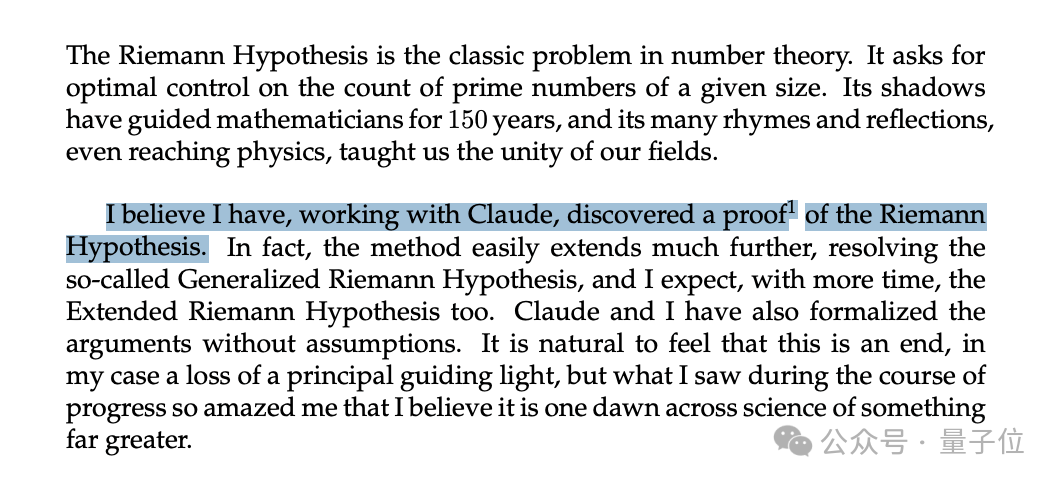
  • Levent Alpöge reportedly used Claude to complete a Lean formalization of the Riemann hypothesis; over 170,000 modules compiled, and two independent kernels accepted the exported code.
  • OpenAI introduced MedChemBench, covering 761 molecules from 117 papers and patents; models still struggle with compound selection and numerical property prediction.
  • Hume released roughly 800 hours of multilingual speech entity data with more than 350,000 annotations across eight languages.
  • OpenAI reported reducing reasoning-trace extraction success from 54% to 0.2% on a specific internal test, while cautioning against generalizing the result.
Representative image for 姚顺雨和混元团队上Reddit答网友,Hy小模型已进路线图

姚顺雨和混元团队上Reddit答网友,Hy小模型已进路线图

Rank 75 · Content 85 · Popularity N/A

TL;DR - Tencent’s Hunyuan team detailed its Hy4 and Hy4 Flash models, training methods, and deployment plans in a Reddit AMA. The roadmap includes smaller models, a Flash-Lite variant, 24GB-GPU support, and broader inference-framework compatibility.

  • Hy4 targets complex multimodal agent tasks; Hy4 Flash supports image-text input and up to 1 million tokens while cutting estimated task costs to about 1/20 of Hy4.
  • Flash was distilled from Hy4, then reinforcement-trained to shorten reasoning chains and reduce overthinking.
  • Its architecture uses MoE sparsity, Engram parameters, and sliding-window attention, which reduces KV-cache requirements to roughly one-quarter.
  • Both models have open weights; llama.cpp support is underway, alongside collaboration with vLLM and SGLang.

Combatting adversarial distillation

Rank 71 · Content 80 · Popularity N/A

TL;DR - OpenAI outlines a layered strategy to prevent adversarial distillation—the unauthorized extraction of model capabilities. The approach matters for protecting proprietary models from replication or misuse.

  • Combines model training, safeguards, detection, and enforcement.
  • Targets attempts to extract capabilities through adversarial interactions.
  • The provided content does not specify individual techniques or measured results.

Multimodal & Generative 3

Representative image for 9B模型为何运行56层?

9B模型为何运行56层?

Rank 75 · Content 85 · Popularity N/A

TL;DR - SenseNova-Loop-9B is SenseTime’s open-source multimodal model for reasoning, coding, and tool use. It reuses 24 of its 32 decoder layers, yielding 56 effective layer executions with fewer unique parameters but no equivalent reduction in compute.

  • Accepts text and images and produces text; weights and code are available.
  • AutomationBench reportedly improved from 14.33 in preview to 36.67, though results are configuration-dependent.
  • Four-bit weights are about 4.9GB; the README estimates roughly 9GiB for a 64K context with four-bit KV cache.
Representative image for 当 Kling Image 4.0 自己出设计方案,生图的门槛又变了!

当 Kling Image 4.0 自己出设计方案,生图的门槛又变了!

Rank 68 · Content 75 · Popularity N/A

TL;DR - Kling Image 4.0 expands AI image generation toward end-to-end commercial design, combining high-resolution generation, text-heavy layouts, precise editing, and coherent image sequences. It matters because users can turn broad goals into usable visual concepts with less manual prompting and design work.

  • Supports native 8K output, up to 2,000 characters per image, and as many as 10 related images per generation.
  • Its unified autoregressive understanding-and-generation architecture targets complex instruction following, visual planning, and localized edits that preserve unaffected content.
  • Tests showed strong Chinese typography, configurable fonts, coherent e-commerce pages, and automatic creation of branding, copy, and layouts from sparse prompts.
  • Multi-image generation maintained broadly consistent subjects and styles while organizing storyboard-like shot sequences, though faces, transitions, and small text still showed imperfections.
Representative image for 美国AI音乐巨头进军视频生成,底层模型来自中国MiniMax

美国AI音乐巨头进军视频生成,底层模型来自中国MiniMax

Rank 68 · Content 75 · Popularity N/A

TL;DR - Suno launched Visuals, a music-oriented image and video creation tool built on MiniMax’s open-weight H3 video model. It integrates song-aware visuals and lip synchronization into Suno’s existing music workflow.

  • Suno fine-tuned H3 with proprietary data to create H3 Move for music-video production.
  • Users can generate and edit clips up to 15 seconds from music, text prompts, and reference images.
  • MiniMax H3 supports text, image, video, and audio context, native stereo audio, and resolutions up to 2K.
  • Visuals uses separate paid credits and applies content filters, copyright restrictions, and watermarks.

Efficiency & Systems 4

Representative image for 26B大模型,塞进32G笔记本

26B大模型,塞进32G笔记本

Rank 82 · Content 95 · Popularity N/A

TL;DR - Thinking Machines Lab released Inkling 2 Mini, an Apache 2.0 open-weight 26.4B model compressed into a roughly 20GB checkpoint that can run locally on a 32GB laptop. Its recurrent-layer design targets capable, lower-cost local coding and tool-use workloads.

  • Repeats 12 intermediate layers three times, yielding 48 layer computations while activating 3.4B parameters per token.
  • Supports text, images, and contexts up to one million tokens.
  • Reported results include 79.2% on SWE-bench Verified and 77.9% on SWE-bench Pro, outperforming Qwen3.8-27B by the cited comparison.
  • Multi-turn dialogue and rule-following remain weaker, while llama.cpp and vLLM support currently requires specialized builds.
Representative image for 八路并发读提示词等一分钟?降到8.5秒

八路并发读提示词等一分钟?降到8.5秒

Rank 78 · Content 90 · Popularity N/A

TL;DR - llama.cpp PR 32342 optimizes prompt prefill for parallel Gemma 4 requests with shared KV layers. It cut eight-way prefill time on an M3 MacBook Air from 63.753 to 8.494 seconds.

  • The patch prunes unnecessary prompt rows per sequence before shared layers instead of processing every row when -np enables multiple slots.
  • On an M3 Air running Gemma 4 E2B Q4_0 with Metal, prefill throughput improved about 7.5×; CUDA testing on an RTX PRO 6000 showed about 2.09×.
  • Validation produced identical argmax results for all 23 tested rows and no scheduler reallocations during speculative decoding tests.
  • Benefits are limited to prompt prefill for compatible KV-sharing models and exclude certain embedding configurations.
Representative image for 腾讯混元这次AMA,把模型的技术底牌都聊出

腾讯混元这次AMA,把模型的技术底牌都聊出

Rank 75 · Content 85 · Popularity N/A

TL;DR - Tencent Hunyuan’s Reddit AMA detailed Hy4 Flash, a 224B-parameter MoE model designed to approach flagship performance while sharply reducing inference cost and latency.

  • Hy4 Flash activates 12B parameters, supports multimodal inputs and a 1M-token context, and decodes above 150 tokens/s.
  • Hybrid attention, LatentMoE, and Engram reduce its KV cache to one-sixth of Hy4’s size; 4-bit quantization and Megakernel further cut deployment costs.
  • Self-distillation from Hy4 preserves general capability, while reinforcement learning reportedly halves end-to-end task output length.
  • On Tencent’s WorkIndex benchmark, it slightly outperformed Hy4 Preview at one-thirteenth the per-task cost.
Representative image for 给万卡国产芯装个“超级外挂”!清华团队要造最强国产Token工厂

给万卡国产芯装个“超级外挂”!清华团队要造最强国产Token工厂

Rank 71 · Content 80 · Popularity N/A

TL;DR - Tsinghua-founded Qingmao Intelligent and Huawei Ascend launched a joint plan to aggregate heterogeneous domestic AI chips into a 10,000-card “Token factory” by 2027, with a 100,000-card network targeted within five years. The initiative aims to sell measurable, SLA-backed Token output rather than raw computing capacity.

  • Qingmao will handle model adaptation, inference optimization, cross-datacenter scheduling, Token metering, and operations using its MLGuider engine and Xuanwu cloud platform.
  • The system targets mixed Agent workloads with dynamic routing, four-level KV caching, distributed parallelism, and automated RSI-based optimization.
  • Company-reported deployments raised utilization from 30–40% to about 80%, increased throughput from 40 million to 140 million Tokens per minute, and reduced P99 time-to-first-token from 180 to 40 seconds.
  • The joint operating model combines Ascend hardware, IDC resources, customer workloads, and standardized quality metrics covering throughput, latency, accuracy, availability, cost, and energy efficiency.

AI Cybersecurity 1

AI is turbocharging cyberattacks — can computer scientists catch up?

Rank 60 · Content 65 · Popularity 48

TL;DR - Nature reports that AI is accelerating cyberattacks while also becoming increasingly important for finding software vulnerabilities. The limited excerpt warns that cybersecurity researchers who do not adopt AI-assisted bug detection risk falling behind.

  • AI is reportedly increasing the speed or capability of cyberattacks.
  • Researchers are using AI to identify software bugs and vulnerabilities.
  • The provided excerpt does not specify particular systems, methods, or measured results.

AI Theorem Proving 1

Representative image for 黎曼猜想被证明?!Claude加持,34岁数学家放出Lean证明

黎曼猜想被证明?!Claude加持,34岁数学家放出Lean证明

Rank 71 · Content 80 · Popularity N/A

TL;DR - Anthropic mathematician Levent Alpöge claims he and Claude produced a Lean-formalized proof of the Riemann hypothesis. The potentially historic result remains unverified and was released as code rather than a conventional paper.

  • The claimed proof adapts Stepanov’s function-field method using successive theta lifts to accumulate multiplicity.
  • Alpöge published 14 Lean archive parts, claiming the formalization uses no additional assumptions.
  • External reviewers must verify that the code compiles, inspect its axioms, and confirm the encoded theorem truly matches the Riemann hypothesis.
  • Alpöge says the approach may also cover the generalized Riemann hypothesis, but no independent validation is reported.

AI for Mathematics 1

Mathematician says he and AI solved Riemann hypothesis — the field’s biggest outstanding challenge

Rank 77 · Content 90 · Popularity 47

TL;DR - A mathematician claims that he and an AI derived a proof of the Riemann hypothesis, one of mathematics’ foremost unsolved problems. The claim remains unverified and requires rigorous expert scrutiny.

  • Nature reported the claim on 20 November 2026.
  • The Riemann hypothesis is a landmark problem concerning the distribution of prime numbers.
  • No proof details or validation results are included in the provided content.
  • Scholars emphasize that extensive checking is necessary before the claim can be accepted.

AI for Science 1

Anthropic IPO: four ways the AI giant wants to disrupt science

Rank 60 · Content 65 · Popularity 48

TL;DR - Anthropic says it aims to use AI to accelerate scientific discovery, automate research and help cure diseases. The limited summary notes that many researchers remain sceptical of these ambitions.

  • The article centers on Anthropic’s science strategy in the context of its IPO.
  • Stated goals include faster discovery and greater automation of scientific work.
  • Disease treatment is highlighted as a major intended application.
  • No technical methods or demonstrated results are provided in the excerpt.

Embodied AI 1

Representative image for GPT-6.2 Astra再次暴击具身模型:16项任务成功率较GPT-6 Astra翻倍

GPT-6.2 Astra再次暴击具身模型:16项任务成功率较GPT-6 Astra翻倍

Rank 82 · Content 95 · Popularity N/A

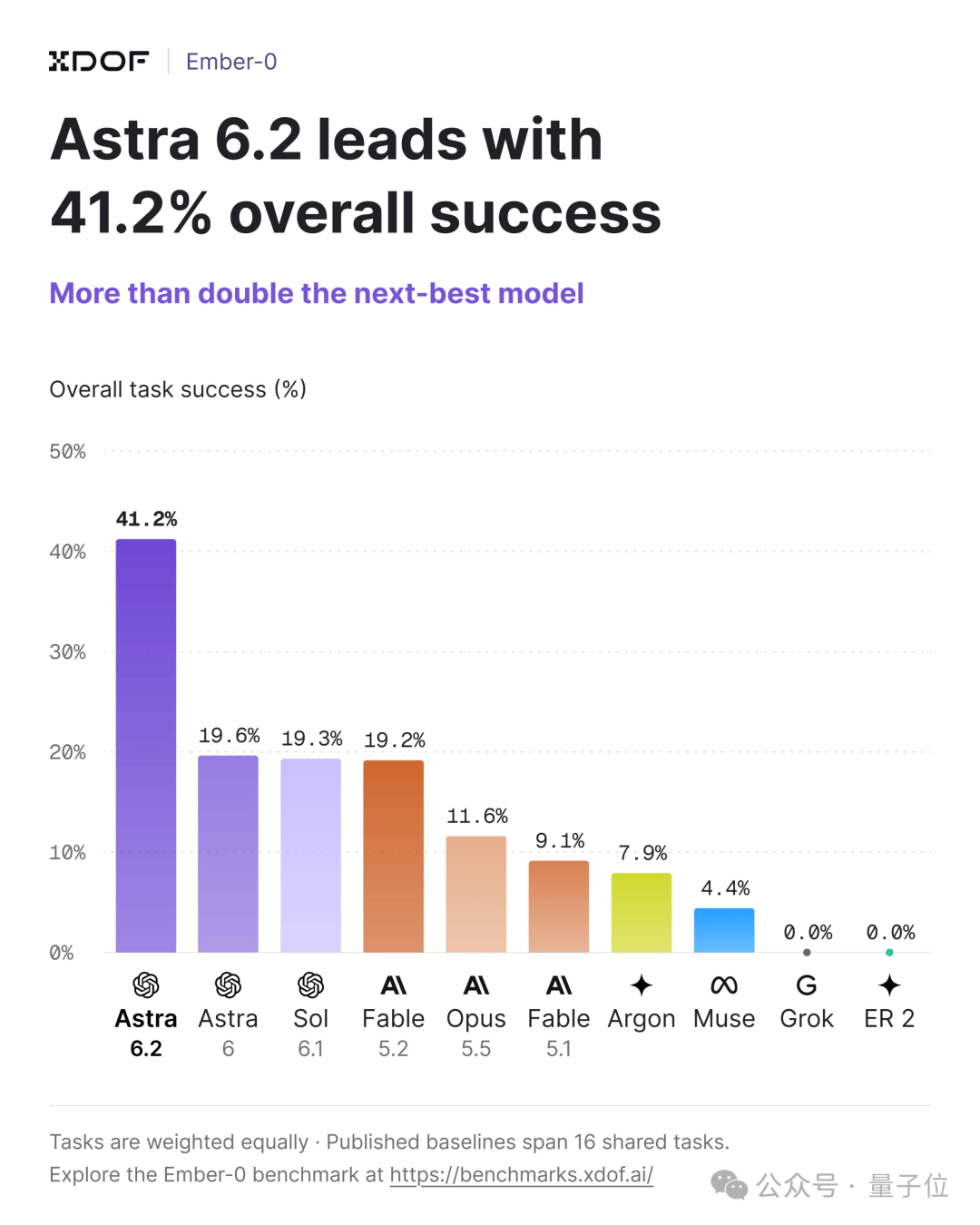
TL;DR - XDOF reports that GPT-6.2 Astra more than doubled GPT-6 Astra’s average success rate on 16 real-world robotic manipulation tasks, reaching 41.2%. The gains suggest general-purpose multimodal models are improving at complex embodied tasks, though inference latency remains a barrier.

  • The Ember-0 benchmark used six dual-arm YAM workstations, with 30 trials per task and human annotation of errors and hardware variability.
  • GPT-6.2 Astra completed previously unsolved tasks such as tying a knot and unfolding a T-shirt, which require deformable-object control, bimanual coordination, and long-horizon planning.
  • Its largest reported task gain was picking up bread with tongs, improving from 10% to 90% success.
  • Average prediction latency fell from 15 seconds to 10.1 seconds, but remains too slow for responsive continuous control.

Research Integrity 1

Sleuth finds ‘impossible proteins’ in hundreds of research papers

Rank 60 · Content 65 · Popularity 47

TL;DR - A Nature investigation reports “impossible proteins” across hundreds of research papers, suggesting a potentially widespread research-integrity problem that has already prompted corrections and retractions.

  • The reported protein anomalies appear in hundreds of publications.
  • The investigation indicates the issue may be systemic rather than isolated.
  • Journals have begun correcting or retracting affected papers.
  • The limited excerpt does not explain how the proteins were identified or why they are impossible.
Top highlights — Opinions

Bioinformatics AI 1

Representative image for 为什么细胞大模型,有时还不如简单模型?

为什么细胞大模型,有时还不如简单模型?

Rank 75 · Content 85 · Popularity N/A

TL;DR - Computational biologist Fabian Theis discusses why large cell models can still underperform simple baselines when predicting cellular responses to genetic or environmental interventions. The gap highlights fundamental challenges in data quality, learning objectives, and evaluation.

  • The goal is to move from observing cells toward predicting and designing interventions.
  • More data and larger models do not necessarily yield better cellular-response predictions.
  • Strong baselines are essential for determining whether complex models learn meaningful biology.
  • Theis’s team helped develop single-cell tools including Scanpy, AnnData, and scverse.