🛰️ Daily AI Frontier
⚠ WeChat login expired or unavailable — new articles may be missing. Reconnect WeChat. An upstream outage cannot be fixed by scanning. Latest stored WeChat publication: 2026-08-25.

WeChat reconnect targets werss, while collection still uses wewe. Login alone does not complete the provider cutover.

Twitter/X collection is rate limited. 0 of 13 handles succeeded at the last check. Stored posts remain available; partial coverage is not a complete timeline.
43 works · 3 categories · 16 topics · rednote 10 blog 12 journal 5 arxiv 15 generated 2026-11-22 15:32:15 UTC
Top highlights — Research

LLM Agents 6

Representative image for 精读:先说意图再跑合成

精读:先说意图再跑合成

Rank 85 · Content 100 · Popularity N/A

TL;DR - VibeSyn is a hierarchical agent system that turns chemists’ synthesis intentions and accumulating experimental evidence into adaptive, executable laboratory decisions. It demonstrated evidence-driven optimization, a ten-step catharanthine synthesis, and automated production of non-natural-amino-acid cyclic peptides.

  • The catharanthine campaign executed 722 actions and produced 160 mg; the final reduction achieved 95% isolated yield, not 95% overall yield.
  • A reaction reached 81% yield after seven evidence-driven optimization rounds.
  • The cyclic-peptide workflow produced 15 compounds meeting reported chemical-quality criteria, but no binding or functional results were provided.
  • Human input and safety oversight remained necessary, including catalyst selection and restricted procedures.
The FrontierOR Challenge: Agentic Algorithm Design for Operations Research

Rank 82 · Content 95 · Popularity N/A

TL;DR - FrontierOR is a benchmark challenge testing whether LLM-agent workflows can autonomously design scalable algorithms for operations research problems. It targets a major gap: the strongest one-shot model currently matches Gurobi’s speed and comes within 1% of its objective on only 39% of large instances.

  • Stage 1 releases 60 of 180 audited problems across six application categories and five formulation types.
  • Stage 2 evaluates generalization on new problems and unseen instances.
  • Main-track algorithms run in a network-isolated, open-source-only sandbox; Self-hosted entries may use any software under time limits.
  • Feasible solutions are scored against frozen reference objectives over hidden instances.
Representative image for 8万条群聊消息做成考卷:腾讯元宝×KCL发布首个基于群聊构建的Agent记忆基准

8万条群聊消息做成考卷:腾讯元宝×KCL发布首个基于群聊构建的Agent记忆基准

Rank 82 · Content 95 · Popularity N/A

TL;DR - Tencent Yuanbao and King’s College London introduced GroupAssistBench, a benchmark testing whether agents can retrieve and correctly apply memories from real multi-user chats. Results show strong recall does not necessarily translate into effective, constraint-aware assistance.

  • The benchmark contains 2,395 tasks derived from 80,299 messages across 50 real group chats, with anonymization and privacy review.
  • It evaluates factual recall (L1) and open-ended service performance (L2), including multi-memory integration and handling updated or conflicting information.
  • Across 14 configurations, EverMemOS outperformed full-context input on L1 recall (0.621 vs. 0.570) but underperformed it on L2 service tasks (0.247 vs. 0.431).
  • Relational evidence refinement and explicit constraint binding improved L2 scores across several memory systems, with combined gains of up to 7.03 percentage points.

ZeroVLN: Learning to Navigate without Supervised Fine-Tuning of the VLM Brain

Rank 78 · Content 85 · Popularity 63

TL;DR - ZeroVLN enables vision-language navigation without supervised fine-tuning of the VLM brain, preserving its general visual capabilities while outperforming representative SFT-based hierarchical methods on VLN-CE benchmarks.

  • Uses a slow-fast framework pairing a VLM brain with an action expert.
  • Communicates movement decisions through natural-language tool calls rather than geometric-goal predictions.
  • Jointly optimizes decision-making and continuous execution with closed-loop reinforcement learning.
  • Produces only minor VLM weight changes while retaining general capabilities.
Representative image for 少问大模型,成功率涨24%成本降65%

少问大模型,成功率涨24%成本降65%

Rank 78 · Content 90 · Popularity N/A

TL;DR - An on-demand reasoning framework uses a task-state monitor to invoke an LLM only at critical points in long-horizon robot manipulation. It improves success rates while substantially reducing token costs.

  • The monitor combines temporal visual observations with interaction memory to estimate progress and predict the next subtask.
  • LLM reviews are event-triggered for anomalies, supporting both low-level execution repair and plan revision.
  • On RMBench, success rose 24.0 percentage points over an agent baseline while token use fell 65.3%.
  • It also beat a policy baseline by 15.1 percentage points and showed qualitative effectiveness on three real-robot tasks.
Representative image for Seer: Guiding Small Deep-Research Agents with Shared Decision Models

Seer: Guiding Small Deep-Research Agents with Shared Decision Models

Rank 76 · Content 95 · Popularity 31

TL;DR - Seer improves small, locally run deep-research agents by using shared offline-trained models to simulate tool responses and estimate action value. It boosts benchmark accuracy without executing discarded candidate actions or retraining guidance models for each agent.

  • Separates agent action proposals from learned consequence prediction and value estimation.
  • Trains reusable simulator and value models on real research trajectories.
  • GAIA accuracy improves from 13.6% to 41.7% for Qwen3.5-4B and from 22.3% to 50.5% for Qwen3.5-9B.
  • Wider candidate search helps despite imperfect simulation, but prediction and scoring errors constrain gains.

Medical/Healthcare AI 5

Representative image for InclusionMed |医疗AI评测,我们还漏掉了谁?

InclusionMed |医疗AI评测,我们还漏掉了谁?

Rank 88 · Content 100 · Popularity 60

TL;DR - InclusionMed introduces a role- and capability-aware framework for evaluating medical AI, showing that aggregate scores can obscure major differences across healthcare use cases and costs.

  • InclusionMed Atlas maps healthcare roles—patients, professionals, and administrators—against knowledge, reasoning, and action capabilities.
  • The study reproduced eight shortlisted benchmarks, retained four public benchmarks, and added the private 312-case DxFiles diagnostic-reasoning benchmark.
  • It evaluated 22 versions across 11 model families; rankings varied by role and capability, while similarly scoring models showed an estimated 24× reasoning-cost difference.
  • The first release covers only three cells of its role-capability matrix and lacks patient-focused benchmarks, so its results should not be treated as clinical deployment evidence.
Representative image for 🔥Nature Medicine 爆文|AI 大模型考医学高分,普通人用它看病反而没用? 很多人觉得 LLM 医学考试接近满分,拿来当线上问诊助手稳了 这篇随机对照预注册研究,直接推翻这个认知✅ 📌六

🔥Nature Medicine 爆文|AI 大模型考医学高分,普通人用它看病反而没用? 很多人觉得 LLM 医学考试接近满分,拿来当线上问诊助手稳了 这篇随机对照预注册研究,直接推翻这个认知✅ 📌六

Rank 82 · Content 95 · Popularity N/A

TL;DR - A preregistered randomized study found that although LLMs performed well independently on medical scenarios, they did not improve ordinary users’ diagnostic or treatment decisions. The gap highlights human–AI interaction as a major barrier to safe consumer medical AI.

  • The study randomized 1,298 participants across 10 clinical scenarios, comparing access to GPT-4o, Llama 3, or Command R+ with self-directed information search.
  • LLMs alone achieved 94.9% disease identification accuracy but only 56.3% accuracy for recommended management.
  • LLM-assisted users scored below 34.5% on disease identification and below 44.2% on management, with no statistically significant advantage over controls.
  • Users struggled to provide relevant information and distinguish correct guidance from mixed-quality responses; the study did not cover high-risk emergencies or long-term outcomes.
Representative image for Nature:糖尿病大鼠成功恢复正常血糖!用电刺激迷走神经控糖

Nature:糖尿病大鼠成功恢复正常血糖!用电刺激迷走神经控糖

Rank 78 · Content 90 · Popularity N/A

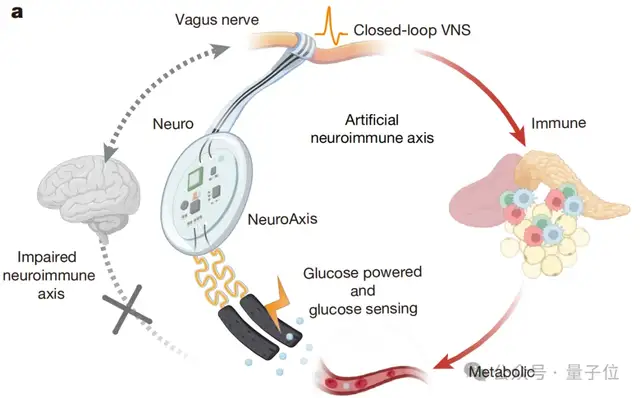
TL;DR - A Nature study presents NeuroAxis, a battery-free implant that uses glucose-generated power to trigger closed-loop vagus nerve stimulation, restoring normal glucose control in diabetic rats. It suggests neuroimmune modulation could complement insulin-based treatment, though human efficacy and long-term durability remain unproven.

  • A glucose fuel cell both powers the device and senses glucose, activating stimulation only after sustained hyperglycemia.
  • Type 2 diabetic rats approached healthy glucose levels within two weeks; type 1 models regained normal control after eight weeks.
  • Treated type 1 rats showed rising insulin levels and pancreatic beta-cell proliferation.
  • Translation challenges include human beta-cell biology, persistent autoimmunity, implant safety, and fuel-cell degradation.

Author Correction: SARS-CoV-2 mRNA vaccines sensitize tumours to immune checkpoint blockade

Rank 39 · Content 35 · Popularity 48

TL;DR - This is an author correction to a Nature paper about SARS-CoV-2 mRNA vaccines sensitizing tumours to immune checkpoint blockade. The provided content does not specify what was corrected or describe the study’s findings.

  • Published online by Nature on 20 November 2026.
  • The correction concerns research connecting mRNA vaccination with cancer immunotherapy response.
  • No technical results, methods, or correction details are included in the provided excerpt.

Author Correction: Pharmacological inhibition of METTL1 as a therapy against solid and blood cancers

Rank 32 · Content 25 · Popularity 48

TL;DR - This is an author correction to a Nature study on pharmacologically inhibiting METTL1 as a potential therapy for solid and blood cancers. The provided content does not specify what was corrected or report technical results.

  • Published online on 19 November 2026.
  • Refers to research targeting METTL1 in both solid and hematological cancers.
  • The correction’s nature and its effect on the original conclusions cannot be determined from the provided text.

Bioinformatics AI 1

Representative image for CryoGaussian: Heterogeneous Cryo-EM Reconstruction Made Explicit with Gaussian Splatting

CryoGaussian: Heterogeneous Cryo-EM Reconstruction Made Explicit with Gaussian Splatting

Rank 78 · Content 95 · Popularity 38

TL;DR - CryoGaussian uses explicit Gaussian splatting to reconstruct heterogeneous macromolecular structures directly from noisy cryo-EM particle images. It reports state-of-the-art CryoBench accuracy while resolving rare and continuous structural states more efficiently.

  • Joint particle-image and per-Gaussian latents model compositional and conformational variation.
  • A differentiable rasterizer incorporates orthographic line integrals and the contrast transfer function.
  • Experimental results resolve a ribosomal state comprising only 1.3% of particles and spliceosome motion.
  • An optimized additive projection rasterizer reduces training time by 12.8–28.0×.

Multimodal & Generative 7

ViDecide: Teaching Video Diffusion Models to Reason and Plan Step by Step

Rank 87 · Content 95 · Popularity 69

TL;DR - ViDecide trains video diffusion models to reason through causal state transitions and decide when to stop, rather than generating fixed-length solutions. It substantially improves multi-step visual planning reliability without policy-gradient optimization.

  • Introduces decision-centric training and a decision-focused schedule for video diffusion models.
  • Corrective Fine-tuning maps noise from failed decisions to the model’s successful continuations.
  • Achieves 83.8% average strict success, versus 23.3% for standard fine-tuning and 67.8% for the strongest prior method.
  • Generalizes to larger puzzles and unseen layouts across games, planning tasks, and robot-planning benchmarks.
Representative image for HiUni: Harmonizing Understanding and Generation in Shared Visual Space

HiUni: Harmonizing Understanding and Generation in Shared Visual Space

Rank 82 · Content 90 · Popularity 64

TL;DR - HiUni unifies visual understanding and image generation by sharing a language-aligned ViT and dense Transformer backbone. It preserves the pretrained VLM’s average understanding performance while achieving competitive image generation and editing results.

  • Task-specific computation is confined to output-side components rather than separate backbones.
  • A Pixel Diffusion Head enables direct pixel-space generation.
  • A lightweight HiGate pathway restores fine spatial details lost through semantic abstraction.
  • Experiments suggest one dense backbone can support both understanding and generation effectively.
Representative image for Streaming-AAA: Streaming AAA Game Video Generation at High Resolution, High Frame Rate, and Low Latency

Streaming-AAA: Streaming AAA Game Video Generation at High Resolution, High Frame Rate, and Low Latency

Rank 82 · Content 95 · Popularity N/A

TL;DR - Streaming-AAA is a controllable diffusion-based system for indefinitely generating interactive, AAA-quality game video. It reports 1080p output at 43 FPS with 198 ms end-to-end interaction latency on NVIDIA A800 GPUs.

  • Redesigns the VAE for efficient real-time, high-resolution decoding.
  • Uses diffusion forcing and longer temporal pretraining to capture long-term dependencies and preserve memory.
  • Applies post-training distillation and memory compression to accelerate inference while retaining visual and temporal quality.
  • Improves fidelity, responsiveness, frame rate, and long-horizon stability over prior controllable video-generation methods.
Representative image for Posterior Matching Distillation

Posterior Matching Distillation

Rank 80 · Content 85 · Popularity 69

TL;DR - Posterior Matching Distillation (PMD) accelerates diffusion generation while preserving more of the teacher model’s sample diversity. It achieves leading FID among tested four-step methods on SDXL and FLUX.2 [klein] 4B.

  • PMD counters reverse-KL’s mode-seeking bias by learning mode-covering clean-image posteriors at trained noise levels.
  • Its stochastic student supports flexible sampling budgets on the trained timestep grid without retraining.
  • The method identifies full conditional posteriors through exponentially tilted mean constraints, requiring no auxiliary student-score network.
  • Experiments report competitive or leading prompt-alignment and perceptual-quality metrics alongside the best four-step FID.
Representative image for EgoCaptioner: Towards Comprehensive and Fine-Grained Egocentric Video Captioning

EgoCaptioner: Towards Comprehensive and Fine-Grained Egocentric Video Captioning

Rank 79 · Content 85 · Popularity 65

TL;DR - EgoCaptioner is an egocentric video-captioning system that combines video-level context with detailed, temporally aligned action steps. It improves caption quality, question answering, and temporal alignment across five benchmarks.

  • Uses coarse-to-fine annotation to produce 50,000 training examples from eight egocentric video sources.
  • Applies GRPO with rewards for factual coverage, temporal alignment, and reduced fragmentation or redundancy.
  • Supplements caption references with pose-derived motion facts when sensor data are available.
  • Outperforms evaluated open-source models and beats select proprietary baselines on PhysCapBench and Minerva-Ego.
Representative image for 多模态大模型的视觉推理能力 ✅多模态大模型做隐式推理时,常常踩两个大坑:视觉部分优化不到位,固定的模型深度对付不了难度不一的样本,北理工这套 Vedas 框架对症下药,跳出传统显式思维链,把推理藏在隐

多模态大模型的视觉推理能力 ✅多模态大模型做隐式推理时,常常踩两个大坑:视觉部分优化不到位,固定的模型深度对付不了难度不一的样本,北理工这套 Vedas 框架对症下药,跳出传统显式思维链,把推理藏在隐

Rank 78 · Content 90 · Popularity N/A

TL;DR - Vedas is a multimodal reasoning framework that internalizes reasoning in latent space while dynamically allocating computation. It reportedly improves visual retention and achieves state-of-the-art results across 12 benchmarks with 3–6× faster inference than explicit chain-of-thought methods.

  • SCF-VR identifies and re-encodes key image regions, using self-distillation to preserve spatial details during long reasoning.
  • RDS scores tokens and assigns more iterations to difficult or information-dense ones while reusing layer weights.
  • Curriculum learning gradually compresses explicit reasoning chains into latent vectors without external teacher distillation.
  • Reported evaluations include MathVista and MMVP, with over 10× fewer autoregressive steps than explicit chain-of-thought.
Representative image for Direct3D-V3: Latent-Free Diffusion Transformers in the Native Voxel Domain

Direct3D-V3: Latent-Free Diffusion Transformers in the Native Voxel Domain

Rank 77 · Content 90 · Popularity 47

TL;DR - Direct3D-V3 is a latent-free diffusion transformer that generates 3D geometry directly as signed-distance-function voxel grids, eliminating the VAE reconstruction bottleneck. It targets richer local detail, watertight surfaces, and better image-to-geometry alignment.

  • Uses native SDF voxels for training and sampling rather than compressed latent representations.
  • Adds implicit manifold regularization and rendered-normal supervision after Marching Cubes conversion.
  • Predicts conditioning-image camera parameters as an auxiliary task to improve geometric alignment.
  • Supports generative reconstruction with normal-guided refinement while completing unseen regions using the learned prior.

Efficiency & Systems 3

NariQ: Sub-3-Bit Quantization for Long-Horizon Agentic Tasks

Rank 86 · Content 100 · Popularity 52

TL;DR - NariQ is a post-training quantization method calibrated on agent-generated trajectories rather than short web text. It enables Qwen3.8-27B at 2.5–3.0 bits per weight to match BF16 performance across long-horizon agentic and shorter benchmarks.

  • Uses trellis-coded quantization calibrated on BF16-generated agent-session tokens.
  • Matches BF16 on DeepSWE, Terminal Bench, AIME, and RealWorldQA at 2.5 and 3.0 bits per weight.
  • The 2.0-bit checkpoint performs worse than the higher-bit variants.
  • The authors released GGUF checkpoints and a llama.cpp inference fork.
Representative image for Online Temporal Rotations for 2 Bit KV-Cache Quantization in Video Diffusion Transformers

Online Temporal Rotations for 2 Bit KV-Cache Quantization in Video Diffusion Transformers

Rank 82 · Content 95 · Popularity N/A

TL;DR - Temporal Rotation Quantization (TRQ) compresses video diffusion transformers’ KV caches to 2-bit precision by fitting lightweight, video-specific temporal rotations online. It reduces memory bottlenecks in long-video generation while improving quality over prior quantization methods.

  • TRQ rotates temporally adjacent cache vectors to flatten channel means and reduce quantization error.
  • Its transforms combine 2-bit planar rotations with a fixed Hadamard transform, requiring no gradients or model-weight changes.
  • A greedy fitting procedure is proven globally optimal for the method’s mean-flattening objective.
  • At matched compression, TRQ improves VBench subject consistency over QVG from 90.38 to 92.02 on LongCat-Video-13B and from 86.33 to 87.61 on HY-WorldPlay-8B.
Representative image for GLiDE: A Fast, Calibrated Decision Model Distilled from Reasoning Teachers

GLiDE: A Fast, Calibrated Decision Model Distilled from Reasoning Teachers

Rank 79 · Content 90 · Popularity 52

TL;DR - GLiDE distills reasoning teachers into calibrated decision models that score candidate answers in one forward pass. It retains reasoning benefits without generating chains of thought, enabling fast inference across models from 0.4B to 27B parameters.

  • Removes causal masking from full-attention layers to enable bidirectional interaction among context, questions, and candidate answers.
  • Combines soft-target distillation from multiple teachers with progressive post-training on diverse decision tasks.
  • GLiDE 27B scores 71.52 with 2.0% calibration error and 92.9 ms median single-GPU latency.
  • Checkpoint averaging and parameter-free recurrent depth raise its score to 73.37 with 2.1% calibration error.

Generative Search Security 1

GEOHunter: Mapping a Generative Engine Optimization Network in the Wild

Rank 82 · Content 95 · Popularity N/A

TL;DR - GEOHunter maps a coordinated paid-content network that manipulates generative-engine recommendations through promotional posts on Chinese UGC platforms. Its measurable influence across nine engines shows that content-only defenses are inadequate.

  • The network involved 1,985 accounts and an estimated 466,357 promotional placements across three platforms.
  • Depending on attribution strictness, 4.5%–20% of retrievable cited pages came from the network.
  • On eight engines, promoted clients appeared in 52% of answers, versus 68% for category leaders.
  • Effective defenses likely require account- and platform-level coordination signals.

Genomics 1

Author Correction: Replication-stress-induced chromatin loops protect fork stability

Rank 32 · Content 25 · Popularity 48

TL;DR - This is an author correction to a Nature paper on replication-stress-induced chromatin loops and DNA replication-fork stability. The provided content does not specify what was corrected or whether the study’s conclusions changed.

  • Published online on 19 November 2026.
  • The underlying study concerns chromatin organization during DNA replication stress.
  • No correction details or technical results are included in the provided text.

Humanoid Robotics 1

Representative image for Awaken-HI: Scaling Humanoid Intelligence with Whole-Body Human Experience

Awaken-HI: Scaling Humanoid Intelligence with Whole-Body Human Experience

Rank 82 · Content 95 · Popularity N/A

TL;DR - Awaken-HI is a vision-language-action model trained with 50,000 hours of synchronized egocentric video and whole-body human motion to transfer loco-manipulation skills to humanoid robots. It achieves 93.75% mean success across eight real-robot tasks and generalizes to unseen objects and novel object-destination pairings.

  • Awaken-Human covers over 100 skills with synchronized stereo video and whole-body trajectories.
  • A shared action expert jointly predicts human motion and retargeted robot actions.
  • More human pretraining data follows an empirical scaling law, reducing robot-action prediction error and improving downstream success.
  • Awaken-HI outperforms GR00T N1.7 and π₀.₅ on individual and long-horizon evaluations.
Top highlights — Industry & News

LLM Agents 2

Representative image for 反超Gemini之后,Karpo新作再开源,浏览器Agent速效双赢

反超Gemini之后,Karpo新作再开源,浏览器Agent速效双赢

Rank 75 · Content 85 · Popularity N/A

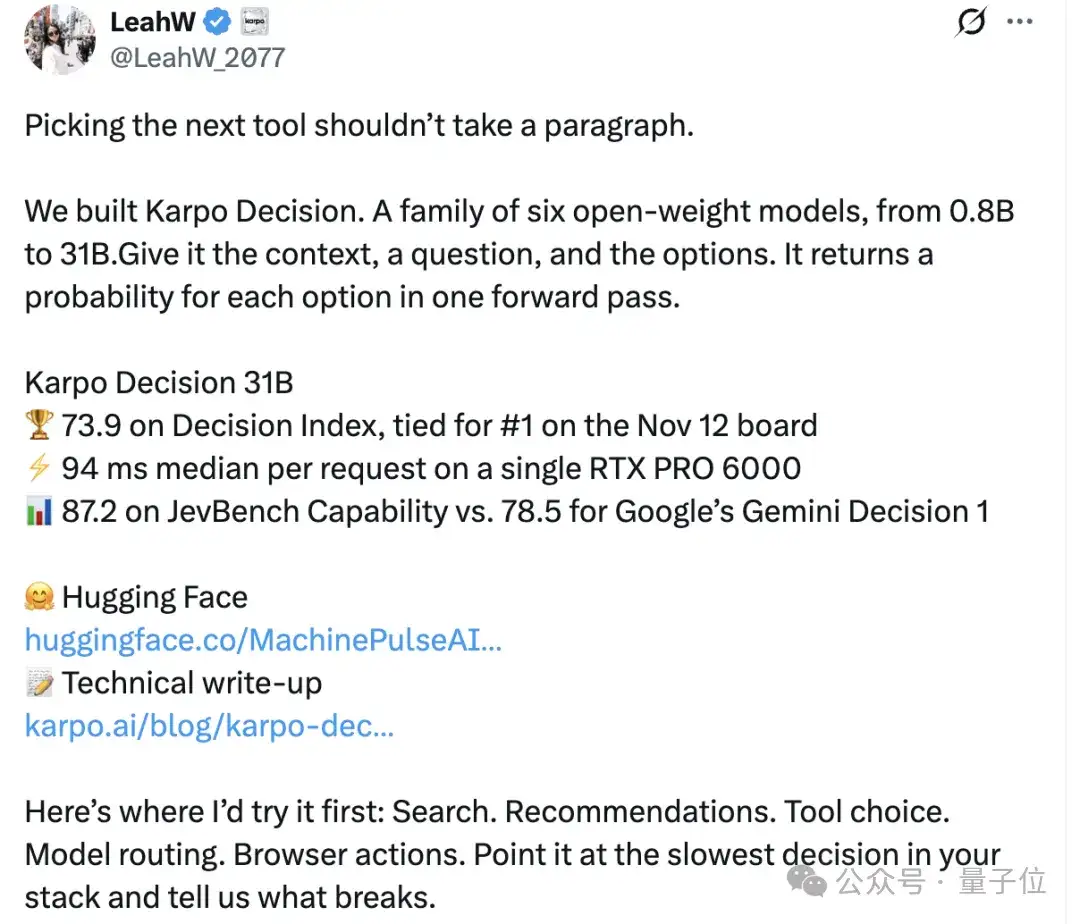
TL;DR - MachinePulse open-sourced its Karpo decision models and browser-agent stack, designed to handle frequent agent decisions faster and more cheaply than general-purpose LLMs. The release combines specialized action models, a TypeScript browser framework, and an evaluation suite.

  • Karpo Decision 31B reportedly led Decision Index with a 73.9 score and 2.3% calibration error, with 94 ms median latency across public-set requests.
  • The System 1/System 2 browser architecture delegates webpage actions to Karpo Decision 27B Act while a general LLM handles planning and complex reasoning.
  • On 102 Browserbase Benchmark v2 tasks, the stack reported 89% average success, 201-second average runtime, and $0.096 model cost per task.
  • Released assets include six Karpo Decision sizes from 0.8B to 31B, the 27B Act model, karpo-browser, and the KBB benchmark covering 23,075 actions across 584 websites.
Representative image for 全网疯传!Grok一姐教你如何月提交3000个PR

全网疯传!Grok一姐教你如何月提交3000个PR

Rank 61 · Content 65 · Popularity N/A

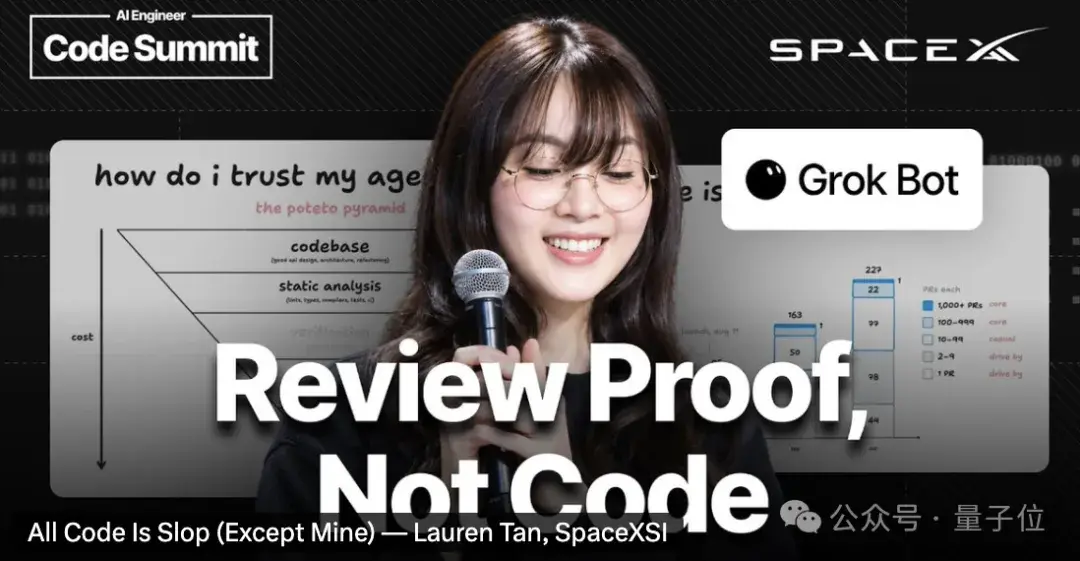
TL;DR - A Grok Bot engineer describes an AI coding workflow that reportedly helped her submit 3,000 PRs in one month. The approach prioritizes clean codebases, deterministic constraints, and extensive automated verification over natural-language agent instructions.

  • Convert recurring agent mistakes into lint rules, type constraints, tests, or safer API designs instead of adding instructions to AGENTS.md.
  • Restrict error-prone patterns—such as most comments and direct useEffect usage—to prevent agents from copying technical debt or applying fragile patches.
  • Give agents runtime debugging tools, reusable verification skills, and formal methods such as TLA+, Lean, and property-based UI testing.
  • The Grok Bot team reports 11,000 PRs in October, a 0.5% withdrawal rate, and an automated pipeline that can find bugs, create fixes, and sometimes merge them.

Bioinformatics AI 1

Representative image for 🧬2026全球虚拟细胞挑战赛收官

🧬2026全球虚拟细胞挑战赛收官

Rank 85 · Content 100 · Popularity N/A

TL;DR - The 2026 Virtual Cell Challenge tested zero-shot prediction of CRISPRi-induced transcriptional responses across three cell lines. Results improved over last year, but models still struggled with cell-line-specific biology.

  • Illumina’s BioInsight AI Lab won with 0.4399, covering 44% of the gap from a background-mean baseline to experimental reproducibility.
  • All three winning systems used modular pipelines combining public perturbation data, control-cell adaptation, and synthetic-cell generation—not end-to-end foundation models.
  • Predictions were overly similar across cell lines and substantially overcalled differentially expressed genes.
  • The results suggest reference-data quality and transfer strategy currently matter at least as much as model architecture.

LLMs & Foundation Models 3

Representative image for Inkling 2 Mini离线跑赢同级

Inkling 2 Mini离线跑赢同级

Rank 78 · Content 90 · Popularity N/A

TL;DR - Thinking Machines released Inkling 2 Mini, an open-weight MoE model designed to run offline in about 20GB of VRAM. It leads comparable sub-100B open models in coding and retrieval benchmarks, though it trails Qwen3.8-27B on long-running agent tasks.

  • The model has 26.4B total parameters, 3.4B active parameters, recurrent layers, and mostly NVFP4-quantized weights.
  • It scored 77.9% on SWE-Bench Pro v2 Hard, versus 73.8% for Qwen3.8-27B.
  • Its AutomationBench score was 41.8%, below Qwen3.8-27B’s 48.2%, indicating weaker sustained autonomy.
  • Its reported violation rate was 9.8%, compared with 27.6%–57.7% for peers.
Representative image for 今天AI圈5件大事🔥黎曼猜想

今天AI圈5件大事🔥黎曼猜想

Rank 75 · Content 85 · Popularity N/A

TL;DR - This AI news roundup covers a purported Claude-assisted Riemann hypothesis proof, two open-weight model releases, a drug-chemistry benchmark, and cheaper real-time voice AI. The proof remains unverified by peer review, while the product releases emphasize local deployment and lower operating costs.

  • Tencent released weights for the 770B-parameter Hy4 mixture-of-experts multimodal model.
  • Thinking Machines’ 26.4B-parameter Inkling 2 Mini reportedly runs in about 20GB of GPU memory.
  • OpenAI introduced the 99-question MedChemBench and reduced idle GPT-Live-1.1 WebRTC pricing by 60%.
  • The claimed Riemann hypothesis proof has machine-checked Lean code but awaits full academic review.

Welcome Inkling 2 Mini, Cutting-edge Performance for your Local Setup

Rank 64 · Content 70 · Popularity N/A

TL;DR - Hugging Face announces Inkling 2 Mini, positioned as a cutting-edge model for local setups. Only the title is provided, so specific capabilities and results cannot be verified.

  • The “Mini” designation suggests an emphasis on compact, locally deployable use.
  • No architecture, benchmarks, hardware requirements, or licensing details are available in the provided content.

Multimodal & Generative 3

Representative image for 1.5B开源ASR,专治悄悄话

1.5B开源ASR,专治悄悄话

Rank 71 · Content 80 · Popularity N/A

TL;DR - GLM-ASR-Nano-2512 is a new 1.5B-parameter open-source speech-recognition model focused on dialects and low-volume or whispered speech. Its developers claim lower average error rates than comparable open models and better results than Whisper V3 on several benchmarks.

  • Optimized for Mandarin, English, Cantonese, and other Chinese dialects.
  • Trained to transcribe extremely quiet audio that conventional ASR models may miss.
  • Reported average error rate is 4.10, with strong results on Wenet Meeting and Aishell-1.
  • Supports WAV, MP3, and FLAC through vLLM and OpenAI-compatible APIs.
Representative image for 当AI影视遇上文化出海:优秀作品亮相第47届美国电影市场

当AI影视遇上文化出海:优秀作品亮相第47届美国电影市场

Rank 54 · Content 55 · Popularity N/A

TL;DR - AI-produced films featuring Chinese cultural themes debuted at the 47th American Film Market, securing multiple Hollywood buyer agreements. The projects show generative AI moving from production experiments toward international distribution and IP commercialization.

  • Reverse Clock Entertainment and Zhaoyuan Culture presented the AI film projects Effigy and Confirmation.
  • The teams negotiated overseas presales, licensing territories, release windows, and delivery requirements.
  • Effigy combines AI-assisted filmmaking with a story centered on traditional Chinese paper-effigy craftsmanship and intergenerational memory.
  • The companies are developing PLUG, a platform connecting creators and IP owners with international buyers for licensing and distribution.
Representative image for AI给乐队现场搓MV,这是黑客松还是音乐节啊

AI给乐队现场搓MV,这是黑客松还是音乐节啊

Rank 50 · Content 50 · Popularity N/A

TL;DR - CapCut hosted an AI music-visual hackathon where creators used CapCut Hub to produce stage-ready music videos and VJ visuals for real bands within hours. The event showed how integrated generative-video tools can sharply reduce production time and technical barriers.

  • More than 20 teams competed across four music genres, with selected 4K works displayed during live performances.
  • CapCut Hub combined ideation, AI visual generation, editing, and music synchronization in one workflow.
  • AI enabled effects previously requiring specialized 3D modeling, rendering, and production expertise.
  • As generation becomes easier, storytelling, musical synchronization, aesthetic judgment, and quality control become key differentiators.

Efficiency & Systems 2

Representative image for DSA(DeepSeek Sparse Attention)是 DeepSeek 提出的一种稀疏注意力机制,主要用于降低大模型在长上下文场景下的 Attention 计算和 KV Cache 读取开销

DSA(DeepSeek Sparse Attention)是 DeepSeek 提出的一种稀疏注意力机制,主要用于降低大模型在长上下文场景下的 Attention 计算和 KV Cache 读取开销

Rank 75 · Content 85 · Popularity N/A

TL;DR - DeepSeek Sparse Attention (DSA) accelerates long-context inference by selecting the Top-K most relevant historical tokens before computing exact attention. This reduces attention computation and KV-cache bandwidth demands.

  • A Lightning Indexer scores historical tokens against each query.
  • Sparse Attention accesses only the keys and values selected by Top-K ranking.
  • Key implementation challenges include Top-K overhead, non-contiguous KV access, GPU memory coalescing, and sparse-kernel optimization.
Representative image for 中国计算,走出新的登峰之路

中国计算,走出新的登峰之路

Rank 68 · Content 75 · Popularity N/A

TL;DR - China’s domestically built Sugon 8000 heterogeneous AI supercluster supported an ACM Gordon Bell Prize-winning quantum chemistry project and finalist-scale weather simulation. Its rapid scientific output highlights the value of integrating CPUs, GPUs, mixed precision, networking, and scheduling around real workloads rather than peak benchmarks.

  • The 100,000-accelerator cluster entered service in July 2026 and has optimized over 300 applications across more than 30 fields.
  • A neural-network quantum-state project scaled from thousands to tens of thousands of accelerators, enabling calculations on large strongly correlated electron systems.
  • The SD3 system achieved global weather simulation at 1.5-kilometer resolution, relying heavily on FP64 accelerator computation.
  • BF16 weak-scaling efficiency reportedly remained 94.9% through 45,000 accelerators, with 93.93% system-wide weak-scaling efficiency.

AI Industry Roundup 1

Representative image for 特朗普表态:英伟达Blackwell芯片可对华销售,但有个条件;OpenAI被曝入局智能手机赛道;DeepSeek第二轮千亿融资落地,31家出资方入局

特朗普表态:英伟达Blackwell芯片可对华销售,但有个条件;OpenAI被曝入局智能手机赛道;DeepSeek第二轮千亿融资落地,31家出资方入局

Rank 61 · Content 65 · Popularity N/A

TL;DR - A broad industry digest reports major AI financing, hardware-policy, device, cloud, and multimodal API developments. Key items include DeepSeek’s new investors, conditional prospects for Blackwell exports to China, and OpenAI’s reported smartphone plans.

  • DeepSeek reportedly completed a major financing round through a holding platform backed by 31 industrial and institutional investors.
  • Trump said Blackwell chips might become eligible for export to China only after they are no longer Nvidia’s most advanced products.
  • Foxconn reportedly secured an assembly order for an OpenAI smartphone, though specifications, volume, and production timing remain undisclosed.
  • ByteDance is reportedly negotiating $500 million in additional Azure spending, while Volcano Engine launched the SeedRealtime 1.0 real-time audio-video model API.

AI Research Integrity 1

Representative image for 大二「天才少女」刚拿下 ACM 最佳论文,立陷造假疑云,通讯作者独家回应

大二「天才少女」刚拿下 ACM 最佳论文,立陷造假疑云,通讯作者独家回应

Rank 50 · Content 50 · Popularity N/A

TL;DR - An ACM MM 2026 Best Paper on low-light image enhancement is being withdrawn after researchers identified questionable comparisons, fabricated or incorrect citations, and other experimental irregularities. The controversy highlights weaknesses in peer review as AI-conference submissions surge.

  • Critics alleged unfair baselines, mischaracterized synthetic data, suspicious user-study scores, and an overstated Clifford-algebra contribution.
  • At least one cited paper reportedly does not exist, while two other references contain incorrect author information.
  • The corresponding author denied algorithmic fabrication but accepted responsibility for inadequate supervision; all authors requested withdrawal.
  • ACM MM’s program leadership confirmed receiving the request and is considering an official response.

AI Wearables 1

Representative image for 独家丨荣耀、腾讯背景团队创业做 AI 交互吊坠,已获李泽湘早期投资

独家丨荣耀、腾讯背景团队创业做 AI 交互吊坠,已获李泽湘早期投资

Rank 54 · Content 55 · Popularity N/A

TL;DR - KnowVoice, founded by former Honor engineer Xiao Yuwei, is developing an AI pendant that helps professionals express ideas using locally accumulated context. The startup has a prototype and early backing from Li Zexiang’s incubation ecosystem.

  • The pendant acts as a floating input layer across apps rather than replacing existing phone or computer input methods.
  • It targets intent understanding, contextual memory, and assisted writing or communication.
  • Core user data stays on-device without passing through KnowVoice’s servers.
  • The initial market is professionals with intensive information-processing needs, including developers, engineers, and independent creators.

AI Workforce 1

How AI is affecting science careers

Rank 42 · Content 40 · Popularity 48

TL;DR - Nature is promoting a webinar about how AI is changing scientific careers, including researchers’ roles, required skills and job security. The provided item is an event announcement and offers no research findings.

  • Focuses on AI’s impact on researchers’ day-to-day responsibilities.
  • Highlights changing skill requirements in scientific work.
  • Raises questions about employment stability as AI adoption grows.

AI for Astronomy 1

Claude, find me a planet: amateur astronomers are using AI with mixed results

Rank 53 · Content 55 · Popularity 48

TL;DR - Amateur astronomers are using AI tools such as Claude to identify potential exoplanets, but the reported candidates vary in credibility. The trend shows AI’s potential to broaden citizen science while underscoring the need for expert validation.

  • AI tools can help non-professionals analyze astronomical data for possible exoplanet signals.
  • Some previously unknown candidates have emerged, but their validity is uncertain.
  • The mixed results highlight the importance of rigorous follow-up and verification.

AI for Mathematics 1

Representative image for A社数学家用Claude又证明另一千禧难题,逼出一份写了12年的940页纯人类手稿

A社数学家用Claude又证明另一千禧难题,逼出一份写了12年的940页纯人类手稿

Rank 75 · Content 85 · Popularity N/A

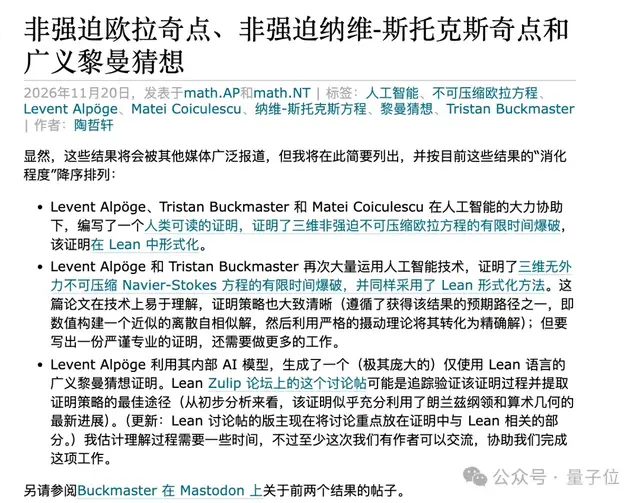
TL;DR - Anthropic mathematician Levent Alpöge and Tristan Buckmaster claim an AI-assisted proof of finite-time singularity formation for unforced 3D Navier–Stokes equations. The potentially landmark result remains unverified because key numerical certificates and reproducible checks are not yet public.

  • Claude helped generate, organize, and rewrite the proof, including translating Lean formalization into natural-language mathematics.
  • The proposed construction starts with a numerically identified self-similar flow and uses rigorous perturbation theory to argue that a true solution exists nearby.
  • Terence Tao considers the broad strategy understandable but says the work still needs a polished, professional proof and independent verification.
  • A separate 940-page, non-AI Riemann-hypothesis draft released the same day also remains under review, with researchers already reporting possible issues.
Top highlights — Opinions

Open Source AI 1

Representative image for RT by @AndrewYNg: At @dealbook with @AndrewYNg to spread the open science and opensource AI gospel…

RT by @AndrewYNg: At @dealbook with @AndrewYNg to spread the open science and opensource AI gospel…

Rank 33 · Content 25 · Popularity N/A

TL;DR - Andrew Ng amplifies a call for open science and open-source AI, arguing that both are especially important now. The brief post provides no technical details or specific initiatives.

  • Advocates openness in AI research and development.
  • Frames open-source AI as increasingly important.
  • Does not identify particular models, results, or policy proposals.