🛰️ Daily AI Frontier
⚠ WeChat login expired or unavailable — new articles may be missing. Reconnect WeChat. An upstream outage cannot be fixed by scanning. Latest stored WeChat publication: 2026-08-25.

WeChat reconnect targets werss, while collection still uses wewe. Login alone does not complete the provider cutover.

Twitter/X collection is rate limited. 0 of 13 handles succeeded at the last check. Stored posts remain available; partial coverage is not a complete timeline.
44 works · 3 categories · 18 topics · rednote 10 blog 12 journal 10 arxiv 15 generated 2026-11-24 15:36:13 UTC
Top highlights — Research

LLM Agents 8

Representative image for RUIBench: What Makes a Good Robot-Use Interface?

RUIBench: What Makes a Good Robot-Use Interface?

Rank 86 · Content 95 · Popularity 65

TL;DR - RUIBench evaluates how robot-use interface design affects embodied agents across 30 manipulation tasks. Interface choice alone raised success from 45% to 81% for a frontier agent, showing that action abstraction and feedback are critical to reliable execution.

  • RUIKit compares 13 interfaces spanning six action abstractions and two interaction forms under shared perception and control.
  • Effective interfaces minimize unnecessary decisions while retaining essential environmental feedback.
  • A fine-tuned 4B model’s success ranged from 13% to 47% depending on the interface.
  • Agents often declared success despite observable failure, exposing a need for task-level verification.
Representative image for CO-GRAFT: Attributing Reinforcement Learning Gains in Search Agents via Role-Level Policy Grafting

CO-GRAFT: Attributing Reinforcement Learning Gains in Search Agents via Role-Level Policy Grafting

Rank 85 · Content 100 · Popularity N/A

TL;DR - CO-GRAFT attributes RL-driven accuracy gains in search agents to four functional roles using policy grafting and cooperative-game analysis. It reveals that reasoning, decision-making, and answer extraction—not query generation—account for most improvements.

  • It evaluates all 16 assignments of RL-trained versus pre-RL policies across reasoning, search-or-answer decisions, query generation, and answer extraction.
  • Shapley values quantify each role’s contribution, while Möbius terms identify interactions between roles.
  • Query generation contributes at most 15% of the total RL gain across tested Search-R1 configurations.
  • Credit shifts with model scale, initialization, answer validity, search retention, and search budgets; smaller base models especially depend on reasoning–decision coupling.

From Local Errors to System Failures: Modeling and Benchmarking Error Propagation in Multi-Agent LLM Systems

Rank 85 · Content 100 · Popularity N/A

TL;DR - REPA models how local errors propagate through multi-agent LLM workflows, enabling interpretable diagnosis and targeted recovery. It substantially outperforms direct regression in predicting system-level error behavior.

  • Separately models input assembly and agent processing across multiple error channels.
  • Evaluated on three Qwen models, six workflows, and ten knowledge and reasoning settings in ErrPropBench-10.
  • Achieves 0.84 mean condition-level Spearman correlation versus 0.47 for direct regression.
  • REPA-guided RAG improves accuracy by 19 percentage points on average with 16% more tokens.

SchemaCaps: When a Compatible Tool Update Silently Widens an AI Agent's Authority

Rank 85 · Content 100 · Popularity N/A

TL;DR - SchemaCaps formalizes when MCP tool-schema updates expand an AI agent’s authority and should trigger user re-approval. A study of 604 MCP server releases found authority-widening changes are common and often silently accepted as compatible.

  • None of eight surveyed MCP clients or scanners was observed or documented re-approving widened schemas; two were indeterminate.
  • The proposed rule uses subschema inclusion and defaults to distrusting field labels, with composition formally verified in Coq.
  • Among 580 compatible schema changes, 412 widened at least one coordinate; adjudication identified at least 76 changes that added or widened authority-bearing arguments.
  • SchemaCaps requested 645 re-approvals, compared with 617 under compatibility checks and 1,197 when pinning input schemas.

Intent-Conditioned Argument Mediation for Tool-Using LLM Agents: Blocking Trusted-but-Unauthorized Arguments

Rank 85 · Content 100 · Popularity N/A

TL;DR - IntentFlow mediates tool calls by checking authority-bearing arguments against user intent and provenance policies. It substantially reduces trusted-but-unauthorized actions while preserving strong benign-task performance.

  • Reduced attack success from 50.5% with provenance alone to 12.0% on 200 synthetic attacks.
  • Blocked all 50 trusted-but-unauthorized attacks, versus provenance-only mediation executing all 50.
  • Incorrectly blocked 0 of 200 paired benign tasks and 4 of 50 harder benign tasks.
  • Blocked all 17 corrupted calls proposed by a live planner across 110 attacks.
Representative image for Transport-Safe Evaluation of LLM Agents: Trajectory-Dependent Judge Error and Anytime-Valid Auditing

Transport-Safe Evaluation of LLM Agents: Trajectory-Dependent Judge Error and Anytime-Valid Auditing

Rank 85 · Content 100 · Popularity N/A

TL;DR - This paper shows that correcting LLM-agent evaluations with fixed judge error rates can produce severe bias when errors depend on agent trajectories. Randomly audited AIPW estimators largely eliminate this bias while supporting valid uncertainty estimates and rankings.

  • Scalar correction had up to 0.245 bias and failed to recover the full four-agent ranking across 250 replications.
  • Uniform and design-aware audits with AIPW reduced maximum bias below 0.003, with pointwise coverage near 0.94–0.95.
  • The framework reports bounds or sensitivity sets when calibration support or judge-independence assumptions fail.
  • An e-process confidence sequence remains valid under predictable adaptive auditing and arbitrary stopping for a stable target.
Representative image for CocoonBench: Can Multilingual Search Agents Escape Language Information Cocoons?

CocoonBench: Can Multilingual Search Agents Escape Language Information Cocoons?

Rank 85 · Content 100 · Popularity N/A

TL;DR - CocoonBench evaluates whether multilingual search agents can connect evidence scattered across languages. Even the best tested model scored below 70%, exposing substantial cross-lingual search weaknesses.

  • Tasks derive from frozen Wikidata relational paths and require clues that jointly identify one unique answer.
  • Prompts are matched across three languages, with direct identifiers removed and provenance retained.
  • Mean accuracy across 10 models ranged from 33.8% to 69.7%.
  • Failures involve language routing, evidence-path recovery, and integrating answers across languages.
Representative image for GameDojo: Benchmarking Real-Time Interactive Agents in Video Games

GameDojo: Benchmarking Real-Time Interactive Agents in Video Games

Rank 84 · Content 100 · Popularity 45

TL;DR - GameDojo is a benchmark for evaluating interactive agents on 120 real-time boss encounters across 20 video games. It exposes substantial weaknesses in frontier models while showing that training on its gameplay data improves real-time performance and cross-task transfer.

  • GameDojo-Data contains 600 hours of gameplay trajectories generated from reconstructed environments and gameplay scripts.
  • Frontier models struggle particularly with real-time observation, action, and adaptation.
  • The trained GameDojo-4B model reaches frontier-level results and achieves the strongest real-time performance.
  • Joint training improves individual tasks, and learned policies transfer across bosses.

Medical/Healthcare AI 5

Demographic Encoding is Not Exposure: Fairness and Privacy in Chest X-ray Foundation Models

Rank 85 · Content 100 · Popularity N/A

TL;DR - A study of chest X-ray foundation models finds that demographic encoding, diagnostic fairness gaps, and membership-inference vulnerability are largely distinct. This means fairness and privacy require separate audits and mitigations.

  • Demographic encoding explained almost none of the variation in membership-inference vulnerability; all 72 CheXpert associations were statistically equivalent to zero.
  • Removing linearly decodable demographics reduced age-related underdiagnosis gaps but did not change privacy leakage.
  • Leakage was driven primarily by classifier-head capacity and training duration.
  • On RAD-DINO, membership-inference AUC rose from 0.694 for a linear head to 0.907 for a 30-epoch MLP despite similar test performance.
Representative image for Evaluable Language-Model Treatment Policies for Sepsis Resuscitation via Offline Value-Guided Selection

Evaluable Language-Model Treatment Policies for Sepsis Resuscitation via Offline Value-Guided Selection

Rank 85 · Content 100 · Popularity N/A

TL;DR - R-LLMC combines a clinician-imitation LLM with an offline critic to select sepsis resuscitation treatments by estimated long-term value while remaining grounded in logged clinical evidence.

  • Maps LLM outputs to an exact distribution over 25 vasopressor-fluid actions.
  • Selects clinician-anchored candidates at inference time rather than fine-tuning directly on sparse outcomes.
  • Generates rationales only after treatment selection, preventing explanations from influencing decisions.
  • On held-out MIMIC-III patients, doubly robust value exceeded the clinician reference by 0.214 (95% CI: 0.091–0.300), consistent with fitted Q evaluation.

MedUIGym: Evaluating and Training GUI Agents for Clinical Workflows

Rank 79 · Content 100 · Popularity 30

TL;DR - MedUIGym is an interactive benchmark and training environment for vision-language agents performing clinical workflows in EHR interfaces. It reveals substantial limitations in current models while enabling trajectory-based and reinforcement learning.

  • Includes 15,739 tasks from 17 benchmarks across six clinical task families.
  • Supports screenshot-based mouse-and-keyboard interaction and a paired native-tool interface over identical data.
  • Evaluates both final answers and required clinical actions; greater reasoning effort alone produced inconsistent gains.
  • Trained Qwen3.5 models improved on in-domain tasks and generalized to external-source tasks.

TrialAgentBench: Evaluating AI Agents for Clinical-Trial Analysis and Long-Horizon Drug-Development Decisions

Rank 79 · Content 100 · Popularity 30

TL;DR - TrialAgentBench evaluates AI agents on simulated clinical-trial analysis and long-horizon drug-development decisions. Leading agents analyze messy trial data competently but remain unreliable at sequential decision-making under uncertainty.

  • Releases nearly 3,500 tasks spanning single-trial analyses and constrained multi-phase drug programs.
  • The strongest agents came within 6% of process-aware analyses, with confidence intervals covering true effects 94–95% of the time.
  • Agents often overcorrected recording errors, doing so unnecessarily in 83% of equally affected tasks.
  • The best agent achieved 48% of oracle program value, versus 58% for a rule-based developer.

Menopause can speed up brain ageing — hormone therapy might protect it

Rank 64 · Content 70 · Popularity 50

TL;DR - Nature highlights research into how menopause may accelerate brain ageing and influence Alzheimer’s disease progression, with hormone therapy being investigated as potentially protective. The provided excerpt does not report specific findings or clinical recommendations.

  • Studies are examining links between menopause, brain ageing, and Alzheimer’s progression.
  • Hormonal changes may help explain sex-related differences in neurodegenerative risk.
  • Hormone therapy’s protective potential remains under investigation.

Bioinformatics AI 2

ISOMPRA enables the disambiguation of transcriptional and post-transcriptional effects of genetic variants

Rank 78 · Content 90 · Popularity 50

TL;DR - ISOMPRA is a massively parallel reporter assay method that distinguishes transcriptional from post-transcriptional effects of regulatory genetic variants. It supports in vivo and in vitro studies of disease-associated variants.

  • Separately assesses transcriptional and post-transcriptional regulation.
  • Evaluates regulatory elements at high throughput.
  • Can be applied in both living organisms and laboratory systems.
  • May clarify how disease-linked variants influence gene expression.
Representative image for Nat Rev Microbio 用AI发现和设计抗生素

Nat Rev Microbio 用AI发现和设计抗生素

Rank 75 · Content 90 · Popularity 39

TL;DR - A Nature Reviews Microbiology article surveys how AI supports antibiotic discovery, mechanism analysis, molecular generation, and candidate optimization. It highlights promising discoveries while emphasizing that clinical translation still requires rigorous biological validation.

  • Deep-learning screens identified structurally novel candidates such as halicin and the narrow-spectrum antibiotic abaucin.
  • Multimodal systems can infer mechanisms of action; MycoBCP reportedly achieved 96% classification accuracy on blinded tests.
  • Generative design produced candidates including NG1 and DN1, with DN1 reducing MRSA burden in a mouse infection model.
  • Progress depends on high-quality resistant-strain data and closed-loop integration of prediction, synthesis, experiments, and model iteration.

LLMs & Foundation Models 2

Attention Latent Feedback

Rank 82 · Content 95 · Popularity 50

TL;DR - Attention Latent Feedback (ALF) lets each sublayer access deeper representations from the previous token, improving autoregressive language models with minimal decoding overhead.

  • ALF unrolls recurrence into two parallel training passes while retaining single-pass cached decoding.
  • Across MoE models up to 4.0B parameters, it reduces held-out loss by 0.022–0.024 nats at roughly 1.1% extra decoding FLOPs.
  • On the 4.0B model, average accuracy across 17 benchmarks rises from 45.1% to 47.0%.
  • A fixed nearest-layer window preserves 89%–94% of the gain with linear read cost.
Representative image for MIT AI for Science大模型究竟懂不懂物理⚛️

MIT AI for Science大模型究竟懂不懂物理⚛️

Rank 82 · Content 95 · Popularity N/A

TL;DR - An MIT study probes whether Gemma models causally represent materials-science relationships rather than merely exploiting textual shortcuts. Some physical relations are both decodable and causally controllable, but robust mechanism-specific understanding is not universal.

  • Jacobian-based probing was reproducible but recovered declared mechanism terms inconsistently, with 36 of 50 prompts failing under both readout methods.
  • Models correctly encoded the direction of 39/40 physical laws; without equations or reasoning scaffolds, Gemma 4B reached 38/40 and the larger models 40/40.
  • Interventions on frozen relation coordinates selectively altered answer evidence on a disjoint 24-law test set, while matched controls had near-zero effects.
  • The experiments test applying known relations—not discovering mechanisms—and show that question-answering accuracy alone does not establish genuine physical reasoning.

Multimodal & Generative 2

Representative image for 做3D动画,让大模型写轨迹比专用模型强?

做3D动画,让大模型写轨迹比专用模型强?

Rank 78 · Content 90 · Popularity N/A

TL;DR - 3AGameFactory-Motion uses LLMs to plan controllable motion trajectories for diverse rigged 3D characters, while a dedicated executor handles frame-level joint movement. Its DivDynBench evaluation indicates this approach handles complex morphologies and fine-grained controls better than the compared generation paradigms.

  • DivDynBench tests three motion-generation paradigms across 850 instructions, 50 assets, and six morphology classes.
  • The compared methods are dedicated 3D motion models, video-to-3D reconstruction, and direct LLM-generated trajectories.
  • The framework separates high-level, part-specific temporal planning from skeletal solving and geometric correction.
  • Developers can adjust individual body-part targets or timing, including coordinated motions for multi-legged or multi-tailed characters.
Representative image for FG-GraphBench:AI能看懂图中细节吗?

FG-GraphBench:AI能看懂图中细节吗?

Rank 73 · Content 90 · Popularity 33

TL;DR - FG-GraphBench evaluates whether multimodal models understand fine-grained objects and spatial relationships, while FiGRA augments models with scene-graph tokens. This targets details often lost in broad image-level summaries.

  • The benchmark covers fine-grained visual question answering, image captioning, and image description.
  • Scene graphs encode entities as nodes and relationships—such as proximity or object handling—as edges.
  • FiGRA integrates continuous graph tokens representing entity and relationship features through two-stage training.
  • FiGRA outperformed compared baselines under the authors’ benchmark settings, but no independently quotable improvement percentages were provided.

Efficiency & Systems 2

Representative image for LiveLoRA: Exact KV Cache Migration Across LoRA Updates for LLM Agents

LiveLoRA: Exact KV Cache Migration Across LoRA Updates for LLM Agents

Rank 85 · Content 100 · Popularity N/A

TL;DR - LiveLoRA enables persistent LLM agents to switch LoRA adapters while exactly migrating KV caches, avoiding expensive full-history replay. It delivers large update-time speedups with modest decoding overhead.

  • Freezes lower decoder blocks and preserves base projections and low-rank coordinates across adapter versions.
  • Proves continuation equivalence to full-history re-prefill in exact arithmetic under stated assumptions.
  • Achieves a median 68.98× publication speedup for 32 concurrent 8K-token sessions on Qwen2.5-3B-Instruct.
  • Adds approximately 4.8% decoding overhead and reduces extra storage 3.42× versus retained-boundary replay at 8K.
Representative image for 长文变图片,推理账单反而更贵

长文变图片,推理账单反而更贵

Rank 82 · Content 95 · Popularity N/A

TL;DR - A paper finds that rendering long text as images can reduce input tokens but increase reasoning-output tokens by 1.5–3.5×, often raising total API costs. A simple compression-ratio and cost-based routing method cuts costs by 6–14% with a 0.3–1.2-point accuracy tradeoff.

  • Image input was 17–55% costlier for Qwen and GLM on QuALITY, but 10–15% cheaper for Kimi-K3 and DeepSeek.
  • OCR recall reached 98.7%, suggesting the issue is not image legibility but the model’s ability to use visually encoded text efficiently.
  • Pre-generation routing signals were weak: tested difficulty predictors correlated at most 0.25 with reasoning length, despite oracle routing offering 25–31% savings.
  • Results model API billing rather than measured compute and rely mostly on 3–5 samples; some Kimi-K3 responses hit the 16k-token limit.

Biomedical Research 1

How acidic compounds in human sweat open a mosquito ion channel

Rank 64 · Content 70 · Popularity 50

TL;DR - Structural studies show how acidic compounds in human sweat bind to and open a mosquito ion channel. The findings could inform strategies to reduce human attraction in malaria-carrying mosquitoes.

  • Examines a mosquito receptor bound to acids found on human skin.
  • Links receptor activation to mosquitoes’ attraction to humans.
  • Provides structural insights that might guide new mosquito-control tactics.
  • The provided summary does not specify the receptor, methods, or experimental results.

Neuroscience Imaging 1

Mini microscope captures brain activity while mice are on the go

Rank 61 · Content 65 · Popularity 50

TL;DR - A miniature head-mounted microscope records neuronal activity while mice move through naturalistic environments and interact socially. The technology could help researchers study brain activity during more realistic behaviors.

  • Enables neural recording in freely moving mice.
  • Supports experiments involving exploration and social interaction.
  • Nature reports specialist perspectives on the device and its potential applications.
  • The provided summary does not specify performance metrics or experimental findings.

Peptide Synthesis 1

Continuous N-to-C Peptide Synthesis

Rank 61 · Content 65 · Popularity 50

TL;DR - This Nature publication concerns continuous peptide synthesis in the N-to-C direction. Only the title and publication metadata are provided, so its methods, results, and significance cannot be assessed.

  • Published online in Nature on 23 November 2026.
  • Focuses on continuous N-to-C peptide synthesis.
  • No experimental details, performance results, or comparisons are included in the provided content.

Robot Safety 1

Representative image for SayDo: Benchmarking the Safety of Frontier Models from Chat to Closed-Loop Robot Control

SayDo: Benchmarking the Safety of Frontier Models from Chat to Closed-Loop Robot Control

Rank 85 · Content 100 · Popularity N/A

TL;DR - SayDo benchmarks VLM safety across chat and closed-loop robot control, finding that text-only evaluations poorly predict embodied behavior. Hazardous-action rates increased from 14% in chat to 47% in simulation.

  • Tests six VLMs across 11 tasks, six embodiment settings, and 11,480 episodes.
  • Open-weight models largely drove the rise in unsafe actions; one model increased from 2% to 80%.
  • Models identified hazards before acting in 73% of unsafe episodes.
  • Safer models sometimes showed overcaution on benign controls.

Structural Biology 1

Architecture of the poxvirus early-transcription machinery and portal complex

Rank 57 · Content 60 · Popularity 50

TL;DR - A Nature paper examining the architecture of the poxvirus early-transcription machinery and portal complex. The provided excerpt contains only bibliographic information, so specific structural findings and methods cannot be determined.

  • Focuses on molecular machinery involved in early poxvirus transcription.
  • Also examines the associated portal complex.
  • Published online in Nature on 23 November 2026.
Top highlights — Industry & News

LLM Agents 2

Representative image for 蚂蚁OceanBase发布AI数据平台:统一管理多模态数据,为Agent提供业务上下文

蚂蚁OceanBase发布AI数据平台:统一管理多模态数据,为Agent提供业务上下文

Rank 68 · Content 75 · Popularity N/A

TL;DR - OceanBase launched OceanLake, a unified AI data platform for managing multimodal enterprise data and supplying real-time business context to agents. It also open-sourced OceanSeek, an enterprise-oriented AI database for developing, evaluating, and operating agents.

  • OceanLake combines transactional databases, analytical warehouses, and open data-lake storage for unified offline and online processing.
  • It governs structured, semi-structured, and unstructured data using business semantics and supports hybrid retrieval.
  • Agent-focused capabilities include evaluation and observability, long-term shared memory, permission governance, and real-time context.
  • Reported deployments include multimodal training pipelines, support for over 30 million Ant “flash apps,” and reducing some data or evaluation preparation workflows from days to minutes.

How to build and maintain an agentic evaluation

Rank 68 · Content 75 · Popularity N/A

TL;DR - A Hugging Face guide on building and maintaining evaluations for agentic AI systems. Only the title and metadata are provided, so specific methods and findings cannot be verified.

  • Focuses on evaluating systems that act through agentic workflows.
  • Emphasizes evaluation as an ongoing maintenance process, not a one-time benchmark.
  • No technical implementation details, metrics, or results are available in the provided content.

Medical/Healthcare AI 2

Representative image for 蚂蚁开源医疗健康预测模型,根据睡眠数据可预测未来六年150种疾病风险

蚂蚁开源医疗健康预测模型,根据睡眠数据可预测未来六年150种疾病风险

Rank 82 · Content 95 · Popularity N/A

TL;DR - Ant Group open-sourced LingSante Pulse, a physiological-signal foundation model that predicts risks for 150 disease phenotypes up to six years ahead. It expands medical AI from near-term detection toward long-range health-risk forecasting.

  • Pretrained on over 150,000 hours of multi-scenario physiological data, including EEG, ECG, PPG, and EMG.
  • Supports varying sensor combinations rather than requiring a fixed monitoring setup.
  • Reliable prediction coverage reportedly exceeded the previous best model by about 42%; ECG and chest-respiration signals alone supported strong predictions for 118 diseases.
  • The technical report and model are available on GitHub and Hugging Face.
Representative image for 从“望闻问切”到开源模型,蚂蚁阿福加速打通AI健康服务闭环

从“望闻问切”到开源模型,蚂蚁阿福加速打通AI健康服务闭环 🔗 2 sources

Rank 71 · Content 80 · Popularity N/A

TL;DR — 蚂蚁集团升级“蚂蚁阿福”健康服务平台,引入实时多模态问诊、可穿戴设备数据和开源医疗模型,推动医疗 AI 从单次问答走向医生监督下的连续健康管理。

  • LingSante-3.1-air-VL 支持文本、图像和视频,采用 124B 总参数、5.5B 激活参数;LingSante-3.1-flash 为 560B 参数,支持 100 万 token 上下文。
  • 实时视频问诊可观察可见症状、引导用户完成动作、追问信息,并将不确定病例转交医生审核。
  • 平台结合可穿戴设备与健康档案形成纵向数据,用于个性化监测、预防、康复和慢病管理。
  • 临床落地仍取决于高效本地部署、可靠证据、隐私保护、监管审批及明确的医疗责任边界。

注: 第二则来源实际介绍 Memory Tensor 与 NVIDIA 的 MemT 1.0 Pro,和“蚂蚁阿福”并非同一项工作,因此未将其技术与数据混入摘要。

LLMs & Foundation Models 2

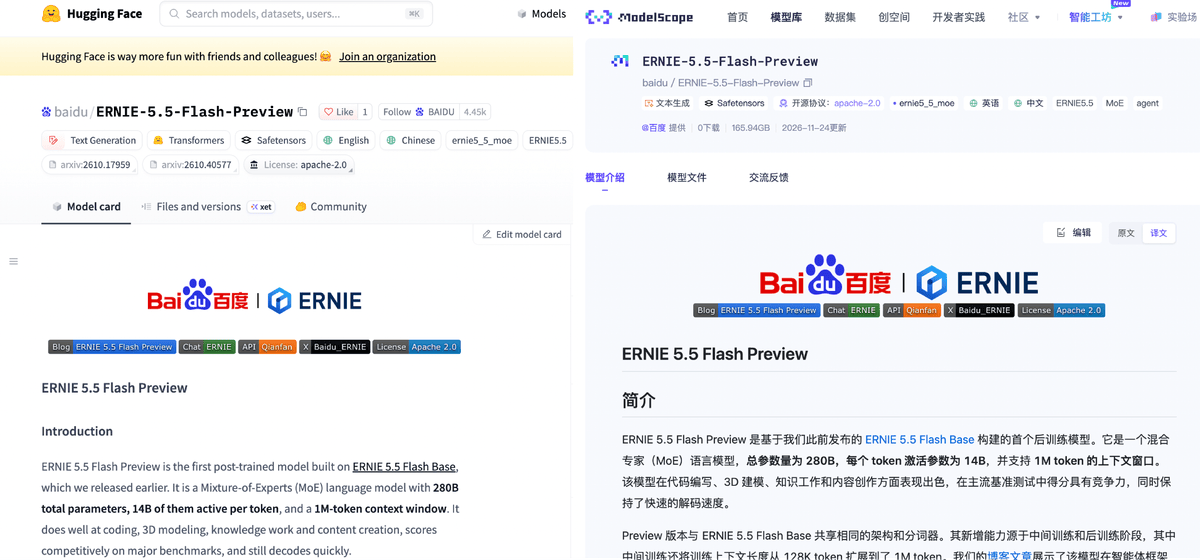
Representative image for 文心 5.5 Flash Preview正式开源,采用 Apache 2.0 协议

文心 5.5 Flash Preview正式开源,采用 Apache 2.0 协议 🔗 2 sources

Rank 75 · Content 85 · Popularity N/A

TL;DR — 百度以 Apache 2.0 协议正式开源文心 5.5 Flash Preview,支持本地部署、微调及商业适配。该稀疏模型兼顾百万级长上下文、快速解码和较强的代码能力。

  • 模型总参数量为 280B,每个 token 激活 14B 参数。
  • 支持最长 100 万 token 的上下文窗口。
  • 权重已发布至 Hugging Face 和 ModelScope,并支持通过 vLLM、SGLang 部署。
  • 面向编程、3D 建模、知识工作和内容创作等场景。
  • 据报道,其 CodeArena WebDev 得分为 1668,在开源模型中排名第二。

注: 两个来源强调的技术特性、应用场景和评测结果基本一致。

Representative image for 腾讯Hy-MT3开源:102种语言翻译实战

腾讯Hy-MT3开源:102种语言翻译实战

Rank 75 · Content 85 · Popularity N/A

TL;DR - Tencent Hunyuan open-sourced Hy-MT3, a translation model family covering 102 languages, alongside TransRubric for automated translation-error assessment. It targets production localization challenges such as terminology consistency, protected code variables, and OCR noise.

  • Available in 1.8B, 7B, and 30B-A3B MoE variants for different quality and compute needs.
  • The 30B model reportedly cuts omission/addition errors by 74% and mistranslations by 43% versus its predecessor.
  • Prompt-injected glossaries help preserve terminology, variables, and rich-text tags.
  • TransRubric identifies error types and severity; high-risk and low-resource deployments still warrant format checks and human review.

Efficiency & Systems 3

Representative image for 5.4GB塞进26B模型:手机都能跑?

5.4GB塞进26B模型:手机都能跑?

Rank 82 · Content 95 · Popularity N/A

TL;DR - MIT’s open-source LookAtMyQuant compiler reportedly compresses 26B–27B models enough to fit within 8GB of memory, potentially enabling offline inference on smartphones. It claims substantially lower quantization error than llama.cpp at comparable sizes.

  • Inkling-2-Mini 26.4B is compressed to 5.4GB or 3.85GB, reportedly reaching 1.65 bits per parameter at 5.4GB.
  • Qwen3.8-27B shrinks from 53.7GB to 7.2GB.
  • At equal size, reported KL divergence is 12× lower than llama.cpp Q4_K_M.
  • Tests cover 13 languages, with Chinese reportedly outperforming comparable compression methods; the ablation work cost about $34 in GPU compute.
Representative image for 蚂蚁OceanBase发布湖库一体AI数据平台OceanLake,CTO杨传辉解读三大能力

蚂蚁OceanBase发布湖库一体AI数据平台OceanLake,CTO杨传辉解读三大能力 🔗 2 sources

Rank 68 · Content 75 · Popularity N/A

TL;DR — 蚂蚁 OceanBase 发布湖库一体 AI 数据平台 OceanLake,并开源核心 AI 数据库引擎 OceanSeek。平台统一事务、分析、离线处理及多模态检索,面向企业级 Agent 的开发、评测与生产运行。

  • 基于对象存储整合事务数据库、分析型数仓及 Iceberg、Paimon 等开放湖格式,统一管理结构化、半结构化与非结构化数据。
  • 支持标量与 JSON 过滤、全文检索、向量搜索、图搜索及 AI 计算等混合查询,并兼顾实时分析与离线处理。
  • 通过逻辑表和数据库分支实现资源共享、数据隔离、并行实验与回滚,无需复制基线数据;评测环境搭建可由数天缩短至数分钟。
  • 提供 Agent 评测、长期与共享记忆、权限治理、实时业务上下文和数据沙箱等能力,支撑大规模 Agent 应用。
  • 已用于多模态训练管线及超过 3000 万个蚂蚁灵光应用;案例显示对象存储读取减少 97%,文档处理准确率由 60% 提升至 97%,Token 用量降低 78.6%。

注: 雷峰网更强调底层架构、混合查询及性能数据,量子位更关注 Agent 全生命周期能力和规模化应用。

Representative image for 业界首提“端侧超节点”,让端侧AI组队计算:AI效率暴涨270%,不用换芯片或模型

业界首提“端侧超节点”,让端侧AI组队计算:AI效率暴涨270%,不用换芯片或模型

Rank 68 · Content 75 · Popularity N/A

TL;DR - Simier Technology introduced Edge SuperPOD, a system for coordinating heterogeneous edge-AI devices without changing their chips or models. The company reports 270% higher effective task throughput through system-level optimization.

  • Edge SuperPOD combines multimodal perception, dynamic task scheduling, and cross-device communication.
  • It assigns workloads across NPUs, CPUs, GPUs, and higher-compute nodes based on latency, load, data location, and communication costs.
  • EdgeFlowOS supports model execution, task orchestration, device management, and more than 200 chip platforms and 100 models.
  • The 270% figure is company-reported under identical hardware and model conditions; detailed benchmark methodology is not provided.

AI Workforce Impact 1

How AI shocks are rattling the next generation of mathematicians — in charts

Rank 57 · Content 60 · Popularity 50

TL;DR - A Nature survey report examines how advances in AI are affecting early-career mathematicians. Students are markedly less optimistic about the technology than professors, highlighting a generational divide.

  • The article presents survey findings through charts.
  • Its focus is the perceived impact of AI on mathematics careers and training.
  • The provided excerpt does not include survey methods, sample sizes, or detailed results.

AI for Mathematics 1

AI is ‘the end of mathematics as we know it’ — where does the field go next?

Rank 71 · Content 80 · Popularity 50

TL;DR - Nature reports on mathematicians preparing for AI systems to take over much of their professional work. The supplied excerpt is too brief to establish what capabilities or evidence underpin this outlook.

  • The article frames AI as potentially transforming how mathematics is conducted.
  • It raises the prospect of delegating most mathematical work to machines.
  • No specific systems, technical results, or timelines are provided in the excerpt.

Embodied AI 1

Representative image for 具身行业,终于等来了自己的通用智能时刻

具身行业,终于等来了自己的通用智能时刻

Rank 75 · Content 85 · Popularity N/A

TL;DR - X Square Robotics introduced WALL-OSS-1.0, an embodied foundation model designed to execute unseen robotic tasks without task-specific fine-tuning, alongside its first model API. Reported benchmarks and production trials suggest improved generalization and substantially lower adaptation costs.

  • Joint vision-language-action pretraining and an upgraded action tokenizer integrate physical behavior into the model’s foundational learning.
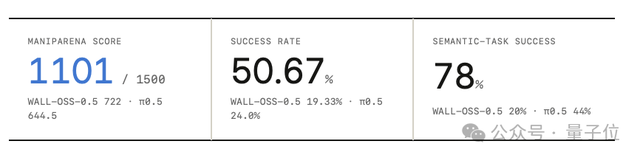
  • The model reportedly achieved a 55.1% zero-shot success rate across 312 open-ended real-robot tasks and 78% on semantic tasks.
  • WALL-OSS-1.0-Lite ranked first on the RoboDojo simulation track with a score of 42.59.
  • In logistics trials, roughly 10 hours of site data reportedly sufficed for deployment, versus over 1,000 hours without general pretraining; WALL-API-1.0 provides external access.

Quantum Algorithms 1

Representative image for Finding faster quantum algorithms with agents and formal verification

Finding faster quantum algorithms with agents and formal verification

Rank 78 · Content 90 · Popularity N/A

TL;DR - Google DeepMind describes using teams of AI agents and formal verification to seek faster quantum algorithms for fusion and chemistry. The provided excerpt does not specify methods, benchmarks, or results.

  • Combines multi-agent collaboration with formal verification.
  • Targets quantum-computing algorithms for fusion and chemistry.
  • Emphasizes improving algorithm speed while formally checking correctness.

Security Systems 1

OpenAI and Cisco introduce Shirudo

Rank 68 · Content 75 · Popularity N/A

TL;DR - OpenAI and Cisco introduced Shirudo, an open-source Linux runtime designed to protect active systems while teams deploy patches.

  • Targets protection during the vulnerable patch rollout window.
  • Runs on Linux and is available as open source.
  • Technical implementation details and effectiveness results were not provided.
Top highlights — Opinions

Bioinformatics AI 1

Representative image for AI30分钟顶一年半实验?没那么简单

AI30分钟顶一年半实验?没那么简单

Rank 84 · Content 100 · Popularity 47

TL;DR - AlphaGenome 2 can rapidly reproduce key aspects of a known inflammatory-bowel-disease finding, but the post argues it is best viewed as a tool for prioritizing experiments—not replacing them.

  • It predicts cell-type-specific gene-expression effects from DNA sequences up to one million bases long.
  • At 90% precision on immune-cell data, it identifies 30% of potential causal variants, versus 16% for its predecessor.
  • The “30 minutes versus 18 months” comparison involved reproducing a known result rather than making a discovery from scratch.
  • The cited work is an unreviewed bioRxiv preprint and has not been validated for clinical or diagnostic use.

LLMs & Foundation Models 1

Representative image for 循环不是省参数,是买迭代次数

循环不是省参数,是买迭代次数

Rank 78 · Content 90 · Popularity N/A

TL;DR - An analysis of GLM-5.4 argues that shared-weight layer looping buys additional iterative computation rather than parameter efficiency or knowledge capacity. The design may improve reasoning and long-context performance, but evidence is limited and fixed loops impose substantial latency.

  • GLM-5.4 reportedly reruns 28 middle layers twice with shared weights, deepening the computation graph without adding parameters.
  • A 30B controlled comparison used roughly 10% more training compute and improved math, science reasoning, and long-context results while shortening outputs by 10–14%; no flagship benchmark table was provided.
  • Two loops reflect training and stability constraints; additional loops would be out of distribution for the learned gating and harder to train through.
  • Fixed iteration counts reportedly cause 12–18-second time-to-first-token latency, while long-context consistency remains a key unresolved concern.

AI Consciousness 1

The science on AI consciousness must acknowledge uncertainty

Rank 57 · Content 60 · Popularity 50

TL;DR - This Nature item argues that scientific discussion of possible AI consciousness must explicitly account for uncertainty. Only the title and publication metadata are provided, so specific arguments or evidence cannot be assessed.

  • Focuses on uncertainty in evaluating whether AI systems could be conscious.
  • Suggests scientific claims should avoid unwarranted certainty.
  • No technical methods, results, or policy recommendations are included in the provided content.

Drug Development 1

Blend public cash and private innovation to unlock drug development

Rank 54 · Content 55 · Popularity 50

TL;DR - This Nature commentary argues that combining public funding with private-sector innovation could spur treatments for common health conditions that industry considers too risky. The limited excerpt does not specify proposed mechanisms or evidence.

  • Commercial risk deters investment despite substantial unmet medical need.
  • Public capital could help reduce early-stage development risk.
  • Private-sector expertise and innovation would remain central to translating funding into treatments.