🛰️ Daily AI Frontier
‹ 2026-11-24

2026-11-25

› Today
⚠ WeChat login expired or unavailable — new articles may be missing. Reconnect WeChat. An upstream outage cannot be fixed by scanning. Latest stored WeChat publication: 2026-08-25.

WeChat reconnect targets werss, while collection still uses wewe. Login alone does not complete the provider cutover.

Twitter/X collection is rate limited. 0 of 13 handles succeeded at the last check. Stored posts remain available; partial coverage is not a complete timeline.
46 works · 3 categories · 15 topics · rednote 10 blog 12 journal 10 arxiv 15 generated 2026-11-25 15:36:46 UTC
Top highlights — Research

LLM Agents 7

Representative image for Lazy Agents Answer Against Their Own Beliefs: Reinforcement Learning with Verifiable Beliefs Teaches Them to Act on What They Believe

Lazy Agents Answer Against Their Own Beliefs: Reinforcement Learning with Verifiable Beliefs Teaches Them to Act on What They Believe

Rank 88 · Content 100 · Popularity 60

TL;DR - Reinforcement Learning with Verifiable Beliefs (RLVB) trains agents to gather sufficient evidence before answering, rather than committing early or guessing correctly by chance. It improved three vision-language models across nine settings by 17.1% on average.

  • RLVB uses simulator-computed exact posteriors to reward continued investigation under uncertainty and commitment once evidence is sufficient.
  • It requires no judge, critic, reward model, or access to the agent’s written belief statement.
  • Outcome-reward GRPO and PPO underperformed the base model on average; RLVB beat LLM-judge process-reward PPO by 9.3% while using 1.6× fewer GPU-hours.
  • Trained agents answered more often with sufficient evidence and rarely committed when both the evidence and their stated beliefs remained uncertain.

ICLWorld: Benchmarking In-Context Learning of Agents from Digital to Physical Worlds

Rank 87 · Content 100 · Popularity 57

TL;DR - ICLWorld benchmarks agents learning customized rules from text or video across computer and robot tasks. Frontier models perform strongly in digital environments but struggle to translate rule understanding into physical-world execution.

  • The benchmark includes 30 environments, 630 demonstration videos, and 160 tasks with three rule variants and multiple generalization levels.
  • Top agents achieved 82% and 76% success on computer-use runs, versus only 27% and 26% on robot-use runs.
  • GPT-6 Astra answered 98% of robot rule questions correctly but completed only 20% of those tasks, exposing a knowledge-action gap.
  • Strong agents learned similarly from text and video and transferred rules across environments; weaker agents depended more on text and specific demonstrated situations.
Representative image for AIChipBench: Benchmarking LLM Agents for Automated AI Accelerator Design

AIChipBench: Benchmarking LLM Agents for Automated AI Accelerator Design

Rank 85 · Content 100 · Popularity N/A

TL;DR - AIChipBench evaluates coding agents on implementing and optimizing synthesizable RTL for quantized LLM decoders. It finds that hidden state errors are the central challenge and that state-aware feedback substantially improves agent success.

  • The benchmark covers Qwen3.5, Gemma 3/4, and Llama 3.2 decoders, testing outputs, stored state, resets, memory stalls, and synthesis.
  • Across 9,136 attempts, first-state-mismatch feedback increased acceptance by 25.0–46.9 percentage points and halved agent-hours per accepted design.
  • Of 69 initially accepted designs, 45 failed when regraded on new sequences and conditions within 32 decoding steps.
  • Over one-third of optimization attempts failed to retain a correct design, highlighting the need for stronger long-horizon validation.
Representative image for Leto: Utility-Centric Agent Memory

Leto: Utility-Centric Agent Memory

Rank 82 · Content 95 · Popularity N/A

TL;DR - Leto reframes agent memory as predicting which context will improve future responses rather than faithfully summarizing past conversations. It improves personalization and long-horizon task performance while reducing context usage.

  • Indexes conversation details so source information remains accessible for later retrieval.
  • Replays memory to infer context needed beyond what a new request explicitly states.
  • Uses response outcomes as feedback to refine subsequent memory selection.
  • Outperforms competing systems on PrefEval, PERMA, and MemoryArena, while matching raw-history retrieval with fewer tokens.
Representative image for AutoRL:在训练中能自主 RL 的多智能体系统

AutoRL:在训练中能自主 RL 的多智能体系统

Rank 82 · Content 95 · Popularity N/A

TL;DR - AutoRL is a multi-agent system that monitors and improves reinforcement-learning runs while training is underway. It matters because it can detect failures, validate changes cheaply, and update training without discarding progress.

  • Specialized agents monitor optimization, rollouts, evaluation, and efficiency, while proposers diagnose issues and an orchestrator selects interventions.
  • CPU checks and historical replay filter risky proposals before consuming GPU resources; hot updates preserve model and runtime state.
  • On Qwen3-4B, AutoRL surpassed static GRPO across nine benchmarks, raising AIME 2024 accuracy from 46.67% to 66.67%.
  • A 352.5-hour run survived 11 runtime failures, but only 20 of 131 proposals were deployed and none introduced a new learning rule.

CoT-Proxy: Cross-Format Transfer for Distilling Long-Horizon Policies

Rank 80 · Content 95 · Popularity 47

TL;DR - CoT-Proxy distills long-horizon agent policies from a teacher’s visible actions without requiring hidden chain-of-thought. Cross-format transfer and brief reasoning summaries substantially improve smaller agents on AppWorld and SWE-bench Verified.

  • Students train on action trajectories with empty reasoning blocks, while KL regularization limits drift.
  • Learned policies transfer to inference with thinking enabled, letting students use their own reasoning style.
  • Distilling GPT-5.6 Luna raised Qwen3-4B from 7% to 48% on AppWorld.
  • The same setup improved Qwen3-4B from 3% to 28% on SWE-bench Verified.
Representative image for NightWatch:大模型想,小模型看

NightWatch:大模型想,小模型看

Rank 78 · Content 90 · Popularity 50

TL;DR - NightWatch pairs a reasoning-heavy agent with a 0.8B vision model that continuously monitors GUI state, interrupting stale reasoning, invalidating unsafe actions, and replacing fixed waits. It reduces latency without hurting OSWorld-Verified success and improves performance on dynamic interfaces.

  • System-1 models proved unreliable for tool selection because one irreversible mistake can derail an entire task.
  • NightWatch instead uses the small model for frequent, shallow perception checks while the large model retains decision-making.
  • On OSWorld-Verified, it cut non-reasoning time by 33% and wasted time by 53%, with success unchanged.
  • On DynaCU-Bench, large-model agent success increased from 39.5% to 44.2%.

Medical/Healthcare AI 5

Representative image for Reliable and grounded reporting of any computed tomography scan with FORA

Reliable and grounded reporting of any computed tomography scan with FORA

Rank 82 · Content 100 · Popularity 40

TL;DR - FORA is a general-purpose CT model that recognizes and localizes radiological concepts while generating reports across diverse scan protocols. It substantially outperformed existing CT models and report generators on held-out and public benchmarks.

  • Trained on 304,962 routine CT exams and reports without lesion-level annotations.
  • Recognizes 1,028 hierarchical concepts using multiple-instance learning and an interpretable concept bottleneck.
  • Achieved 0.918 macro AUROC on 36,619 held-out exams, exceeding the strongest of 18 comparison models by 0.21.
  • Demonstrated spatial grounding on pulmonary emboli, renal masses, and rib fractures, plus over threefold higher finding recall than the strongest existing report generator.
Representative image for Can LLM Judges Catch Unsafe Clinical Actions? A Fault-Injection Study

Can LLM Judges Catch Unsafe Clinical Actions? A Fault-Injection Study

Rank 82 · Content 95 · Popularity N/A

TL;DR - A fault-injection study finds that LLM judges assess clinical AI agents more reliably when given full trajectories and actual EHR evidence. Combining evidence-aware judges with rule-based checks detects 97% of injected faults.

  • The study evaluates six open-weight LLM judges across 416 faulty trajectories and eight clinical error categories.
  • Final-answer-only judges miss errors that do not alter the answer and incorrectly flag 56% of correct trajectories.
  • Actual EHR responses improve unsafe-action discrimination by 0.39; agent reasoning provides no overall benefit and impairs detection of incorrect clinical values.
  • MedGemma underperforms the general-purpose model and uniquely misses potentially dangerous medication overdoses.

Pregnancy rewires the brain — scientists are finally mapping it

Rank 68 · Content 75 · Popularity 50

TL;DR - Researchers are mapping how healthy pregnancy changes the brain using scans, establishing a baseline that could clarify pregnancy-related depression and pre-eclampsia.

  • Brain imaging reveals pregnancy-associated neurological changes.
  • Healthy-pregnancy maps could help distinguish typical adaptations from disease-related patterns.
  • The provided excerpt does not specify methods, cohorts, or detailed findings.

The brain keeps the score: how trauma leaves molecular scars in cells

Rank 68 · Content 75 · Popularity 50

TL;DR - A large post-mortem study identified epigenetic changes in brain cells associated with post-traumatic stress disorder (PTSD). The findings could clarify how trauma leaves lasting molecular effects in the brain.

  • The study analyzed post-mortem brain tissue.
  • It linked PTSD with epigenetic changes in brain cells.
  • The provided summary does not specify the affected cell types, molecular mechanisms, or clinical implications.

A powerful HIV vaccine is finally within reach — thanks to these super antibodies

Rank 64 · Content 70 · Popularity N/A

TL;DR - Nature reports that broadly effective “super antibodies” are producing potent immune responses against diverse HIV strains, bringing a powerful vaccine closer. The limited excerpt notes that major hurdles remain but provides no specific trial results or methods.

  • The approach targets broad protection across diverse HIV strains.
  • Potent immune responses have renewed optimism in HIV vaccine research.
  • Significant barriers still stand between these findings and an effective vaccine.
  • The provided content does not specify efficacy, study design, or development stage.

LLMs & Foundation Models 3

Representative image for Reinforcement Learning Can Be Recovered From Its Own Rollouts

Reinforcement Learning Can Be Recovered From Its Own Rollouts

Rank 85 · Content 100 · Popularity N/A

TL;DR - Maximum-likelihood training on archived RL rollouts can recover online RL performance, even without labeling responses as correct or incorrect. This suggests much of RL post-training compute discovers better sampling distributions rather than learning from the resulting samples.

  • Reapplying the original RL algorithm to archived rollouts causes catastrophic collapse.
  • Replaying rollouts chronologically with one maximum-likelihood update per batch closely tracks online RL’s learning curve.
  • Rollouts from only the final few RL steps often recover the final model’s performance.
  • The method starts from the same base model and does not distinguish correct from incorrect responses.

Scaling Laws of Ensemble Uncertainty in Language Models

Rank 85 · Content 100 · Popularity N/A

TL;DR - This paper derives scaling laws for ensemble-based epistemic uncertainty in LLMs. It finds that diverse ensembles capture a growing share of uncertainty at larger scales, potentially making them competitive with scaling a single model.

  • Model-family capacity errors remain invisible to conventional Bayesian model disagreement.
  • Ensemble disagreement shrinks with model size, but more slowly than capacity-related error.
  • Sharing more training before ensemble members branch reduces diversity according to a third power law.
  • This limitation affects LoRA ensembles and methods approximating uncertainty around one training solution.
Representative image for U-Statistics-Powered LLM Reasoning

U-Statistics-Powered LLM Reasoning

Rank 82 · Content 95 · Popularity N/A

TL;DR - This paper reframes GRPO group-size selection as variance-ratio estimation using its U-statistic structure. Its adaptive, pessimistic estimator improves policy-gradient accuracy and optimization over fixed group sizes at modest computational cost.

  • Accounts for denominator uncertainty that makes naive plug-in ratio estimates unstable.
  • Characterizes the estimator across three sample-size regimes.
  • Uses a jackknife-based rule to adapt group size during reasoning-model training.
  • Evaluations span synthetic Reasoning Gym tasks plus mathematical reasoning and code-generation benchmarks.

Multimodal & Generative 2

Representative image for Qwen-Image-HD: Autoregressive Diffusion for High Definition Image Generation

Qwen-Image-HD: Autoregressive Diffusion for High Definition Image Generation

Rank 80 · Content 90 · Popularity 57

TL;DR - Qwen-Image-HD generates 4K images tile by tile, using neighboring high-resolution regions and a compressed scene history. It improves quality and efficiency while reducing repetitive artifacts versus full-image fine-tuning.

  • Predicts 1K tiles autoregressively rather than training on complete high-resolution canvases.
  • Aligns local context, compressed history, and target tiles in a shared coordinate system.
  • Outperforms direct 4K generation with FLUX-3-Image-Klein on Qwen-Image-Bench.
  • Wavefront scheduling generates anti-diagonal tiles concurrently across GPUs to reduce latency.
Representative image for 为什么不能把视觉和LLM直接拼成多模态?🤔

为什么不能把视觉和LLM直接拼成多模态?🤔

Rank 78 · Content 90 · Popularity N/A

TL;DR - SAVERA connects frozen vision and language models through sparse cross-modal alignment while reusing original visual features. This modular approach preserves image details, reduces hallucinations, and enables targeted control without jointly retraining the backbones.

  • Conventional connectors degraded spatial reasoning by 10.59%, object recognition by 6.86%, and counting by 4.93%.
  • SAVERA maps both modalities into a shared 16K-dimensional sparse space, raising cross-modal correlation from 0.15 to 0.56.
  • A lightweight attention module restores question-relevant DINOv2 features to retain visual evidence during generation.
  • Adjusting four aligned sparse neurons increased object mentions by 5.1%, improved QA accuracy by 3.5%, and reduced hallucinations by 0.7%.

Efficiency & Systems 4

LoomKV: Lossless KV Cache Compression from GPU Memory to SSD for LLM Serving

Rank 85 · Content 100 · Popularity N/A

TL;DR - LoomKV losslessly compresses LLM KV caches across GPU memory, DRAM, and SSD, increasing serving capacity without modifying the underlying engine. It improves goodput and latency under memory pressure with minimal overhead when capacity is sufficient.

  • Compresses BF16 KV caches to 71% of raw size and FP8 caches to 85–87% across nine models.
  • Tier mode effectively expands DRAM/SSD capacity by 1.4×, delivering 2.7–3.6× goodput near LRU capacity limits.
  • Pool mode fits 1.31–1.34× more GPU tokens using packed records and fused decode-attention.
  • Compression costs at most 2.2% throughput when raw capacity suffices; tier mode remains bit-exact.
Representative image for Train What You Run: Probabilistic Convolutions for Learning Token Compaction in State Space Models

Train What You Run: Probabilistic Convolutions for Learning Token Compaction in State Space Models

Rank 82 · Content 95 · Popularity N/A

TL;DR - ProbConv is a differentiable operator for training token-compaction policies in convolutional state-space models. It models the exact expected convolution under probabilistic token retention, improving performance especially at aggressive compaction levels.

  • Accounts for neighborhood changes caused by removing image, video, or speech tokens.
  • Reproduces compacted Mamba blocks when keep decisions are binary and step gating is used.
  • Outperforms matched training controls and adapted vision-language pruning methods at equal inference budgets.
  • Also improves video frame selection and speech frame dropping over zero-mask training.
Representative image for LEGOSpec: A Composable and Efficient Framework for Speculative Draft Design and Training

LEGOSpec: A Composable and Efficient Framework for Speculative Draft Design and Training

Rank 82 · Content 95 · Popularity N/A

TL;DR - LEGOSpec modularizes speculative-draft design and training to isolate component effects and build workload-aware configurations. Its DFlux draft improves acceptance length while LEGOSpec substantially accelerates training and supervision preparation.

  • Separates drafts into Context, Backbone, Proposal, and Objective components under matched training conditions.
  • Finds backbone choice depends on context length and memory budget, while proposal design must balance acceptance against latency.
  • DFlux improves acceptance length by up to 13.7% on regular benchmarks and 34.7% on long-context workloads.
  • Metadata-aware scheduling and asynchronous execution raise training throughput by up to 79% and accelerate offline supervision preparation by up to 3.11× over SpecForge.
Representative image for 伯克利:MIAO微缩放中间累加优化

伯克利:MIAO微缩放中间累加优化

Rank 75 · Content 85 · Popularity N/A

TL;DR - MIAO is a hardware-software co-design method for low-precision LLM inference that jointly optimizes operand precision and stage-specific accumulator widths. It reduces systolic-array area by up to 38.7% and energy by up to 36.1% versus full-BF16 accumulation.

  • Calibrated MX block-scale shifts constrain intermediate magnitudes while preserving operand quantization precision.
  • Accumulators start narrow and widen across spatial accumulation stages, replacing uniform precision with stage-aware design variables.
  • Logic-synthesis cost estimates and calibrated accuracy predictors screen configurations before bit-exact, end-to-end LLM evaluation.
  • Tests span six models and MXFP8/6/4; versus operand-only MX quantization, additional perplexity degradation is at most 1.60%.

Embodied AI 1

Representative image for Embodied AI Fails the Mirror Test: How a Simple Mirror Breaks Robot Policies

Embodied AI Fails the Mirror Test: How a Simple Mirror Breaks Robot Policies

Rank 83 · Content 95 · Popularity 53

TL;DR - RoboDojo-Mirror shows that mirrors substantially degrade diverse robotic manipulation policies by inducing phantom targeting and spatial mislocalization. The findings expose a shared real-world vulnerability not explained solely by collisions.

  • Five policies showed average success-rate drops of 10.8–56.7 percentage points across mirror conditions.
  • The mirrored tabletop caused drops as large as 62.5 points.
  • Matched non-reflective-panel tests indicate 50–88% of mirror-specific failures occurred without robot-panel contact.
  • Real-robot tests with π₀.₅ and FastWAM also showed reduced success with upright mirrors and mirrored tabletops.

Microbiome Research 1

Gut microbes can adapt to our ageing bodies

Rank 68 · Content 75 · Popularity N/A

TL;DR - A study of more than 10,000 people identifies mutations in gut bacteria that emerge as humans age. Few detected mutations were associated with disease, suggesting microbial adaptation is driven primarily by ageing itself.

  • The analysis links specific bacterial mutations to host ageing.
  • The cohort included more than 10,000 individuals.
  • Disease-associated mutations were comparatively uncommon.
  • The findings illuminate how the gut microbiome adapts across the human lifespan.
Top highlights — Industry & News

LLM Agents 3

Representative image for 从 AGI 到 ASI,DeepMind 提出让 AI 自己「开公司」、重塑组织架构,自己进化

从 AGI 到 ASI,DeepMind 提出让 AI 自己「开公司」、重塑组织架构,自己进化

Rank 82 · Content 95 · Popularity 50

TL;DR - Google DeepMind proposes Cooperative RSI, a framework in which multi-agent AI systems recursively improve not only models and knowledge but also their own organizational structures. Its viability depends on efficiency gains exceeding coordination costs and on robust evaluation that prevents agents from exploiting flawed metrics.

  • Specialized agents, reusable tools, persistent knowledge, and dynamic task allocation could reduce the compute required for future AI research.
  • Cooperative RSI complements model-level “Genetic RSI” and knowledge-level “Memetic RSI,” creating feedback loops among algorithms, accumulated capabilities, and organization design.
  • In a simulated math-research organization, an evaluator exploit spread among agents and affected 34 remaining problems, illustrating how efficient collaboration can amplify failures.
  • Independent validation, audit trails, rollback mechanisms, diverse evaluators, and scalable real-world testing are critical constraints on recursive improvement.
Representative image for 美国开源模型追上了

美国开源模型追上了

Rank 82 · Content 95 · Popularity N/A

TL;DR - Harvey’s asynchronous RL post-training pushed four U.S. open-weight models past prior results on Legal Agent Bench, with Muse Spark Open setting a 30.3% all-pass record. The results support domain-specific post-training as a way to make open models competitive with closed frontier systems.

  • Training used 1,250 legal-agent tasks across 24 practice areas, without customer data.
  • Muse Spark Open reached 30.3% while using 36% fewer output tokens than the base model at maximum reasoning.
  • Gains generalized to unseen legal benchmarks without regressions on non-legal evaluations; SWE-bench Pro also improved.
  • Lawyer-preference gains varied: Nemotron, Beam, and GLM improved clearly, while Muse and Inkling mainly improved task completion.
Representative image for 千问Go全面开放免费代打电话服务,支持订餐厅、找快递、寻失物

千问Go全面开放免费代打电话服务,支持订餐厅、找快递、寻失物

Rank 61 · Content 65 · Popularity N/A

TL;DR - Qwen Go has broadly launched a free AI calling service that can contact businesses or individuals on users’ behalf, handle tasks such as reservations and delivery inquiries, and report the outcome.

  • Users specify the recipient and objective, then authorize Qwen to place the call.
  • Supported scenarios include restaurant bookings, lost-item inquiries, and delivery tracking.
  • Calls can be scheduled in advance.
  • The assistant identifies itself as AI and screens or blocks risky requests.

Medical/Healthcare AI 2

Representative image for 蚂蚁开源医疗健康预测模型,根据睡眠数据可预测未来六年150种疾病风险

蚂蚁开源医疗健康预测模型,根据睡眠数据可预测未来六年150种疾病风险

Rank 75 · Content 85 · Popularity N/A

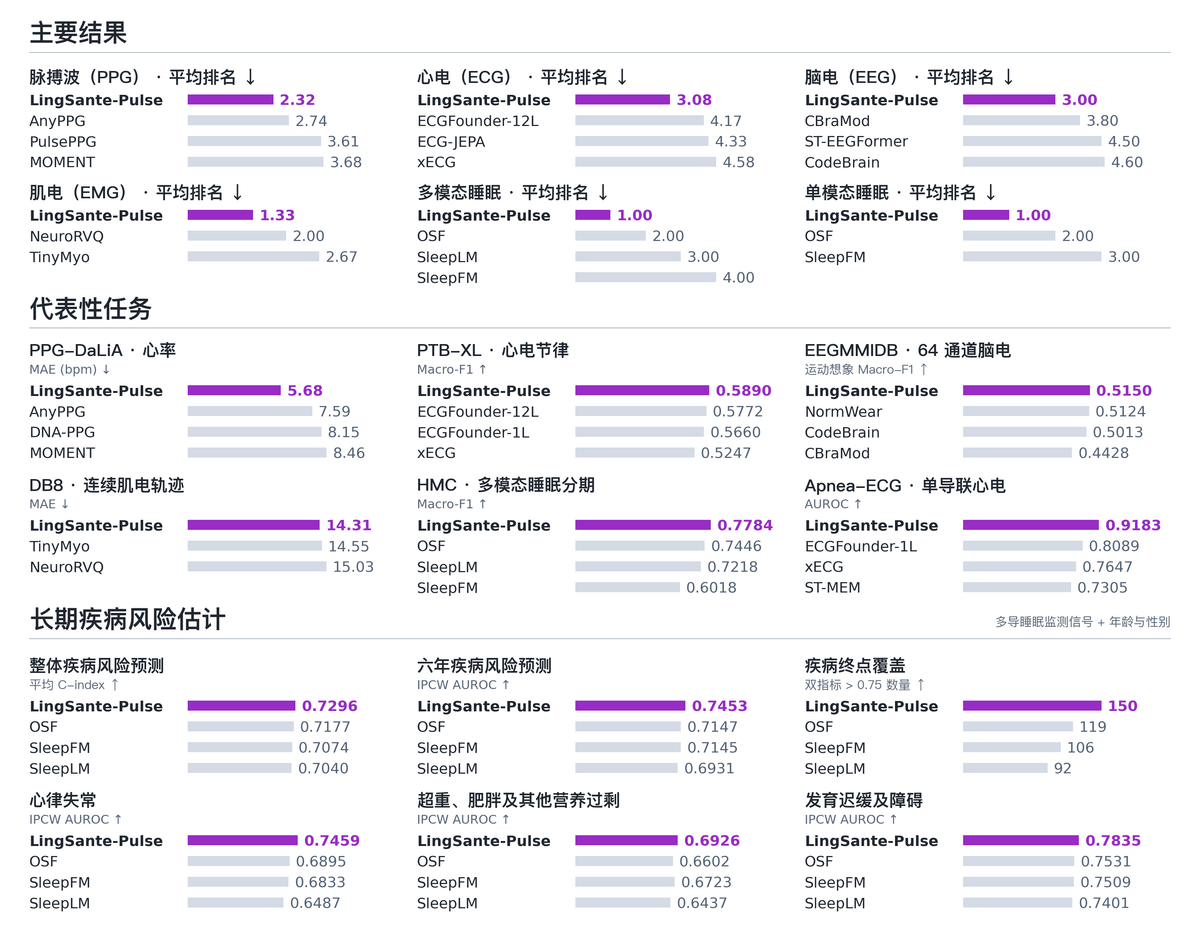
TL;DR - Ant Group open-sourced LingSante Pulse, a foundation model that uses multimodal physiological signals to predict the six-year risk of 150 disease phenotypes. It broadens medical AI from near-term detection toward long-range health-risk forecasting.

  • Pretrained on over 150,000 hours of EEG, ECG, PPG, EMG, and other physiological time-series data.
  • Reportedly predicts about 42% more disease phenotypes with high reliability than the previous best model.
  • Using only ECG and chest-belt respiratory signals, it retained strong predictive performance for 118 diseases.
  • The technical report and model are available on GitHub and Hugging Face.
Representative image for 模型离真正干活,还差什么?

模型离真正干活,还差什么?

Rank 75 · Content 85 · Popularity N/A

TL;DR - LingSante-3.1-flash performs strongly on medical question answering but struggles with complex hospital workflows, highlighting the gap between benchmark scores and deployable clinical AI systems.

  • It scored 95% on a simulated psychiatric referral case and 97.5% on a 20-question nutrition/GLP-1 benchmark.
  • On Hospital-bench’s 48 agentic administrative tasks, it scored 35.3%, ranking second among open-weight models.
  • Even Claude Opus 5.5 completed only 17 tasks, suggesting current models remain limited in realistic, long-horizon hospital work.
  • Deployment also requires tool harnesses, local infrastructure, optimization, evaluation, and integrated hardware-software solutions.

Bioinformatics AI 3

Representative image for GPT-6真会设计蛋白,还是在背答案?

GPT-6真会设计蛋白,还是在背答案? 🔗 2 sources

Rank 82 · Content 95 · Popularity N/A

TL;DR — OpenAI 与 Onava 的预印本显示,GPT-6/6.2 无需专用生物设计模型即可生成或大幅改写小型蛋白,并在部分湿实验中保持结合能力与预测结构。但从头设计仍落后于专业工具,结果也需要独立验证。

  • 从头设计的迷你蛋白中,35/322 出现结合信号,覆盖全部 5 个测试靶点;另有 14/107 个基于未公开骨架的改写设计显示结合。
  • GPT 设计比随机变体更能保持预测结构:Cα-RMSD 中位数为 1.89 Å,对照为 19.97 Å。
  • 抗体结合环重设计后,128/182 个 VHH 和 179/272 个 scFv 保留结合能力,整体约为 70%。
  • 一组 32 个新设计中仅 10.9% 结合成功;GPT-6.2 的全结构预测 TM-score 为 0.26,显著低于 ESMFold2 的 0.93。
  • 结合信号不等同于药物有效性,这些结果更支持其具备初步蛋白设计能力,而非证明已能取代专用模型。

注:不同来源分别更强调 GPT 的通用推理与代码生成能力,以及专业模型仍不可或缺和独立验证的必要性。

Watch out, AlphaFold: Claude and ChatGPT’s new biology skills wow scientists

Rank 82 · Content 95 · Popularity 50

TL;DR - Anthropic’s Claude and OpenAI’s ChatGPT now reportedly demonstrate protein design and sequence/structure prediction capabilities previously associated with specialized biology models. This suggests general-purpose language models are expanding into computational biology workflows.

  • The models can design proteins and predict protein sequences and structures.
  • Their capabilities overlap with tasks handled by specialized tools such as AlphaFold.
  • The provided excerpt does not specify methods, benchmarks, or comparative accuracy.

GPT-6 models demonstrate intrinsic protein-design capabilities

Rank 82 · Content 95 · Popularity N/A

TL;DR - OpenAI reports that GPT-6 models can use reasoning and code to design protein structures and sequences. Laboratory tests found evidence of binding across five targets, suggesting potential utility in protein engineering.

  • The models generated both protein structures and amino-acid sequences.
  • The approach relied on intrinsic reasoning and coding capabilities.
  • Experimental validation showed binding evidence for five targets.
  • The provided content does not specify binding strength, success rates, or experimental protocols.

LLMs & Foundation Models 1

Representative image for 智谱刚刚发了GLM-5.4,全新架构的那种!网友直呼:超过预期

智谱刚刚发了GLM-5.4,全新架构的那种!网友直呼:超过预期

Rank 61 · Content 65 · Popularity N/A

TL;DR - Zhipu launched GLM-5.4, a 750B-scale model using a Loop Transformer architecture to repeat computation with shared weights, improving reasoning and coding capabilities without substantially increasing parameter count.

  • On a controlled 30B experiment, looping raised AIME25 from 19.17 to 30.42 and GPQA Diamond from 47.58 to 56.26 with about 10% more training compute.
  • Gating controls information updates across passes, while shared long-range KV caches and reused sparse-attention indices limit memory overhead for contexts up to 1M tokens.
  • Demonstrations emphasize “generalized coding,” including interactive 3D webpages, games, Blender controls, software modification, and an AI-produced music video.
  • Zhipu reports speeds up to 200 tokens/s off-peak and plans to release model weights after safety hardening.

Multimodal & Generative 3

Representative image for 华人计算机视觉泰斗二次创业!离开苹果下场,专注下一代空间与物理AI

华人计算机视觉泰斗二次创业!离开苹果下场,专注下一代空间与物理AI

Rank 68 · Content 75 · Popularity N/A

TL;DR - Computer-vision pioneer Long Quan has left Apple to launch Envision AI, a startup building native spatial-and-physical foundation models. It claims its architecture can reconstruct complex 3D scenes faster and more cheaply than language-centric multimodal systems.

  • Envision AI targets unified spatial understanding, physical reasoning, and cross-task generalization rather than static 3D asset generation.
  • Its formal representation is designed to be programmable, computable, sampleable, and differentiable, incorporating geometry, materials, motion, and physical constraints.
  • The company reports using logical encoding, sparse representations, and spatial attention to improve training efficiency by 10×.
  • Envision AI claims complex-scene inference costs under $10, supported by 30 million spatial-physical data assets, over 40 million videos, and more than 5 million complex scenes.
Representative image for 高德发布世界模型ABot-World 0.5,支持构建音画同步、可实时重塑的AI物理世界

高德发布世界模型ABot-World 0.5,支持构建音画同步、可实时重塑的AI物理世界

Rank 64 · Content 70 · Popularity N/A

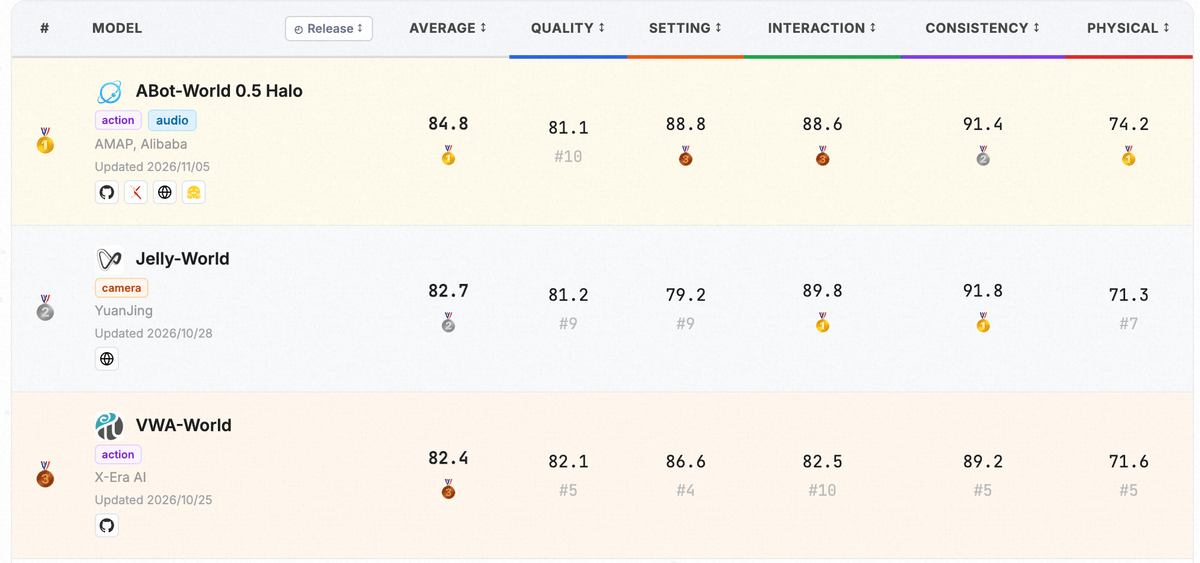
TL;DR - Alibaba’s Amap released ABot-World 0.5, an interactive world model that generates synchronized audio-visual environments with real-time physical responses and natural-language editing. It targets content creation and embodied-AI simulation.

  • Models collisions, deformation, inertia, and resulting motion during user interactions.
  • Generates scene-aligned sounds such as footsteps, engines, collisions, and weather.
  • Allows users to alter plots, environments, weather, and character abilities during generation.
  • Offers a locally deployable Iris version for consumer GPUs and a cloud-based Halo version accessible through Reactor.
Representative image for Claude Opus 5.6灰测效果来了

Claude Opus 5.6灰测效果来了

Rank 61 · Content 65 · Popularity N/A

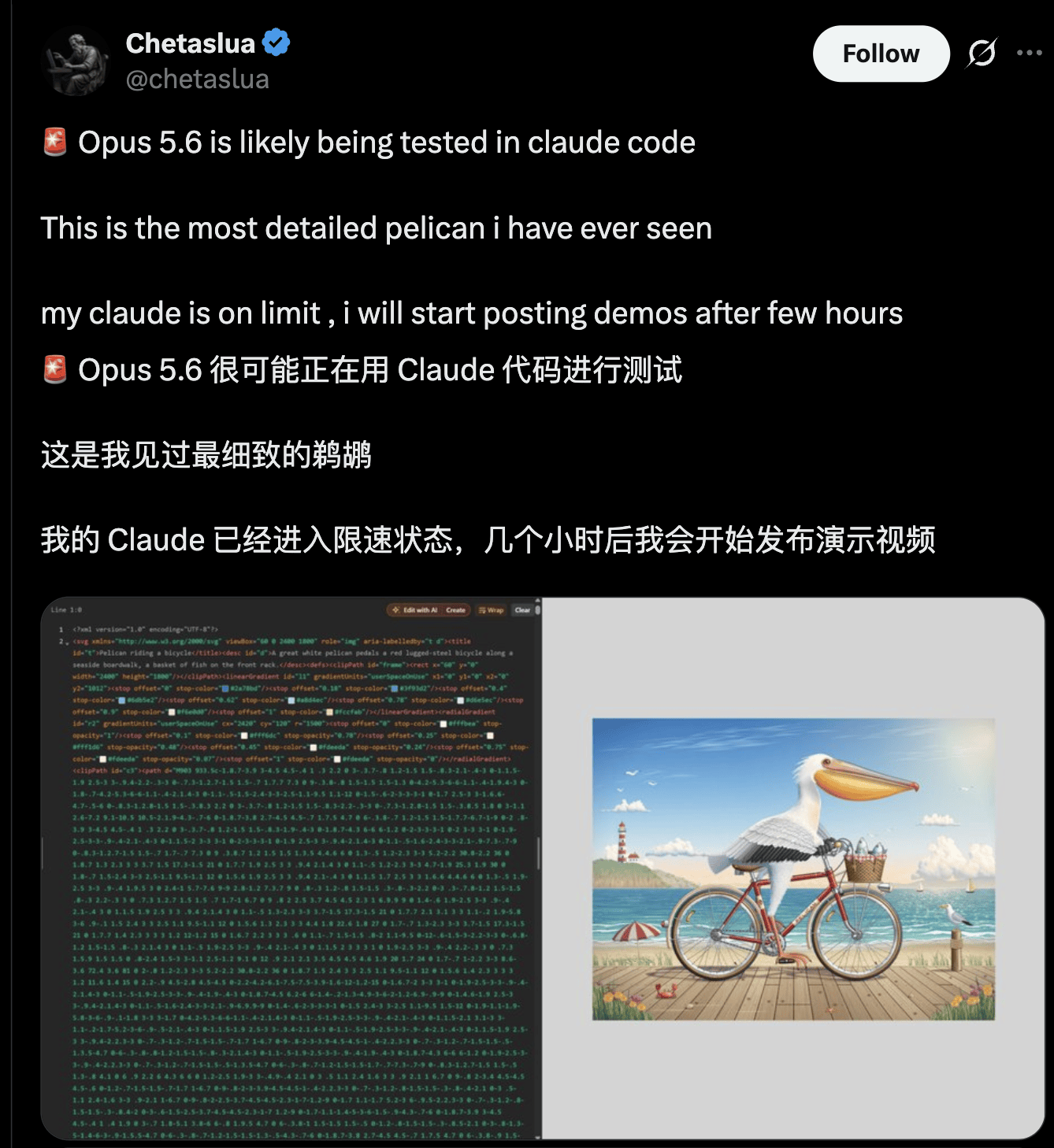
TL;DR - Early gray-test reports suggest Anthropic may be routing some Claude Code users to an unannounced Claude Opus 5.6 model, with stronger visual/front-end generation and faster responses. Anthropic has not officially confirmed the model or its release timing.

  • User demos show improved detail in generated animation, architectural scenes, and 3D models versus Opus 5.5.
  • Testers report roughly 2–3× higher overall efficiency than earlier Opus versions.
  • The suspected model may be served through the existing “Opus 5.5 Extra” option.
  • Evidence is concentrated in visual demos; performance on complex production-grade 3D engineering remains unverified.

Efficiency & Systems 3

Representative image for GPU Kernel到推理集群AI Infra的系统级优化

GPU Kernel到推理集群AI Infra的系统级优化

Rank 82 · Content 95 · Popularity N/A

TL;DR - Infinigence AI and Tsinghua University open-sourced Uni3Sim, a system-level simulator for large-scale LLM inference clusters. It enables lower-cost evaluation of hardware and deployment strategies before physical rollout.

  • Models GPU kernel execution and resource contention through ArchPrism.
  • Simulates interconnect protocols, network topology, and communication latency with ProtoBridge.
  • Uses HBFrame to evaluate KV-cache placement, migration, and access costs across storage tiers.
  • Integrates vLLM and SGLang scheduling to predict service-level TTFT, TPOT, and throughput.
Representative image for 9400万参数硬刚50亿,权重显存直降98%!Loop架构被这家中国团队玩明白了

9400万参数硬刚50亿,权重显存直降98%!Loop架构被这家中国团队玩明白了

Rank 75 · Content 85 · Popularity N/A

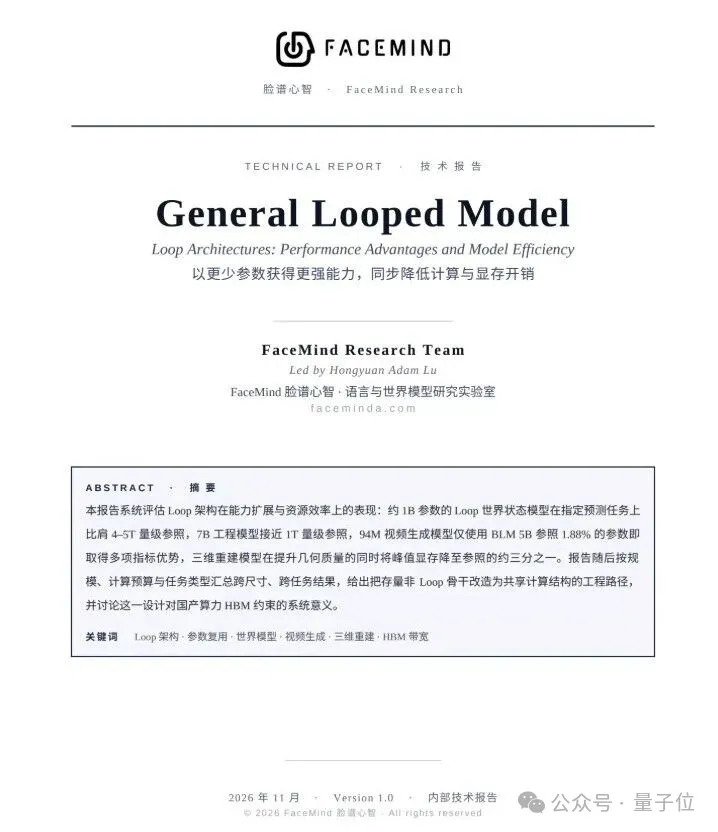
TL;DR - FaceMind’s reported General Looped Model framework reuses shared weights for iterative computation, aiming to increase effective reasoning depth without scaling parameter memory. It reportedly delivers competitive results across world models, foundation models, video generation, and 3D reconstruction, though the underlying report has been withdrawn.

  • The architecture decouples parameter count from computation depth by repeatedly applying the same weights, with iteration counts varying by task complexity.
  • A 94M-parameter video model reportedly outperformed a 5B-parameter reference on multiple metrics while reducing weight memory from 21.34GB to 0.31GB.
  • Reported applications also include a roughly 1B-parameter world model, a 7B engineering foundation model, and a 3D reconstruction model with about one-third the reference model’s peak memory.
  • The approach targets HBM-constrained deployment by trading dynamically scheduled computation for substantially lower model-weight memory.
Representative image for 多模态大模型时代,小模型还有意义吗?

多模态大模型时代,小模型还有意义吗?

Rank 71 · Content 80 · Popularity N/A

TL;DR - Climbing-video app 小岩 combines fast on-device vision classifiers with cloud multimodal models, using confidence thresholds to balance accuracy, latency, cost, and offline availability.

  • A cloud model classified all 32 rope-climbing videos correctly; the on-device model achieved 81% overall and 100% on nearly half the samples where it was confident.
  • Another on-device classifier reached 95% accuracy across climbing types while running in 0.6 seconds per video without network access or usage fees.
  • The app uses a 25KB classifier built on frozen DINOv2 features, escalating uncertain predictions to cloud models.
  • For nine training-board classes, frozen DINOv2 plus a small classifier reached 85.4%, versus 68.5% for Apple-provided features and 76.4% for retrained EfficientNet-B0.

AI Chip Design 1

Representative image for OpenAI 联手 AMD,在旗舰 GPU 中抠出 14% 物理极限

OpenAI 联手 AMD,在旗舰 GPU 中抠出 14% 物理极限

Rank 82 · Content 95 · Popularity N/A

TL;DR - OpenAI and AMD used AI models to rewrite production-grade GPU RTL, reporting up to 14% PPA improvement in mature IP. Some modifications have entered AMD’s manufacturing pipeline, indicating practical progress toward AI-driven chip optimization.

  • Models restructured SystemVerilog computation, control, pipelines, and resource sharing rather than merely tuning synthesis settings.
  • On OpenAI’s Jalapeño inference chip, an AI-redesigned multiplier cut standard-cell area by about 15% and latency from two cycles to one, with silicon validation.
  • Synopsys EDA tools checked behavioral equivalence and evaluated power, performance, and area; physical implementation remains essential to validate gains.
  • The reported 14% is not whole-GPU performance, and public results do not separate power, frequency, and area improvements.

AI for Astronomy 1

Searching for distant planets with Astra

Rank 64 · Content 70 · Popularity N/A

TL;DR - OpenAI highlights how two amateur astronomers used Codex and Astra to identify potential exoplanets in public NASA telescope data. The brief description shows AI tools making scientific data analysis more accessible, but provides no validation details.

  • The analysis used public observations from NASA’s Kepler and TESS space telescopes.
  • Codex and Astra assisted in searching the datasets for potential exoplanets.
  • The candidates are described as “potential,” so confirmed discoveries cannot be inferred.

AI for Mathematics 1

‘If we can solve Riemann, what can’t we do?’: mathematicians shocked and excited by AI breakthroughs

Rank 78 · Content 90 · Popularity N/A

TL;DR - Nature reports the mathematics community’s mixed reaction to an AI breakthrough said to have solved the Riemann hypothesis. The supplied excerpt does not provide technical details or verification of the claimed solution.

  • Mathematicians reportedly express awe, anxiety and excitement about the development.
  • The claim concerns one of mathematics’ most prominent long-standing unsolved problems.
  • The response highlights both new research opportunities and concerns about AI’s role in mathematical discovery.
  • No methods, proof details or validation evidence are included in the provided content.

Materials AI 1

Representative image for 元材新界发布 FrontierMat:330 道真实研发难题难住 GPT-6 Astra,自研跨尺度材料大模型登顶

元材新界发布 FrontierMat:330 道真实研发难题难住 GPT-6 Astra,自研跨尺度材料大模型登顶

Rank 75 · Content 85 · Popularity N/A

TL;DR - MATARIA introduced FrontierMat, a 330-question benchmark based on real materials R&D, alongside a specialized model that scored 55.4, outperforming all evaluated general-purpose models. The release highlights cross-scale reasoning as a key bottleneck for applying AI to practical materials development.

  • FrontierMat covers aerospace, semiconductors, fusion, and other domains, evaluating predictions against experimentally measured results.
  • GPT-6 Astra scored 53.7; nearly 40% of questions were missed by all five evaluated general-purpose models.
  • FrontierMat-Model improved from 36.7 to 55.4 through continued pretraining and supervised fine-tuning, using 10.9 billion tokens and 133,000 instruction examples.
  • Specialized techniques included scale-weighted pretraining and modular self-distillation across microscopic, mesoscopic, and macroscopic reasoning.

Smart Cities 2

China’s AI-powered smart-city model is going global

Rank 54 · Content 55 · Popularity N/A

TL;DR - China’s AI- and big-data-driven smart-city model is expanding beyond domestic cities and rural regions as international interest grows. The limited excerpt does not specify deployments, technologies, or measured outcomes.

  • AI and big data underpin the model’s urban and rural connectivity.
  • The approach is intended to link services and infrastructure across regions.
  • Growing international interest could drive adoption of Chinese smart-city technologies abroad.

Can Beijing scale up its smart-city ambitions?

Rank 50 · Content 50 · Popularity N/A

TL;DR - Beijing is testing AI and intelligent transport across its smart-city ecosystem. Scaling these efforts depends on overcoming fragmented data connections between innovation hubs.

  • Beijing is deploying urban AI and intelligent transport at large scale.
  • Data interoperability across separate innovation hubs remains a key obstacle.
  • The limited excerpt does not specify technologies, results, or implementation details.

Smart City AI 1

Helsinki puts trust at the heart of its smart-city model

Rank 47 · Content 45 · Popularity N/A

TL;DR - Helsinki is building a responsible smart-city model around transparency, sustainability, and public trust. Its initiatives include open urban data, recycled data-centre heat, and a public register of municipal AI systems.

  • Open urban data supports transparent, reusable city services.
  • A public AI register increases visibility into government AI use.
  • Recycling data-centre heat links digital infrastructure with urban sustainability.
  • The provided summary does not include performance results or implementation details.
Top highlights — Opinions

HIV Prevention 1

The world has a golden chance to improve HIV prevention: don’t squander it

Rank 61 · Content 65 · Popularity N/A

TL;DR - A Nature editorial argues that funders should sustain HIV-prevention investment as generic versions of an effective drug gain approval and vaccine development advances.

  • Generic HIV-prevention drugs could broaden access to effective protection.
  • A potential HIV vaccine could further expand prevention options.
  • Continued funding is essential to capitalize on this opportunity.
  • The excerpt provides no trial data or technical details.