TUM 教授 Angela Dai:放下完美数据执念,「逆向自监督」重构 3D 空间智能 | ECCV 2026
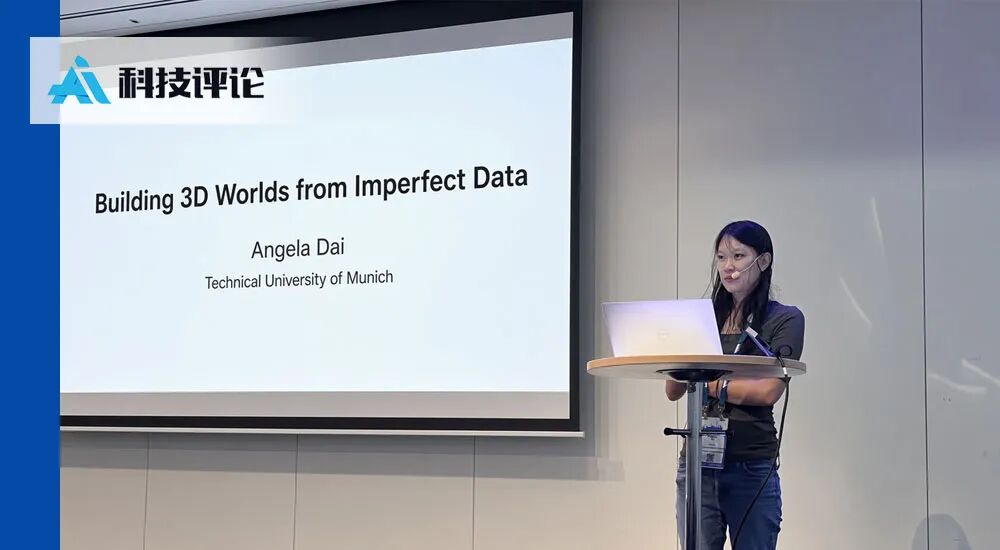
TL;DR - TUM professor Angela Dai presents research that treats real-world occlusion as a structural prior for self-supervised 3D scene completion and generation. The approach could support spatial agents that reconstruct unseen geometry and actively select better viewpoints.
- A three-state representation distinguishes known empty space, observed surfaces, and unknown occluded regions; withheld observations provide self-supervised targets, while masked losses exclude genuinely unobserved space.
- For large ambiguous gaps, visibility-guided generative modeling combines a stable geometric scaffold with 2D image priors and geometry-regularized 3D Gaussian splatting to reduce blur, drift, and collapse.
- Priors learned from complete synthetic scenes can be transferred back to incomplete real scans, improving reconstruction beyond the directly observed geometry.
- Sparse voxel regression can be fast enough for real-time use, but high-fidelity diffusion generation remains limited by sampling latency and the accuracy–speed tradeoff.