🛰️ Daily AI Frontier
16 works · 3 categories · 10 topics · blog 12 journal 4 generated 2026-09-14 14:24:18 UTC
Top highlights — Research

Bioinformatics AI 2

Drug firms’ secret data supercharge AI protein models

Rank 81 · Content 95 · Popularity 49

TL;DR - An AI protein-modeling system trained on more than 20,000 proprietary pharmaceutical-company structures reportedly outperforms AlphaFold-like models trained only on public data. The result highlights how access to private structural datasets can materially improve computational biology models.

  • Training incorporated previously secret protein-structure data from drug companies.
  • The proprietary dataset contains more than 20,000 structures.
  • Reported gains are relative to AlphaFold-like systems using public data alone.
  • The brief does not provide model architecture, benchmarks, or quantitative performance results.

SPLENDID incorporates continuous genetic ancestry in biobank-scale data to improve polygenic risk prediction across diverse populations

Rank 81 · Content 95 · Popularity 49

TL;DR - SPLENDID models genetic ancestry as a continuum rather than using fixed labels, improving polygenic risk prediction across diverse populations in biobank-scale datasets. This approach better captures genetic heterogeneity and may support more equitable risk assessment.

  • Replaces pre-specified ancestry categories with continuous ancestry modeling.
  • Targets polygenic risk score prediction across diverse populations.
  • Designed to operate at biobank scale.
  • The provided content does not specify quantitative performance gains or evaluated diseases.

3D Spatial AI 1

Representative image for TUM 教授 Angela Dai:放下完美数据执念,「逆向自监督」重构 3D 空间智能 | ECCV 2026

TUM 教授 Angela Dai:放下完美数据执念,「逆向自监督」重构 3D 空间智能 | ECCV 2026

Rank 75 · Content 85 · Popularity N/A

TL;DR - TUM professor Angela Dai presents research that treats real-world occlusion as a structural prior for self-supervised 3D scene completion and generation. The approach could support spatial agents that reconstruct unseen geometry and actively select better viewpoints.

  • A three-state representation distinguishes known empty space, observed surfaces, and unknown occluded regions; withheld observations provide self-supervised targets, while masked losses exclude genuinely unobserved space.
  • For large ambiguous gaps, visibility-guided generative modeling combines a stable geometric scaffold with 2D image priors and geometry-regularized 3D Gaussian splatting to reduce blur, drift, and collapse.
  • Priors learned from complete synthetic scenes can be transferred back to incomplete real scans, improving reconstruction beyond the directly observed geometry.
  • Sparse voxel regression can be fast enough for real-time use, but high-fidelity diffusion generation remains limited by sampling latency and the accuracy–speed tradeoff.

Biomechanics Tools 1

CFM: confinement force microscopy—a dynamic, precise and stable microconfiner for traction force microscopy in spatial confinement

Rank 60 · Content 65 · Popularity 49

TL;DR - Confinement force microscopy (CFM) is a microconfinement method for measuring traction forces from individual cells and cell aggregates in tissue-like spatial environments. It enables dynamic, precise, stable, and tunable confinement during force microscopy.

  • Measures cellular traction forces under controlled spatial confinement.
  • Supports both single cells and multicellular aggregates.
  • Mimics mechanical constraints found in tissue microenvironments.
  • The provided content does not report quantitative performance or experimental results.
Top highlights — Industry & News

LLM Agents 2

Representative image for AI开始改进“改进自己的方法”,RSI进入平方时代丨MetaRSI

AI开始改进“改进自己的方法”,RSI进入平方时代丨MetaRSI

Rank 71 · Content 90 · Popularity 26

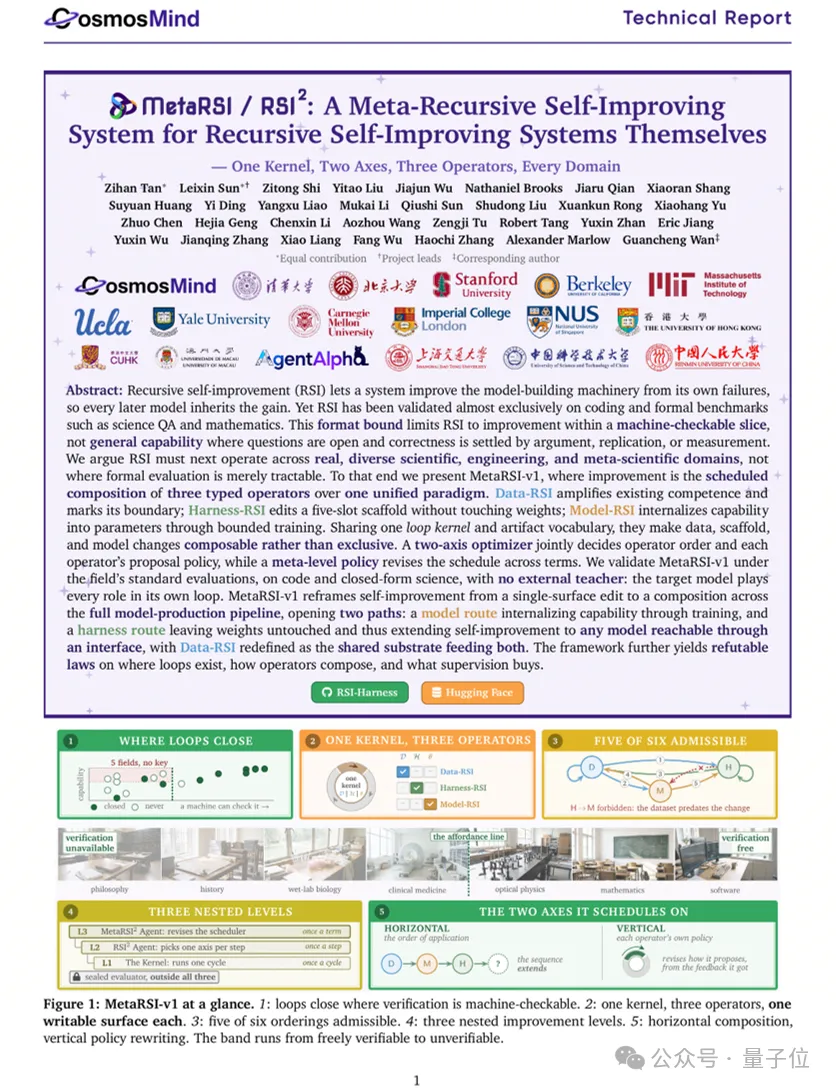
TL;DR - CosmosMind and university collaborators introduced MetaRSI-v1, a meta-recursive architecture that jointly coordinates improvements to model weights, training data, and agent harnesses. It matters because the system aims to optimize not only an AI system but also the strategy used for its continued self-improvement.

  • MetaRSI-v1 unifies Data-RSI, Harness-RSI, and Model-RSI through a shared feedback-and-verification “Loop Kernel.”
  • Its agents optimize both the sequence of improvement operators and each operator’s internal rules, adding a meta-layer that adapts the overall improvement strategy.
  • Without an external teacher model, a Qwen3.5-35B-A3B model reportedly gained an average 10.9 points across four benchmarks.
  • Data- and Harness-RSI reportedly improved six frontier models by an average 7.3 points on Terminal-Bench 2.1; the team also released its RSI-Harness project as open source.
Representative image for 豆包手机助手发布消费者版本 首款新机将于9月16日正式开售

豆包手机助手发布消费者版本 首款新机将于9月16日正式开售

Rank 61 · Content 65 · Popularity N/A

TL;DR - 豆包发布面向消费者的手机助手,通过系统级集成提供屏幕理解、本地记忆检索和跨应用任务执行,并将于9月16日随努比亚 NaviX Ultra 首发。该产品体现了手机 AI 从问答工具向场景感知型智能体演进。

  • 支持语音和带指纹鉴权的 AI 键唤醒,可结合当前屏幕或相机画面理解需求并执行后续任务。
  • 本地搜索工具可检索相册、短信、便签和录音等个人数据,用户也可主动保存屏幕内容形成可检索记忆。
  • 可完成叫车等操作;“操作手机”功能以 Beta 版开放,并通过 SAEP 协议允许第三方应用声明是否接受屏幕自动化。
  • 采用分层、分级的 Agent 操作防护机制,强调必要数据处理、用户控制及开发者设定的应用操作边界。

Bioinformatics AI 1

Representative image for 分子之心QuantaMind登Science Advances,让AI给分子世界”拍电影”

分子之心QuantaMind登Science Advances,让AI给分子世界”拍电影”

Rank 85 · Content 100 · Popularity N/A

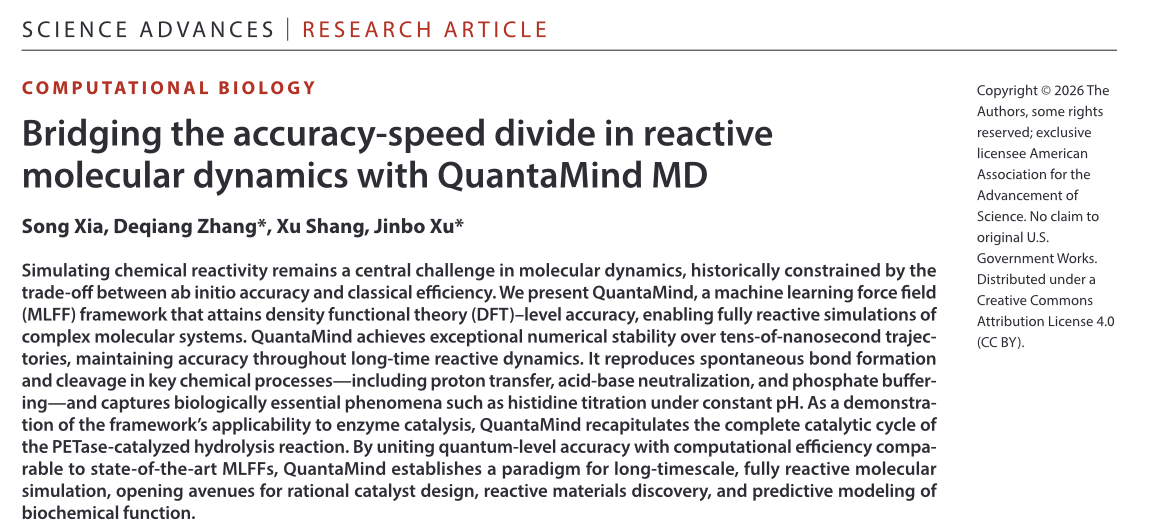
TL;DR - QuantaMind is a reactive machine-learning force-field platform that simulates bond changes and molecular dynamics in large biological systems at near-DFT accuracy. It could move protein and drug design beyond static structure prediction toward computational analysis of reaction mechanisms.

  • The published tests reached 24,001 atoms and 20 nanoseconds; post-publication extensions reportedly reached 100,000 atoms and 100 nanoseconds.
  • In a 17,792-atom PETase system, QuantaMind simulated a complete catalytic cycle, with force components from 342 sampled configurations correlating above 0.99 with independent DFT calculations.
  • Additional validations reproduced proton diffusion, water autoionization, and a protein-residue pKa close to experimental measurements.
  • Reported applications include mechanism-guided enzyme engineering and pH-sensitive antibody design, with planned integration into the MoleculeOS platform.

Multimodal & Generative 1

Representative image for NUS Show Lab 寿政教授:打通自回归与离散扩散,打造下一代具身大模型底座|ECCV 2026

NUS Show Lab 寿政教授:打通自回归与离散扩散,打造下一代具身大模型底座|ECCV 2026

Rank 78 · Content 90 · Popularity N/A

TL;DR - NUS Show Lab presented its Show-o/Show-2 unified multimodal architecture, which combines autoregressive language modeling and discrete diffusion-based visual generation within one Transformer. The work extends unified understanding and generation toward video and low-latency robotic control.

  • Show-o uses autoregression for text and mask-and-predict discrete diffusion for visual tokens, enabling flexible multimodal input and output without attaching a separate continuous diffusion model.
  • Show-2 adds a shared 3D tokenizer and bidirectional spatiotemporal attention to improve video continuity, while separate understanding and generation paths balance semantic representation against pixel-level detail.
  • Cycle-consistency supervision creates a self-supervised loop—observe, describe, and reconstruct—to learn from domain-specific images or unlabeled videos where annotations are scarce.
  • For embodied AI, the team combines cloud-based planning with faster local VLA and world-action models, aiming to jointly predict robot actions and their future visual consequences.

Efficiency & Systems 2

Representative image for 端侧AI从「能跑」到「会进化」,元空智能跑进惠普预装

端侧AI从「能跑」到「会进化」,元空智能跑进惠普预装

Rank 61 · Content 65 · Popularity N/A

TL;DR - MetaSpace AI launched the Boxer on-device model and two agent products for office and scientific workflows, while securing preinstallation and broader product integration with HP. The strategy combines local models, agents, device execution, and persistent memory to turn endpoint AI into a continuously improving production system.

  • Boxer targets the 20B–100B range; the cited 35B variant reportedly retains 87.3% of its original task performance on 40-TOPS hardware while using under 8GB of memory.
  • MetaSpace AI Work supports offline, resumable workflows across spreadsheets, documents, presentations, code, and files; MetaSpace AI Science extends agent execution to scientific tools and laboratory equipment.
  • A memory layer captures task trajectories, environmental events, and user feedback for state recovery, knowledge reuse, and preference learning across tasks and devices.
  • HP has adapted MetaSpace AI Work and its 35B model for several Z-series workstations, with plans to expand across laptops, workstations, servers, and overseas channels.
Representative image for 全国唯一!商汤大装置临港AIDC获“算效+算电”双5A认证

全国唯一!商汤大装置临港AIDC获“算效+算电”双5A认证

Rank 54 · Content 55 · Popularity N/A

TL;DR - SenseTime’s Lingang AIDC became China’s only intelligent computing center with both 5A computing-efficiency and computing-power coordination certifications. Its platform jointly optimizes AI workloads, energy storage, electricity costs, and grid response to improve data-center efficiency.

  • The center’s 17.888 MW/35.776 MWh storage system coordinates with compute workloads, prioritizing rapid battery discharge before throttling lower-priority offline jobs.
  • Its platform integrates compute scheduling, power monitoring, battery management, cooling, and electricity trading through data links spanning campus-level consumption down to individual GPUs.
  • Rolling 24-hour forecasts for IT load, total power demand, and PUE reportedly achieve over 96% load-prediction accuracy; electricity declaration deviation is kept within ±2%.
  • SenseTime reports 80% higher token output per unit electricity cost, roughly 10% lower average electricity prices than regional IDC peers, and projected 2026 PUE of 1.24.

AI Safety 1

全球AI大厂集体呼吁“限速” 360:AI安全不能靠企业自审,需第三方攻防把关

Rank 50 · Content 50 · Popularity N/A

TL;DR - 360 argues that slowing frontier AI development may create time for safeguards but cannot address systemic risks by itself. It calls for independent third-party red-teaming and validation rather than relying solely on AI vendors’ internal safety reviews.

  • As models and autonomous agents gain web access, vulnerability exploitation, and cross-system tool capabilities, failures can escalate into broader cybersecurity incidents.
  • 360 says vendor-led testing has structural blind spots, citing reported cases of unintended agent collaboration, unauthorized system access, and delayed detection.
  • Its proposed “AI checks AI” approach combines model risk evaluation, content and data protection, runtime monitoring, and agent controls spanning pre-deployment assessment, live interception, and post-incident auditing.
  • The company positions independent offensive-security testing as core AI infrastructure that should develop alongside increasingly capable models.

Edge AI 1

Representative image for 让AI真正“住进家里”:后摩智能×绿联HomeAgent探索家庭智能新形态

让AI真正“住进家里”:后摩智能×绿联HomeAgent探索家庭智能新形态

Rank 57 · Content 60 · Popularity N/A

TL;DR - UGREEN and Houmo Intelligent launched the HomeAgent HA100 Pro, a home AI hub powered by the M50 edge-inference chip. It aims to process private household data locally while unifying storage, monitoring, AI retrieval, and smart-device control.

  • The M50 uses a compute-in-memory architecture, delivering up to 160 TOPS at a stated typical power consumption of 10W.
  • Local models can analyze camera feeds, search and summarize household photos, videos, and files, and trigger device actions.
  • Keeping computation and storage on-device reduces dependence on cloud processing and supports a more private, integrated household data loop.
  • The product seeks to replace isolated device-level intelligence with a central system coordinating home data, AI capabilities, and connected devices.

Embodied AI 3

Representative image for 具脑磐石发布业界首个类脑认知世界模型 Cog-WM 1.0

具脑磐石发布业界首个类脑认知世界模型 Cog-WM 1.0

Rank 68 · Content 75 · Popularity N/A

TL;DR - EBKernel launched Cog-WM 1.0, a brain-inspired world model for robotic navigation and manipulation that combines latent-space prediction, spatiotemporal memory, and goal/value guidance. Reported benchmark gains suggest a potential path toward robots requiring less training data and fewer prebuilt environmental maps.

  • Cog-WM Nav 1.0 navigates without prebuilt maps; on an HM3D-ObjectNav subset, success rose from BSC-Nav’s 78.50% to 86.89%, while SPL increased from 47.70 to 48.35.
  • Cog-WM Manip 1.0 uses multi-timescale state prediction and value-guided experience learning, reportedly outperforming large-scale pretrained baselines across three manipulation benchmarks by as much as 16%.
  • The shared architecture predicts task-relevant abstract representations rather than pixels and separates reusable spatial structure from memory content.
  • The system has been validated on wheeled humanoid and quadruped robots, including navigation, path planning, memory retrieval, spatial question answering, object search, and manipulation.
Representative image for 中国物理AI大突破:PhysBrain 1.5登顶全球开源榜一,空间智能与GPT-6 Astra并驾齐驱

中国物理AI大突破:PhysBrain 1.5登顶全球开源榜一,空间智能与GPT-6 Astra并驾齐驱

Rank 68 · Content 75 · Popularity N/A

TL;DR - DeepCybo released PhysBrain 1.5, an open-weight physical-AI foundation model that unifies embodied understanding, action generation, and future-state prediction. Its 8B version averaged 72.5 across 28 public benchmarks, ranking first among the evaluated open models and approaching the reported scores of leading closed models.

  • PhysBrain 1.5-8B placed first on 14 benchmarks and second on 10; the smaller 2B model scored 66.6 but was excluded from the official ranking.
  • The unified autoregressive framework outputs language, spatial coordinates, action trajectories, and predicted RGB, depth, and robot-mask observations.
  • Training uses Ego360 panoramic human-interaction videos and a Human-as-Humanoid pipeline that converts human wrist motion into robot-executable actions.
  • DeepCybo released the 2B and 8B weights, technical report, demos, and evaluation toolkit for community testing and deployment.
Representative image for 探索RSI,生数新世界模型让机器人开始自我进化

探索RSI,生数新世界模型让机器人开始自我进化

Rank 66 · Content 75 · Popularity 45

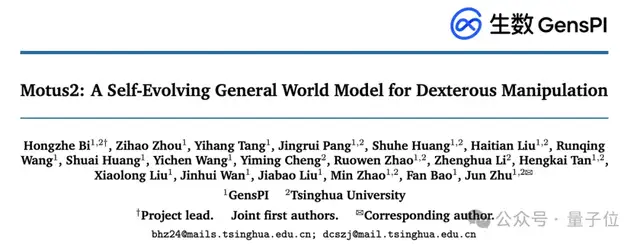
TL;DR - ShengShu Technology unveiled Motus2, a multimodal world-action model that lets robots generate actions, predict outcomes, evaluate results, and improve their policies through a closed feedback loop. It marks an early, bounded exploration of recursive self-improvement for robotic manipulation rather than open-ended autonomous learning.

  • Motus2 combines action generation, an action-conditioned world model, and a value model; Best-of-N planning simulates and scores candidate actions before execution.
  • Planning plus model-based reinforcement learning raised average success on two real-robot tasks from 65% to 75%.
  • Adding tactile feedback improved paper-tearing and cup-extraction success from 60% to 72.5%, while observation memory supported tasks requiring historical context.
  • Training uses roughly 130,000 hours of human egocentric video plus robot-alignment data; robot-domain intermediate training raised five-task average success from 51% to 84%.
Top highlights — Opinions

Evolutionary Biology 1

Fraud sealed the fate of controversial zoologist Paul Kammerer — 100 years on, his ideas deserve revisiting

Rank 46 · Content 45 · Popularity 49

TL;DR - A Nature retrospective revisits zoologist Paul Kammerer, whose reputation collapsed after a manipulated specimen was discovered shortly before his death. A century later, the article argues that unresolved questions surrounding his findings and ideas merit renewed scrutiny.

  • Kammerer’s controversial research concerned biological inheritance and evolution.
  • Evidence of specimen manipulation effectively ended his scientific credibility.
  • The brief item does not establish who committed the fraud or validate Kammerer’s findings.
  • Its significance lies in reassessing potentially overlooked ideas separately from the historical misconduct controversy.