我们用 Kimi K3 搓了一颗火影螺旋丸,只花129元就顶一个前端团队?
Ranking
No observed public metrics; popularity remains neutral/archived.
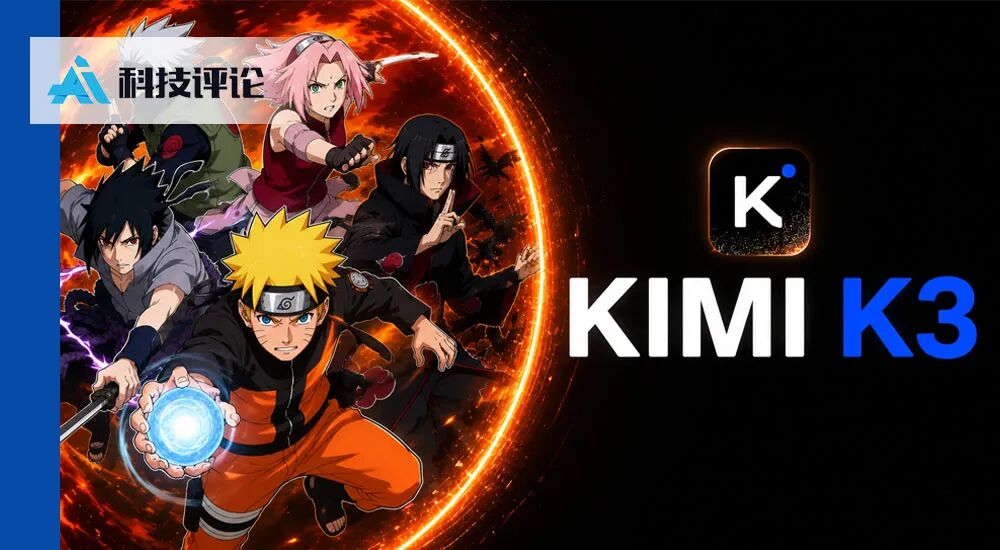
Merged summary
TL;DR — A hands-on 雷峰网 review of Moonshot's newly open-sourced 2.8T-parameter Kimi K3, using a Naruto "Rasengan" web demo to stress-test its architecture claims and agentic front-end coding. It matters as the first openly released model at closed-source scale, with efficiency gains coming from architectural constraints rather than parameter count.
- Scale + cost: 2.8T params (largest open-weight model, up from the 1T K2 tier), but only 16 of 896 experts active per token, with MXFP4 weight / MXFP8 activation quantization-aware training starting post-training. Deployment needs a 64+ accelerator supernode; API is $3/M input, $15/M output — roughly 4x K2.7's output price. Some official benchmarks ran on performance-capped H20s.
- KDA (Kimi Delta Attention): 3:1 mix of linear to full attention layers, so three of four layers work from a fixed-size running summary instead of rescanning context. Reported on a 48B validation model: up to 75% KV-cache reduction and ~6x faster decoding at 1M tokens.
- AttnRes (attention residuals): replaces fixed weight-1 residual accumulation with learned per-layer connections, addressing unbounded hidden-state growth and dilution of individual layer contributions; matched a baseline using 1.25x compute over 1.4T training tokens (~25% training efficiency gain). Both techniques were open-sourced ~8-9 months before K3.
- Practical caveats: multi-turn quality reportedly degrades sharply unless the full assistant message including
reasoning_contentis echoed back, which the author speculates explains the Terminal-Bench 2.1 gap (88.3 self-reported via Kimi Code vs 85.0 third-party). The demo took 26 iterations, blew past the 1M context twice, and consumed ~$19 of quota in two days — an assisted result, not one-shot.
Sources (1)
我们用 Kimi K3 搓了一颗火影螺旋丸,只花129元就顶一个前端团队?
TL;DR — A hands-on 雷峰网 review of Moonshot's newly open-sourced 2.8T-parameter Kimi K3, using a Naruto "Rasengan" web demo to stress-test its architecture claims and agentic front-end coding. It matters as the first openly released model at closed-source scale, with efficiency gains coming from architectural constraints rather than parameter count.
- Scale + cost: 2.8T params (largest open-weight model, up from the 1T K2 tier), but only 16 of 896 experts active per token, with MXFP4 weight / MXFP8 activation quantization-aware training starting post-training. Deployment needs a 64+ accelerator supernode; API is $3/M input, $15/M output — roughly 4x K2.7's output price. Some official benchmarks ran on performance-capped H20s.
- KDA (Kimi Delta Attention): 3:1 mix of linear to full attention layers, so three of four layers work from a fixed-size running summary instead of rescanning context. Reported on a 48B validation model: up to 75% KV-cache reduction and ~6x faster decoding at 1M tokens.
- AttnRes (attention residuals): replaces fixed weight-1 residual accumulation with learned per-layer connections, addressing unbounded hidden-state growth and dilution of individual layer contributions; matched a baseline using 1.25x compute over 1.4T training tokens (~25% training efficiency gain). Both techniques were open-sourced ~8-9 months before K3.
- Practical caveats: multi-turn quality reportedly degrades sharply unless the full assistant message including
reasoning_contentis echoed back, which the author speculates explains the Terminal-Bench 2.1 gap (88.3 self-reported via Kimi Code vs 85.0 third-party). The demo took 26 iterations, blew past the 1M context twice, and consumed ~$19 of quota in two days — an assisted result, not one-shot.