🛰️ Daily AI Frontier
33 works · 2 categories · 11 topics · blog 12 journal 2 arxiv 15 generated 2026-08-03 14:16:09 UTC
Top highlights — Research

LLM Agents 8

Scaling Scientific Discovery Environments for Turn-Level Agentic RL

Rank 78 · Content 80 · Popularity 74

TL;DR - SciDisco is a framework for training LLM-based scientific discovery agents inside process-verifiable environments, using turn-level RL credit assignment rather than only final-answer rewards. It matters because long-horizon data analysis has lacked environments that can check intermediate analytical progress, not just the final claim.

  • SciThèque compiles hypotheses, datasets, hidden evidence graphs, and verifiers into task environments where analytical progress is checkable mid-interaction.
  • DAG-grounded trajectory synthesis uses those environments to generate verifier-filtered multi-turn demonstrations for supervised bootstrapping.
  • DiscoPO treats the environment itself as the training signal, assigning turn-level credit to actions yielding verifiable analytical evidence.
  • The resulting SciDisco-14B model is reported as state-of-the-art on hypothesis-driven scientific data analysis benchmarks; no specific metrics or baselines are given in the abstract.
Representative image for Data Turnstile: A Scalable Open Framework for Function-Calling Data Generation

Data Turnstile: A Scalable Open Framework for Function-Calling Data Generation

Rank 76 · Content 80 · Popularity 66

TL;DR - Data Turnstile is an open-source framework that turns user-supplied API specs into validated synthetic function-calling data, letting sub-billion-parameter models match or beat models 7–53× larger on tool-use benchmarks. It matters because it targets data quality — the main bottleneck for agentic small language models — rather than scale.

  • Decomposes multi-turn tool-use into constrained stepwise generation with validation and error-feedback loops, giving control over API diversity, conversation complexity, and output correctness.
  • On BFCL single-turn, a fine-tuned Qwen3-0.6B (no chain-of-thought) reaches 75.9% overall accuracy vs. 67.4% for the thinking-enabled base, approaching thinking-enabled Qwen3-1.7B (78.4%) and Qwen3-4B (79.9%).
  • On the multi-turn τ²-bench Telecom domain, Turnstile-trained Qwen3-1.7B hits 31.1% pass^1 (4.7× over its 6.6% base), surpassing Qwen2.5-32B-Instruct (27.4%); Qwen3-0.6B reaches 24.6% (7× over base).
  • Released with the framework: a dataset spanning 1,000+ APIs and 100K+ multi-turn interactions.

ExtractBench: A Benchmark for Schema-Guided Enterprise Document Extraction

Rank 73 · Content 75 · Popularity 70

TL;DR - ExtractBench is a benchmark for schema-guided document extraction, where an agent fills a user-defined schema from an enterprise document and cites source evidence. It's presented as the first to jointly score value accuracy, large-scale record completeness, grounding, and measured cost — a combination that matters for real document-processing agent deployments.

  • Corpus spans 4,869 pages across 370 enterprise documents, 8 business domains, and 67 document types, tagged by challenge scenario.
  • Ground truth is built via a scalable pipeline: independent-system agreement for real documents, known values for synthetic lists, and human verification for forms.
  • Metrics are order-insensitive value F1 for accuracy plus word-level and page-level F1 for source traceability/grounding.
  • Findings: commercial VLMs do well on short documents but truncate record lists on long ones; coding agents are more accurate but far costlier; LlamaExtract Agentic Plus ranks first on all three metrics at a fraction of coding-agent cost (note: authors are affiliated with LlamaIndex, per the released dataset/code links).

Self-Play Meets Skill Evolution: Self-Evolving Search Agents that Pose, Solve, and Remember

Rank 70 · Content 80 · Popularity 46

TL;DR - SESA (Self-Evolving Skill-Augmented Agent) couples self-play task generation with an evolving procedural skill memory, so a challenger's problem distribution and the solver's skill bank co-evolve instead of the curriculum being stateless. It matters because it shows external memory can reshape policy learning itself, not just serve as an inference-time add-on.

  • Architecture: a challenger poses problems while a separately parameterized solver retrieves skills; informative failures are distilled into reusable skills written back to memory, and updated memory shifts solver success, challenger reward, and future problem distribution — a bidirectional loop.
  • Because retrieved skills shape on-policy training trajectories, gains are absorbed into model parameters, allowing memory-free deployment (SESA-Off) with optional inference-time retrieval.
  • Results across seven open-domain and multi-hop QA benchmarks: +1.2–3.2 average accuracy points over SSP across backbones, +0.9 over the skill-augmented SkillRL baseline under a unified protocol.
  • On Qwen3, SESA-Off keeps 1.8–2.2 points over SSP without the memory bank, and re-adding the final skill bank contributes another 0.5–1.0 points; code is released publicly.
Representative image for MAGA: Multi-Platform Self-Fusion of GUI Agents via Structured Action Distillation

MAGA: Multi-Platform Self-Fusion of GUI Agents via Structured Action Distillation

Rank 69 · Content 80 · Popularity 43

TL;DR - MAGA is a distillation method that fuses multiple domain-specific GUI agents (mobile, web, desktop) into one cross-environment policy by weighting the training signal toward structured action tokens. It matters because it avoids the action corruption of weight merging while beating standard on-policy distillation on multi-platform GUI control.

  • Frames the problem as consolidating specialized GUI experts: weight merging can corrupt executable actions when experts disagree, and on-policy distillation treats all response tokens equally despite actions being the only agent–environment interface.
  • Re-allocates the distillation signal based on generated-action correctness — suppressing unnecessary or invalid signals and concentrating learning on erroneous actions.
  • Adds a training-only hint that improves the supervision from domain-specific teachers without altering the student's input.
  • Reported across two model scales: highest mean success rate, +2.0% over the strongest baseline at 8B, and roughly parity with the individual teachers on average.
Representative image for Beyond Retrieval: Analytic Memory for Multimodal Agents

Beyond Retrieval: Analytic Memory for Multimodal Agents

Rank 66 · Content 75 · Popularity 43

TL;DR - An arXiv paper introducing "analytic memory" for long-term multimodal agents — memory that supports computing over accumulated observations (filtering, aggregation, ranking, temporal comparison) rather than only retrieving them. It matters because current agent memory systems stop at retrieval, limiting questions that require reasoning across many past interactions.

  • Formalizes analytic memory as a complement to retrieval memory, which today is mostly summaries and indexes returning query-relevant content at varying granularity.
  • AdaMM extracts provenance-linked attribute-value observations from dialogue, images, and contextual metadata without requiring application-defined schemas, then discovers recurring field structures and materializes them for analytical queries.
  • A memory-aware planner decomposes incoming queries into retrieval vs. analytic operations and routes each to the appropriate tool.
  • Reported gains of up to 11.3% on MemEye and 7.3% on MemGallery, two long-term multimodal memory benchmarks.
Representative image for Beyond Component Testing: Validating Agentic AI Systems

Beyond Component Testing: Validating Agentic AI Systems

Rank 66 · Content 75 · Popularity 43

TL;DR - A survey of 257 papers argues that agentic AI systems must be validated as multi-step trajectories in context, not as isolated components or one-shot input–output tests. It matters because current assurance practice leaves major gaps for safety-critical agent deployments.

  • Proposes a five-dimension validation taxonomy: behavioral, safety, temporal, regulatory, and multi-agent concerns, used to map existing approaches and expose coverage gaps.
  • Synthesizes literature across agent evaluation, software assurance, cyber-physical systems, runtime monitoring, and regulatory guidance.
  • Finds behavioral evaluation comparatively mature, while temporal validity, runtime evidence maintenance, regulatory legibility, and open-ended multi-agent assurance remain under-developed.
  • Case studies in medical care, industrial operations, and smart mobility motivate a lifecycle research agenda: bounded-autonomy specs, adversarial trajectory generation, runtime monitoring, and audit-ready evidence structures.
Representative image for Qwen-UI-Agent Technical Report Toward Next-Generation Real-World Centric Foundation GUI Agents…

Qwen-UI-Agent Technical Report Toward Next-Generation Real-World Centric Foundation GUI Agents…

Rank 64 · Content 70 · Popularity N/A

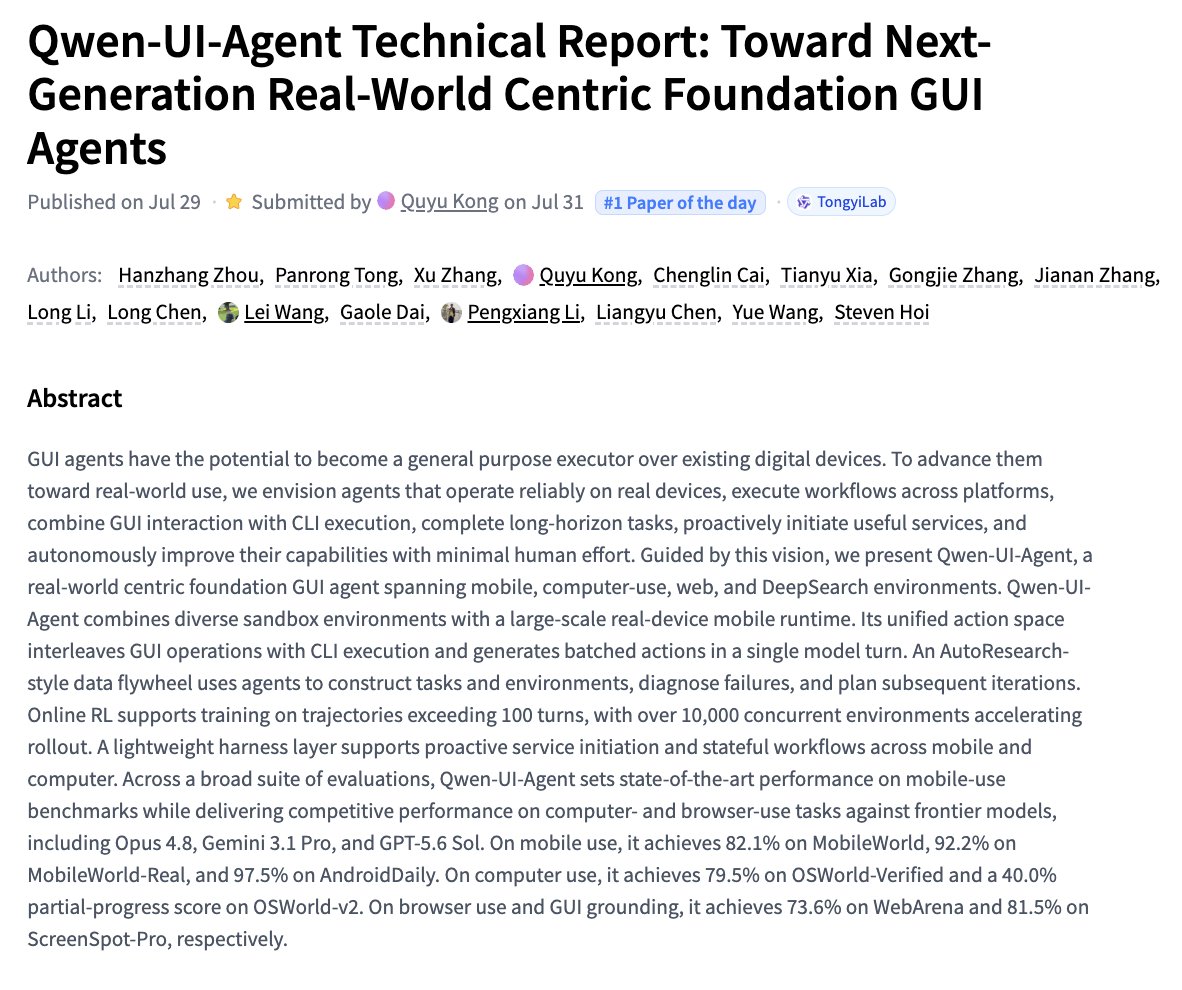
TL;DR - A shared link to the "Qwen-UI-Agent" technical report, which presents a foundation model for GUI agents aimed at real-world computer/mobile interface control. It matters because GUI agents are the bridge between LLM reasoning and actually operating software on behalf of users.

  • Content is thin — the post is essentially a title plus a Hugging Face papers link, so takeaways are inferred from the title alone; no benchmarks, architecture details, or results are provided.
  • Positioned as a technical report for a foundation-scale GUI agent, implying a trained/released model family rather than a narrow method paper.
  • The framing "real-world centric" signals emphasis on practical, in-the-wild interface tasks (grounding, element localization, multi-step action execution) over synthetic or sandboxed benchmarks.
  • Comes from the Qwen line, suggesting continuity with prior Qwen vision-language work as the perception backbone for screen understanding.

Medical/Healthcare AI 2

Representative image for UltraSAM3: A Concept-Driven Foundation Model for Universal Ultrasound Image Segmentation

UltraSAM3: A Concept-Driven Foundation Model for Universal Ultrasound Image Segmentation

Rank 69 · Content 80 · Popularity 43

TL;DR - UltraSAM3 adapts SAM3 into a concept-driven foundation model for universal ultrasound segmentation, letting clinicians specify targets by text instead of expert-drawn visual prompts. It matters because ultrasound's speckle noise, low contrast and ambiguous boundaries have kept segmentation stuck in task-specific or prompt-dependent models.

  • Trained on image–mask–concept triplets from a large-scale corpus spanning 37 public ultrasound datasets and 13 anatomical categories, aligning ultrasound visual patterns with clinically meaningful concepts across organs and lesions.
  • Replaces visual-prompt dependence with text-based target specification, addressing the usability gap in existing foundation models like SAM-style segmenters.
  • Adds an instruction-guided agent that parses complex natural-language queries into concise ultrasound concept prompts, reported to improve robustness on complex user instructions.
  • Reported to outperform representative concept- and text-driven biomedical segmentation baselines on multi-organ benchmarks, external datasets, and visual-prompt-enhanced settings (no numeric metrics given in the abstract).
Representative image for The K-Space Signature: Frequency-Domain Representation Learning for Medical Deepfake Detection

The K-Space Signature: Frequency-Domain Representation Learning for Medical Deepfake Detection

Rank 66 · Content 75 · Popularity 43

TL;DR - An arXiv preprint proposing K-Space Signature (KSS), a frequency-domain forensic framework for detecting AI-generated "medical deepfakes" in 3D MRI. It matters because synthetic medical imaging, while useful for privacy-preserving data sharing, can be weaponized, and this offers a near-perfect detector that generalizes to unseen scanners.

  • KSS moves analysis into the spectral domain and subtracts an empirical global anatomical prior in Logarithmic Power Spectral Density (Log-PSD) space, suppressing macroscopic anatomical variance to expose hardware and generative traces.
  • Detection uses a 3D MLP-Mixer with an ArcFace metric-learning head, chosen deliberately over CNNs because spectral artifacts are globally distributed and CNNs carry a local spatial bias.
  • On multi-center 3D MRI with multiple generators, the method reports >0.99 Accuracy and ROC-AUC; zero-shot transfer to independent datasets from entirely unseen scanners holds up to 0.93 Accuracy.
  • Source code and pre-trained models are promised publicly upon acceptance; no external baseline comparisons or ablation details are given in the abstract.
Bioinformatics AI 1

Representative image for MolGVR: A Chemistry-Grounded Framework for Text-to-Molecule Generation

MolGVR: A Chemistry-Grounded Framework for Text-to-Molecule Generation

Rank 69 · Content 80 · Popularity 43

TL;DR - MolGVR is a chemistry-grounded Generator–Verifier–Refiner framework for text-to-molecule generation that replaces one-shot sequence decoding with a loop of generation, executable chemical verification, and correction. It matters because molecular descriptions carry hard structural constraints whose violation changes molecular identity, making verification a more reliable path to correctness than larger single-pass models.

  • Reframes text-to-molecule generation from direct description→representation mapping into a three-stage pipeline: a Generator that infers structural evidence and proposes candidates, a Verifier, and a Refiner.
  • The Verifier converts natural-language descriptions into explicit chemical constraints and checks candidate molecules against them, supplying the chemical validation step the authors argue is missing in prior work.
  • The Refiner revises candidates rejected by the Verifier, closing a feedback loop rather than discarding failed generations.
  • Reported to improve exact-match performance on the ChEBI-20 and PCDes benchmarks; the abstract gives no numeric scores or baseline comparisons, so magnitude of gains is unstated here.

LLMs & Foundation Models 2

Representative image for Evidence-Type Competition: When Can Interventional Data Teach Language Models Causal Direction?

Evidence-Type Competition: When Can Interventional Data Teach Language Models Causal Direction?

Rank 69 · Content 80 · Popularity 43

TL;DR - A controlled synthetic study finds that adding more interventional data to pretraining does not teach LMs correct causal direction; instead, the evidence type present in the inference-time context determines whether causal knowledge is used. It matters because it challenges the assumption that interventional pretraining data alone buys causal reasoning.

  • In Simpson's-paradox worlds, raising the interventional fraction in pretraining grows the magnitude of the model's do()-response monotonically, but its sign is copied from the observational context.
  • Under an identical training recipe, context type drives outcomes: purely observational contexts cause sign reversal in 29/50 worlds, mixed in 19/50, while aligned interventional probes alone give 41/50 correct; erasing observational evidence releases suppressed causal interpolation (ratio_true = +0.56), and a four-state content manipulation shows the switch is content-mediated and graded.
  • Effects are stable across seeds (11/11 strong reversals on a matched-protocol second seed) and persist as a rate at 0.93B parameters (31.8% vs. 6% reversals in the probe-only arm), though absolute gains shrink four-fold; activation patching localizes the switch to middle-layer observational rows.
  • A CLadder audit reveals a learned positive-effect prior with two-layer structure (sign-randomized retraining removes it in-distribution but not out-of-distribution); the authors also quantify probe-based evaluation's sampling noise floor and an evidence-averaging protocol cutting sign errors from 26% to 9%.

Learning Latent Reasoning Traces for Scalar Reward Models End-to-End

Rank 69 · Content 80 · Popularity 43

TL;DR - LatentRM is a reward-modeling framework that treats intermediate reasoning traces as discrete latent variables optimized end-to-end to maximize scalar reward likelihood, bridging the gap between interpretable scalar RMs and robust generative RMs. It matters because reward model generalization is a key bottleneck for RLHF-based alignment on complex and out-of-distribution tasks.

  • Frames the problem as a mismatch: scalar RMs are efficient and probabilistically interpretable but latch onto superficial cues; generative RMs reason well but produce natural-language scores lacking numerical flexibility.
  • Argues existing hybrids using off-policy multi-task learning optimize reasoning and scoring in parallel, with no guarantee the generated traces actually help downstream scalar prediction.
  • Core method: discrete latent reasoning traces optimized on-policy end-to-end, explicitly coupling reasoning-based evaluation to precise scoring.
  • Reported to outperform scalar, generative, and hybrid RMs on in-distribution and OOD preference modeling plus RLHF policy alignment, spanning open-ended conversation to complex reasoning (no specific numbers given in the abstract).

Multimodal & Generative 1

Role-Break in Attention Heads: Understanding and Detecting Hallucinations in VLMs

Rank 69 · Content 80 · Popularity 43

TL;DR - An arXiv cs.CV paper identifying "Role-Break," a head-level signature where attention heads deviate from their faithful contextual behavior during hallucination, and using it to build a cheap linear hallucination detector for VLMs. It matters because it generalizes across hallucination patterns rather than targeting a single one, which is where prior detectors break down.

  • Argues real VLM hallucinations mix multiple patterns (e.g. visual-textual imbalance), so single-pattern signals don't transfer stably across models and tasks; proposes a unified head-level view instead.
  • Finds hallucination-induced deviations are systematically structured across attention heads, contextual sources, and deviation directions, and become linearly readable when head identity is preserved (not pooled away).
  • Detector is lightweight: no VLM fine-tuning, feature dimension under 5,000, averaging 93.23 AUROC across six VLMs and four benchmarks.
  • A small-scale intervention experiment shows detected tokens can be acted on directly in the discriminative setting; mitigation beyond that scope isn't claimed.

AI for Materials Discovery 1

Reinforcement learning steers generative crystal design

Rank 68 · Content 75 · Popularity 50

TL;DR - A Nature Machine Intelligence item describing a reinforcement learning method that steers generative models toward crystal candidates that are simultaneously novel and functionally useful. It matters because it targets a core weakness of generative materials discovery: coverage of the useful-but-unexplored region of chemical space.

  • Generative ML has already advanced crystal discovery, but the piece states these methods cannot fully explore the space of candidates that are both novel and useful.
  • The contribution is an RL-based method that biases/steers candidate generation toward those under-covered regions rather than sampling the generative prior directly.
  • Stated outcome is the design of novel functional materials, i.e. optimizing for property/utility objectives alongside novelty.
  • Content is thin (a publication abstract/summary only): no architecture details, reward formulation, baselines, or quantitative results are given, so specifics cannot be assessed here.

Embodied 3D Perception 1

Representative image for RSS-2026 | 港科大(广州)开源首个无需训练的开放词汇3D占据地图构建系统|RRS 2026

RSS-2026 | 港科大(广州)开源首个无需训练的开放词汇3D占据地图构建系统|RRS 2026

Rank 64 · Content 70 · Popularity 50

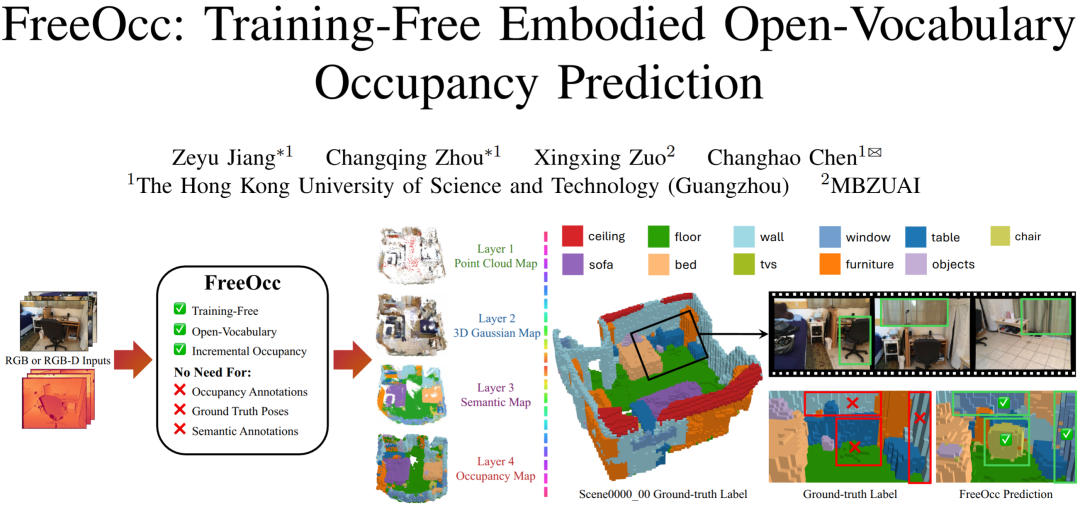
TL;DR - FreeOcc (HKUST-Guangzhou + MBZUAI, accepted to RSS 2026) is the first training-free, open-vocabulary 3D semantic occupancy prediction system, building globally consistent voxel occupancy maps online from monocular or RGB-D image sequences without 3D annotations or ground-truth camera poses. It matters because it removes the annotation and per-scene retraining bottleneck that blocks embodied perception from generalizing to new environments.

  • Four-layer modular map: SLAM point cloud (DROID-SLAM backbone) → 3D Gaussians → open-vocabulary semantics from a pretrained VLM lifted onto Gaussian primitives → probabilistic Gaussian-to-Occupancy voxel projection queryable by arbitrary text.
  • Key designs are Geometry-aware Initialization (G-ini) and Geometrically Anchored Gaussian Updates (GAGU), which anchor Gaussian centers to SLAM points instead of letting them drift for rendering loss; ablation (RGB-D) goes 27.98 IoU / 11.20 mIoU / 8.8 FPS → 45.03 IoU / 18.37 mIoU / 24.6 FPS.
  • On EmbodiedOcc-ScanNet it reaches 31.29 IoU / 13.86 mIoU (monocular) and 34.40 / 15.84 (RGB-D), over 2x self-supervised baselines GaussianOcc (10.17/4.34) and GaussTR (15.63/4.95) despite using no poses.
  • Authors introduce the ReplicaOcc zero-shot benchmark with finer-grained classes, where supervised EmbodiedOcc collapses to ~0 mIoU while FreeOcc holds 55.65 IoU / 20.90 mIoU (RGB-D); code, dataset, and a real RealSense D435i + Qwen3-VL deployment are released.

LLM Security & Privacy 1

Representative image for PTP: Previous-Token Prediction based LLM Inversion for Near-Exact Prompt Reconstruction

PTP: Previous-Token Prediction based LLM Inversion for Near-Exact Prompt Reconstruction

Rank 66 · Content 75 · Popularity 43

TL;DR - An arXiv preprint introducing PTP, a black-box LLM inversion method that trains an inverse language model from scratch via "previous-token prediction" to reconstruct the prompts that produced observed outputs. It matters because it shows near-exact prompt recovery without needing model weights, logits, or external datasets — a direct prompt-confidentiality risk.

  • Frames inversion functionally rather than as semantic reconstruction: the inverse model is trained on data synthetically generated from the target LLM itself, avoiding fine-tuning of pretrained seq2seq models on large external corpora.
  • Previous-token prediction mirrors forward next-token prediction, creating a generative link between forward and inverse processes that the authors argue enables faithful reconstruction.
  • Sampling from the inverse model yields diverse candidate prompts that reportedly induce similar responses under the forward target LLM.
  • Claims generalization across datasets and transferability to responses from different LLMs, outperforming prior work on token-based prompt and response reconstruction metrics.

Neuro-AI Alignment 1

Beyond representational alignment with brain-guided language models for robust reasoning

Rank 75 · Content 85 · Popularity 50

TL;DR - A Nature Machine Intelligence paper by Xiao et al. reporting that LLM internal representations partially align with human brain activity during deductive reasoning, and that brain signals can be used to directly steer models toward better reasoning performance. It matters because it moves neuro-AI work past passive similarity measurement into actively using neural data to improve model behavior.

  • Establishes partial representational alignment between LLMs and human neural activity recorded during deductive reasoning tasks.
  • Goes "beyond representational alignment": brain signals are used as a guidance signal to directly improve model performance, not just to benchmark similarity.
  • Reported gains transfer across reasoning types, suggesting the brain-derived guidance captures generalizable reasoning structure rather than task-specific artifacts.
  • Details are limited to the abstract-level summary provided — specific model families, neuroimaging modality, datasets, and effect sizes are not stated here.

Robot Learning & World Models 1

Representative image for BWM: A Low-Cost High-Fidelity World Simulator for Robot Learning

BWM: A Low-Cost High-Fidelity World Simulator for Robot Learning

Rank 66 · Content 75 · Popularity 43

TL;DR - BWM (Boundless World Model) is an open-source, action-conditioned video world model that predicts future observations of robot manipulation from fine-grained actions, aiming to replace costly physics-simulator asset construction and calibration. It matters because it doubles as both a data engine for imitation learning and a closed-loop policy evaluator that can anticipate risky or failure-prone outcomes before hardware execution.

  • Architecture combines initial-environment guidance, dynamic visual history, and temporally aligned robot-action conditioning for stateful autoregressive rollout prediction — targeting the control precision that generic video generators lack.
  • Training data is built via trajectory replay, overlapping clip sampling, and initial-observation enhancement to produce action-aligned clips.
  • Two claimed use modes: augmenting imitation-learning datasets with action-aligned rollouts, and closed-loop policy assessment/ranking plus risk anticipation.
  • Reported first place overall in the WorldArena Challenge (Track 1 and both Track 2 applications), with fidelity and utility gains validated on the WorldArena benchmark and physical robots; checkpoints, training/inference code, and data-generation/evaluation interfaces are released.
Top highlights — Industry & News

LLM Agents 2

Representative image for 阿里“千问办公”开启公测

阿里“千问办公”开启公测

Rank 57 · Content 60 · Popularity N/A

TL;DR - Alibaba opened public beta of "QwenWork" (千问办公), an enterprise-grade agent product consolidating QoderWork, MuleRun, and 悟空, powered by its latest flagship model Qwen3.8. It matters as a push to move LLM agents from personal assistants into real enterprise workflows and data systems.

  • Claimed to be the first product to simultaneously support desktop agents, cloud agents, and enterprise collaborative agents; available now via web and standalone PC client, with DingTalk PC/mobile entry points coming soon.
  • Enterprise focus: already partially integrated with DingTalk IM, with planned connections to real corporate databases and workflows.
  • Key feature is "organization-level Skills" — a completed multi-turn workflow (e.g., an M&A due-diligence report) can be saved once and reused by other employees who pick an execution path.
  • Roadmap includes a standalone app and international version; beta incentives give new users 2,000 points plus 500–2,000 daily login points in week one.
Representative image for 阿里“千问办公”开启公测

阿里“千问办公”开启公测

Rank 57 · Content 60 · Popularity N/A

TL;DR - Alibaba opened public beta of "QwenWork" (千问办公), an enterprise-grade agent product that merges three prior products and runs on its latest flagship model Qwen3.8. It matters as a push to move LLM agents from individual productivity demos into real enterprise workflows and data systems.

  • Positioned as the first product to simultaneously support desktop agents, cloud agents, and enterprise collaboration agents; consolidates QoderWork, MuleRun, and 悟空 (Wukong) into one offering.
  • Available now via web and standalone PC client at qwenwork.cn, with DingTalk PC/mobile entry points, a standalone app, and an international version planned.
  • Key enterprise hook: initial DingTalk IM integration plus "organization-level Skills" — a senior user's multi-turn workflow (e.g. an M&A due-diligence report) can be captured once and reused by other employees who pick an execution path.
  • Targets cross-team/asynchronous work: agents can auto-compile decision context, generate English project docs, and answer a partner team's questions 24/7 in project groups; beta offers 2,000 signup credits plus 500–2,000 daily login credits in week one.

Medical/Healthcare AI 1

Representative image for 独家丨璨辰科技完成数千万天使系列融资,AI 虚拟器官仿真平台加速落地

独家丨璨辰科技完成数千万天使系列融资,AI 虚拟器官仿真平台加速落地

Rank 68 · Content 75 · Popularity N/A

TL;DR - Chinese startup CANCHEN TECH (璨辰科技) raised tens of millions of RMB across seed/angel rounds to build a full-scale AI "virtual organ" digital-twin simulation platform aimed at replacing parts of traditional animal testing in preclinical drug evaluation. It matters because regulators (China's CDE, plus FDA/EMA/MHRA) are now opening the door to New Approach Methodologies, making simulation-based evidence commercially viable.

  • Platform is a three-layer stack: a multi-omics foundation model at the base, digital twins of individual organs (brain, gut, liver) in the middle, and multi-organ/whole-body lifecycle inference on top; the team emphasizes causal modeling via dynamical systems and biological constraints rather than parameter scaling.
  • Claimed technical differentiator is a closed loop of simulation → wet-lab → preclinical validation, with cross-scale organ twins applied at scale to developmental toxicity assessment and neurological disease mechanism studies, and risk predictions cross-checked against in vivo models and partner hospitals.
  • Prior work includes first full-cycle 3D dynamic modeling of mammalian embryos, with results published in Cell; infrastructure partnerships cover a dedicated virtual-organ training data platform, a southwest national intelligent computing center, BGI's Sanya life science institute, and tertiary hospitals for newborn developmental disease screening.
  • Investors include 东方富海, 松禾资本, 零以创投, 水木清华基金, 启迪之星创投, 启繁资本 and 南山战新投; the article notes regulatory validation standards and data-loop maturity remain unresolved industry-wide.

LLMs & Foundation Models 5

Representative image for 阿里Qwen3.8正式发布,编程与办公再进化,推理更快更稳定

阿里Qwen3.8正式发布,编程与办公再进化,推理更快更稳定 🔗 2 sources

Rank 71 · Content 80 · Popularity N/A

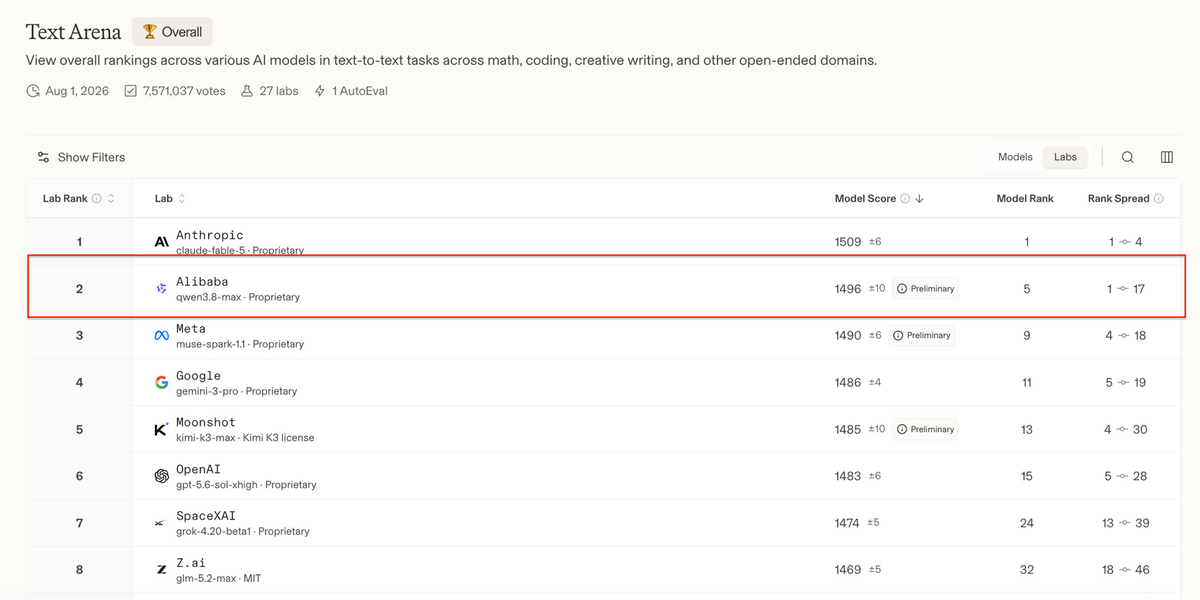
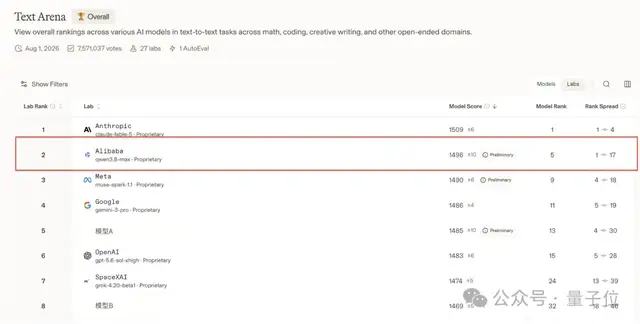
TL;DR — Alibaba released Qwen3.8, a 2.4T-parameter sparse-MoE flagship (95B active) with 1M-token context and native vision, aimed at agentic coding and long-horizon professional "Cowork" tasks. It matters as a price-aggressive frontier alternative — second only to Anthropic's Claude on Arena overall — with Qwen3.8-Max and Qwen3.8-27B slated for open-sourcing next week.

  • Architecture & serving: Joint sparse-MoE + hybrid attention optimization scales totals to 2.4T with 95B activated for faster/cheaper inference; 1M-token context and native visual understanding. Alibaba's Zhenwu M890 supernode claims up to 1.5x agentic inference speedup.
  • Pricing & availability: API live on the Qwen AI platform at ¥12/M input and ¥36/M output (¥1.5 on implicit cache hits) — stated as 40%/24% of Opus 5's international pricing — and wired into the new "Qianwen Office" agent product.
  • Agentic coding: PaperBench 93.0 (+28.2 over prior gen) and 4th on CodeArena; a demo run had the model work unattended for ~16 days from an empty folder to build "oh-my-cli," a self-evolving agent framework now published on GitHub.
  • Agent & reasoning benchmarks: WideSearch 81.9, Agent's Last Exam 52.4, IFBench 82.8, GPQA Diamond 92.6, and OSWorld-Verified 86.1 (claimed first among mainstream models).
  • Multimodal: 2nd on Vision Arena; BabyVision 82.0 without tools; handles 200-page PDFs and 100+ hour video, plus a self-built RecreationBench for zero-source-code app replication via iterative visual coding.

Emphasis differs slightly: 量子位 flags that all figures are vendor-supplied from an authorized Alibaba release and not independently verified, while 雷峰网 foregrounds productization (API pricing tiers, "Qianwen Office" integration) and the open-source roadmap.

Representative image for 刚刚,阿里Qwen3.8-Max来了!冲进全球第一梯队,模型表现直逼Claude

刚刚,阿里Qwen3.8-Max来了!冲进全球第一梯队,模型表现直逼Claude

Rank 71 · Content 80 · Popularity N/A

TL;DR - Alibaba released Qwen3.8-Max, a 2.4-trillion-parameter flagship foundation model positioned in the global top tier on Arena leaderboards while undercutting Claude Opus 5 pricing by roughly 60–76%. It matters because it signals a Chinese frontier model competing on coding/agentic capability and cost simultaneously.

  • Claimed 2.4T total parameters, targeting coding, professional work, long-horizon tasks, and multimodal agents; the article cites Text Arena and front-end coding leaderboard placements ahead of Claude Opus 5 and "Fable 5," and reported wins over GPT-5.6/Opus 4.8 on research reproduction, multimodal understanding, long video, and computer use.
  • Pricing in China: ¥12 per million input tokens, ¥36 output, ¥1.5 for implicit cache hits — stated as 40% (input) and 24% (output) of Opus 5's international price.
  • Agentic claims include autonomous end-to-end delivery (an official case of 10+ days unattended from an empty folder), coherence across thousands of interaction turns, and hundreds of legal documents processed per hour.
  • Hands-on tests in the piece: a full AI-news web app built from a one-page PRD in ~5 minutes with self-generated issue logs and acceptance checks; cross-section analysis of a dozens-of-pages ImageNet paper (tables + appendix figures) in ~33s; a topic timeline with timestamps for a ~70-minute podcast in 2–3 minutes.
  • Positioning context: Alibaba cites 400+ open-sourced models, 200k+ derivatives, 1B+ downloads; API is live on the Qianwen AI platform alongside a new "Qwen Work" agent product. Note these are vendor/媒体 claims from a promotional review, not independently verified benchmarks.
Representative image for 我们用 Kimi K3 搓了一颗火影螺旋丸,只花129元就顶一个前端团队?

我们用 Kimi K3 搓了一颗火影螺旋丸,只花129元就顶一个前端团队?

Rank 64 · Content 70 · Popularity N/A

TL;DR — A hands-on 雷峰网 review of Moonshot's newly open-sourced 2.8T-parameter Kimi K3, using a Naruto "Rasengan" web demo to stress-test its architecture claims and agentic front-end coding. It matters as the first openly released model at closed-source scale, with efficiency gains coming from architectural constraints rather than parameter count.

  • Scale + cost: 2.8T params (largest open-weight model, up from the 1T K2 tier), but only 16 of 896 experts active per token, with MXFP4 weight / MXFP8 activation quantization-aware training starting post-training. Deployment needs a 64+ accelerator supernode; API is $3/M input, $15/M output — roughly 4x K2.7's output price. Some official benchmarks ran on performance-capped H20s.
  • KDA (Kimi Delta Attention): 3:1 mix of linear to full attention layers, so three of four layers work from a fixed-size running summary instead of rescanning context. Reported on a 48B validation model: up to 75% KV-cache reduction and ~6x faster decoding at 1M tokens.
  • AttnRes (attention residuals): replaces fixed weight-1 residual accumulation with learned per-layer connections, addressing unbounded hidden-state growth and dilution of individual layer contributions; matched a baseline using 1.25x compute over 1.4T training tokens (~25% training efficiency gain). Both techniques were open-sourced ~8-9 months before K3.
  • Practical caveats: multi-turn quality reportedly degrades sharply unless the full assistant message including reasoning_content is echoed back, which the author speculates explains the Terminal-Bench 2.1 gap (88.3 self-reported via Kimi Code vs 85.0 third-party). The demo took 26 iterations, blew past the 1M context twice, and consumed ~$19 of quota in two days — an assisted result, not one-shot.
Representative image for RT by @NVIDIAAI: 🎉 Congrats to @thinkymachines on Inkling-Small-- live with Day 0 vLLM support!…

RT by @NVIDIAAI: 🎉 Congrats to @thinkymachines on Inkling-Small-- live with Day 0 vLLM support!…

Rank 64 · Content 70 · Popularity N/A

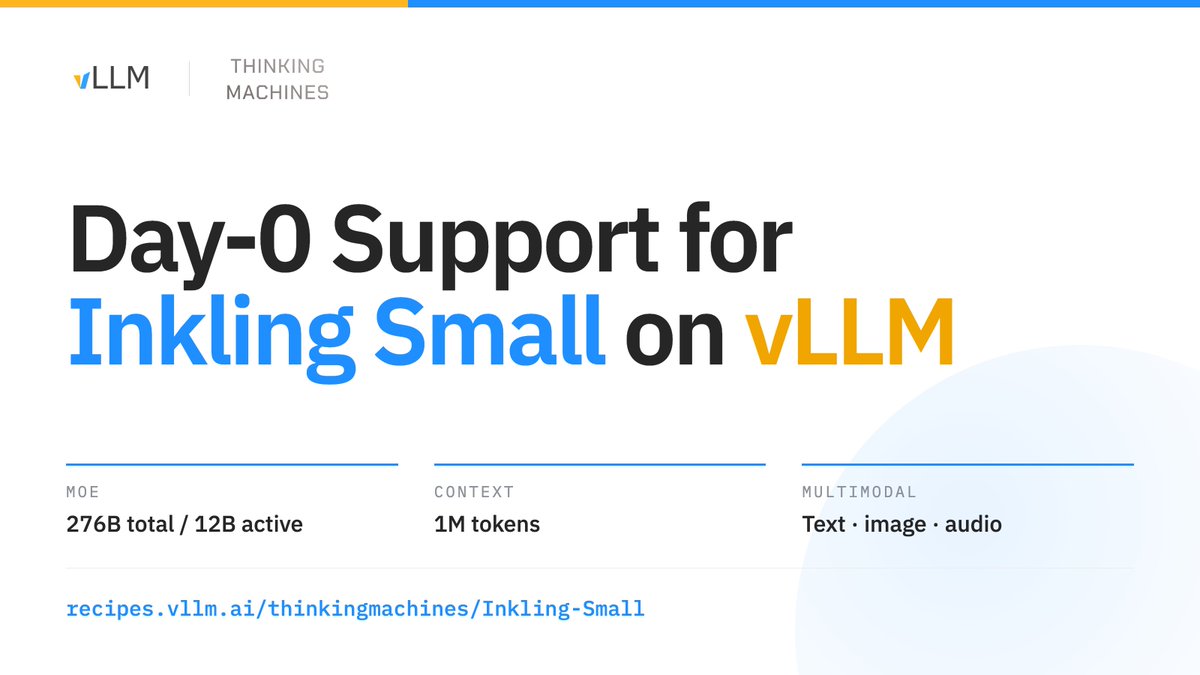
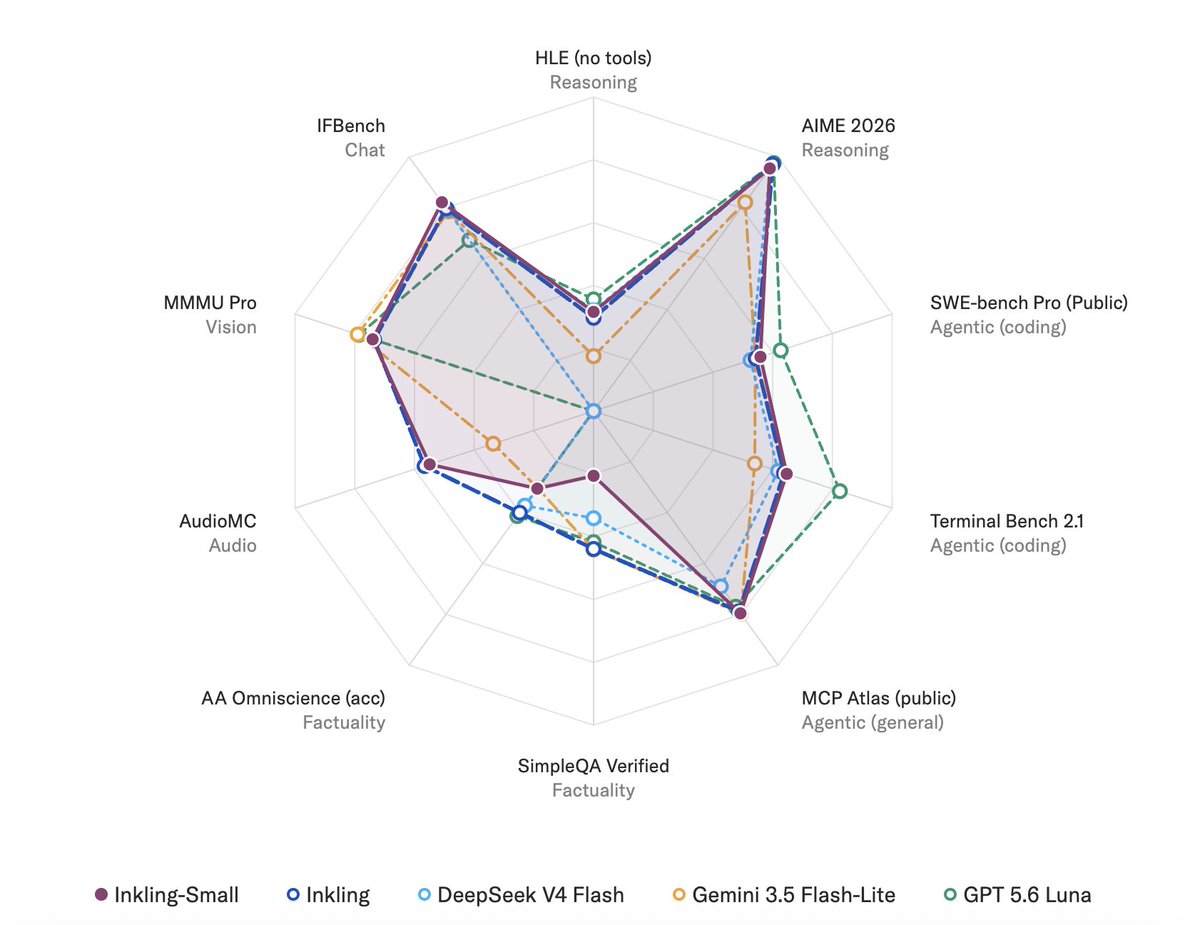
TL;DR - NVIDIA is amplifying Thinking Machines' release of Inkling-Small, an open-weights multimodal MoE model that reportedly matches the larger Inkling at a quarter of the size, with Day 0 vLLM support optimized for NVIDIA Blackwell. It matters because a frontier-class open-weights model with same-day serving support lowers the barrier to deploying multimodal agentic systems.

  • 276B total parameters with 12B active (Mixture-of-Experts), native text, image, and audio input, and a 1M-token context window.
  • Architecture mirrors the larger Inkling, so it reuses the existing vLLM code path — enabling Day 0 support and Blackwell-targeted optimization.
  • Positioned for agentic/tool-use systems, coding assistants, and RAG; features controllable reasoning effort.
  • Full weights released; fine-tuning offered via Thinking Machines' Tinker, with text/image/audio chat in Tinker Playground. Note: performance parity with Inkling is a vendor claim, with no benchmark numbers given in this post.
Representative image for RT by @huggingface: Thinking Machines released Inkling Small (🦖) + NVFP4 12B active 276B total…

RT by @huggingface: Thinking Machines released Inkling Small (🦖) + NVFP4 12B active 276B total…

Rank 64 · Content 70 · Popularity N/A

TL;DR - Thinking Machines released Inkling Small, a sparse Mixture-of-Experts model (12B active / 276B total params) shipped in NVFP4 format, with Hugging Face publishing a companion blog on benchmarks, performance, and deployment. It matters because a smaller-active-parameter model reportedly beats the larger Inkling on coding, suggesting gains from sparsity and low-precision formats rather than raw scale.

  • Architecture is sparse MoE: 276B total parameters with only 12B active per token, targeting large-model quality at small-model inference cost.
  • Distributed in NVFP4 (NVIDIA 4-bit floating point), a quantized format aimed at efficient serving on modern NVIDIA hardware.
  • Claimed to outperform the larger Inkling model on coding tasks — a counter-intuitive result, though no specific benchmark numbers are given in this post.
  • Weights are available via a Hugging Face collection, with a HF blog covering benchmarks and deployment; details beyond the announcement are thin here and would need the linked blog to verify.

Multimodal & Generative 5

Representative image for 原生统一多模态进阶!SenseNova U1.5-Lite-Preview开源,生成编辑能力再进化

原生统一多模态进阶!SenseNova U1.5-Lite-Preview开源,生成编辑能力再进化

Rank 68 · Content 75 · Popularity N/A

TL;DR - SenseTime open-sourced SenseNova U1.5-Lite-Preview, an 8B-MoT natively unified multimodal model built on the NEO-Unify architecture that handles visual understanding, reasoning, generation, and editing in a single model. It matters because it pushes native 4K generation and iterative image editing at lightweight scale, with weights on GitHub/Hugging Face/ModelScope.

  • Native 4K image generation via a redesigned generation head that reduces visual-token grid artifacts and seams; training extended to 4K resolution.
  • Encoder-free visual modeling avoids fixed-encoder information compression, preserving text strokes, local texture, and spatial structure for more precise editing and identity/background preservation.
  • Strong long-prompt control (examples cite 1,675- and 3,880-word prompts) plus improved Chinese/English text rendering and complex layout; an experimental Prompt Enhance Skill expands short ideas into structured specs.
  • Reported benchmark gains over U1: Qwen-Image-Bench 47.14→55.20 (with Prompt Enhance), ImgEdit-Bench 3.90→4.37, GEdit-Bench-en 7.47→8.17, GEdit-Bench-zh 7.42→8.05; a delivery-grade U1 Pro is in closed testing.
Representative image for RT by @huggingface: MiniMax H3 just dropped on Hugging Face text-to-video, image-to-video…

RT by @huggingface: MiniMax H3 just dropped on Hugging Face text-to-video, image-to-video…

Rank 64 · Content 70 · Popularity N/A

TL;DR - MiniMax released H3, a 33B-parameter video generation model, on Hugging Face with text-to-video, image-to-video, and reference-to-video modes that all produce synchronized audio. It matters because open-weight video+audio generation at consumer-GPU scale narrows the gap with closed commercial video models.

  • Three conditioning modes in one model: text-to-video, image-to-video, and reference-to-video, each generating video with accompanying audio rather than silent clips.
  • 33B parameters, but the announcement claims it is runnable on consumer GPUs — implying quantization/offloading support rather than datacenter-only inference.
  • Ships with day-one ecosystem integration: 🧨 diffusers and ComfyUI support, plus downloadable weights and a hosted demo app on Hugging Face Spaces.
  • Note: this is a distribution/launch post from Hugging Face; no benchmarks, training details, or license terms are given in the content provided.
Representative image for Another open-weight release from @thinkymachines 👀 Inkling-Small is here. With native reasoning…

Another open-weight release from @thinkymachines 👀 Inkling-Small is here. With native reasoning…

Rank 64 · Content 70 · Popularity N/A

TL;DR - Thinking Machines released Inkling-Small, an open-weights multimodal MoE model (276B total / 12B active) that reportedly matches the larger Inkling at a quarter of its size, and NVIDIA is amplifying it with an NVFP4 checkpoint for fine-tuning on NeMo/DGX Station.

  • Mixture-of-Experts architecture: 276B total parameters with only 12B active per token, targeting Inkling-level quality at ~1/4 the size.
  • Natively reasons over text, images, and audio, with controllable/variable "thinking effort" as a user-tunable knob.
  • Full weights are open; an NVFP4-quantized checkpoint is published on Hugging Face for low-precision inference and fine-tuning on NVIDIA NeMo + DGX Station.
  • Available to fine-tune via Thinking Machines' Tinker platform and to try interactively in Tinker Playground; no benchmark numbers are given in the post beyond the "comparable performance" claim.
Representative image for Google 牺牲了图片分辨率、编辑能力和准确性换取了 「它」 的极致性价比!

Google 牺牲了图片分辨率、编辑能力和准确性换取了 「它」 的极致性价比!

Rank 57 · Content 60 · Popularity N/A

TL;DR — Google released Nano Banana 2 Lite (Gemini 3.1 Flash-Lite Image) and opened Gemini Omni Flash to developers, pairing a 4-second, $0.034-per-1K-image generator with an image-to-video model to form a chainable visual production pipeline. It matters because it reframes image generation from a human creative act into a cheap, callable function inside automated agent/ad/e-commerce workflows.

  • The tradeoff: Lite caps output at 1K (1024×1024), drops Search grounding, and trims most of the "thinking" deliberation step (Thinking On remains, but abbreviated), buying 4s latency and ~half the cost of NB2 ($0.067); batch tier halves it again to $0.0168.
  • Benchmarks: text-to-image scores 1251 vs NB2's 1270, beating Flux Klein (1069), Grok Imagine (1174), and SeedreamLite (1132); editing is the weak spot at 1308, losing to NB2 (1387) and Grok Imagine (1329). Nano Banana PRO was pointedly absent from Google's comparison charts.
  • Six-scenario hands-on: Lite held up for "consumable" images (promo creatives, WeChat cover art, thumbnails) but failed accuracy-critical ones — garbled the rare character 嵴 on a mitochondria diagram and fabricated numbers with blurry small text on an Nvidia revenue chart. Dividing line: decoration → Lite, information carrier or brand asset → PRO.
  • Pipeline framing: Omni Flash ($0.10/sec, matching Veo 3.1 Fast) turns Lite output into 10s video with up to three conversational edit passes; the authors argue the real bottleneck shifts from generation to QA, proposing generate → automated validation (OCR, rule checks, similarity, moderation) → model routing → human sign-off, since verification and error costs can dwarf the per-image price.
Representative image for 这个新生图模型有点夯:4K直出的,国产的,开源的!

这个新生图模型有点夯:4K直出的,国产的,开源的!

Rank 54 · Content 55 · Popularity N/A

TL;DR - SenseTime open-sourced SenseNova U1.5-Lite-Preview, an 8B-MoT lightweight native unified multimodal model that generates native 4K images and supports precise, instruction-driven editing. It matters because it packages understanding, reasoning, generation, and editing into one small open model aimed at real design workflows rather than one-shot image generation.

  • Built on SenseTime's NEO-Unify native unified architecture, modeling language, visual semantics, and pixel generation in a single model covering understanding, reasoning, generation, and editing.
  • A redesigned generation head reduces the influence of the visual-token grid and extends training to 4K resolution, cutting grid artifacts, seams, and texture breakage when zoomed in.
  • Editing features include reference images, multi-image composition, localized text edits, and targeted edits via red boxes, coordinates, and markers; long/structured prompts are handled with Prompt Enhance.
  • Reported benchmarks vs. prior U1: Qwen-Image-Bench 47.14 → 55.20 (with Prompt Enhance), ImgEdit-Bench 3.90 → 4.37, GEdit-Bench EN 7.47 → 8.17 and ZH 7.42 → 8.05, WeEdit overall 6.44. It is an early preview (weak spots: short prompts, small text/portrait detail, aesthetic consistency), with the full U1.5 release promised soon; weights are on GitHub, Hugging Face, and ModelScope.

AI Compute Market 1

Representative image for B300半年涨三倍;大厂集体绕开算力中转站;Infra公司多名核心高管离职;Token成本击穿圈人再变现丨算力情报局Vol.13

B300半年涨三倍;大厂集体绕开算力中转站;Infra公司多名核心高管离职;Token成本击穿圈人再变现丨算力情报局Vol.13

Rank 54 · Content 55 · Popularity N/A

TL;DR - Leifeng.com's compute-intelligence column reports on China's AI hardware market: NVIDIA B300 server prices tripled in six months amid hoarding and fraud, domestic inference chips are being disaggregated by transformer block, and the economics of token-based AI services are breaking the old internet growth playbook.

  • B300 full-system spot prices in China rose from ~RMB 4M to over RMB 12M per unit since the Spring Festival, quoted "daily" rather than weekly; one East China firm pursuing 10,000+ units allegedly pressured suppliers into exclusivity, while some "in-stock" offers are scams to harvest buyers' procurement and deployment data.
  • Domestic inference silicon is splitting the transformer: one AFN-architecture vendor has taped out an FFN/MoE chip (Attention chip still in design, to run heterogeneously with GPUs), while another is starting with a Prefill-only chip targeting above-H100 performance, LPDDR first and 3D stacking later.
  • 3D-stacked chip startups are seeing valuations jump from hundreds of millions to billions of RMB in six months, but yield, stacking process, and supply chain still gate mass production; investors reportedly won't fund new inference architectures pre-tape-out and see room for only one or two training-side GPU winners.
  • Large firms avoid third-party API relay services over data security, TPM/RPM concurrency limits, unauditable billing, and account-ban risk (ByteDance and Tencent were both burned); more broadly, per-user token cost makes "free tokens to acquire users, monetize later" economically unworkable.