RT by @_akhaliq: Meshy T2 A fast native mesh generation framework using flow matching that produces…
Ranking
No observed public metrics; popularity remains neutral/archived.
Merged summary
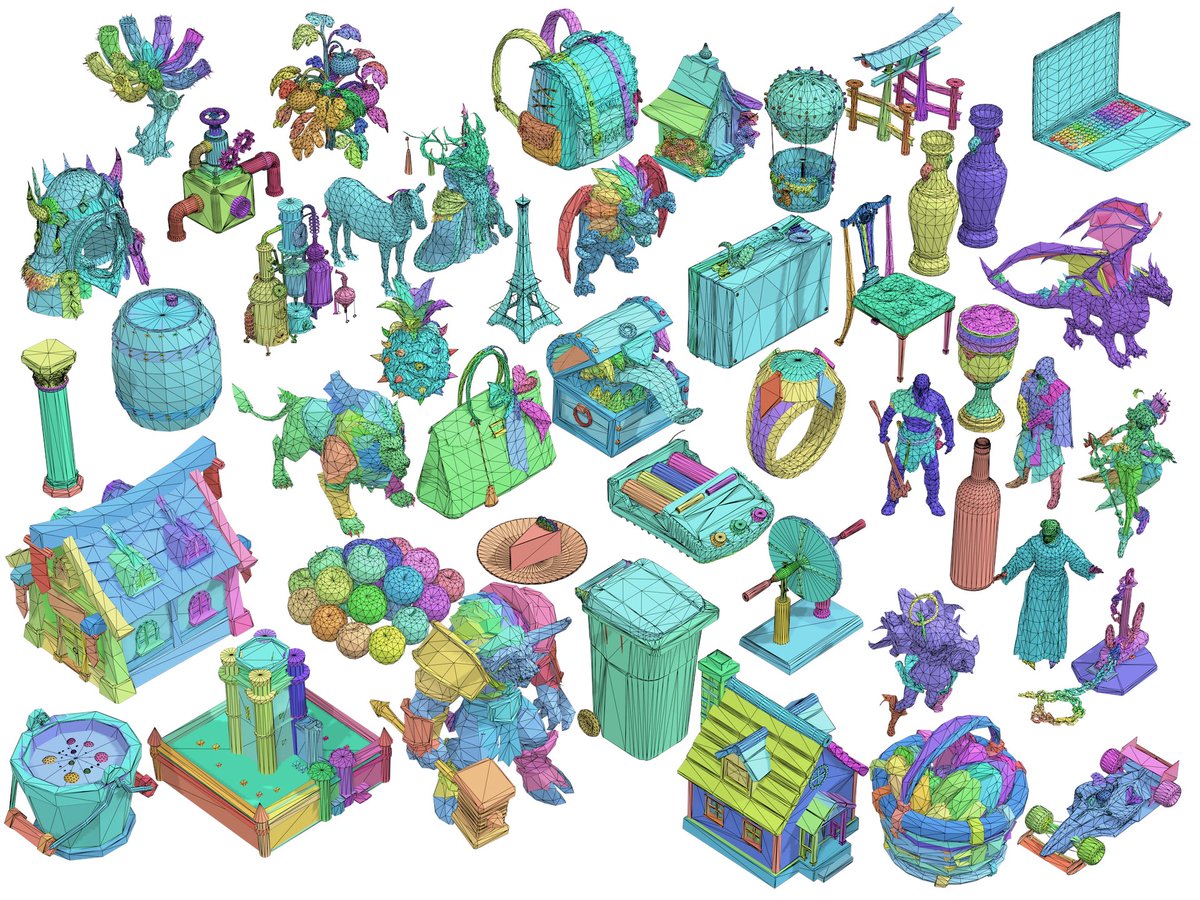
TL;DR - Meshy T2 is a native 3D mesh generation framework that uses flow matching to produce artist-quality meshes in a median of ~6 seconds, claimed to be over 10x faster than autoregressive mesh generators. It signals a shift in 3D asset generation from token-by-token autoregression toward flow-based sampling, which matters for practical content-creation pipelines.
- Generates meshes natively (direct mesh output) rather than via intermediate representations converted after the fact.
- Uses flow matching as the generative mechanism, enabling few-step sampling instead of sequential token decoding.
- Reported median latency of ~6 seconds per mesh, a claimed >10x speedup over autoregressive mesh generation methods.
- Output is characterized as "artist-quality" topology, targeting production-usable assets — though the shared content is a brief product/announcement blurb with no benchmarks, ablations, or evaluation details, so quality and speed claims are unverified here.
Sources (1)
RT by @_akhaliq: Meshy T2 A fast native mesh generation framework using flow matching that produces…
TL;DR - Meshy T2 is a native 3D mesh generation framework that uses flow matching to produce artist-quality meshes in a median of ~6 seconds, claimed to be over 10x faster than autoregressive mesh generators. It signals a shift in 3D asset generation from token-by-token autoregression toward flow-based sampling, which matters for practical content-creation pipelines.
- Generates meshes natively (direct mesh output) rather than via intermediate representations converted after the fact.
- Uses flow matching as the generative mechanism, enabling few-step sampling instead of sequential token decoding.
- Reported median latency of ~6 seconds per mesh, a claimed >10x speedup over autoregressive mesh generation methods.
- Output is characterized as "artist-quality" topology, targeting production-usable assets — though the shared content is a brief product/announcement blurb with no benchmarks, ablations, or evaluation details, so quality and speed claims are unverified here.