🛰️ Daily AI Frontier
54 works · 3 categories · 31 topics · blog 11 journal 10 arxiv 15 wechat 15 generated 2026-08-06 16:18:04 UTC
Top highlights — Research

LLM Agents 7

Representative image for ABSeeker: Training Long-Horizon Search Agents via Answer-Backtracked Credit Assignment

ABSeeker: Training Long-Horizon Search Agents via Answer-Backtracked Credit Assignment

Rank 77 · Content 80 · Popularity 70

TL;DR - ABSeeker is a long-horizon search agent trained with Answer-Backtracked Credit Assignment (ABC), which turns sparse trajectory-level outcomes into dense step-level supervision so useful search steps are rewarded and redundant or erroneous ones suppressed. It matters because a 4B model trained on just 8.5k examples reaches performance competitive with ~30B-scale agents on BrowseComp.

  • ABC has two stages: Answer-Backtracked Clue Recovery traces from the ground-truth answer back to the intermediate clues needed to solve the query, then Clue-Anchored Step Scoring grades each search step against those clues to produce dense per-step rewards.
  • The rewards feed two training variants: ABC-SFT reweights per-turn loss, and ABC-GRPO uses step-level scores as the RL reward signal; credit can be assigned to useful actions even inside failed trajectories.
  • ABSeeker (Qwen3.5-4B, 8.5k training examples) scores 37.3% on BrowseComp and 39.1% on BrowseComp-ZH; adding context management raises these to 55.3% and 52.9%.
  • Reported gains beat same-scale 4B agents and match roughly 30B-scale agents, arguing that fine-grained credit assignment substitutes for parameter count in long-horizon search.

Representative image for When Memory Lies: An Empirical Study of Spatial Memory Staleness in VLM Agents

When Memory Lies: An Empirical Study of Spatial Memory Staleness in VLM Agents

Rank 73 · Content 80 · Popularity 57

TL;DR - An empirical study showing that persistent spatial memory in VLM agents silently goes stale as environments change, and that trusting it uncritically is a measurable safety liability. It reframes memory staleness as a safety failure mode rather than a mere accuracy issue.

  • Uses a dynamic FrozenLake testbed pairing a staleness-detection task with downstream navigation across three closed-source and three open-weight VLMs, in text and image input modes (1,800 detection runs; 12,000 text-mode navigation episodes over four LLM navigators at a shared 50-seed scale).
  • Text solvability doesn't imply visual grounding: models that reliably flag stale entries from text span vision F1 from 0.887 down to 0.067 on identical grids, with the weakest confidently ignoring the image.
  • Unaudited stale memory is worse than none: in the primary GPT-4o setting, an agent trusting raw memory dies more than twice as often as the same agent given no memory at all.
  • Auditing only partially helps: a transparent read-time filter removes much of the text-mode safety cost, but oracle stale labels add no further significant gain at this grid size, and filtering gives no consistent benefit when visual auditing is unreliable.
Representative image for Skill-Use: Can LLMs Actually Use Skills in Agentic Harnesses?

Skill-Use: Can LLMs Actually Use Skills in Agentic Harnesses?

Rank 71 · Content 85 · Popularity 38

TL;DR - Skill-Use is a benchmark testing whether LLM agents can autonomously recognize, retrieve, and follow "skills" (structured procedure documents) under progressive disclosure; it finds current agents unreliable, with the best configuration scoring only 0.613 SU.

  • Decomposes skill use into three facets: Trigger (invokes the relevant skill), Compliance (follows the prescribed procedure), and Boundary (avoids forbidden operations); the combined SU score credits execution only after triggering.
  • Benchmark scope: 79 real skills paired with 177 executable tasks across nine domains, grounded in real files, run in isolated Docker sandboxes and graded by a trajectory-based rubric.
  • Evaluated eight LLMs under two agent harnesses; triggering and procedural compliance emerged as independent bottlenecks rather than a single failure mode.
  • Both absolute scores and model rankings shifted with the harness, implying skill use is a harness-conditioned capability, not a fixed model property — so harness choice must be reported in agent evaluations.

Hierarchical Graph Memory for LLM Agents with Path-level Localization and Rewrite

Rank 68 · Content 80 · Popularity 39

TL;DR - HiGram is an evolving hierarchical graph memory framework for long-term LLM agents that replaces flat graph memory with a coarse-to-fine structure and rewrites memory at the level of localized evidence paths. It matters because it targets the two main pain points of agent memory — retrieval noise from accumulated history and costly unit-by-unit updates.

  • Hierarchical graph memory organizes storage into upper-level nodes over fine-grained MemoryUnits, cutting irrelevant context surfaced during multi-hop retrieval.
  • MicroGraph-based path-level localization builds query- and update-conditioned MicroGraphs to pinpoint the support subgraph and evidence path before any rewrite occurs.
  • A coordinated rewriting step jointly revises intra-unit content and inter-unit dependencies, keeping dependency structures valid instead of requiring repeated independent unit rewrites.
  • Reported gains over baselines on long-term conversational QA and conflict-aware memory benchmarks cover answer quality, token efficiency, and evidence selection under dynamic, static, and conditional conflicts.

EvolveNet: Collaborative Harness Evolution for Agent Self-Improvement

Rank 68 · Content 80 · Popularity 39

TL;DR - EvolveNet is a federated-style paradigm for evolving an LLM agent's harness (the program that builds context, calls tools, verifies, and recovers) across isolated deployments, sharing learned program adaptations instead of raw execution data. It matters because it lets agents inherit operational experience from workloads that cannot be centrally pooled, with no model weight updates.

  • Frames agent capability as harness-dependent: a shared harness is broadcast to data-local deployments, each evolves it on its own workload, and only the resulting program adaptations are composed back into an updated shared harness.
  • Moves the aggregation boundary from raw workloads to learned adaptations, keeping data local and enabling concurrent evolutionary searches with reduced serial depth versus single-optimizer sequential evolution.
  • Since modified programs can't be parameter-averaged and may conflict, it introduces scope-typed, evidence-guided program aggregation to compose adaptations.
  • Reported improvements in all five evaluated settings (text-to-SQL, data-science coding, competitive programming, software engineering, agentic workflows), largest under heterogeneous workloads; ablations credit composition of adaptations rather than selection among them.

When Does Latent Communication Pay? A Causal Audit of Relayed KV Caches in Multi-Agent LLMs

Rank 67 · Content 85 · Popularity 25

TL;DR - An arXiv preprint that causally audits whether multi-agent LLM systems relaying KV caches actually transmit example-specific "latent thoughts," by swapping in deranged (mismatched-example), zeroed, and moment-matched random caches. It matters because benchmark gains alone are shown to be insufficient evidence for latent-thought transfer.

  • Two regimes are tested: when the receiver needs the sender's private information, the audit reads ceiling (100% vs 23–25% for answer-irrelevant relays on the primary backbone), replicated across three model families, five checkpoints, and a prose document-QA surface.
  • When private information isn't needed, a pre-registered five-seed protocol with Holm-corrected TOST establishes equivalence within 2.8 points on GSM8K and ARC-Challenge across three Qwen3 scales and MedQA at 8B; one cell shows a small detected advantage inside the margin, and a second family shows none.
  • Cache magnitude ≠ pairing: in one natural cell, zeroing the relay costs 14.7 points while a mismatched cache costs only 0.4 — so a large cache effect need not be example-specific.
  • Delivered channels differ under the same test: LatentMAS's native relay hits ceiling, KVComm's layer subset is partial, and C2C's released projector shows no detected example-specific transfer; the authors release the mismatched-cache audit.
Representative image for LongHorizon-Harness Advancing Long-Horizon Agents for Real-World Tasks paper…

LongHorizon-Harness Advancing Long-Horizon Agents for Real-World Tasks paper…

Rank 61 · Content 65 · Popularity N/A

TL;DR - A shared paper titled "LongHorizon-Harness: Advancing Long-Horizon Agents for Real-World Tasks," surfaced via @_akhaliq's Hugging Face papers feed, targeting the persistent weak spot of LLM agents: sustaining coherent, multi-step execution over long task horizons rather than short tool-call bursts. Note: only the title and a link were available, so the points below are inferred from the title, not verified results.

  • The name "Harness" signals an evaluation/execution scaffold — an environment plus runner for exercising agents on extended, real-world task trajectories, not a new base model.
  • "Long-Horizon" frames the core problem as error accumulation, context/memory management, and goal drift across many sequential tool and environment interactions.
  • "Real-World Tasks" implies benchmarks drawn from practical workflows (e.g., software, web, or operational tasks) rather than synthetic puzzle suites, which typically means noisier, partially observable settings and outcome-based grading.
  • Accompanied by a video demo; no metrics, model comparisons, or ablations were included in the shared content.

Bioinformatics AI 4

GHT-SELEX demonstrates unexpectedly high intrinsic sequence specificity and complex DNA binding of many human transcription factors

Rank 74 · Content 75 · Popularity 71

TL;DR - A Nature Methods paper introducing GHT-SELEX, a high-throughput SELEX variant that uses fragmented genomic DNA instead of random oligos to profile human transcription factor (TF) binding. It matters because it shows TF binding is far more sequence-specific and structurally complex than standard motif models assume, which has direct implications for regulatory-genomics datasets and the models trained on them.

  • GHT-SELEX performs in vitro selection over fragmented genomic DNA, so the measured binding preferences are anchored to real genomic loci rather than synthetic random sequence libraries.
  • Result: many human TFs display unexpectedly high intrinsic sequence specificity — they discriminate strongly among candidate genomic sites, rather than binding degenerately as simple PWM-style motifs would predict.
  • C2H2 zinc finger proteins show mode-switching: the same protein engages different subsets of its zinc fingers at different binding sites, implying a single consensus motif per TF is an inadequate representation.
  • Practical implication: benchmark and training data for sequence-to-function / regulatory models may need multi-mode binding representations; note this summary is based only on the published abstract blurb, so quantitative results (TF counts, effect sizes) are not available here.

An expanded codebook of human transcription factor DNA-binding specificity

Rank 71 · Content 75 · Popularity 62

TL;DR - A Nature paper reports an expanded reference codebook of human transcription factor (TF) DNA-binding specificities, derived from a panel of complementary assays and adding more than 100 new motifs. It matters because motif catalogues are the core training and annotation resource for regulatory-genomics models that predict binding sites, enhancer activity and variant effects.

  • Multiple assay types were combined, each probing a different aspect of DNA sequence specificity, rather than relying on a single binding-assay modality.
  • The result is >100 previously uncharacterized motifs, extending coverage to putative/unvalidated human TFs that lacked known binding preferences.
  • Broader motif coverage directly improves downstream computational tasks: motif scanning, regulatory-element annotation, and interpretation of noncoding variants.
  • Content is thin (abstract-level only) — no details are given here on assay names, TF counts, model architectures, or validation metrics; the above is inferred from the published summary.

Membranolytic peptide programs immunogenic cell death for cancer therapy

Rank 54 · Content 50 · Popularity 62

TL;DR - A Nature paper reporting a synthetic acid-responsive membranolytic peptide, aMPC16-CA50, that triggers immunogenic membranolytic cell death in tumour cells and substantially boosts immune checkpoint blockade therapy. Note: only the abstract-level blurb was provided, so details of design method, models, and quantitative results are unavailable.

  • The agent is a designed peptide (aMPC16-CA50) engineered to activate in the acidic tumour microenvironment, giving conditional, tumour-selective membrane lysis rather than constitutive cytotoxicity.
  • Mechanistically it induces immunogenic membranolytic cell death — lysis that releases immune-stimulatory signals — rather than silent/immunologically inert killing.
  • The stated payoff is combination therapy: the peptide "robustly potentiates" immune checkpoint blockade, positioning it as an adjuvant to existing immunotherapy rather than a standalone treatment.
  • The provided content contains no AI/ML methodology, effect sizes, model systems, or safety data; any computational peptide-design component would need to be confirmed from the full paper.

More muscle, less belly fat: mutations to a gene are linked to wide-ranging benefits

Rank 52 · Content 55 · Popularity 43

TL;DR - A Nature news item reporting a large-scale genomic analysis of roughly one million diverse genomes that identified mutations in a gene associated with higher muscle mass, lower belly fat, and reduced cardiometabolic risk. It matters as a demonstration of population-scale genomics at a size where computational/statistical pipelines are the bottleneck and where diverse cohorts surface variants missed by smaller, less representative studies.

  • Scale: the association scan spans ~1 million genomes, a cohort size that requires industrial-grade variant calling, imputation, and association-testing infrastructure.
  • Phenotypic signal: carriers of the reported mutations show increased muscle and reduced abdominal fat, plus lower risk of diabetes, heart disease, and related "cardiometabolic" conditions.
  • Diversity emphasis: the article stresses that the cohort is genetically diverse, which is the stated basis for detecting these variants and improving generalizability of polygenic/variant findings.
  • Caveat: this is a news summary only — the provided content gives no effect sizes, gene name, statistical thresholds, replication cohorts, or methodological detail, so any mechanistic or therapeutic claims are unverified here.

LLMs & Foundation Models 4

Toward Skill-Native LLMs: Skill Entropy for Benchmarking and Training Long-Horizon Reasoning

Rank 76 · Content 80 · Popularity 67

TL;DR - An arXiv paper introduces "Skill Entropy," a measure of how hard it is to switch reasoning skills mid-chain, and uses it both to benchmark and to train LLMs on cross-skill long-horizon tasks. It matters because it exposes and helps close a distinct failure mode — skill switching — that single-skill benchmarks miss.

  • Defines cross-skill long-horizon tasks (multi-step problems where consecutive steps need different reasoning skills and depend on prior outputs) and quantifies transition difficulty via Skill Entropy.
  • Releases Skill²-Bench: 558 skills across 9 verifiable and open-ended domains, with per-task skill-entropy scores bucketed into three difficulty levels.
  • Evaluating 8 frontier and 4 open-source models reveals a "skill-switching gap": accuracy degrades as task skill entropy rises.
  • Skill-Entropy RL has the model predict both the answer and the skill per step, rewarding step correctness plus alignment with the gold skill sequence; Skill²-Bench scores rise 34.4%→68.4% (Qwen3-4B-Instruct) and 14.6%→40.1% (Qwen3-1.7B), and the pipeline transfers to existing data like OpenR1-Math. Code at github.com/Gen-Verse/Skill-Entropy-RL.

OctoLong: Mid-Training On Cross-Repository Code Contexts Enhances Long-Context Modeling

Rank 74 · Content 80 · Popularity 61

TL;DR - OctoLong is a context-engineering pipeline that mines dependency-rich, cross-repository code contexts (up to millions of tokens) to build long-context training data, plus OctoLong-Instruct, a suite of open long-context LMs trained on it. It matters because existing long-context corpora are finite and weak in long-distance dependencies, and this offers a scalable substitute.

  • The pipeline combines an AST parser, a language server backend, and a package manager to recursively retrieve code references, assembling contexts with genuine long-range dependencies rather than concatenated text.
  • Training recipe: context-extension mid-training on a ~50B-token mixture including ~6.2B tokens of OctoLong code contexts, followed by ~10B tokens of instruction tuning, across base models from 600M to 14B parameters.
  • Replacing just 12% of traditional context-extension corpora with OctoLong data reportedly improves long-range retrieval, long-term state tracking, repository-level code understanding, and downstream agentic tasks.
  • Gains also carry over to short-context coding (API usage); claims are evaluated via ablations and comparison against 18 state-of-the-art open-weight long-context LMs, though no specific numbers are given in the abstract.
Representative image for The Personalization Mirage: How LLMs Fabricate User Profiles, and Why Self-Monitoring Misleads

The Personalization Mirage: How LLMs Fabricate User Profiles, and Why Self-Monitoring Misleads

Rank 72 · Content 75 · Popularity 64

TL;DR - MirageBench is a benchmark showing that personalized LLMs routinely fabricate user attributes beyond available evidence, and that models' own self-assessments of this behavior are an unreliable — even inverted — signal for comparing models. It matters because persistent-memory personalization is shipping into products while its faithfulness goes unverified.

  • Benchmark design: 150 personas (stereotypical, counter-stereotypical, neutral), 6 personalization tasks along an "imagination gradient," and a four-way faithfulness taxonomy scored by an independent judge validated against a blind human annotator (Cohen's kappa = 0.863 four-class, 0.900 binary) over 143,616 judged claims from 12 models across 7 families.
  • Over-inference is universal: every model fabricated 35%–49% of its claims (cross-model mean 41.6%, claim-weighted 41.8%), with rates varying by task from 27% to 59%.
  • Self-Monitoring Inversion: across models, self-assessed over-inference is negatively rank-correlated with judge-measured over-inference (rho = -0.60, p = 0.044; wide bootstrap CI [-0.90, +0.06], n = 12) — though within a single model, self-audit still ranks its own claims moderately well (AUROC 0.58–0.83).
  • A multi-turn pilot found inferred attributes accumulate roughly linearly with little revision, supporting the authors' argument for external verification over model self-report as the basis for trustworthy personalization.

Reasoning Core: Designing Broad Procedural Data for Completion-Supervised Reasoning Training

Rank 68 · Content 80 · Popularity 39

TL;DR - Reasoning Core is an open library of 50 procedural problem generators (math, logic, planning, state tracking, formal languages, code, games, causality) built specifically as data for completion-supervised fine-tuning, and it outperforms existing procedural collections on reasoning benchmarks. It matters because it shows procedural data quality — not just volume or validity — drives downstream reasoning gains.

  • 50 generators ship with semantic scorers, difficulty controls, and task evaluators; library, generated datasets, and audit material are public.
  • Under a matched completion-supervised protocol across four base-model settings and multiple training durations, the primary 3B comparison gives Reasoning Core the highest mean scores on DROP, LogiQA, and ARC-Challenge, beating a no-procedural-data baseline plus Procedural Warmup, Reasoning Gym, and SynLogic.
  • Task-level analysis finds semantic validity alone doesn't guarantee training utility; compact targets and calibrated difficulty are highlighted as key design factors.
  • Audits combining model-assisted review, human adjudication, and regression testing exposed subtle mismatches among generation, rendering, targets, and scoring — in Reasoning Core and the comparison collections alike.

Multimodal & Generative 1

Towards Physics of Multimodal Pretraining: Knowledge Flow, Modality Synergy, Early Unification, and Recipes

Rank 77 · Content 80 · Popularity 70

TL;DR - A systematic empirical study of natively unified multimodal (language + visual understanding + visual generation) pretraining, mapping how modalities transfer knowledge and interact, and distilling actionable design recipes. It matters because it turns largely ad-hoc unified-model design choices into controlled, measured guidance, validated at 13.5B MoE / 2T-token scale.

  • Knowledge flow: Transfer among language, visual understanding, and visual generation is disentangled and shown to be asymmetric, with distinct patterns of cross-modal influence.
  • Synergy vs. competition: Data "complexity" largely decides whether modalities help or fight each other; shared attention and normalization paired with modality-specific FFN layers promote synergy, and this holds across different visual tokenizer designs.
  • Early unification: Joint training of modalities from the very start beats late alignment or sequential training; delayed integration induces a "vision laziness" effect where the model leans on language priors.
  • Recipes & scale: Derived pretraining recipes reach strong generative performance with only 5% of the compute budget, and the findings are validated by training multiple 13.5B MoE models on 2T tokens.

Efficiency & Systems 2

MALT: Lightweight Curvature-Aware Muon via Diagonal Preconditioning

Rank 75 · Content 80 · Popularity 64

TL;DR - MALT augments the Muon optimizer with lightweight two-sided diagonal preconditioners so orthogonalized momentum updates also account for loss-landscape curvature, reportedly beating Muon on GPT-2 pretraining at near-identical memory and wall-clock cost.

  • Diagnoses a gap in Muon: Newton-Schulz orthogonalization of momentum matrices addresses gradient anisotropy but ignores curvature geometry, leaving it sensitive to curvature anisotropy.
  • MALT applies cheap diagonal preconditioners on both sides of the momentum matrix, orthogonalizes the preconditioned momentum via Newton-Schulz, maps back to get the update direction, and uses norm grafting to set update magnitude.
  • MALTER adds adaptive stepsize rescaling for robustness to stochastic gradient noise; convergence guarantees are given for MALT in the stochastic non-convex setting.
  • Empirical claims come from GPT-2 Small/Medium/Large pretraining, where both methods outperform Muon with nearly the same memory footprint and wall-clock time (no specific numbers provided in the abstract).

SparseDitto: Customizing GPU Kernels for Different Sparsity Patterns with LLM-Based Agentic System

Rank 68 · Content 80 · Popularity 39

TL;DR - SparseDitto is an LLM-based agentic system that generates a custom GPU sparse-matrix kernel per matrix, operator, and target GPU, reporting ~2.7-2.8x geometric-mean speedups over cuSPARSE. It matters because no single sparse format or execution strategy dominates across sparsity patterns, so per-workload kernel specialization can unlock large, otherwise-stranded performance.

  • Motivating observation: for the same SpMM on the same matrix, cuSPARSE shows a 350x gap between CSR and Blocked-ELL; a survey of formats, specialized systems, and sparse compilers found no consistently dominant implementation.
  • Pipeline: a lightweight additive model ranks known strategies from structural matrix features, an architecture-aware planner proposes candidate designs, and coding/verification agents implement and refine them using on-device measurements.
  • Coverage and results: unified support for SpMV, SpMM, and SpGEMM; 2.68x geomean (max 146.61x) on an NVIDIA RTX PRO 6000 and 2.79x geomean (max 78.5x) on an H200 versus cuSPARSE.
  • Downstream impact: generated SpMM kernels speed up full-batch GCN training by up to 3.39x.

Benchmarks & Evaluation 1

SciCode-Verified: How Benchmark Defects Underestimated the Scientific-Coding Ability of Language Models

Rank 76 · Content 90 · Popularity 43

TL;DR - A domain-expert audit of SciCode, the standard scientific-coding benchmark, found pervasive defects that wrongly rejected correct solutions; the corrected release (SciCode-Verified) shows frontier models are far stronger at scientific coding than reported, meaning the apparent score plateau was an artifact of the evaluation instrument, not model capability.

  • A per-problem audit of all 65 test problems uncovered 263 defects, 192 of which suppress scores across 91% of main problems — via non-reproducible gold answers, over-tight tolerances, and self-contradictory specifications.
  • 78% of the score-suppressing defects required specialized physics or math knowledge to detect, so ordinary clerical proofreading would not have surfaced them.
  • Corrections add missing specifications, repair grading, and also tighten tests that were too lenient; each change is logged with justification and independently re-verified by a second domain expert.
  • Re-evaluating twelve frontier model snapshots: subproblem accuracy rises from 45–60% to 84–98%, and main-problem accuracy from 9–27% to 69–92%.

Cancer Cell Plasticity 1

ZFP36L2 orchestrates stress-adaptive plasticity in regeneration and cancer

Rank 48 · Content 50 · Popularity 43

TL;DR - A Nature paper reporting that the RNA-binding protein ZFP36L2 drives stress-adaptive cellular plasticity in intestinal regeneration and colorectal cancer metastasis; only the abstract teaser is available, so details are limited. Note: this is wet-lab cancer/regeneration biology with no stated AI or computational-method component.

  • Identifies ZFP36L2, an RNA-binding protein of the ZFP36 family (post-transcriptional regulators that bind AU-rich elements in mRNA), as the orchestrator of a stress-adaptive plasticity program.
  • Links the same regulatory axis across two contexts: physiological intestinal regeneration and pathological colorectal cancer metastasis, implying shared reactivation of a regenerative/fetal-like state in tumours.
  • Positions post-transcriptional (mRNA stability) control, rather than transcription-factor rewiring alone, as a lever on cell-state switching under stress.
  • Content provided is a single-sentence abstract line; no experimental models, effect sizes, datasets, or mechanistic targets are given, so specific results cannot be reported here.

Clinical Oncology Outcomes 1

Representative image for 新辅助治疗后腋窝病理学完全缓解的预测因素及其在HER2阳性、初始淋巴结阳性乳腺癌中的预后价值

新辅助治疗后腋窝病理学完全缓解的预测因素及其在HER2阳性、初始淋巴结阳性乳腺癌中的预后价值

Rank 50 · Content 50 · Popularity N/A

TL;DR - A WeChat summary of a multicenter retrospective study (Medicina, 221 patients) on HER2-positive, biopsy-confirmed node-positive breast cancer, identifying predictors of axillary pathological complete response (ApCR) after trastuzumab-based neoadjuvant therapy and its prognostic value. Note: this item is clinical oncology, with no AI/ML component.

  • Response rates: ApCR 67.9%, breast pCR 53.4%, overall pCR 51.1%; cohort was 92.3% invasive ductal, 63.3% HR-positive, 88.35% HER2 IHC 3+, 64.7% stage III, and 71% received dual HER2 blockade (trastuzumab + pertuzumab).
  • Multivariate logistic regression found two independent ApCR predictors: clinical stage II vs III (OR 2.251; 95% CI 1.182–4.287; p=0.014) and HER2 IHC 3+ vs IHC 2+/FISH+ (OR 2.745; 95% CI 1.138–6.619; p=0.025).
  • Survival (median follow-up 34.3 months, 28 recurrences, 14 deaths): 3-year EFS 92% with ApCR vs 75% without (p=0.001); 3-year OS 96% vs 86% was not significant (p=0.063), likely underpowered by few events.
  • Practice gap: sentinel lymph node biopsy was used in only 36% of ApCR patients (29.4% overall), suggesting surgical de-escalation lags behind response rates; limitations include retrospective design, short follow-up, and a small IHC 2+/FISH+ subgroup.

Mitochondrial Biology 1

An ancient mitochondrial program tunes translation to haem availability

Rank 52 · Content 55 · Popularity 43

TL;DR - A Nature paper reporting an evolutionarily ancient mitochondrial mechanism that senses haem availability and tunes translation accordingly, with possible therapeutic relevance for iron-deficiency disorders. Note: this is a molecular-biology study with no AI/ML component evident from the provided abstract.

  • Describes a haem-sensing program in mitochondria that regulates translation output in response to haem levels, coupling cofactor supply to protein synthesis.
  • The mechanism is reported as evolutionarily conserved and predating haemoglobin-based oxygen transport, implying an ancestral role for haem sensing beyond vertebrate oxygen carriage.
  • Authors suggest therapeutic potential in iron deficiency disorders, where haem/iron availability limits erythropoiesis and mitochondrial function.
  • Content provided is abstract-only (Nature, published 05 Aug 2026, doi:10.1038/s41586-026-10885-x); no experimental systems, effect sizes, or mechanistic details are available, so takeaways are limited to the stated claims.

Monocular Depth Estimation 1

Representative image for ECCV 2026|AerialMetric:无人机单目深度估计新突破

ECCV 2026|AerialMetric:无人机单目深度估计新突破

Rank 40 · Content 40 · Popularity 40

TL;DR - AerialMetric (ECCV 2026) is a benchmark and dataset for UAV monocular metric depth estimation, plus MoGe2-Aerial, a LoRA-adapted model that fixes the scale bias ground-trained depth models exhibit on drone imagery.

  • Dataset: ~52K real and ~16K synthetic RGB-depth pairs across four complementary subsets — Oblique (25 real oblique-photogrammetry scenes, ~47K pairs), Decoupled (4 controlled scenes, ~4.6K pairs), Synthetic (7 scenes, ~16K pairs), and Wild (100 internet drone videos, ~1.1K pairs, eval-only).
  • The Decoupled subset orthogonally varies 4 pitch angles × 2 altitudes × 2 FOVs so the usually-entangled effects of flight height, pitch, and field of view can be analyzed separately.
  • Ground truth pipelines differ by source: LiDAR point-cloud projection or multi-view mesh rendering for real flights; Unreal Engine render buffers / Google Earth Studio reconstruction for synthetic; and pose + landmark-size-based global scaling to convert relative depth to pseudo-metric depth for internet video.
  • Method: LoRA fine-tuning of MoGe2 on a mix of real aerial, synthetic, and a small amount of ground data yields MoGe2-Aerial, reported to improve AbsRel/δ1 on aerial, controlled, and in-the-wild sets while largely retaining ground-scene performance (paper reports tables; specific numbers not given in this excerpt).

Optimization & Implicit Bias 1

The Loss Does Not See the Basis, but Adam Does

Rank 79 · Content 85 · Popularity 64

TL;DR - An arXiv paper showing that the implicit low-rank bias of gradient descent on factored models $W=UV^\top$ survives only under optimizers that are gauge-equivariant (invariant to $(U,V)\mapsto(UQ,VQ)$), which coordinate-wise methods like Adam and RMSProp are not. It reframes basis/preconditioner choice as determining which interpolant the optimizer selects, not a mere tuning detail.

  • Gradient descent, momentum, "shared-scalar" Adam, Muon, and Shampoo are gauge-equivariant; Adam, RMSProp, and other coordinate-wise rules are not. Equivariance is necessary but not sufficient for low-rank recovery.
  • Theory contributions: a structure theorem identifying memoryless equivariant rules as exactly the Gram-determined left preconditioners, plus a transfer theorem carrying gradient flow's pathwise properties to common-scalar flows.
  • Empirically, nine update rules are ranked on underdetermined matrix sensing; a one-parameter interpolation from coordinate-wise to shared-scalar preconditioning restores the low-rank bias monotonically, isolating anisotropy as the cause. A "spectral schedule" explains conflicting Muon reports: equal-rate updates recover exactly low-rank targets but lose their edge as the spectral tail grows.
  • In transformers, Adam splits two gauge-equivalent initializations at the first step (equivariant optimizers stay at float precision), ending with per-head invariants $W_Q^\top W_K$ 56% apart in relative Frobenius distance. On two hyperspectral datasets at matched training loss, GD cuts held-out error 43–44% at the lowest sampling density and at lower effective rank.

Quantum Computing 1

An entangling gate for dual-rail erasure qubits

Rank 57 · Content 65 · Popularity 40

TL;DR - A Nature paper reports a fast, low-error entangling gate for dual-rail cavity erasure qubits that preserves the qubit's strong error hierarchy, a key step toward scalable, fault-tolerant quantum error correction. Only the abstract-level blurb is available, so specifics below are limited to what the summary states.

  • Demonstrates a two-qubit entangling gate for dual-rail erasure qubits encoded in superconducting cavities, where dominant errors are detectable as erasures (known-location losses) rather than unknown Pauli errors.
  • The gate is reported as both fast and low-error, and — critically — maintains the error hierarchy in which erasure errors substantially outnumber undetected errors, which is the property that makes erasure qubits advantageous.
  • Preserving that hierarchy during entangling operations (historically the hard part) translates into substantially improved fault-tolerant performance and higher error-correction thresholds.
  • No numerical gate fidelities, erasure-to-Pauli ratios, or hardware scale figures are given in the provided content; those would need the full paper.

Quantum Computing Hardware 1

Encapsulation epitaxy of air-stable 2D superconductors for quantum circuits

Rank 52 · Content 55 · Popularity 43

TL;DR - A Nature paper reports an "encapsulation epitaxy" growth mechanism that produces air-stable two-dimensional superconducting films at the interface of a 2D–3D hybrid substrate, addressing the ambient-degradation problem that has kept atomically thin superconductors out of practical devices. It matters because stable 2D superconductors are a prerequisite for scalable superconducting quantum circuitry, the hardware substrate underlying most quantum-computing efforts.

  • The core contribution is a growth mechanism, not just a material: the superconducting film forms at the buried interface of a hybrid 2D-on-3D substrate, so the 2D overlayer encapsulates and protects it during and after epitaxy.
  • Air stability is the headline property — conventional ultrathin superconductors typically oxidize or degrade on exposure to ambient conditions, forcing in-situ-only processing and blocking standard lithographic fabrication.
  • The stated application target is superconducting quantum circuit fabrication, implying compatibility with device patterning workflows rather than one-off measurement samples.
  • Note: only the Nature abstract/teaser text was available, so no critical temperatures, film compositions, thicknesses, coherence figures, or fabricated-device results can be reported here; the specific material system and superconducting parameters are not stated in the provided content.

Robotics World Models 1

Representative image for 李飞飞、Yilun Du罕见联手:别给机器人建大脑了,直接偷视频模型的|GAIR Paper 115

李飞飞、Yilun Du罕见联手:别给机器人建大脑了,直接偷视频模型的|GAIR Paper 115

Rank 61 · Content 65 · Popularity N/A

TL;DR - A media deep-dive on the arXiv preprint Masked Visual Actions for Unified World Modeling (MVA), co-authored by Fei-Fei Li, Yilun Du, Jiajun Wu, Lvmin Zhang, Gordon Wetzstein and others, which argues robots don't need a bespoke action foundation model — actions can be re-encoded as pixel-space mask trajectories that off-the-shelf video generators already understand.

  • Interface, not a new brain: SAM segments the robot arm and manipulated object per frame, turning an action into two colored mask trajectories — no joint angles, coordinates, or numeric action tokens.
  • Masked-completion duality: Masking the object trajectory makes the model a forward world simulator; masking the arm trajectory makes it an inverse action generator — same model, same weights, switched only by which mask is hidden.
  • Cheap adaptation: Built on Alibaba's open-source Wan2.2 (14B diffusion transformer) via LoRA with ~15 hours of robot data; reported LPIPS 0.0945 vs 0.362 for Ctrl-World, and zero-shot transfer from a single-arm training robot to an unseen bimanual robot.
  • Cross-embodiment via URDF: The pipeline predicts where the end-effector should go, then uses each robot's URDF with FK/IK to solve joint angles — this indirection is credited (by industry CTO Li Linxin) as the real source of cross-embodiment generalization, and also constrains the video model to kinematically feasible poses.

Viral Immunology 1

Virus reactivation in acute and long COVID-19

Rank 66 · Content 65 · Popularity 68

TL;DR - A Nature paper reporting that chronic reactivation of specific herpesviruses and anelloviruses occurs during acute and long COVID-19 and correlates with severity, inflammation and outcomes. Note: based on the abstract provided, this is a virology/immunology study with no explicit AI or machine-learning component, so its relevance to an AI digest is indirect (biomedical data that could inform prognostic modeling).

  • Distinct herpesviruses and anelloviruses show chronic reactivation in both acute and long COVID-19, rather than a single uniform viral signature.
  • Reactivation tracks with disease severity, inflammatory state, and clinical outcomes, suggesting it is not merely incidental.
  • The authors frame the resulting immune signatures as having prognostic potential — a candidate biomarker set for risk stratification.
  • Content available is abstract-only; cohort sizes, assays, and effect magnitudes are not stated here and should not be assumed.
Top highlights — Industry & News

LLM Agents 3

AI agents are checking the scientific literature — and spotting decades-old errors

Rank 63 · Content 70 · Popularity 47

TL;DR - A Nature news article (not a research paper) reporting that AI agents are now being deployed to audit the published scientific literature, where they are surfacing errors in papers and reference databases that went unnoticed for decades. It matters because automated error-checking could become a routine layer of research integrity infrastructure, at scale and retroactively.

  • The item is a Nature news piece (DOI prefix d41586, 6 Aug 2026), so it is journalism about the trend rather than a primary study — details below are limited to what the blurb states.
  • Application area: agentic LLM systems applied to literature auditing, i.e. reading papers and cross-checking claims, numbers, and citations autonomously.
  • Reported finding: the agents are "adept" at locating faults not only in decades-old papers but also in curated reference databases, implying errors propagate through shared data resources as well as individual publications.
  • Content is thin (title plus a one-sentence abstract); no benchmarks, error rates, agent architectures, or named tools are provided in the supplied text.
Representative image for 国内首个,千问办公通过中国信通院办公智能体能力评估

国内首个,千问办公通过中国信通院办公智能体能力评估

Rank 36 · Content 30 · Popularity N/A

TL;DR - Alibaba's "Qwen Office" (千问办公) is the first product in China to pass CAICT's new Office Agent capability assessment, signaling emerging standardized benchmarks for enterprise-grade agent trustworthiness and security.

  • CAICT's first-batch evaluation covers four dimensions: intelligent/multimodal interaction, full-scenario office task execution, security protection, and Skills management — 16 tests total, including multimodal processing, data analysis, collaborative-office adaptation, data privacy, service-environment security, and trusted skill execution.
  • Qwen Office uses a device-cloud collaborative architecture with defense-in-depth spanning infrastructure, application, model, agent runtime, data, and extension ecosystem layers.
  • Agent-specific risks (prompt injection, tool misuse) are mitigated via sandboxed execution, memory safety, context isolation, runtime monitoring, and one-click termination, aiming for auditable and traceable decisions.
  • Claimed as the first product to simultaneously support desktop, cloud, and enterprise-collaboration agents; the assessment targets enterprise gaps around prompt abuse, data leakage, and output reliability.

“千问办公”上架鸿蒙电脑应用市场,全面支持三大主流操作系统

Rank 29 · Content 20 · Popularity N/A

TL;DR - Alibaba released a HarmonyOS desktop build of "Qianwen Office" (千问办公), its enterprise-grade agent product, now covering Windows, macOS, and HarmonyOS. It signals Chinese vendors pushing LLM agents into native desktop productivity across all three major OS ecosystems, including Huawei's domestic platform.

  • Launched August 6; the HarmonyOS PC version is distributed through Huawei's app market.
  • Positioned as an enterprise-facing Agent product, i.e. an agentic assistant for office/productivity workflows rather than a plain chatbot.
  • Full tri-OS coverage (Windows/macOS/HarmonyOS) is the headline claim — notable because HarmonyOS PC support requires separate native packaging outside the usual Win/Mac targets.
  • Content is thin (a short press item): no details given on model backbone, tool-calling capabilities, benchmarks, or pricing.

Medical/Healthcare AI 1

Representative image for 降压药早上吃还是晚上吃?真的有讲究!

降压药早上吃还是晚上吃?真的有讲究!

Rank 40 · Content 35 · Popularity N/A

TL;DR - A WeChat clinical-education piece from 医学界 that walks through the evidence on morning vs. bedtime antihypertensive dosing, framed as a demo of "DrSeek," an evidence-retrieval AI assistant inside the 医学界医生站 app. It matters as an example of RAG-style clinical decision support being productized for Chinese physicians at the point of care.

  • The AI tool is positioned for evidence triage: each clinical claim in the article is presented as a "click to experience" DrSeek query output, i.e. literature synthesis on demand rather than physician recall.
  • Cited evidence includes a 2025 JAMA RCT (n=3,357, ~5-year follow-up) showing no significant difference in death or major cardiovascular events between bedtime and morning dosing, but higher long-term adherence in the morning group (88% vs. 70%).
  • For non-dipper hypertension, cited systematic-review data show bedtime dosing lowers nocturnal systolic BP by 8.62 mmHg; evening telmisartan restored normal dipping in 73% of non-dippers, and evening lacidipine in 47.1% vs. 18.8% for morning dosing.
  • Stated decision logic: individualize by ambulatory-BP-confirmed rhythm type and drug class, with caution in patients >65 with nocturnal hypotension risk, sleep apnea, or orthostatic hypotension. The article carries an explicit disclaimer that content accuracy is not guaranteed — a notable caveat for AI-assisted clinical content.

Bioinformatics AI 2

Representative image for 暑期特训长沙站:Codex赋能单细胞+空间转录组线下培训班来袭!

暑期特训长沙站:Codex赋能单细胞+空间转录组线下培训班来袭!

Rank 47 · Content 45 · Popularity N/A

TL;DR - 生信技能树 (a large Chinese bioinformatics education community) is advertising a two-day offline training course in Changsha (Aug 15–16) on single-cell and spatial transcriptomics analysis, taught with the Codex coding agent driving the workflow. It matters mainly as a signal that agentic coding tools are being packaged as the primary teaching medium for wet-lab/clinical researchers, not just for software engineers.

  • Course wraps analysis training around Codex (or "zcode" as a Windows substitute) configured with various LLMs, covering one-sentence setup of hard bioinformatics environments, using and authoring custom "skills," a plotting skill for publication-grade figures, and AI-assisted paper reading.
  • Curriculum targets the full single-cell + spatial transcriptomics pipeline plus self-directed advanced/custom analysis; audience is biology, medical, and bioinformatics students, clinicians, and industry staff.
  • Stated market rationale: large accumulated public single-cell/spatial datasets since 2018, spatial-specific tooling maturing beyond borrowed single-cell methods, and per-slide spatial costs falling from >20k to ~5k RMB.
  • Logistics: 2499 RMB for new students, 500 RMB venue fee for prior beta-course attendees; includes one-year recorded replays, sample data/code, and six months of post-course Q&A.
Representative image for 近2亿!上海国资,投了一家AI4S,打造“生命世界模型”

近2亿!上海国资,投了一家AI4S,打造“生命世界模型”

Rank 40 · Content 35 · Popularity N/A

TL;DR - Beijing-based AI4S company Zheyuan Technology (哲源科技) raised nearly ¥200M in an A2 round led by Sansure Biotech's industry fund, with Shanghai state-backed Zhangjiang Sci-Tech among co-investors, to scale its "Life World Model" platform for drug discovery.

  • The platform builds a "digital twin of life function," integrating multi-omics, cell-experiment, pathology and clinical data into an AI-navigable substrate.
  • Five model families: biomedical knowledge model, population/individual dual-scale genomic language model, signaling-pathway model, virtual cell model, and lesion world model — spanning genetic analysis to lesion-evolution simulation.
  • Two commercial offerings: D2P (Disease to Product, full-cycle co-development with pharma from target discovery to launch) and T2I (Target to Indication, digital-twin simulated trials to pinpoint indications and benefiting patient populations).
  • In-house Class I drug PR00012 has entered Phase I; collaborations with national medical centers target oncology and psychiatric diseases for novel target discovery.

Multimodal & Generative 3

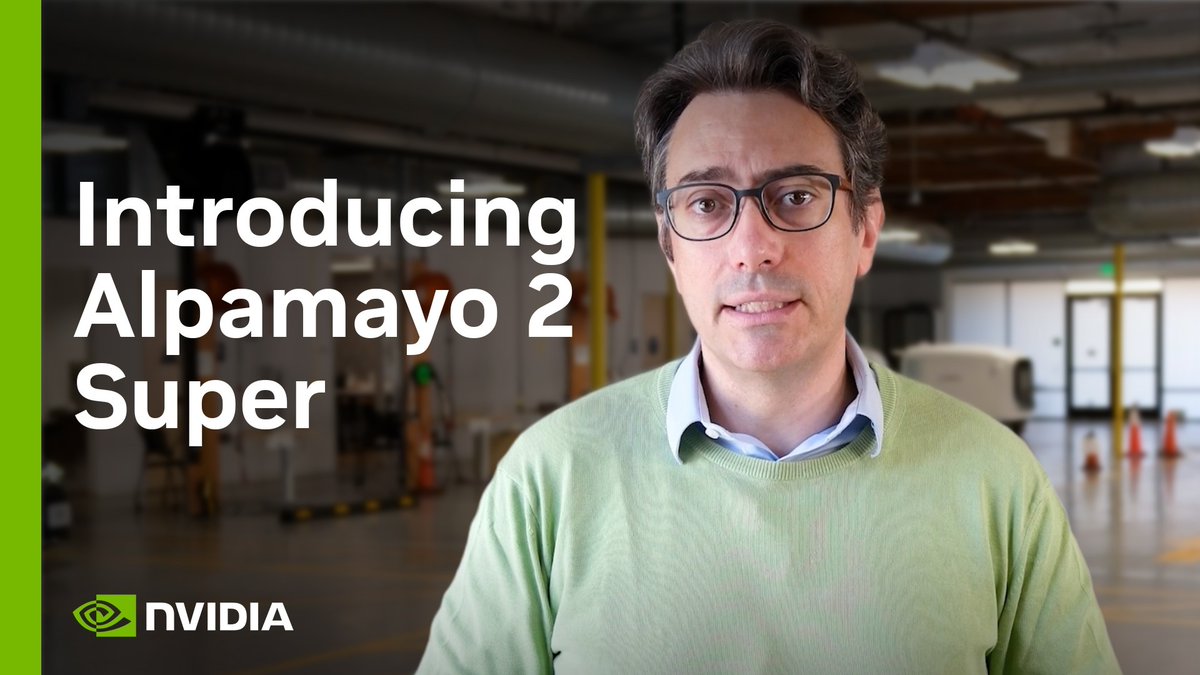
Representative image for RT by @NVIDIAAI: Introducing Alpamayo 2 Super: the frontier open reasoning VLA for autonomous…

RT by @NVIDIAAI: Introducing Alpamayo 2 Super: the frontier open reasoning VLA for autonomous…

Rank 64 · Content 70 · Popularity N/A

TL;DR - NVIDIA announced Alpamayo 2 Super, a 34B-parameter open vision-language-action (VLA) model aimed at autonomous vehicles and robotaxis, released on Hugging Face under the permissive OpenMDW-1.1 license for commercial use. It signals a push toward open, reasoning-capable driving foundation models rather than closed proprietary AV stacks.

  • Positioned as a "frontier open reasoning VLA": couples perception and language-style reasoning with action outputs for driving, at 34B parameters.
  • Claims "full-surround awareness," implying multi-camera/360° sensor input rather than single forward-facing vision.
  • Distributed via Hugging Face under OpenMDW-1.1, explicitly permitting commercial deployment — relevant for robotaxi and AV developers.
  • Content is a launch announcement only; no benchmarks, latency figures, training data, or safety-validation results were provided.
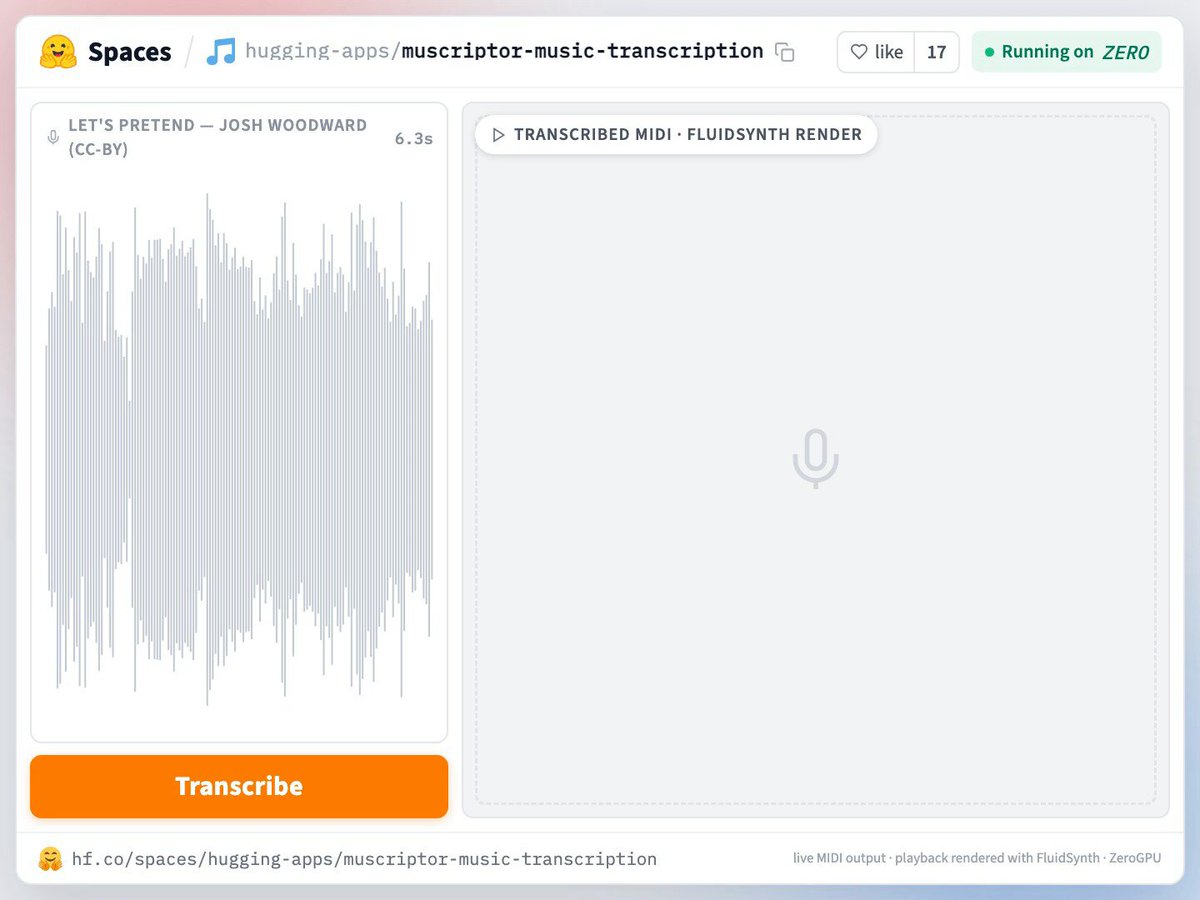
Representative image for RT by @huggingface: your band's jam session, but now it's editable MIDI Muscriptor (Mirelo x…

RT by @huggingface: your band's jam session, but now it's editable MIDI Muscriptor (Mirelo x…

Rank 57 · Content 60 · Popularity N/A

TL;DR - Hugging Face is highlighting Muscriptor, a Mirelo × Kyutai model that transcribes recorded audio into editable, per-instrument MIDI note tracks, with a live demo hosted on Hugging Face Spaces. It matters because reliable multi-instrument audio-to-MIDI turns raw performance recordings into directly editable symbolic music.

  • Task is automatic music transcription: polyphonic audio in, MIDI note tracks out, separated per instrument rather than a single merged track.
  • Claimed as the first model to do per-instrument MIDI transcription "really well" — a promotional claim with no benchmarks, metrics, or baselines given in the post.
  • Distributed as a public Hugging Face Space demo (plus a video), so it is an accessible product/release announcement rather than a paper.
  • Collaboration between Mirelo and Kyutai; no details provided on architecture, training data, instrument coverage, or licensing.
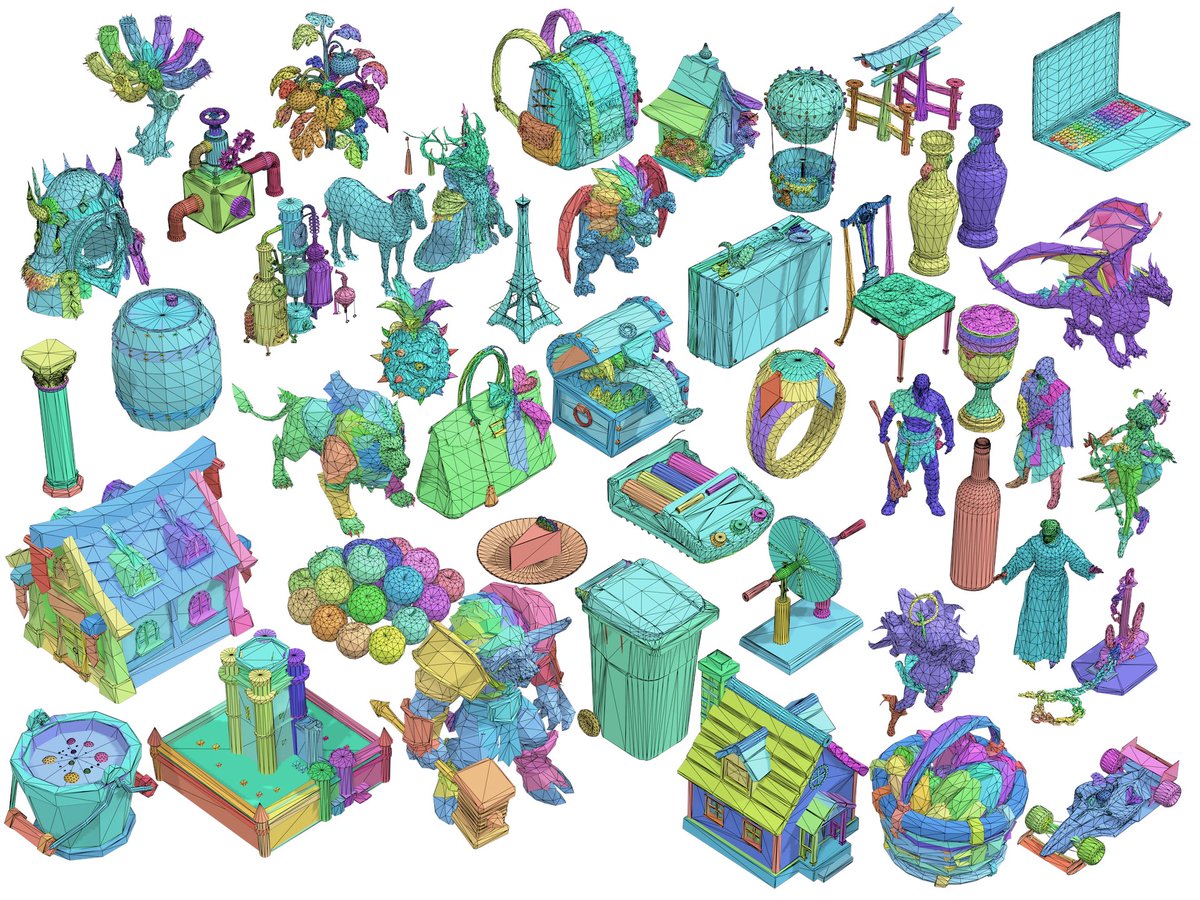
Representative image for RT by @_akhaliq: Meshy T2 A fast native mesh generation framework using flow matching that produces…

RT by @_akhaliq: Meshy T2 A fast native mesh generation framework using flow matching that produces…

Rank 57 · Content 60 · Popularity N/A

TL;DR - Meshy T2 is a native 3D mesh generation framework that uses flow matching to produce artist-quality meshes in a median of ~6 seconds, claimed to be over 10x faster than autoregressive mesh generators. It signals a shift in 3D asset generation from token-by-token autoregression toward flow-based sampling, which matters for practical content-creation pipelines.

  • Generates meshes natively (direct mesh output) rather than via intermediate representations converted after the fact.
  • Uses flow matching as the generative mechanism, enabling few-step sampling instead of sequential token decoding.
  • Reported median latency of ~6 seconds per mesh, a claimed >10x speedup over autoregressive mesh generation methods.
  • Output is characterized as "artist-quality" topology, targeting production-usable assets — though the shared content is a brief product/announcement blurb with no benchmarks, ablations, or evaluation details, so quality and speed claims are unverified here.

Efficiency & Systems 2

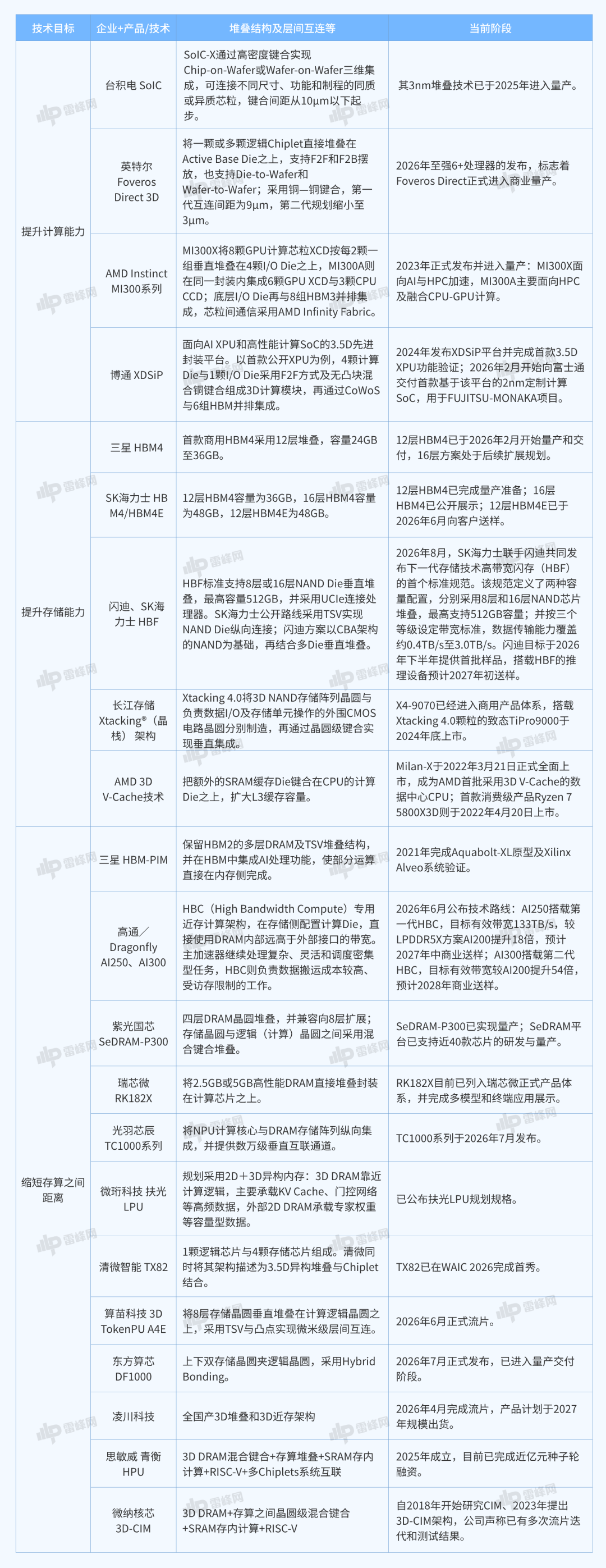
Representative image for 把512 GiB闪存搬到xPU旁边,HBF能打破推理内存墙?

把512 GiB闪存搬到xPU旁边,HBF能打破推理内存墙?

Rank 68 · Content 75 · Popularity N/A

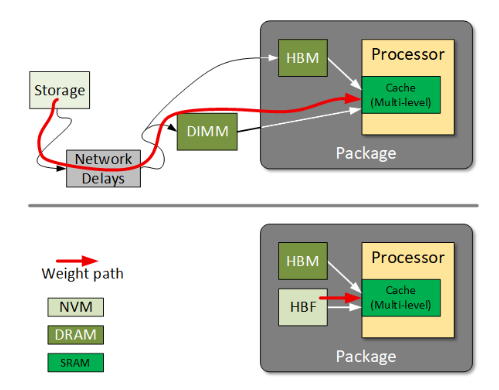
TL;DR - SK hynix and SanDisk published the OCP "High Bandwidth Flash (HBF) High-Level Base Die Specification v0.7.0", defining a non-coherent, memory-centric NAND device co-packaged next to GPUs/TPUs to add TB-scale capacity between HBM and SSD. It matters because inference is increasingly capacity-bound (weights, KV cache, MoE, multi-model), not just bandwidth-bound.

  • Architecture: Base Die + stacked NAND core dies + TSVs; host connects over UCIe 3.0 with AXI as the transaction protocol. The Base Die handles NAND commands, ECC, scheduling, error reporting and TSV redundancy — it is not a passive interposer.
  • Performance: reference config is 16 NAND dies, 16 banks/channel, 4 KiB pages, 512 GiB total; up to 16 independent host channels, 64-bit each at up to 32 GT/s per lane, yielding a spec target of ~3 TB/s. That figure is aggregate parallelism at max configuration, not measured silicon.
  • Workloads extend beyond static weights to KV cache, MoE, multimodal and agentic serving; multi-model layouts can either interleave across all channels (max bandwidth) or dedicate channel groups (isolation).
  • Key tradeoff: NAND constraints remain — 4 KiB-aligned sequential writes within a block, erase-before-rewrite, endurance limits. Channels have separate address spaces and HBF must be managed separately from HBM, so the host software owns global-to-channel mapping, weight/KV-cache partitioning, and part of wear leveling.
Representative image for 都叫3D芯片,为什么是三门不同的生意?

都叫3D芯片,为什么是三门不同的生意?

Rank 54 · Content 55 · Popularity N/A

TL;DR - A Chinese tech-media analysis of the current "3D stacking" AI-chip investment wave, arguing that the shared label actually covers three distinct businesses with different markets, engineering hurdles, and validation criteria. It matters because agentic/long-context inference is shifting the chip bottleneck from peak FLOPS to memory capacity, bandwidth, and data movement.

  • Three distinct 3D routes are conflated: (1) logic-chiplet recombination (TSMC SoIC, Intel Foveros, AMD MI300) to sustain scaling as advanced nodes get costly; (2) memory-side expansion (HBM, HBF, 3D V-Cache) targeting bandwidth, capacity, and cache hierarchy; (3) vertical logic-DRAM integration or compute-in-memory (Ziguang Guoxin, Rockchip, Samsung HBM-PIM, plus startups) that changes where compute sits.
  • Agent workloads lengthen inference into sustained multi-call tasks; the decode phase repeatedly reads weights and KV cache, so compute and bandwidth demands diverge and general-purpose GPUs stop being cost-optimal for that stage.
  • Chinese startups favor logic-memory vertical integration because 3D memory competition requires DRAM/NAND wafer fabs (Samsung, SK Hynix, Micron, CXMT, YMTC) and chiplet routes need mature die-to-die and software ecosystems; they stack at ~7nm rather than 3/2nm, using architecture to offset process gaps.
  • Cited practical limits: heterogeneous compute+memory stacks face uneven stress, warpage, thermal and yield issues, making roughly 4-6 layers realistic today; success requires proving decode (ideally attention operators) on real silicon with high TPS, plus a full software stack (ISA, compiler, runtime, operator libraries) — several firms are pre-tape-out yet already valued in the tens of billions of RMB.

AI Chips & Hardware 1

金刚GC3芯片重新定义视频AI算力规则,国产RISC-V高端算力商业化提速

Rank 47 · Content 45 · Popularity N/A

TL;DR - Chinese firm 中科通量 unveiled 金刚GC3 at CCF Chip 2026, billed as the world's first RISC-V dataflow-architecture chip purpose-built for video AI and AIGC workloads. It signals a strategy of winning on domain-specific efficiency rather than chasing general-purpose GPUs.

  • Architecture: 12-core RISC-V dataflow design at 2.0GHz with no program counter — nodes fire on "data ready," passing intermediate results down the pipeline instead of round-tripping through global memory, targeting the data-movement energy cost that reportedly exceeds compute cost several times over in video processing.
  • Claimed specs: 200 TOPS INT8, 32 TFLOPS FP16, plus 128 channels of 1080p@30fps hardware decode and 64 channels of encode on a single chip.
  • Positioning: deliberately narrow — AIGC video generation, smart-city analytics, industrial vision — with per-watt video processing density, not peak throughput, cited as the differentiator (per SJTU's 冷静文).
  • Open questions raised at the conference itself: compiler tooling, software ecosystem, and large-scale deployment stability for dataflow architectures remain unproven. Figures are vendor/event claims; no independent benchmarks appear in the source.

AI Economics & Pricing 1

Representative image for 我每月花5000元养AI,Anthropic拿走了80%毛利

我每月花5000元养AI,Anthropic拿走了80%毛利

Rank 54 · Content 55 · Popularity N/A

TL;DR - A WeChat analysis pieces together third-party estimates (SemiAnalysis, The Information, Epoch AI, company filings) to show that LLM providers' inference gross margins have swung sharply positive, yet API list prices have stayed flat or risen — meaning falling compute costs are being retained to fund next-generation training rather than passed to users.

  • Anthropic's API gross margin is estimated at >80% (blended ~65%), up from roughly -94% in 2024; the swing is attributed to capacity expansion (cited ~220k GPUs / 300+ MW added) plus inference optimizations (prompt caching, batching, speculative decoding, quantization, MoE routing). Training compute sits in R&D, not COGS, so it is excluded from these margins.
  • Epoch AI data cited shows median inference price for equal capability falling ~50x per year, yet 2026 flagship pricing held flat or increased (Kimi K3 anchor raised 5-6x; Zhipu GLM Coding Plan Pro from ¥149 to ¥538; Anthropic Enterprise moved from a $200/seat cap to usage-based; DeepSeek adding peak/off-peak pricing).
  • Margin profiles diverge by strategy: DeepSeek reportedly hits 70-80% margin at floor prices (engineering efficiency, ~$500M annualized revenue), Zhipu's API margin rose from <4% to 18.9% (¥724M 2025 revenue, 41% blended), MiniMax from 12.2% to 25.4% with ~70% overseas revenue, while OpenAI remains deeply negative (cited Q1 $9.3B loss, -122% non-GAAP margin) largely from subsidizing ~1B free users at ~$0.7/user/month.
  • The author's framing: pricing has shifted from cost-plus to value-based ("what it would cost you to do the work"), and retained gross profit is the primary funding source for next-gen training — SemiAnalysis is cited projecting ~$160B reinvestable for Anthropic and ~$92B for OpenAI by 2027. Note these are third-party estimates, not audited figures.

AI Health Hardware 1

Representative image for 独家丨联手千问AI大牛 ,觅光联创郦轲杀入女性AI健康硬件江湖

独家丨联手千问AI大牛 ,觅光联创郦轲杀入女性AI健康硬件江湖

Rank 33 · Content 25 · Popularity N/A

TL;DR - AMIRO觅光联合创始人郦轲已低调成立深圳市丛容地健康科技有限公司,切入"AI+女性健康"硬件赛道,首款产品可能是女性AI健康项链。这标志着消费级美护创业者向端侧AI健康穿戴设备的迁移,是该赛道人才与资本集聚的又一信号。

  • 团队构成:AI 负责人来自阿里千问(Qwen)模型训练团队,具备大规模语言模型与端侧 AI 落地经验;设计团队来自法国 Lucas-Bernard 珠宝团队,主打奢侈品工艺基因。
  • 产品路线:以女性全生命周期健康管理为场景,规划覆盖饮食、情绪、生理周期等多维度的智能硬件系列,形态上从手环、戒指延伸到颈部吊坠。
  • 赛道判断:文中称 AI 健康硬件正从"单一数据采集"走向"多模态、无感化"竞争,渗透睡眠、运动、情绪等场景。
  • 背景:郦轲1989年生,川大/浙大工业设计出身,曾任 MIT Media Lab 研究科学家与阿里资深交互设计师;2015年联合创办宗匠科技,主导 LED 智能化妆镜到射频美容仪产品线,累计营收数十亿元。报道为独家爆料,无产品规格、技术指标或发布时间等可验证细节。

AI Industry Roundup 1

Representative image for 长鑫拒绝苹果压价:坚持要求不低于三星电子和SK海力士;马斯克个人财富亏掉2个「黄仁勋」;宇树上市在即,王兴兴身价即将突破百亿

长鑫拒绝苹果压价:坚持要求不低于三星电子和SK海力士;马斯克个人财富亏掉2个「黄仁勋」;宇树上市在即,王兴兴身价即将突破百亿

Rank 29 · Content 20 · Popularity N/A

TL;DR - A Leiphone daily news roundup covering the AI/tech ecosystem: memory-chip pricing power shifting toward China's CXMT, DeepSeek's reported ¥50B second funding round, Unitree's imminent STAR Market IPO, and ByteDance's new real-time audio-video model. It matters because it maps how compute, capital, and hardware supply are realigning around AI demand.

  • Memory supply crunch: CXMT reportedly refused Apple's price-cut demands, insisting on quotes at or above Samsung/SK Hynix, as capacity shifts to high-value AI server memory (HBM) over commodity DRAM; Huawei's Yu Chengdong warned phones must raise prices broadly or sell at a loss. Samsung and SK Hynix are also testing AMEC etch tools to hedge U.S. export-control risk.
  • Capital flows: DeepSeek has reportedly restarted a second round targeting ¥50B at a ~¥500B pre-money valuation, signing late August, after a first round of >¥50B (Liang Wenfeng ¥20B, Tencent ¥10B, CATL ¥5B). Unitree opened IPO bookbuilding to raise ¥4.202B for 10% of post-issue shares (~¥104/share, >¥40B market cap), with founder Wang Xingxing controlling 68.78% of votes via dual-class structure.
  • Model release: ByteDance launched SeedRealtime, a natively multimodal full-duplex audio-video model with a unified end-to-end architecture that fuses audio, video, and text for simultaneous perception, understanding, decision, and speech ("see, hear, speak" concurrently), now fully rolled out in Doubao's call feature.
  • Generative media economics: AI short-drama virtual actor Fang Taozi hit 412K Douyin followers in under two months with ad rates of ¥168K–258K per clip, exceeding many million-follower human influencers; separately, Supor drew backlash for AI-generated suggestive ads, and Disney–TikTok signed an IP-sharing deal for creator remixes.

AI Safety & Moderation 1

Representative image for R to @MistralAI: The model takes moderation policy as a plain-language question and returns a…

R to @MistralAI: The model takes moderation policy as a plain-language question and returns a…

Rank 68 · Content 75 · Popularity 50

TL;DR - Mistral AI announced a moderation model that accepts a moderation policy expressed as a plain-language question and returns a calibrated score, handling both text and images through a single interface. It matters because it shifts content safety from fixed taxonomies to policy-as-prompt, letting operators define their own rules without retraining a classifier per category.

  • Policy is supplied at inference time as a natural-language question rather than baked into a fixed label set, so moderation criteria are configurable per deployment.
  • Output is a calibrated score (not just a binary flag), which is what allows threshold tuning against a given risk tolerance.
  • One unified interface covers text and image inputs, removing the need for separate modality-specific moderation pipelines.
  • Details are thin in the post itself — it points to an accompanying arXiv technical report for methodology and evaluation, none of which is described in the announcement.

AI for Science 1

Representative image for 2026 AI for Science行业研究报告案例征集 | 智局咨询

2026 AI for Science行业研究报告案例征集 | 智局咨询

Rank 29 · Content 20 · Popularity N/A

TL;DR - 智药局 (Zhiyao Ju) is issuing an open call for案例 (case-study) submissions for its 2026 AI for Science Industry Research Report, aiming to map how AI is being applied across scientific R&D. It is a call-for-participation notice rather than a technical result, so the substance is mostly agenda-setting about where AI4S is heading.

  • Framing: Claims AI4S momentum has hit a new high in 2026, with OpenAI and Anthropic extending model capabilities into scientific research and newer entrants like Isomorphic Labs drawing strong capital-market attention — AI moving from language to "understanding life, materials, and the physical world."
  • Policy context cited: China's《关于深入实施"人工智能+"行动的意见》 explicitly pushes "AI+科学技术," while the US "Genesis" program is described as scaling past $5B.
  • Report scope: Four planned sections — latest AI advances across drug discovery, life science, materials, chemistry/catalysis, energy, semiconductors/advanced manufacturing and industrial R&D; collaboration models between AI4S startups and incumbents (licensing, joint development, JVs, M&A); global market sizing, regional distribution, drivers (compute cost declines, data, capital) and risks; and teardowns of successful cases from technical path to clinical translation and commercial value.
  • Caveat: No data, benchmarks, or findings are presented — content is a solicitation (contact via WeChat) and final scope is stated as subject to the published report.

Adaptive ML Algorithms 1

Representative image for 蚂蚁集团 IJCAI 2026 论文盘点:让 AI 学会「随机应变」

蚂蚁集团 IJCAI 2026 论文盘点:让 AI 学会「随机应变」 🔗 2 sources

Rank 53 · Content 50 · Popularity 61

TL;DR — 雷峰网(AI科技评论)盘点了蚂蚁集团被 IJCAI-ECAI 2026 收录的四篇论文,共同主线是让 AI 从「静态求解器」转向能随环境变化(数据密度、分布漂移、搜索维度、AIGC 生态演进)自适应的系统;其意义在于展示了工业界实验室如何把学术产出对齐实时风控、十亿级用户流量波动等生产约束。

  • MSRGC-Net(与重庆邮电大学):时间序列聚类,用免训练的多尺度回声状态网络储备池 + 密度自适应「粒球」锚点图;无需预设簇数,复杂度从 O(n²) 降至近线性,在 5 个多变量基准的 15 项指标上取得 12 项最优、2 项次优。
  • ROAD(与上海交大):把 offline-to-online RL 中的离线/在线数据混合比例当作动态决策变量,用双层优化(内层 Bellman 误差、外层期望在线回报)并以多臂老虎机近似求解;可插入 IQL/PEX/CQL/Cal-QL,PEX+ROAD 在 D4RL 上平均 71.12 分、24 项中 18 项第一。
  • DSEBO(与华东师大、南京大学):高维贝叶斯优化,按收敛触发条件逐步扩张随机嵌入子空间维度,借共享嵌入矩阵使子空间嵌套,并依最优值曲线自适应调整扩张步长;在 D=1000 合成函数及 MSLR/Lasso-Hard/LIMO 上对比 REMBO、SIRBO、BAxUS、TuRBO。
  • VGA-BenchV2(与北京电影学院、BIGAI):新增 3.6 万条任务级人工标注(较 VGA-Bench 分别为 13.46×/11.15×/1.55×),混合评估器(VAQA-Net 输出连续美学分,VTag-Net/VGQA-Net 基于 Qwen 视觉语言模型),并将学到的美学评估器复用为 RL 奖励信号微调生成模型,打通「评分—优化」闭环;数据集已在 Hugging Face 开源。

注:两份来源侧重不同——第一份聚焦上述蚂蚁集团四篇论文;第二份实际盘点的是华为的四篇 IJCAI 2026 论文(分层 ViT 扩至 30B、可学习帧选择器 LFS、RaMod、代码转换语音翻译),主题为从「规模密度」转向「设计密度」,与本条目标题所指工作并非同一对象,故未并入正文。

Biomanufacturing Funding 1

Representative image for 亿元!广东国企,投了一家生物制造!

亿元!广东国企,投了一家生物制造!

Rank 36 · Content 30 · Popularity N/A

TL;DR - Microalgae biomanufacturing startup 元育生物 (Yuanyu Bio) closed a RMB 100M A+ round funded solely by Guangdong Salt Industry Group, a provincial SOE. It signals state-backed capital flowing into synthetic-biology/biomanufacturing platforms rather than AI models per se.

  • Founded 2021 with a core team out of Tsinghua University; positions microalgae as a platform "biological chassis" spanning cosmetics and food.
  • Two product lines: non-animal-derived active delivery systems (microalgal extracellular vesicles, MEVs) for beauty, and novel microalgal protein for food.
  • Claimed traction: exclusive MEV supply-chain deal with a top global cosmetics group, and national New Food Ingredient approval for a yellow protein Chlorella strain.
  • Proceeds mainly fund a standardized MEV manufacturing base (construction already started), extending its Algsis brand beyond algae to microbial and higher-plant vesicle sources (Chlorella, Euglena, Chlamydomonas, lactic acid bacteria, yeast).

Note: the source is a short WeChat news post with no technical data or AI methodology — takeaways are limited to the funding and commercialization claims stated.

Computer Vision Modules 1

Representative image for CVPR 2026上的即插即用模块大盘点!

CVPR 2026上的即插即用模块大盘点!

Rank 33 · Content 25 · Popularity N/A

TL;DR - A WeChat promotional post from the CVer account advertising a curated library of 366 "plug-and-play" neural network modules with source code, drawn largely from top conferences (CVPR, ICLR, ICML, NeurIPS) and pitched at researchers hunting for paper novelty and easy accuracy gains. It is a resource/marketing roundup rather than new research, and access requires adding a WeChat assistant and sending a keyword.

  • Modules are organized into five buckets: model enhancement (96), structural innovation (92), frontier techniques (50), efficiency optimization (26), and task-specific applications (99).
  • Enhancement category is attention-heavy: 63 attention mechanisms, 17 feature-fusion, 12 normalization, 3 feature-enhancement, 1 loss function; structural category covers 41 convolution, 36 feature-extraction, 11 multi-scale fusion, 4 frequency-domain, 3 backbone variants.
  • The "frontier" set tracks current trends — 23 Mamba/SSM, 13 large-model, 12 diffusion, and 2 KAN modules — while efficiency covers 16 lightweight, 9 down-sampling, 1 up-sampling module.
  • All modules are claimed to expose standard interfaces for drop-in integration; no benchmarks, datasets, or reproducibility evidence are provided, and the title's "CVPR 2026" framing is promotional, so treat the "won't hurt your baseline" claim as unverified.

Embodied AI Talent 1

Representative image for 自驾转具身的路,越来越难了。

自驾转具身的路,越来越难了。

Rank 40 · Content 35 · Popularity N/A

TL;DR - A WeChat post from 自动驾驶之心 reports that the once-easy career pivot from autonomous driving to embodied AI is closing in 2026, as robotics companies now prioritize candidates with actual robotics and large-model training experience over cross-industry AD engineers.

  • Historically embodied-AI startups cloned teams straight from the AD talent pool — founders like 星海图高继扬, 智平方郭彦东, and 它石智航陈亦伦 all have AD backgrounds, with ~40 senior execs crossing over.
  • Recruiters report that since early 2026, interview pass rates for cross-industry candidates have dropped sharply, notably for world-model researcher roles.
  • Technical gap cited: vehicles have ~2 DOF (steering, speed) versus 20+ DOF contact dynamics in robots; AD chases one universal solution with no "downstream task" concept, while robotics is a set of tasks requiring pretrain → post-train → scenario fine-tuning.
  • Skills teams now demand: VLA training, LLM pretraining/post-training, RL (RLHF, RLVR, policy optimization), large-scale distributed training, and real-robot data closed-loop experience; AD experience alone is treated as depreciating rather than useless.

Transcription Regulation Biology 1

Representative image for BioArt百家论坛第9期 | 超转录稳态的调控机制与功能 主讲嘉宾:张涛 清华大学生命科学学院博士

BioArt百家论坛第9期 | 超转录稳态的调控机制与功能 主讲嘉宾:张涛 清华大学生命科学学院博士

Rank 43 · Content 40 · Popularity N/A

TL;DR - An event announcement for BioArt's 9th "百家论坛" webinar (Aug 5, 2026, 20:00), where Tsinghua PhD Zhang Tao will present his Cell-published work on the regulation and function of hypertranscription homeostasis. It is a seminar promotion rather than new AI research, notable mainly as molecular-biology community programming sponsored by ABclonal.

  • Speaker: Zhang Tao (Tsinghua School of Life Sciences PhD, advised by Assoc. Prof. Liu Nian), co-first author on papers in Cell and Molecular Cell, focused on transcriptional regulation and developmental disease.
  • Core science claim: a chromatin-regulator condensate–mediated mechanism that restricts hypertranscription; multiple developmental-disorder genes may jointly maintain hypertranscription homeostasis, so its imbalance could be a shared molecular basis across several developmental diseases.
  • Format: discussants include Liu Chengyang (Peking University postdoc; tumor multi-omics, metabolic immune regulation, tumor microenvironment) and Xie Li (ABclonal senior product manager, molecular enzymes/NGS); viewable via registration link, WeChat Channels, plus Q&A groups.
  • Content note: no AI/ML component is present — this is a life-science seminar notice; technical details are limited to what the abstract-style blurb states.
Top highlights — Opinions

AI & Developer Roles 1

Representative image for 程序员远没到“完了”的时候!Sam Altman:OpenAI不包办一切,模型只是底座,开发者仍是AI生态的主角

程序员远没到“完了”的时候!Sam Altman:OpenAI不包办一切,模型只是底座,开发者仍是AI生态的主角

Rank 33 · Content 25 · Popularity N/A

TL;DR - A Chinese-language write-up of Sam Altman's Invest Like The Best interview, in which he rejects the "software engineers are cooked" narrative and frames OpenAI as an infrastructure/platform provider ("like electricity") that deliberately leaves vertical applications to developers. It matters because it signals where OpenAI will and won't compete, and how engineering work is shifting up a layer rather than disappearing.

  • Jobs move up a layer, not away: developers increasingly direct agents that read repos, propose plans, generate code and run tests; time shifts from implementation to task design, acceptance criteria, review and maintenance. Altman calls AI "jagged" — genius on some tasks, childlike errors on others — so humans still own validation, reproducibility, traceability and accountability.
  • Platform boundary is explicit: OpenAI refocused on models, chips, data centers and platform after earlier consumer/media detours; on building every vertical app itself, Altman says "no interest in doing that." The gap left for developers: enterprise data/account integration, domain rules as callable tools, permissions/approval/audit for high-risk actions, and business-outcome-based evaluation.
  • Next-gen personal AI: Altman describes agents that see everything on his screen (email, docs, meetings) and run overnight under a user-set token budget — raising concrete engineering problems around window/document permissions, access revocation, selective long-term memory with expiry, per-task cost caps, and logging of which inputs and tools drove each action.
  • Two calibrations: the industry overestimated AI's short-term economic impact (2019-era OpenAI would have called today's models AGI); enterprise adoption moves in quarters/years while model releases move monthly. Altman also predicts robotics hits its "ChatGPT moment" in 2–3 years, importing observability, canary rollout and rollback practices into physical systems where failure costs are higher.

AI for Mathematics 1

Representative image for 从陶哲轩与AI的一段长对话谈起:顶级数学家面对陌生公式时,究竟在想什么?

从陶哲轩与AI的一段长对话谈起:顶级数学家面对陌生公式时,究竟在想什么? 🔗 2 sources

Rank 50 · Content 50 · Popularity N/A

TL;DR — A commentary essay that walks through a public Terence Tao–ChatGPT conversation about the Jacobian Conjecture, using it to show how a top mathematician turns brute algebraic computation into structural understanding, and where AI actually fits in that workflow. It matters as a grounded counter-narrative to "AI solves math": the human role remains question-selection, modeling, and verification.

  • The worked example: an explicit 3-variable polynomial map with constant Jacobian (so locally invertible everywhere) that nonetheless has three distinct preimages of a single point; Tao's interest is not confirming these facts but explaining why the cancellations happen.
  • Structural moves traced: substituting recurring expression blocks as new coordinates (which reveals the constant Jacobian as two coordinate-change volume factors cancelling), assigning scaling weights to expose weighted homogeneity, and reinterpreting the 3-to-1 fiber as "choose one of a cubic's three simple roots," normalized via a resultant condition on the linear×quadratic factorization.
  • Non-properness at infinity: when two roots collide, the derivative at the root vanishes, sending two sheets of the normalized factorization to infinity while one stays finite — explaining why an everywhere-nonzero local Jacobian does not force global invertibility.
  • Division of labor with AI: ChatGPT handled algebraic expansion, substitutions, bookkeeping, and rapid recomputation; Tao retained verification, direction-setting, and the distinction between verified identities and structural conjecture. The article explicitly declines to frame the episode as "AI cracked a famous conjecture."

Note: the two supplied sources do not describe the same work — the second (夕小瑶科技说, on ByteDance Doubao's SeedRealtime omni-modal full-duplex video calling) is unrelated to the titled article, so its content is not merged here.

Autonomous Driving Careers 1

Representative image for 智驾人最后的归宿,软件工程师?

智驾人最后的归宿,软件工程师?

Rank 40 · Content 35 · Popularity N/A

TL;DR - A personal essay from an autonomous-driving practitioner (published via the 自动驾驶之心 WeChat account) arguing that the AD field has shifted from paradigm breakthroughs to industrialization, and that AD algorithm engineers are converging toward "intelligent systems engineers." It matters as a first-hand read on where talent and capital in embodied AI are moving.

  • Frames AD's arc in four stages — dream (~2016), capital burn (2016–2022), deployment of highway/urban NOA (2023+), and the current profitability phase marked by IPOs (Momenta cited); AD stock behavior now tracks autos rather than AI.
  • Argues the era of yearly paradigm shifts (BEV, Occupancy, Transformer perception, end-to-end) has given way to incremental gains in accuracy, latency, long-tail coverage, and cost; company moats are now data closed-loops ("data flywheel"), training platforms, simulation, compute, and org efficiency rather than a single model.
  • Explains embodied-AI/robotics recruiting of AD talent by shared capability stack: 3D perception, multi-sensor fusion, spatiotemporal modeling, planning/control, RL, data closed-loop, and large-model training — with robotics seen as sitting where AD was 7–8 years ago in capital and error tolerance.
  • Author's thesis: technology-name-bound value (BEV → Occupancy → world models → VLA) has shrinking half-lives, so engineers should build system-level competence; predicts AD becomes commodity infrastructure like ABS/ESP, splitting practitioners into "frontier migrants" and "industrialization builders." Opinion piece — no data or results presented.

World Models & Embodiment 1

Representative image for 对话 IDEA 张磊:「不以动作为输入条件,就不叫世界模型」

对话 IDEA 张磊:「不以动作为输入条件,就不叫世界模型」

Rank 43 · Content 40 · Popularity N/A

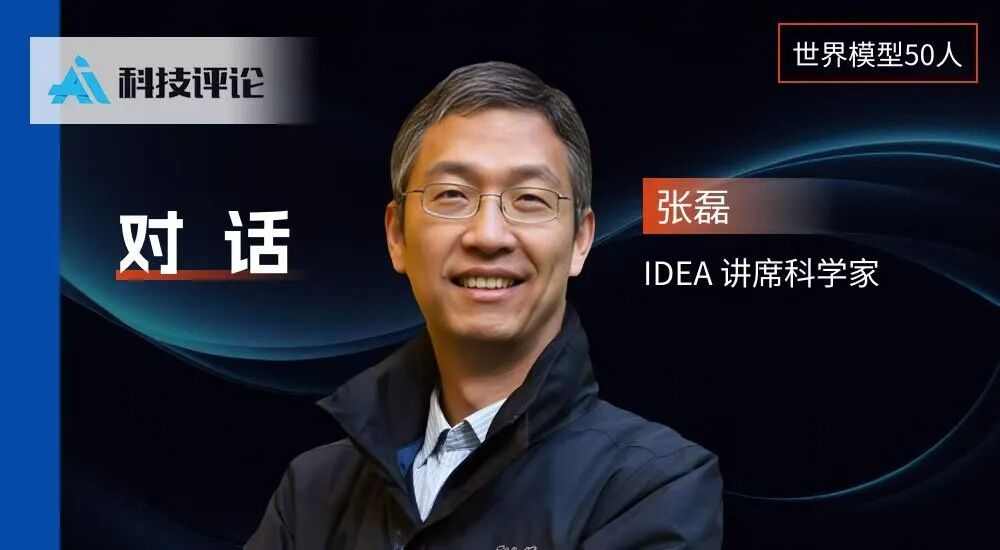
TL;DR - An in-depth interview with IDEA chief scientist / 视启未来 founder Zhang Lei (IEEE Fellow, DINO/Grounding DINO/DINO-X author) arguing that a system only qualifies as a "world model" if it is action-conditioned, cutting through the definitional chaos in China's ~¥30–90B world-model funding wave in H1 2026.

  • Core definition claim: world models come from model-based RL and must do action-conditioned next-state prediction, not just next-state prediction; pure video generators like early Sora aren't world models because they never model the agent's action, and World Action Models (WAM) are "effect-before-cause" (generate future frames, then infer action) so they can't serve RL.
  • Motivation for the hype: VLA imitation learning plateaus, and RL on real robots is bottlenecked by slow data collection and unacceptable failure costs (broken dishes, crashes); a world model gives a virtual sandbox to "imagine" trials before acting.
  • Route debate: pixel vs. latent is a false dichotomy since Stable Diffusion/Sora also compress to latents — the real question is what to discard. Latent risks representation collapse; pixel realism just flatters human eyes, so evaluation should target physical plausibility, not image fidelity.
  • His differentiator vs. LeCun's JEPA line: inject object structure into the latent space (objects as the basic unit of prediction/planning, starting pragmatically from masks, extendable to non-rigid things like water/sand), leveraging DINO-X open-world object perception; plus "action alignment" via 3D keypoints to map human-hand 2D video, 2-finger grippers, and dexterous hands into one latent action space.
  • Bottleneck view: the brain, not the body — current robots hit 70–80% success in single scenes (1 in 5 failures), lack causal reasoning/common sense, and still depend on heavy off-board compute.