百年黎曼猜想被Claude破了新纪录!是个未公开新模型
Ranking
No observed public metrics; popularity remains neutral/archived.
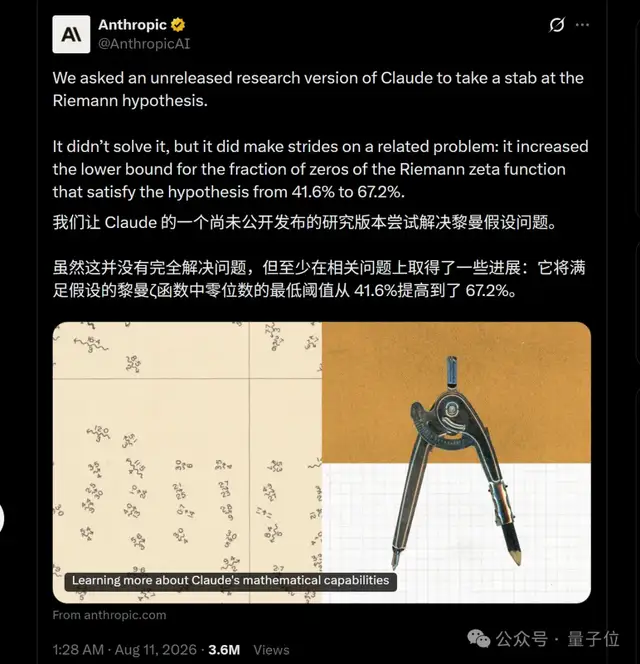
Merged summary
TL;DR — Anthropic reported that an unreleased Claude research model, run as a ~60-agent swarm, raised the proven lower bound on the proportion of Riemann zeta non-trivial zeros lying on the critical line from 41.6% to 67.2% — breaking a long-stalled record, though it does not prove the Riemann Hypothesis itself.
- Setup and scale: Given only the prompt "try to prove the Riemann Hypothesis," Claude generated and failed at ~650 approaches; a simple "try again" triggered a second run using ~60 sub-agents in Claude Code over ~1.5 days, 2,400 shell commands, hundreds of Python scripts, and ~31M output tokens.
- Division of labor: 2 agents produced the key mathematical ideas, 13 contributed supporting ideas, 30 explored dead ends, 13 verified arguments, and 2 drafted the paper; the human contribution was mostly encouragement.
- Method: The result came from recombining existing published results rather than inventing new machinery. Self-checking included cross-review agents, counterexample search, novelty checks against 54 arXiv papers, and an independent re-derivation.
- Validation and caveats: Reviewed by Anthropic mathematicians Levent Alpöge and Ralph Furman plus analytic number theorists Brian Conrey and Dan Goldston, and formalized in Lean (passing Comparator). Anthropic stresses this is not traditional peer review and that the method likely cannot extend to a full proof.
- Model identity: The underlying model is unreleased; speculation that it is "Fable 5.1/6" is unconfirmed rumor.
Note: The two supplied sources do not in fact cover the same work — the second describes an unrelated Anthropic announcement about invisible text watermarks and C2PA-signed provenance metadata for new Claude models (tied to the EU AI Act Code of Practice), and contributes nothing to the Riemann result above.
Sources (2)
百年黎曼猜想被Claude破了新纪录!是个未公开新模型
TL;DR - Anthropic announced that an unreleased Claude research model, running as a ~60-agent swarm, raised the proven lower bound on the proportion of Riemann zeta non-trivial zeros lying on the critical line from 41.6% to 67.2% — a long-stalled record — without proving the Riemann Hypothesis itself.
- Setup: given only "try to prove the Riemann Hypothesis," Claude first generated and failed ~650 approaches; a simple "try again" prompt triggered a second run using ~60 sub-agents in Claude Code over ~1.5 days, 2,400 shell commands, hundreds of Python scripts, and ~31M output tokens.
- Agent division of labor: 2 agents produced the key mathematical ideas, 13 contributed supporting ideas, 30 explored dead ends, 13 verified arguments, and 2 drafted the paper; the human's role was mostly encouragement.
- Result came from recombining existing published results rather than new machinery; Claude self-checked via cross-review agents, counterexample search, 54 arXiv papers for novelty checking, and an independent re-derivation.
- Validation: reviewed by Anthropic mathematicians Levent Alpöge and Ralph Furman plus analytic number theorists Brian Conrey and Dan Goldston, and formalized in Lean (passing Comparator). Anthropic notes it is not traditional peer review and the method likely cannot extend to a full proof. The model's identity (speculation about "Fable 5.1/6") is unconfirmed rumor.
Claude骂声中启动「隐形水印」:新模型全量嵌入,标记所有文字
TL;DR - Anthropic will embed invisible, text-level watermarks in output from new Claude models and attach C2PA-signed provenance metadata to generated image/SVG files, rolling out globally rather than only in the EU. It matters because it makes AI-authorship marking a default, hard-to-strip property of generated text across an entire major model provider's product line.
- Trigger is Anthropic's signing of the EU AI Act Code of Practice on transparency of AI-generated content (~190 signatories including Google, Meta, Microsoft, OpenAI); the watermark applies to models released on/after 2026-08-02, with retrofits to existing Claude models under study.
- The text mark is embedded in the token stream itself, not metadata — it survives copy/paste and some editing. Anthropic claims no impact on meaning, quality, or readability; the algorithm has not been published, and the article flags skepticism about sampling-distribution-based watermarking affecting output quality.
- Coverage spans API, Claude, Claude Code, Claude Cowork, Claude Tag, plus cloud access via AWS, Google Cloud, and Microsoft Foundry. Files (.svg/.png/.jpg) get digitally signed C2PA provenance metadata that can also reveal tampering.
- Anthropic states explicit limits: detection proves Claude processed the content, not that Claude authored it; absence of a mark doesn't prove human authorship (old models, heavy rewriting, short passages, metadata stripped by format conversion or screenshots). A detection tool for users and third parties is in development.
- Context/reaction cited: an earlier Reddit reverse-engineering claim that Claude Code inserted visually identical Unicode variants to flag China-region users, and talk of third-party "rephrase to strip the watermark" services.