人形之外,擎羽把“身体”变成具身智能的新变量
Ranking
No observed public metrics; popularity remains neutral/archived.
Merged summary
TL;DR - Chinese startup FEAGINE (擎羽科技) launched three mass-produced cable-driven flexible robot arms (A01/A02/A03) plus Fi0, a first-generation cross-embodiment foundation model, arguing that robot bodies — not just humanoid form factors — should be a design variable, with shared intelligence reused across differing embodiments.
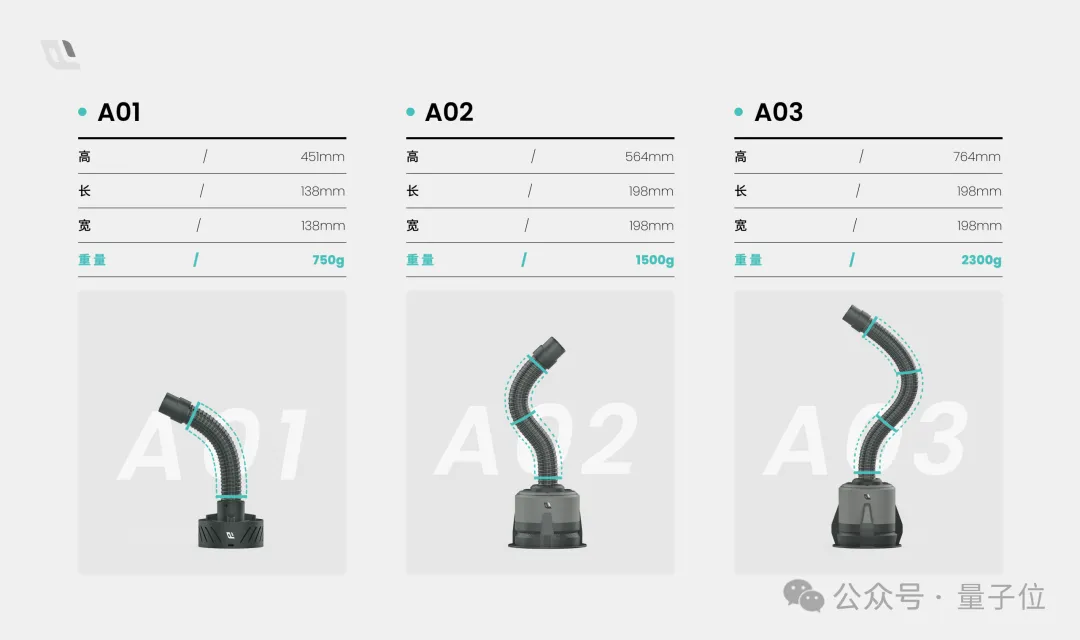
- Hardware matrix: A01 (1 flexible joint, 2 DoF, 750g, 200g payload), A02 (2 joints, 4 DoF, 30cm, 400g payload, 0.78 m/s), A03 (3 joints, 6+1 DoF, 50cm, 600g payload, 1.17 m/s); all support ROS 1/2, Python, C++, with GUI, MuJoCo and SAPIEN support on A02/A03. The company claims this is the first standardized mass-produced cable-driven flexible arm product line.
- Fi0 architecture: task/world knowledge is meant to transfer across bodies while actions are regenerated per embodiment. Components include a Skill Encoder (turns human demos into skill tokens), a Cross-view World Encoder (aligns egocentric human and robot wrist/body camera views into a shared world representation), an Embodiment Graph → Body Tokens (topology, segments, scale, sensing, actuation, dynamic state), plus a World Dynamics Model and MAWA (Multi-objective Action-World Assessment) that roll out and score candidate actions on task progress, success probability, physical risk, and uncertainty.
- In-context skill learning: for tasks outside training coverage, a single human demonstration captured via an "Ego" headset becomes inference-time skill context — no parameter updates or retraining, aimed at on-device deployment and long-tail tasks.
- Positioning: the flexible/continuum bodies are pitched as a continuous embodiment-variation testbed (length, segments, DoF vary systematically) rather than only end products; the article is a company announcement with no benchmark results or quantitative model evaluations disclosed.
Sources (1)
人形之外,擎羽把“身体”变成具身智能的新变量
TL;DR - Chinese startup FEAGINE (擎羽科技) launched three mass-produced cable-driven flexible robot arms (A01/A02/A03) plus Fi0, a first-generation cross-embodiment foundation model, arguing that robot bodies — not just humanoid form factors — should be a design variable, with shared intelligence reused across differing embodiments.
- Hardware matrix: A01 (1 flexible joint, 2 DoF, 750g, 200g payload), A02 (2 joints, 4 DoF, 30cm, 400g payload, 0.78 m/s), A03 (3 joints, 6+1 DoF, 50cm, 600g payload, 1.17 m/s); all support ROS 1/2, Python, C++, with GUI, MuJoCo and SAPIEN support on A02/A03. The company claims this is the first standardized mass-produced cable-driven flexible arm product line.
- Fi0 architecture: task/world knowledge is meant to transfer across bodies while actions are regenerated per embodiment. Components include a Skill Encoder (turns human demos into skill tokens), a Cross-view World Encoder (aligns egocentric human and robot wrist/body camera views into a shared world representation), an Embodiment Graph → Body Tokens (topology, segments, scale, sensing, actuation, dynamic state), plus a World Dynamics Model and MAWA (Multi-objective Action-World Assessment) that roll out and score candidate actions on task progress, success probability, physical risk, and uncertainty.
- In-context skill learning: for tasks outside training coverage, a single human demonstration captured via an "Ego" headset becomes inference-time skill context — no parameter updates or retraining, aimed at on-device deployment and long-tail tasks.
- Positioning: the flexible/continuum bodies are pitched as a continuous embodiment-variation testbed (length, segments, DoF vary systematically) rather than only end products; the article is a company announcement with no benchmark results or quantitative model evaluations disclosed.