🛰️ Daily AI Frontier
50 works · 3 categories · 27 topics · blog 12 journal 3 arxiv 15 wechat 15 generated 2026-08-12 14:37:40 UTC
Top highlights — Research

LLM Agents 6

Why Does CLAUDE.md Keep Growing? Catastrophic Remembering in Agentic Coding

Rank 82 · Content 90 · Popularity 62

TL;DR - An empirical + methodological study of why agentic coding prompt files (e.g. CLAUDE.md) grow without bound, naming the effect "catastrophic remembering" and proposing prompt comments that encode an instruction's rationale as the fix. It matters because unbounded prompt growth degrades instruction-following and maintainability in real agentic coding workflows.

  • Root cause framing: appending is cheap, but deleting an instruction whose rationale is lost risks correctness regressions at O(2^|D|) verification cost in a prompt of |D| instructions — the inverse of catastrophic forgetting.
  • Large-scale measurement across 247,694 instruction lifetimes in 1,867 repositories: prompts grow +226% over their lifetime, +4.9 net instructions per commit, and older instructions are progressively less likely to be deleted (log-hazard −0.032/commit).
  • Intervention: inverting IFEval creates verifiable worlds with known optimal prompts; adding comments that encode latent reasoning removes 99.3% of excess instructions (+211.3% → +1.4% excess).
  • Real-world transfer: the same inversion applied to WildIFEval shows prompt comments improve agentic instruction-following by up to 23.1%.


VibeLifeBench: Can Your Life Agent Be Proactive and Persistent in a Living World?

Rank 76 · Content 80 · Popularity 66

TL;DR - VibeLifeBench is a benchmark of 200 long-horizon, multi-week "everyday life assistant" tasks in a simulated world that evolves on its own clock, testing whether LLM agents can act proactively and stay consistent rather than just answering one-shot prompts. It matters because seven frontier models all score low, exposing a large gap between current agent capabilities and real-life assistance.

  • 200 scripted multi-week timelines span ten everyday-life domains inside a simulated environment of 22 mock services; the world advances autonomously and many state changes are silent, so only agents that re-inspect the environment discover them.
  • Evaluation targets proactivity and persistence: deciding when to act, ask, or stay silent, noticing unannounced changes, and keeping a single coherent plan from start to finish.
  • Grading uses fine-grained weighted checks over artifacts the agent actually left behind, scoring end state, action timeliness, and adherence to implicit (never-stated) constraints.
  • All seven evaluated frontier models score low; the authors say tasks, environments, and the evaluation framework will be open-sourced.

InSight-doc: Agentic Visual Perception for Long-Document Understanding

Rank 75 · Content 80 · Popularity 62

TL;DR - InSight-doc is an agentic visual perception framework that treats image resolution as an adaptive reasoning-time resource, starting from low-resolution pages and selectively zooming into regions for evidence, rather than using an external retriever. It matters because it cuts both hallucination and inference cost on long, visually rich documents while improving accuracy.

  • Training pipeline combines SFT on a 17.9K-example active-perception corpus with region-level zoom-in trajectories, plus 19.2K hard RL examples (SFT+RL).
  • InSight-doc-8B improves over the baseline by 4.3–16.4 accuracy points across document VQA benchmarks.
  • On long documents, it reduces hallucination by over 40% and inference latency by 41%–68% while retaining an accuracy lead.
  • Retriever-free design targets "context rot" from many-page inputs; code, datasets, and model are released publicly.
Representative image for SkillZip: Evaluation-Free Skill Compression for Self-Evolving Agents by Discovering Reusable Structure

SkillZip: Evaluation-Free Skill Compression for Self-Evolving Agents by Discovering Reusable Structure

Rank 73 · Content 75 · Popularity 68

TL;DR - SkillZip is an evaluation-free method that compresses the skill libraries accumulated by self-evolving LLM agents by finding the shortest faithful structural explanation of each skill. It matters because bloated, redundant skills are expensive to inject into context and hard to maintain, and existing compression either ignores skill structure or requires costly rollout-based evaluation.

  • Frames skills as structured objects (name/description triggers, workflow, tool and output contracts, obligations) rather than flat text, so generic prompt compression is deemed ill-suited.
  • Core principle is "explain once, reference many": state a repeated rule once at its applicable scope, factor repeated action sequences into shared procedures, and retain only differences as explicit exceptions.
  • Formalized as a typed minimum description-length objective over a skill contract plus residual, under a hard coverage constraint for every extracted trigger, workflow edge, tool requirement, obligation, and output field — which preserves rare rules by construction and yields simple sharing thresholds.
  • Offers a one-shot mode (single structured extraction call plus deterministic optimization) and a continual "Zip-on-Write" mode that folds in each self-evolution patch without replaying tasks or reparsing history; the abstract claims gains in compression, generalizability, and cost overhead but reports no specific numbers.

Actions Speak Louder than Words: Measuring Cross-Lingual Policy Retention in Tool-Using Agents

Rank 70 · Content 85 · Popularity 33

TL;DR - An arXiv study that measures whether tool-using agents take the same actions (not just reach the same answers) when a task is posed in different languages, across 8 models, 6 parallel benchmarks, 41 languages, and 2.38M rollouts. It matters because action traces determine cost, latency, failure modes, and auditability — and they diverge structurally across languages.

  • Naive trace-similarity measurement is broken by five confounds: short traces score higher, empty traces score perfectly, unrelated traces agree by chance >50% of the time, the gap is capped by model reproducibility, and models are not self-consistent even within one language. Correcting all five makes the measured divergence larger, not smaller.
  • Divergence is structural, not sampling noise: it persists under greedy decoding in every cell and stays flat as temperature rises. Normalized by their own reproducibility, four frontier models converge at 71–73% action-policy retention across languages, with model identity explaining only 5.7% of variance.
  • Below roughly 10B parameters retention breaks down, and rankings among smaller models are largely an artifact of a chance floor the authors measure by permutation rather than assume.
  • Agents pivot non-English tasks through English; this is causally load-bearing (confirmed via a pre-registered prediction across four models) and models will not abandon it when instructed to. Separately, a single trace-extraction regex — not the model — manufactured an apparent multilingual failure: two worked examples raised one model's measured accuracy 26x while accuracy on readable outputs barely changed.
Representative image for ThinkRetrieve: Retrieval-Augmented Reasoning Traces for Test-Time Scaling

ThinkRetrieve: Retrieval-Augmented Reasoning Traces for Test-Time Scaling

Rank 68 · Content 80 · Popularity 40

TL;DR - ThinkRetrieve is a test-time scaling framework that injects dynamically retrieved solved exemplars into a reasoning model's chain-of-thought at each intermediate step, countering the diminishing or negative returns of simply generating longer traces. It matters because it reframes retrieval as guidance on how to reason rather than what facts to recall.

  • Motivation: sequential test-time scaling degrades as traces lengthen, due to rising uncertainty, error compounding, and drift from the original problem.
  • Method: given an external corpus of problems paired with step-by-step solutions, relevant exemplars are retrieved at each reasoning step and injected directly into the thinking trace.
  • Evaluation: five reasoning models spanning 1.5B–8B parameters on GSM-8K, MATH-500, AIME 2025, and SciQ.
  • Results: consistent accuracy gains over standard test-time scaling, with relative improvements up to 60% on AIME 2025.

Medical/Healthcare AI 4

Representative image for ConRub-Med: Reinforcement Learning with Consensus Rubrics for Open-Ended Medical Question Answering

ConRub-Med: Reinforcement Learning with Consensus Rubrics for Open-Ended Medical Question Answering

Rank 66 · Content 80 · Popularity 33

TL;DR - ConRub-Med is an RL recipe that replaces expensive physician-written rubrics with consensus-filtered, model-generated rubrics to supervise open-ended medical QA, where cheap outcome verifiers don't exist. It shows scalable rubric supervision can beat larger-sample baselines on hard clinical benchmarks.

  • Rubric construction: three heterogeneous LLMs independently propose atomic criteria, and a separate reviewer model keeps only criteria with semantic support from all three generators.
  • Three-State scoring separates correct coverage, missing information, and incorrect claims, with errors given negative rather than zero credit.
  • GRPO variant: when all responses in a group get identical rewards, a pairwise judge supplies sequence-level advantages only if both candidate orderings agree; untied groups use vanilla GRPO.
  • Results: ranks first on 6 of 9 benchmarks with the best medical and generalization averages; 38.98 ± 1.04 on HealthBench-Hard from 5,166 prompts vs. InfiMed-ORBIT's 33.60 (8K) and 37.30 (28K). Blinded ratings by two medical experts favored the full pipeline's rubric panels over single-generator panels.

CARE: Confidence-Aware Reasoning for Reliable Medical VQA

Rank 66 · Content 80 · Popularity 33

TL;DR - CARE is a dual-stage fine-tuning framework that makes medical multimodal LLMs express calibrated confidence alongside chain-of-thought answers for visual question answering, addressing the gap between stated certainty and real diagnostic accuracy that erodes clinical trust.

  • Stage 1 uses a scalable Medical-CoT synthesis pipeline to generate structured cold-start reasoning data for supervised fine-tuning.
  • Stage 2 applies GRPO reinforcement learning with a Confidence-Aware Reward (CAR) that couples expressed confidence to diagnostic correctness in the reward signal.
  • Reported results across three Medical VQA benchmarks: highest diagnostic accuracy plus lowest Expected Calibration Error and hallucination rate; code released on GitHub.
  • Framing targets trustworthy clinical decision support, treating calibration as a first-class objective rather than a post-hoc correction.
Representative image for ConfTriage: A Calibration-Aware LLM Triage Framework for Pulmonary Nodule Malignancy with Selective Specialist Deferral

ConfTriage: A Calibration-Aware LLM Triage Framework for Pulmonary Nodule Malignancy with Selective Specialist Deferral

Rank 66 · Content 80 · Popularity 33

TL;DR - ConfTriage is a calibration-aware framework where a generalist LLM reads structured natural-language descriptions of pulmonary nodules to triage malignancy risk, deferring only low-confidence cases to a specialist image-trained DL model. It matters because it shows clinically useful diagnostic signal can be extracted from text alone, reducing reliance on heavily annotated imaging pipelines.

  • Three design pillars: language as the input modality, confidence calibration as the safety mechanism, and a selective specialist DL backstop for uncertain cases.
  • Two theoretical guarantees: a finite-sample combined-error bound giving a per-threshold operational certificate, and an oracle inequality bounding excess risk over the Bayes-optimal deferral classifier by the LLM's L1 calibration error.
  • On LIDC-IDRI: F1 of 88.22% and AUC of 0.92, with 76.5% of cases resolved by zero-shot LLM inference alone.
  • A seven-way input ablation across five frontier LLMs found natural-language attribute descriptions carry the diagnostic signal, while low-level image statistics were essentially uninformative; code is released publicly.

HIV vaccines guide rare immune cells to make broadly neutralizing antibodies

Rank 55 · Content 60 · Popularity 43

TL;DR - A Nature News & Views piece covering three non-human-primate studies showing that rationally designed HIV immunogens can prime rare precursor B cells to mature into broadly neutralizing antibody (bnAb) producers — a long-sought step toward an HIV vaccine. Note: only the abstract/blurb was provided, so details below are limited to what it states.

  • Germline-targeting vaccine design: immunogens were "strategically designed" to engage a rare pre-existing B-cell population rather than elicit generic antibody responses.
  • Validation in non-human primates across three independent studies, a stronger preclinical model than mouse/knock-in systems for immunogen priming.
  • The readout is priming toward broadly neutralizing antibodies — the class of antibodies able to cover HIV's high sequence diversity, the core obstacle for HIV vaccines.
  • Content is thin (single-paragraph editorial summary): no antibody titers, breadth/potency numbers, boosting regimens, or specific immunogen identities are given here.

Multimodal & Generative 2

Representative image for AdvFD: Boosting Visual Generation via Adversarial Fr'echet Distance Loss

AdvFD: Boosting Visual Generation via Adversarial Fr'echet Distance Loss

Rank 69 · Content 70 · Popularity 68

TL;DR - AdvFD is a post-training loss for visual generators that pairs the standard Fréchet-distance objective with an adversarially learned feature space, addressing "Fréchet hacking" where the target metric improves while actual visual quality stagnates. It matters because it makes distribution-level generator post-training more robust than optimizing against fixed pretrained features.

  • Diagnoses Fréchet hacking as a consequence of static pretrained feature spaces, which give incomplete and fixed views of the real-vs-generated distribution gap.
  • Adds a learnable representation trained to adversarially maximize Fréchet discrepancy, while the generator minimizes it in that adaptive space — a min–max complement to the original static FD-Loss.
  • Introduces real-feature whitening to normalize the adversarial representation's scale and covariance geometry, preventing trivial objective inflation via feature amplification and stabilizing training.
  • Reports consistent gains for one-step generator post-training across JiT and pMF backbones and multiple model scales (no specific numbers given in the abstract).

StreamFlow: Dynamic Memory Flows for Streaming Video Understanding

Rank 66 · Content 80 · Popularity 33

TL;DR - StreamFlow is a visual memory framework that lets multimodal LLMs handle streaming video under causal, bounded-memory constraints without modifying the backbone, using dynamic on-demand retrieval of past visual evidence. It matters because it improves both accuracy and efficiency on streaming video understanding, a bottleneck for real-time multimodal agents.

  • Two-tier memory: a lightweight, dynamics-aware mid-term memory filters temporally redundant frames before visual encoding, while a latent long-term memory consolidates history into visual latents for later reasoning.
  • An attention-guided retrieval mechanism injects relevant visual latents during generation, triggered when the model's reliance on visual evidence weakens.
  • Reports 67.73% overall accuracy on StreamingBench (claimed state-of-the-art) plus strong offline long-video results.
  • Efficiency gains vs. the vanilla setting: +59.1% visual attention score, −50.4% end-to-end latency, −21.1% peak memory.

Efficiency & Systems 2

DistilVDR: A Compact End-to-End Visual Document Retriever via Dual-Student Distillation

Rank 75 · Content 80 · Popularity 62

TL;DR - DistilVDR is a 524M-parameter end-to-end visual document retriever distilled from an 8B vision-language teacher, reaching ~87% of teacher quality while indexing an order of magnitude faster with a far smaller index. It matters because VDR deployment cost is currently dominated by multi-billion-parameter multi-vector models.

  • Bilateral (dual-student) distillation uses only a pointwise cosine alignment loss against the frozen teacher's embedding space — no relevance labels, negative sampling, or contrastive term.
  • Asymmetric encoder-only student mirrors VDR's text-query/image-document asymmetry: visual capacity concentrated on the document encoder, query side kept at 70M parameters.
  • DistilVDR-HiRes hits 61.74 average NDCG@5 on ViDoRe v1+v2+v3 (86.9% of the 8B teacher) and leads reproduced sub-1B baselines on the high-resolution-sensitive v3; DistilVDR-Fast reaches 59.98 with a 3x smaller visual-token budget.
  • Single-vector output yields a 15.6x smaller index for one million documents than the strongest sub-1B multi-vector baseline; code released as NanoVDR.

SCOUT: Symmetric Consensus Outlier Detection for Failure Localization in LLM Pre-Training

Rank 66 · Content 80 · Popularity 33

TL;DR - SCOUT is a runtime failure-localization framework for LLM pre-training that pinpoints the originating rank behind job-wide stalls, stragglers, and numerical errors by finding outliers via strict-majority consensus among equivalent replicas. It matters because synchronization masks rank-local faults, and existing in-process monitors, post-mortem logs, and offline health checks all lose the evidence needed to attribute them.

  • Core primitive is a Consensus Collective Communication (C3) abstraction: replica progress, timing, and numerical evidence are aligned, and ranks whose compact signatures disagree with peers are flagged as outliers.
  • An out-of-band CPU observer stays responsive after the trainer blocks or terminates, addressing the case where in-process monitors go silent during hangs.
  • In-situ replay reproduces recurring stragglers and silent data corruption alongside the live job, preserving model state, kernels, allocations, communication path, and thermal/memory pressure; collective fingerprints surface rank-local protocol divergence.
  • Clean replay coverage certifies checkpoint numerical integrity so recovery avoids SDC-corrupted state; integrates with PyTorch, TorchTitan, Megatron-Core, and DeepSpeed without training-loop or framework-source changes, and is open source.

3D Perception & Autonomous Driving 1

Representative image for ECCV 2026 | 浙大提出CoGoal3D:协同3D目标检测,刷新多个SOTA!

ECCV 2026 | 浙大提出CoGoal3D:协同3D目标检测,刷新多个SOTA!

Rank 52 · Content 60 · Popularity 34

TL;DR - CoGoal3D, an ECCV 2026 paper from Zhejiang University's Machine Vision & Autonomous Navigation Lab, is a two-stage collaborative (vehicle-to-everything) 3D object detection framework that fixes 3D spatial misalignment left unaddressed by conventional 2D BEV feature fusion, reporting ~10-point 3D AP@0.7 gains across three real-world datasets.

  • Problem framing: Broadcast-style collaborative perception aligns agent features in 2D BEV space, implicitly assuming all sensors share one horizontal plane; differing mounting heights/poses and sloped roads leave residual 3D misalignment that degrades 3D box accuracy.
  • Stage 1 — 3D-AGF: A multi-scale 3D-aware global fusion module encodes collaborator BEV grid positions into ego coordinates, adds positional encoding, and uses deformable attention to sample/align collaborator features before multi-scale fusion feeding an RPN.
  • Stage 2 — RGLR: BEV RoI pooling plus self-attention feeds a 3D point reconstruction auxiliary task (training only) to learn fine object geometry; a Ground-Truth Optimization step transfers collaborator in-box points into ego boxes to reduce calibration/sync/scan noise. Inference uses only the detection branch.
  • Results: DAIR-V2X 72.16 BEV / 50.55 3D AP@0.7 (+6.77 / +10.86); V2V4Real 59.72 / 31.50 (+6.65 / +10.34); V2X-Real 76.98 / 54.64 (+6.96 / +10.18). Stage-1-only runs 24.8 FPS, full model 16.8 FPS. Also proposes MCDA multi-agent collaborative data augmentation (local rotation + global scaling/flip) to cut information loss. Code: github.com/Megalo-f/CoGoal3D.

AI for Materials 1

Representative image for 苏州大学江林&新加坡南洋理工大学陈晓东最新JACS丨ΔG描述符筛选锌电添加剂!

苏州大学江林&新加坡南洋理工大学陈晓东最新JACS丨ΔG描述符筛选锌电添加剂!

Rank 47 · Content 50 · Popularity 40

TL;DR - A JACS paper from Soochow University (Jiang Lin) and NTU Singapore (Chen Xiaodong) introduces ΔG, an "electronically coupled interfacial energy" descriptor that fuses additive adsorption energy on Zn and interfacial charge transfer into one physically interpretable feature for machine-learning screening of aqueous zinc-battery electrolyte additives. It matters because it moves additive discovery from trial-and-error and isolated-molecule descriptors (HOMO/LUMO, hydrophobicity) to molecule–interface co-design.

  • ΔG unifies adsorption energy (E_ads) and interfacial charge transfer (Δq); on an 84-formulation database with CE converted to LCE to amplify small reversibility differences, a random forest ranked ΔG as the dominant predictor while E_ads alone contributed little.
  • Screening 12 untested candidates, DFT + the model flagged pentaerythritol (PTT) as low-ΔG/high-LCE; 0.05 M PTT gave 99.71% average CE in Zn||Cu over 470+ cycles at 1.0 mA cm⁻²/1.0 mAh cm⁻², >1000 h stable Zn||Zn cycling, and roughly 2× the lifetime of additives picked by intrinsic descriptors alone.
  • Mechanism: MD/density profiles show PTT enriches at the Zn interface and displaces water without significantly disrupting Zn²⁺ solvation or the H-bond network (RDF, Raman); XPS and TOF-SIMS confirm a PTT- and anion-derived SEI (CHO⁻, CO₃⁻), suppressing HER, corrosion, and dendrites, with SEM showing dense uniform deposition.
  • Zn–I₂ full cells with high loading remained stable at 25 °C and 60 °C under lean-electrolyte conditions (DOI: 10.1021/jacs.6c08057).

AI for Mathematics 1

Long-Horizon AI Research for Grothendieck Constant: A Case Study in Human-AI Mathematical Collaboration

Rank 70 · Content 85 · Popularity 33

TL;DR - A case study documenting how an AI research system was used over a long horizon to tighten the best known bounds on the Grothendieck constant $K_G$, alongside a candid account of what worked and what didn't in human-AI mathematical collaboration.

  • Reports improved bounds of $6\pi/11 \le K_G \le \pi/(2\log(1+\sqrt{2})) - 10^{-4}$, where $K_G$ quantifies the gap between combinatorial problems and their continuous (SDP) relaxations; the exact value remains unknown.
  • The AI system produced insights that domain experts judged genuinely novel, rather than merely mechanizing known arguments.
  • The paper's main contribution is methodological: a detailed discussion of the AI's strengths and weaknesses on long-horizon research tasks.
  • Emphasizes constructing "ideal conditions" — problem framing and workflow setup — as a prerequisite for AI-driven breakthrough insights.

Robot Learning 1

Surgical WAM: A World-Action Model for Data-Efficient Surgical Robot Learning

Rank 66 · Content 80 · Popularity 33

TL;DR - Surgical WAM is a unified world-action model (built on Cosmos Policy) that pretrains on cheap, action-free endoscopic video and then fine-tunes on a fixed budget of action-labeled dVRK demonstrations, showing that video dynamics priors substantially improve closed-loop surgical manipulation. It matters because action-labeled surgical teleoperation data is the main bottleneck for scaling surgical robot learning.

  • Jointly predicts future endoscopic observations and executable action chunks, unlike prior surgical world models that use video only for simulation or policy evaluation rather than control.
  • Deployed as a receding-horizon closed-loop controller: executes a short prefix of each predicted action chunk, then replans from the resulting observation.
  • Across four simulated surgical manipulation tasks, action-free video pretraining raised average success rate from 63.5% to 77.8%, with a 20-point absolute gain on PegTransfer.
  • Gains were largest on contact-rich and bimanual tasks, supporting the claim that video supplies transferable visual dynamics priors under limited action supervision.

Robotic Manipulation 1

Learning contact representations in real-world clutter for universal robotic grasping

Rank 65 · Content 75 · Popularity 43

TL;DR - A Nature Machine Intelligence paper from Wang et al. that learns contact-based representations of robot–environment interaction to enable grasping in real-world clutter, generalizing across different articulated hand designs. It matters because hand-agnostic, clutter-robust grasping is a key bottleneck on the path to general-purpose robotics.

  • Core contribution is an efficient contact representation of robot–environment interaction, rather than a policy tied to one gripper or scene.
  • Claims generalization across multiple articulated robotic hand models, suggesting the representation abstracts away embodiment-specific kinematics.
  • Demonstrates task adaptability in diverse cluttered grasping scenarios, i.e. the hard real-world case where objects occlude and constrain each other.
  • Note: only the publication abstract/summary blurb was available, so no benchmark numbers, baselines, or ablation details can be reported here.
Top highlights — Industry & News

LLM Agents 5

Representative image for R to @huggingface: And it ships with its data. Alongside Lightning, we’re releasing…

R to @huggingface: And it ships with its data. Alongside Lightning, we’re releasing…

Rank 64 · Content 70 · Popularity N/A

TL;DR - NVIDIA's official AI account announces the open release of Nemotron-RL-Agentic-Terminal-Pivot, the agentic reinforcement-learning dataset used to post-train the coding-agent capabilities of its "Lightning" model, published on Hugging Face. It matters because open post-training data for agentic coding RL is rarely shared, letting others reproduce or extend terminal-based agent training.

  • Corporate product/ecosystem announcement from @NVIDIAAI, not a personal take — hence Industry & News despite the Twitter source.
  • The dataset (nvidia/Nemotron-RL-Agentic-Terminal-Pivot-v1) accompanies a model release referred to as "Lightning," shipping weights and training data together.
  • Focus is agentic RL for terminal/coding-agent behavior, i.e. tool-using agents operating in a shell environment.
  • Content is thin: no benchmark numbers, dataset size, licensing, or methodology details are given in the post itself.
Representative image for RT by @ylecun: Meet Muse Glimmer: an open-weight model built for always-on local agents. 30B…

RT by @ylecun: Meet Muse Glimmer: an open-weight model built for always-on local agents. 30B…

Rank 64 · Content 70 · Popularity N/A

TL;DR - Muse Glimmer is an open-weight, Apache 2.0-licensed 30B-parameter model positioned for always-on local agents, tuned for long-horizon, multi-step tool-using workflows. It matters because it targets agentic reliability at a size meant to run on consumer/edge hardware rather than in the cloud.

  • 30B parameters released under Apache 2.0 (permissive commercial use, open weights available for download now).
  • Explicitly tuned for agentic loops: planning, tool/function calling, error handling, retries, and task completion over long horizons.
  • Design goal is a capability-vs-resource tradeoff — fitting the memory and compute limits of local hardware for persistent, always-on operation.
  • Content is a promotional launch post; no benchmarks, architecture details, or evaluation results were provided, so performance claims are unverified here.

RT by @ylecun: 1/ big announcement today: we will be releasing an open weight version of muse spark…

Rank 64 · Content 70 · Popularity N/A

TL;DR - A retweeted product announcement (thread opener) stating that Muse Spark 1.2 will get an open-weight release and that Muse Glimmer, a 30B agentic model, is being released under Apache 2.0. It matters as another push toward permissively licensed agentic models that run on consumer-class hardware.

  • Muse Spark 1.2: an open-weight version is promised "soon"; no date, benchmarks, or license stated in the excerpt.
  • Muse Glimmer: 30B parameters, positioned as an "agentic" model, released with open weights under Apache 2.0 (commercially permissive).
  • Claimed deployment target is 24GB VRAM (single high-end consumer GPU) "without losing agentic reliability" — implies quantization/compression, though no method or eval is given.
  • Content is thin: this is only tweet 1 of a thread, so all claims are vendor-stated and unverified here.
Representative image for 赛事发布|AI 社会科学家研究挑战赛:开启AGI时代的社会科学研究之旅

赛事发布|AI 社会科学家研究挑战赛:开启AGI时代的社会科学研究之旅

Rank 43 · Content 40 · Popularity N/A

TL;DR - Tsinghua's Computational Social Science and National Governance Lab (with its EE Department) has launched an "AI Social Scientist" research challenge built on the AgentSociety² platform, inviting teams to run large-scale LLM-agent social simulations across seven research tracks. It matters as a concrete push to turn LLM agents from research assistants into full participants in the social-science research pipeline.

  • AgentSociety² is pitched as an "Integrated Research Environment for Executable Social Science": it chains question formulation, hypothesis generation, simulation design, mechanism intervention, result analysis, and paper writing into one environment, supporting multi-scale analysis from individual decisions to emergent macro phenomena, plus counterfactual and intervention experiments.
  • Seven tracks span public administration/governance, computational political science and digital government, computational law, digital economy, computational communication, computational sociology, and open agent-based CSS exploration — with recurring questions on policy sandboxes, opinion polarization, recommendation-algorithm feedback loops, and human–AI-agent coexistence.
  • Logistics: teams of 3–5 (plus 1–2 advisors), all research submissions must run on AgentSociety²; LLM APIs are pre-integrated with ~¥200 starter credit per team. Prize pool is ¥180k (¥80k awards; ¥100k earmarked for API compute).
  • Timeline: released 2026-08-08, platform training 8/13, screening 9/15, Q&A 9/17, on-site review and awards tentatively 2026-10-25; strong entries may be recommended to journals such as Journal of Social Computing, ACM TSC, and IEEE TCSS. Judging covers social-science value, novelty, methodological rigor, theoretical contribution, and impact potential.
Representative image for 刚刚,Manus恢复独立运营

刚刚,Manus恢复独立运营

Rank 40 · Content 35 · Popularity N/A

TL;DR - Manus, the general-purpose AI agent startup acquired by Meta in late 2025 for a reported $2B+, announced it is returning to independent operation as a Singapore-headquartered company, completing its spin-off from Meta. It matters as a rare unwind of a major AI acquisition, and it comes with a forced deletion of user data generated during the Meta ownership period.

  • Regulatory/compliance terms of the split require deleting data created by "some users" on or after 2025-12-29 (SGT); deletion runs 2026-08-23 08:00 through 08-24, with affected users notified in-app and by email.
  • Users must back up by 2026-08-23 07:59 and can restore from 2026-08-25 08:00; Manus built dedicated backup/restore tooling, waives charges for affected users during the window, allows repeat backups, and offers a "return gift" incentive. Accounts are inaccessible between backup close and restore opening.
  • Post-independence, user data will be stored in the US and Singapore — effectively reverting to its pre-acquisition operating footprint.
  • Trajectory per the article: launched March 2025 as "first general AI agent," strong GAIA results, Alibaba Qwen partnership, ARR reportedly $100M in 8 months and $400–500M by June 2026, Meta acquisition (founder Xiao Hong became a Meta VP), separation begun June 2026, ~$1B founder buyback sought. Manus says new features are coming, entering a now-crowded agent market.

Medical/Healthcare AI 2

Representative image for Radiology AI is evolving beyond report generation. CARE-X explores a unified approach that combines…

Radiology AI is evolving beyond report generation. CARE-X explores a unified approach that combines…

Rank 64 · Content 70 · Popularity N/A

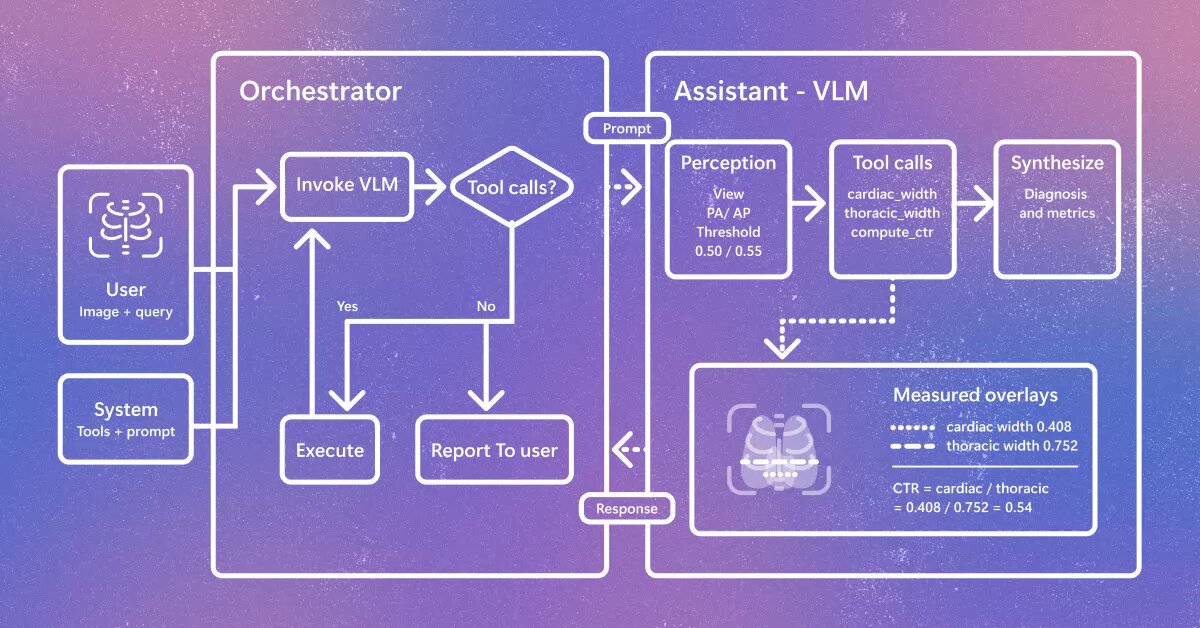
TL;DR - Microsoft Research announced CARE-X, a unified chest X-ray interpretation model that goes beyond automated report generation to combine reasoning, calibrated predictions, and measurement tools. It matters because it signals a shift in radiology AI from narrative text output toward clinically actionable, uncertainty-aware assistance.

  • Positioned as a "unified approach" for chest X-ray interpretation rather than a single-task report generator.
  • Three stated pillars: flexible reasoning, calibrated predictions (confidence that reflects true likelihood), and measurement-based tools — suggesting tool-augmented, quantitative outputs alongside text.
  • Framed explicitly as evolving past report generation, implying prior radiology VLMs are limited by free-text-only outputs that are hard to verify or trust clinically.
  • Content is thin: this is a promotional post with a link and video, so no benchmarks, datasets, model scale, or evaluation results were provided — the above is inferred from the announcement text only.
Representative image for 吴一龙:改写全球肺癌指南的中国医生

吴一龙:改写全球肺癌指南的中国医生

Rank 40 · Content 35 · Popularity N/A

TL;DR - A profile of Guangdong Provincial People's Hospital oncologist Wu Yilong, awarded the 7th "Taishan Award" for clinical medical research, whose lung-cancer trials have been written into 27 treatment guidelines across 15 countries/regions. It matters as a case study of how China moved from follower to standard-setter in precision oncology — and where AI is being eyed next.

  • Established EGFR-mutation-guided targeted therapy: his cohort work found ~30% EGFR mutation rate in Chinese NSCLC patients vs <10% in Western populations, and the 2009 IPASS trial (NEJM) showed gefitinib extended PFS to 9.5 months in mutation carriers, cementing the "test first, then treat" principle.
  • A sustained trial pipeline moved targeted agents from advanced to adjuvant settings: ADJUVANT (2011), CheckMate-078 (2015, PD-1), ADAURA (2020, osimertinib, 51% lower post-op death risk), ALINA (2024, alectinib, 76% lower recurrence risk), LIBRETTO-432 (2026, selpercatinib, 83% lower recurrence/death risk in RET-fusion disease).
  • Scale and infrastructure: 16 global-lead international trials, 110+ domestic multicenter trials, and the CTONG consortium (founded 2007) grown from 11 to 40+ sites with ~10,000 enrolled patients; a 2023 Nature Medicine "loose-eligibility" trial is cited as an early patient-centered design.
  • Forward-looking AI angle is aspirational, not a result: the article states he is exploring how to apply artificial intelligence to find the next breakthrough in precision lung-cancer treatment, with no specific models or findings described.

LLMs & Foundation Models 2

RT by @ylecun: excited to be releasing open weights for muse glimmer today, a 30b model that runs…

Rank 64 · Content 70 · Popularity N/A

TL;DR - Meta is releasing open weights for Muse Glimmer, a 30B dense model small enough to run on a single consumer GPU, with weights for its larger Muse Spark 1.2 foundation model promised soon. It signals Meta's continued push to put frontier-adjacent models directly into practitioners' hands.

  • Muse Glimmer is a 30B-parameter dense (not MoE) model, positioned for local/single-consumer-GPU inference — implying quantized deployment is the intended path at that size.
  • Muse Spark 1.2 is described as Meta's "latest foundation model" and a deliberately different design point from Glimmer; weights are announced but not yet available.
  • Framed as a two-tier open-weights strategy: a compact locally-runnable model plus a larger flagship, with "more to come."
  • Content is a promotional announcement amplified by Zuckerberg and retweeted by LeCun — no benchmarks, training details, license terms, or eval results are given, so capability claims are unverified.
Representative image for 刚刚,OpenAI曝光GPT-6!传10万亿参数,8月强行发布

刚刚,OpenAI曝光GPT-6!传10万亿参数,8月强行发布

Rank 50 · Content 50 · Popularity N/A

TL;DR — A WeChat (新智元) report aggregating unverified X/SemiAnalysis rumors that OpenAI will ship "GPT-6" (codename Astra), allegedly ~10T parameters, in August, with an even larger model codenamed "Doug" by year-end. It matters as a signal that frontier labs may be returning to large-scale pretraining, but the numbers are leaks, not confirmed specs.

  • Claimed specs for Astra/GPT-6: ~10T parameters (vs. GPT-4's rumored ~1.8T), a new pretraining base beyond the prior ~4T-token "Spud" run, and context possibly reaching ~1.5M tokens; release reportedly delayed by safety review.
  • "Doug" is described as OpenAI's largest pretraining run yet, rumored to use NVIDIA's next-gen Vera Rubin silicon, targeted for as late as November after cybersecurity testing; a smaller run codenamed "Garlic" is framed as the validation experiment.
  • The core argument: since GPT-4o, o1/o3/GPT-5/5.5 were post-training, RL, and inference-time scaling on an aging base, so a new full-scale pretrain would test whether pretraining scaling laws still deliver.
  • Competitive framing: Anthropic allegedly holding "Fable 5.1" as a counter-launch at matching price, plus reported Google/DeepMind leadership departures — treat all of this as rumor; no benchmarks, papers, or official statements are cited.

Efficiency & Systems 2

Representative image for 独家解读丨对手买「法拉利」,AMD为何给自己添了一辆「拖拉机」?

独家解读丨对手买「法拉利」,AMD为何给自己添了一辆「拖拉机」?

Rank 64 · Content 70 · Popularity N/A

TL;DR - AMD announced on Aug 6 it is acquiring Canadian inference-chip startup Taalas, whose chips bake a specific model's weights directly into silicon; the deal signals AI hardware specialization being pushed to an extreme, trading generality for cost and latency gains.

  • Taalas hardwires model weights and part of the dataflow into the chip (Mask ROM–like metal connections rather than rewritable memory); its first chip HC1 reportedly hits ~17,000 tokens/s single-user generation on Llama 3.1 8B.
  • Flexibility is preserved only narrowly: a programmable SRAM block holds KV cache and LoRA fine-tuning parameters, and context length is adjustable; base-model changes require a respin, though a structured-ASIC approach means only ~2 model-specific mask layers change, targeting ~2-month customization cycles.
  • Scaling is the open question — HC2 aims to go from 8B to 20B via lower-precision formats and off-chip SRAM, while hundreds-of-billions-parameter models force multi-chip systems, reintroducing partitioning, interconnect, idle-utilization, and yield/defect risks; AMD's system integration and supply chain are seen as the missing piece.
  • Interviewees (all pseudonymous) frame it as AMD buying a "tractor" (narrow but cheap/efficient) versus NVIDIA's Groq LPU "Ferrari"; viability hinges on whether enough stable, high-volume workloads exist — cited signals include DeepSeek V4 Flash's ~8.99T tokens in ~10 days on OpenRouter and GPT-5-Codex's 40T+ tokens in three weeks. Similar model-hardening efforts are emerging in China (ICT/Cambricon's HNLPU paper, startup Sytrix).
Representative image for 紫东太初推出GMC核心集剪枝方法,少80%Token仍满血保真多模态能力

紫东太初推出GMC核心集剪枝方法,少80%Token仍满血保真多模态能力

Rank 61 · Content 65 · Popularity 50

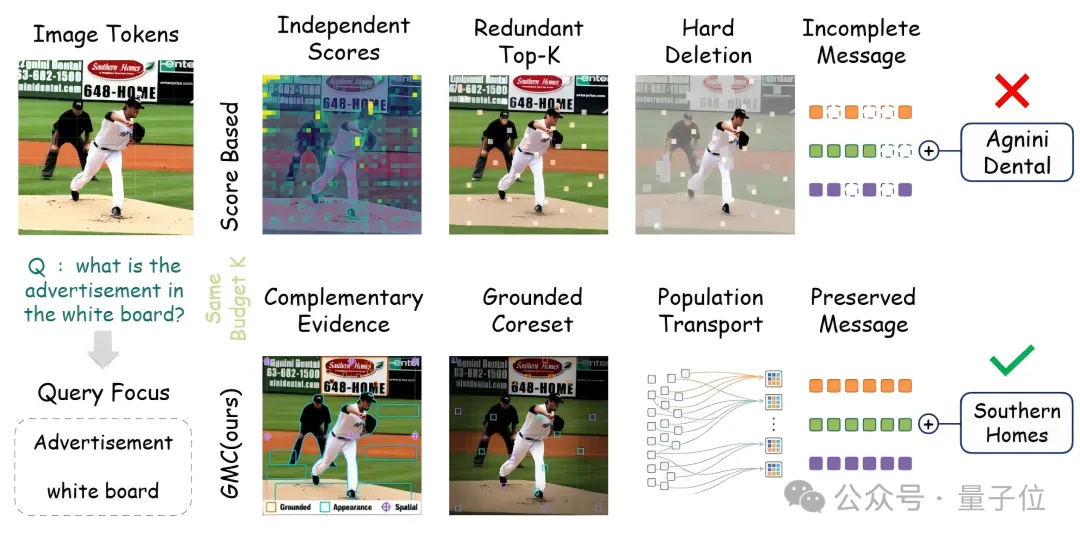
TL;DR - 中科院自动化所紫东太初团队发布 GMC(Grounded Message Coreset Pruning),一种免训练的视觉 Token 核心集剪枝方法,可在删除 80–90% 视觉 Token 的情况下保持接近原模型的多模态能力,直指高分辨率 VLM 的显存与推理成本瓶颈。

  • 双阶段设计:先做"互补证据自适应筛选"(结合问题—视觉注意力、视觉特征相似性、原始图像坐标空间证据),按对未覆盖证据的边际贡献选 Token,避免 Top-K 反复保留同质化显著区域;再用 Population Transport 把待删 Token 的隐藏状态按特征相似度与空间邻近性迁移到代表 Token。
  • 实测结果:Qwen2.5-VL-7B 上从 1296 个视觉 Token 减到 256(-80.2%)保留 97.78% 平均性能,减到 128(-90.1%)的 GMC-L16 达 99.11%;LLaVA-1.5-7B 保留 128/64 个 Token 时分别为 99.76%/99.82%。
  • 长文档场景:15876 个原始视觉 Token 输入下保持 98.87% 问答质量,端到端推理加速 1.258 倍,提示 KV Cache 减少 73.94%——因为是真实序列压缩而非掩码遮蔽。
  • 免训练、无需任务标签/OCR/检测器等外部依赖,可直接接入 Qwen、LLaVA 等主流 VLM;在 POPE、AMBER、HallusionBench、CHAIR 等幻觉基准上事实一致性优于同预算基线。论文:arXiv 2608.02134v1。

3D Vision Hardware 1

Representative image for 科研级精迅V1~V4!从零搭建一套面结构光扫描仪!提供源码+高阶班课程+答疑

科研级精迅V1~V4!从零搭建一套面结构光扫描仪!提供源码+高阶班课程+答疑

Rank 36 · Content 30 · Popularity N/A

TL;DR - Suzhou Sandisiwei (via the 3D视觉工坊 channel) is marketing its "精迅" V1–V4 research-grade structured-light 3D scanners, sold with full source code and bundled training courses on structured-light reconstruction and PCL point-cloud processing. It matters as an example of the commercial tooling layer feeding 3D perception for robot grasping, metrology, and defect inspection.

  • Product tiers differ mainly by projector and camera: V1/V2 use a DLP3010 light engine (mono/stereo calibration, one-click reconstruction, point-cloud filtering), V3 moves to DLP4710 for higher resolution, stripe writing, and up to 1000 lm for outdoor/dark-object scenes (but >4 kg), and V4 uses a metrology-grade DLP4710 with interchangeable C-mount lenses, passive copper-tube cooling, and a 14 MP Hikvision global-shutter camera.
  • V4 claims CUDA acceleration across reconstruction and point-cloud processing; the post shows capture-time comparisons for a CPU version (V2) vs GPU version (V4) at 30 FPS projection, with hardware supporting up to 60 FPS.
  • Software is a Qt demo with source-level access: HDR multi-exposure fusion for shiny/black surfaces (aluminum, dark backgrounds), manual/feature-based point-cloud registration, SSD surface reconstruction to meshes, single-point and region measurement (flatness, sphericity), plus secondary development against OpenCV/Halcon/VisionMaster.
  • Purchase bundles two video courses (advanced structured-light reconstruction; PCL/Qt/VTK point-cloud processing); no independently verified accuracy or throughput figures are given in the text — performance tables and sample reconstructions (calipers, coins, blades, plaster bust) are referenced as images only.

AI Coding Tools 1

Representative image for 奥特曼笑疯!Claude Code之父「挖角」OpenAI网红高管,惨遭秒拒

奥特曼笑疯!Claude Code之父「挖角」OpenAI网红高管,惨遭秒拒

Rank 37 · Content 25 · Popularity 65

TL;DR - A WeChat (新智元) report on an 8-hour public spat in which a developer was banned by Anthropic for running GPT-5.6 Sol inside the Claude Code harness, prompting Claude Code creator Boris Cherny to publicly offer OpenAI's Codex lead Tibo a job (instantly declined) and Tibo to reset all paid users' quotas. It matters because it spotlights the "harness vs. model" shift in AI coding competition.

  • Model swapping is trivial: a local proxy hijacks Claude Code's requests to OpenAI's API (aliased "claudex"), keeping tools, permissions, and memory while changing only the underlying model.
  • The ban was attributed by Cherny to a misfiring account classifier, not policy on model substitution; the account was restored in under 8 hours, but the thread surfaced widespread complaints about Anthropic's ban/appeal process.
  • The article cites an MBZUAI paper claiming 98.4% of Claude Code's functionality comes from harness architecture (context management, cross-session memory) and <2% from the model itself — treat this figure and the arXiv link as unverified as presented.
  • Contrasting go-to-market styles: Anthropic bans/limits, while OpenAI's Tibo uses public quota "resets" (43 so far, ~every 7.5 days) as a viral acquisition tactic alongside Codex growth from ~3M weekly actives in April to 10M+ by late July.

AI Data Center Infrastructure 1

Representative image for 百万卡时代来了!全球最大AI「超级单体」在中国点亮

百万卡时代来了!全球最大AI「超级单体」在中国点亮

Rank 54 · Content 55 · Popularity N/A

TL;DR - Envision Group (远景科技集团) has brought online its "Ulanqab Xinghe Base" in Inner Mongolia, claiming the world's largest single-building AI compute block ("超级单体") at >120,000 m², as the flagship of its Mission Gobi plan. It matters because it reframes frontier AI scaling as an energy/infrastructure problem — power, cooling, and interconnect — rather than a pure chip race.

  • Park-level plan is 2GW capacity supporting ~1M accelerators and "million-P" compute; cited for contrast, OpenAI's Abilene Stargate site is reported at ~400k cards, while >60% of US 2027-target datacenter capacity reportedly hasn't broken ground.
  • Power is self-generated: a dedicated wind farm supplies >80% of annual energy via direct line, stabilized by Envision's Tianji weather model (wind/solar forecasting), Tianshu energy model (dispatch optimization), and EnOS IoT OS unifying turbines, storage, and compute load into one control loop.
  • Electrical architecture uses solid-state transformers plus embedded BESS on an 800V DC bus to shorten the medium-voltage-to-GPU chain and cut conversion losses; multi-timescale storage (hourly + second-level) absorbs renewable volatility and AI training/inference load transients.
  • Thermal design is co-engineered with power delivery — Ulanqab's cold climate enables free cooling combined with air and liquid cooling; Envision delivers civil works, power, green electricity, storage, and cooling, while customers "ship in cards and deploy."

AI Industry Roundup 1

Representative image for DeepSeek招土木工程师;腾讯参投!林俊旸深夜官宣新公司:做下一代AI智能体;宇树科技中签号出炉:共19414个丨雷峰早报

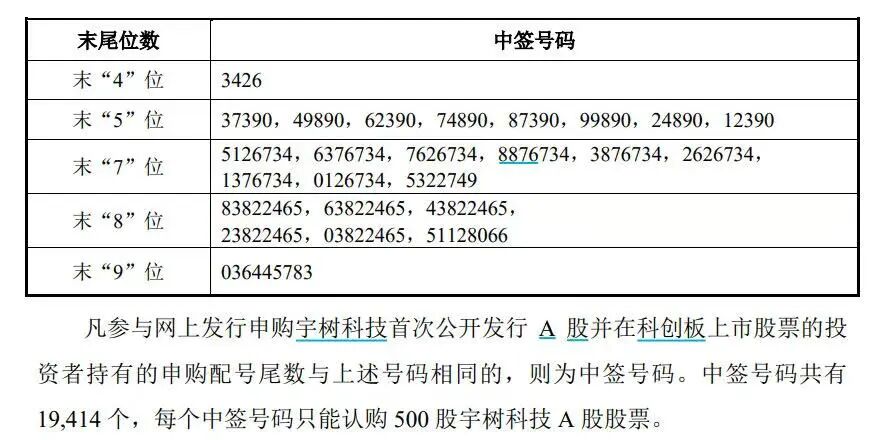
DeepSeek招土木工程师;腾讯参投!林俊旸深夜官宣新公司:做下一代AI智能体;宇树科技中签号出炉:共19414个丨雷峰早报

Rank 40 · Content 35 · Popularity N/A

TL;DR - A Chinese tech-news daily digest covering AI industry moves: DeepSeek hiring civil/electrical engineers to build its own datacenter capability, Qwen's former tech lead Lin Junyang launching agent startup Pragmatik Labs (p7k), plus Anthropic watermarking Claude output and OpenAI's $7B tender offer at an $852B valuation.

  • DeepSeek moves down the stack: job posts for IDC datacenter teams in Hangzhou, Beijing and Ulanqab span electrical, HVAC, automation, energy, comms and civil engineering — signaling a model company building its own compute infrastructure rather than renting it. It also opened a "DeepSeek Harness team" account, an internal code-agent effort benchmarked against Claude Code.
  • Agent startups draw big money: Lin Junyang (ex-Alibaba Qwen tech lead) founded Pragmatik Labs in Shanghai to build "next-generation agents spanning digital and physical worlds," led by Gaorong and Sequoia China with Tencent participating; reported $2B pre-money, possibly >$5B next round. Separately, ex-Huawei "Genius Youth" Lou Yihang left to found Gravity Blueshift for a 200B+ parameter "embodied brain."
  • Anthropic adds invisible text watermarks to Claude models released on/after Aug 2, framed as EU AI Act transparency compliance; watermarks survive copy-paste and possibly partial edits, with third-party detection tools planned.
  • Other signals: Google reportedly shelved Gemini 3.5 Pro (ranked 8th on Artificial Analysis index) and may pivot to Gemini 4; SpaceX's ~$60B Cursor acquisition may retire the Cursor brand; miHoYo shut its AI-companion product BSide: Olivia Lin after under a month, citing inference cost and no monetization path.

AI Product Monetization 1

Testing ads in ChatGPT

Rank 50 · Content 50 · Popularity N/A

TL;DR - OpenAI is beginning to test advertising inside ChatGPT as a way to fund continued free access to the product. The announcement is notable less for technology than for business model: it signals ad-supported monetization arriving in a mainstream consumer LLM assistant.

  • Ads are framed as a revenue mechanism to sustain ChatGPT's free tier, alongside existing subscription tiers.
  • OpenAI states ads will be clearly labeled and visually distinguishable from assistant output.
  • Model answers are stated to remain independent of advertisers — ad presence is not supposed to influence generated responses or ranking of information.
  • Privacy protections and user controls (opt-out/settings) are promised, though the provided content gives no detail on targeting signals, auction mechanics, rollout scope, or measurement.

Note: this summary is based on a short abstract only; no technical specifics, metrics, or launch timeline were included in the supplied content.

AI Survey Roundup 1

Representative image for 2026必看AI干货!《大模型/AIGC/GPT-4/Transformer/DL/KG/NLP/CV AI+X》集合

2026必看AI干货!《大模型/AIGC/GPT-4/Transformer/DL/KG/NLP/CV AI+X》集合

Rank 36 · Content 30 · Popularity N/A

TL;DR - A link-roundup post from the WeChat account 专知 (Zhuanzhi) aggregating hundreds of 2025–2026 AI survey papers, PhD theses, conference tutorials, books, and industry reports across LLMs, agents, multimodal, and AI4Science. It is a curation/index item rather than new research, useful mainly as a reading map of where the field's review literature currently concentrates.

  • Heaviest concentration is on LLM agents: surveys on agentic RL, agent memory (evaluation taxonomies, SSGM controlled-memory framework), deep research/search agents, multi-agent systems (MASPO prompt optimization), agent communication protocols/MCP, and full-stack agent security.
  • Multimodal and embodied AI form the second cluster: vision-language-action models, embodied world models, UAV vision-language navigation, 3D/4D scene generation and world modeling, edge-side embodied foundation models.
  • Efficiency and systems recur throughout: LLM inference engines and serving, LoRA variant taxonomies and low-rank structure, model merging, knowledge/dataset distillation, test-time scaling, and efficient reasoning ("don't overthink" R1-style surveys).
  • Also indexed: named news items (CVPR 2026 awards with He Kaiming's ResNet and YOLO taking test-of-time; DeepSeek's open-sourced sparse "memory" module paper co-signed by Liang Wenfeng; GLM-5; Stanford AI Index 2025), plus theses from CMU, Stanford, Berkeley, MIT, EPFL. No technical results are presented — only titles and links.

AI for Chemistry 1

Representative image for 新书推荐 | 化学领域的人工智能革命

新书推荐 | 化学领域的人工智能革命

Rank 40 · Content 35 · Popularity N/A

TL;DR - RSC published AI Revolution in Chemistry (RSC Foundations Vol. 7, July 27 2026), a 134-page, 10-chapter practitioner's guide by independent pharma consultant Brian McKew. It targets bench chemists with no data-science background, aiming to translate ML/AI concepts into auditable lab and plant workflows.

  • Covers ML, deep learning, generative models, and digital twins applied to reaction prediction, synthesis/route planning, autonomous experimentation, materials design, process control (including PAT), and quality/GMP management.
  • Emphasizes representation choices: molecular descriptors and fingerprints as robust baselines, graphs/sequences for structure, 3D modeling where shape or binding pose dominates, and spectra/images requiring careful preprocessing.
  • Stresses deployment-realistic validation — scaffold, time, or site-based data splits, uncertainty calibration, and explicit applicability domains — to avoid lab-to-plant performance gaps.
  • Treats data access, integrity, change control, governance, ethics/bias, and regulatory compliance as core implementation steps, with checklists and case studies on where AI works and where it fails.

AI for Cybersecurity 1

Daybreak models are now available on AWS

Rank 47 · Content 45 · Popularity N/A

TL;DR - OpenAI's Daybreak cybersecurity models are now offered through Amazon Bedrock, putting specialized security-focused AI into AWS's managed model platform for enterprise use. It matters because it extends OpenAI distribution beyond Azure and packages security AI as a directly consumable cloud service.

  • Distribution move: Daybreak models are served via Amazon Bedrock, so enterprises can call them through existing AWS accounts, IAM, and networking rather than a separate OpenAI integration.
  • Positioning: the models are framed as cybersecurity-specific capabilities aimed at enterprise security workflows (e.g., analysis and defensive operations) rather than general-purpose chat.
  • Ecosystem signal: an OpenAI–AWS partnership on a vertical model family points to multi-cloud availability becoming standard for frontier model vendors.
  • Caveat: the provided content is a brief announcement blurb only — no benchmarks, model sizes, pricing, regions, or task-level evaluations are given, so capability claims are unverified here.

Alzheimer's Disease Treatment 1

A controversial Alzheimer’s surgery is said to reverse symptoms — here’s what scientists know

Rank 55 · Content 60 · Popularity 43

TL;DR - A Nature news piece on a contested brain-drainage surgery that has gone viral in China on the strength of patient videos and testimonials claiming reversal of Alzheimer's symptoms, and is now moving into formal trials internationally. It matters as a case study in how anecdotal evidence can outpace controlled clinical validation.

  • The procedure targets improved fluid drainage from the brain (i.e., the glymphatic/meningeal-lymphatic clearance hypothesis for amyloid/tau removal); the provided blurb does not specify the surgical technique in detail.
  • Adoption in China was driven by "jaw-dropping" patient videos and miraculous testimonials rather than published controlled outcomes — the article frames the procedure as controversial for exactly this reason.
  • Trials are now starting worldwide, which is the step needed to separate genuine effect from placebo, caregiver-report bias, and natural fluctuation in dementia symptoms.
  • Note: the supplied content is only a title plus a one-line summary — no efficacy data, cohort sizes, or trial registrations are included, and none should be assumed. This item is not AI-related despite coming from an AI-digest feed.

Autonomous Driving 1

Representative image for Uber曾卖掉自动驾驶业务,如今为何砸100亿美元杀回Robotaxi?

Uber曾卖掉自动驾驶业务,如今为何砸100亿美元杀回Robotaxi?

Rank 40 · Content 35 · Popularity N/A

TL;DR - Uber plans to spend $10B expanding its robotaxi footprint — investing in AV startups, buying autonomous vehicles, and building its own AV fleet operations — five years after selling its self-driving unit to Aurora. It marks a strategic shift from pure demand aggregator to participant in the robotaxi stack, and the market reacted with a ~5% stock drop on weak near-term guidance and doubts about the spend.

  • Strategy arc: in-house AV R&D from 2015 (including the Otto acquisition), retreat after the 2018 fatal test crash and cost pressure, sale of the AV unit to Aurora in 2020, then a 2023 Waymo platform partnership, and now direct capital deployment.
  • Trigger: Waymo's proof of durable commercial demand — cited at 500K+ paid trips per week, thousands of driverless vehicles across multiple US cities, and hundreds of millions of autonomous miles — raised the risk that AV operators could own the customer entry point themselves.
  • Portfolio approach rather than a single bet: investment in UK-based Wayve, a Stellantis–Wayve–Uber L4 vehicle-platform tie-up (June 2026), a Wayve–Nissan–Uber pilot in Japan using Leaf vehicles, and Middle East work with WeRide; Chinese players (Apollo Go, WeRide, Momenta) increasingly use Uber as an overseas distribution channel.
  • Framing: the hard problem is no longer driving autonomy alone but operating driverless fleets at ride-hailing-grade reliability, shifting competition from technology to full-stack ecosystems spanning AV software, vehicle manufacturing, and demand.

Autonomous Driving VLA 1

Representative image for 现在不做VLA和世界模型的公司,还有哪些?

现在不做VLA和世界模型的公司,还有哪些?

Rank 40 · Content 35 · Popularity N/A

TL;DR - A WeChat industry roundup (from 自动驾驶之心, ending in a promotion for a 14-week paid research course) arguing that VLA (Vision-Language-Action) plus world models have become the default technical route for essentially every major autonomous-driving player, with differentiation now in the entry point rather than the direction.

  • Companies with publicly disclosed VLA work: Li Auto (Mind-VLA), XPeng (VLA 2.0), DeepRoute (元戎), Xiaomi; internationally Tesla (world model fused with FSD), Waymo, NVIDIA. BYD and Changan are named as recent entrants to VLA + world model.
  • World-model-leaning players cited: NIO, Huawei, Momenta, Pony.ai, WeRide — with few public papers, so the routing is inferred by the industry rather than confirmed.
  • Holdouts named (Geely, GAC, SAIC, Chery) are argued to be doing internal pre-research; the author's claim is that silence reflects KPIs tied to mass-production milestones, not absence of work. This is opinion, not verified.
  • Open technical problems the piece flags: coupling VLA reasoning chains with world-model future prediction, shared representations between action generation and physics modeling, on-vehicle stability, VLM real-time latency, language hallucination, and long-horizon spatiotemporal coherence. Referenced baselines/datasets: UniAD, VAD, DiffusionDrive, OpenDriveVLA, Senna; nuScenes, Waymo, Argoverse, Bench2Drive.

Clinical Cardiology Cases 1

Representative image for 21岁女性“心衰+心梗”,医生:这个病在年轻人中极易被忽视!

21岁女性“心衰+心梗”,医生:这个病在年轻人中极易被忽视!

Rank 43 · Content 40 · Popularity N/A

TL;DR - A WeChat clinical case report (医学界) of a 21-year-old woman presenting with decompensated heart failure who was found to have an old right coronary artery infarct and symptomatic triple-vessel disease; it argues clinicians systematically overlook premature coronary artery disease (PCAD) in young patients. Note: the item contains no AI/ML content, so its relevance to an AI digest is limited to being medical-domain source material.

  • Presentation: exertional dyspnea and lower-limb edema, BP 168/118 mmHg, HR 110, JVD; troponin mildly elevated (0.043 ng/mL), BNP 1499 pg/mL, HDL low at 22 mg/dL; ECG showed no acute ischemic change while chest X-ray showed pulmonary edema, bilateral effusions, cardiomegaly.
  • Workup trajectory: EF fell from 55–60% to 40–45% with global hypokinesis; cardiac MRI showed subendocardial late gadolinium enhancement consistent with old RCA infarct; nuclear stress testing showed a fixed inferior perfusion defect; catheterization revealed LCx 60/80/90% stenoses, LAD 70–90%, and total proximal RCA occlusion with collaterals.
  • Risk factors cited: HFpEF history, poorly controlled diabetes, hypertension, nephrotic syndrome, dyslipidemia; the piece defines PCAD as atherosclerotic obstruction before age 45 (men) / 55 (women), notes ~3% of cases are symptomatic under 40, and cites autopsy data (20% of men, 8% of women aged 30–34 with advanced disease).
  • Management and message: family declined CABG, so treatment was medical (DAPT, beta-blocker, statin, vasodilators) with outpatient follow-up; the authors urge ischemic workup in young patients whenever cardiac function changes materially, plus tighter control of modifiable risk factors and screening in high-risk youth.

Clinical Drug Interactions 1

Representative image for “治痛”还是“致命”?心衰患者的一片止痛药,可能让所有利尿剂白吃了

“治痛”还是“致命”?心衰患者的一片止痛药,可能让所有利尿剂白吃了

Rank 40 · Content 35 · Popularity N/A

TL;DR - A WeChat clinical-education case teaser from 医学界 warning that adding ibuprofen to a stable chronic heart-failure patient's regimen can silently undo furosemide's diuretic effect; it contains no AI research or technical AI content beyond a closing promo for an "AI learning journey" mini-program.

  • Case: 72F with 3-year chronic HF (NYHA II) on furosemide 20mg qd and benazepril 10mg qd, seen in orthopedics for bilateral knee osteoarthritis, prescribed ibuprofen sustained-release 0.3g bid.
  • The teaching point posed as a question: NSAIDs (prostaglandin inhibition) can blunt loop-diuretic natriuresis and destabilize fluid balance — patients "on their water pill" return with new lower-limb edema.
  • Triple exposure of NSAID + loop diuretic + ACE inhibitor is flagged as the risky combination; the article stops at the question and defers the answer to a WeChat mini-program, so no data, outcomes, or evidence base are provided.
  • Content is thin/promotional: it is physician-education marketing rather than an AI advancement item, and its only AI link is an unexplained "AI learning" call-to-action.

Embodied AI Robotics 2

Representative image for 国产具身智能创全球新纪录!以30%成本跑赢 Figure AI 45%效率,聪明的具身大脑成关键

国产具身智能创全球新纪录!以30%成本跑赢 Figure AI 45%效率,聪明的具身大脑成关键

Rank 47 · Content 45 · Popularity N/A

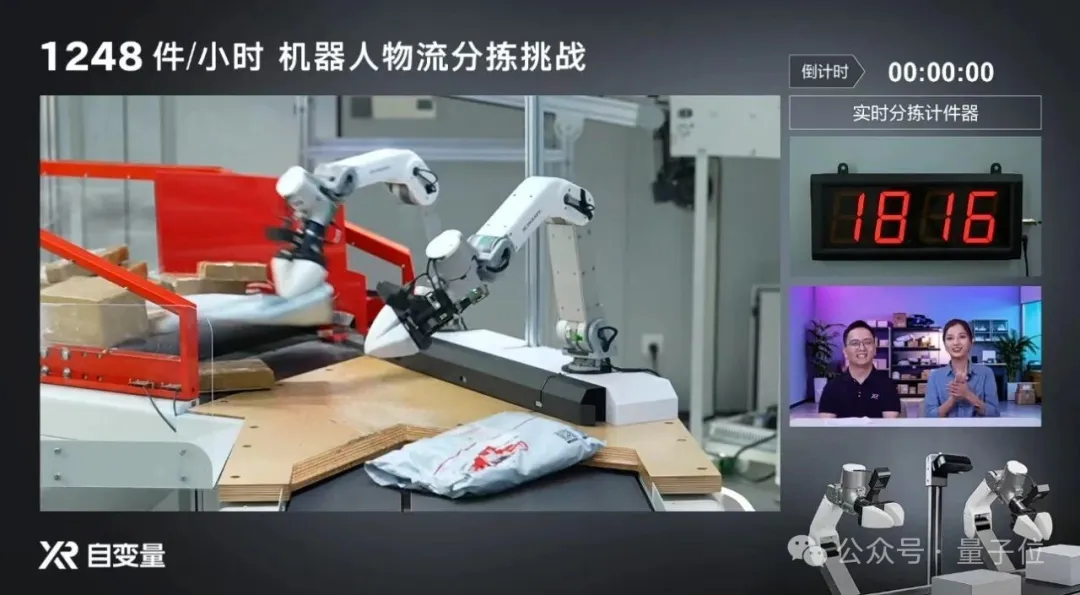
TL;DR - Chinese robotics startup 自变量机器人 (Wuwen/Bianliang) ran a live, unscripted 1-hour logistics-sorting demo where its WALL-B embodied foundation model sorted 1,816 parcels/hour at 98% accuracy — claimed ~45% above Figure AI's published 1,248/hour, using a dual-arm + standard gripper rig said to cost ~70% less than a humanoid with five-finger hands. It's a vendor-run benchmark, but it argues model capability can substitute for hardware complexity in embodied AI.

  • Test conditions: randomly mixed parcels (cartons, soft mailers, cylinders, foam-packed fresh goods) in arbitrary poses on a moving conveyor, no fixed waypoints or preset trajectories, no human takeover or stoppage for the full hour.
  • WALL-B is billed as the first embodied model on a "World Unified Model" (WUM) architecture — fusing vision, audio, language, touch, and action in one network rather than the modular VLA pipeline, to avoid inter-module information loss.
  • Claimed behaviors: strategy switching by object properties (fast grasp for light/regular items, dual-arm cooperation for heavy boxes, side-pushing for awkward ones), separating stacked parcels before picking, flattening deformable soft bags before locating shipping labels, plus zero-shot generalization to unseen packaging.
  • Positioning: the same model was previously deployed in home environments; transferring it to industrial logistics is presented as evidence for cross-scenario generalization and drop-in deployment at existing sorting stations. All figures are self-reported by the vendor and not independently verified.
Representative image for 人形之外,擎羽把“身体”变成具身智能的新变量

人形之外,擎羽把“身体”变成具身智能的新变量

Rank 43 · Content 40 · Popularity N/A

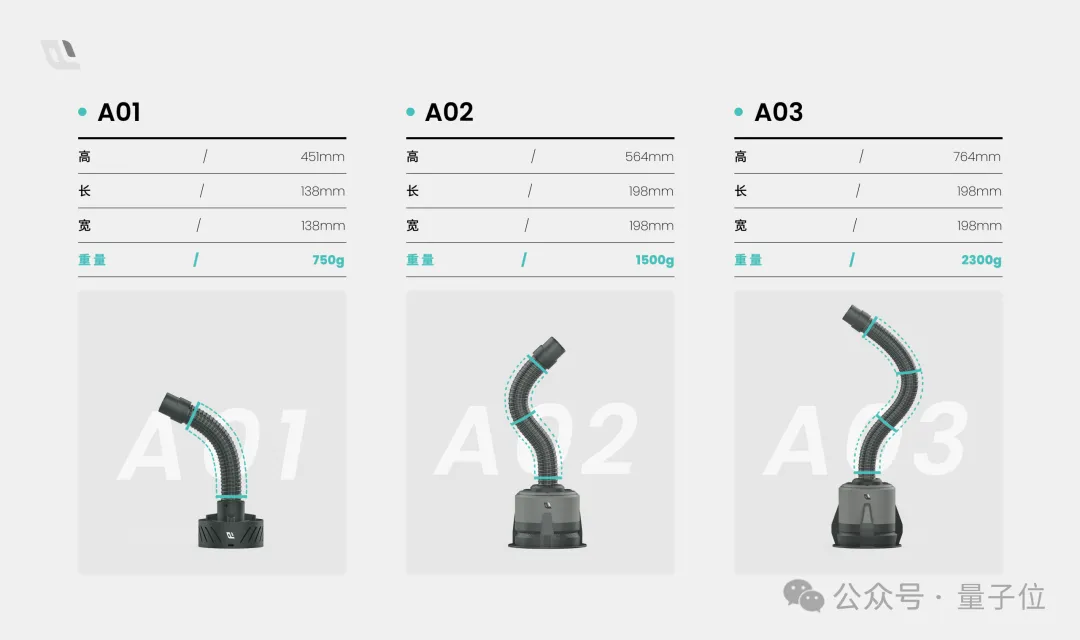
TL;DR - Chinese startup FEAGINE (擎羽科技) launched three mass-produced cable-driven flexible robot arms (A01/A02/A03) plus Fi0, a first-generation cross-embodiment foundation model, arguing that robot bodies — not just humanoid form factors — should be a design variable, with shared intelligence reused across differing embodiments.

  • Hardware matrix: A01 (1 flexible joint, 2 DoF, 750g, 200g payload), A02 (2 joints, 4 DoF, 30cm, 400g payload, 0.78 m/s), A03 (3 joints, 6+1 DoF, 50cm, 600g payload, 1.17 m/s); all support ROS 1/2, Python, C++, with GUI, MuJoCo and SAPIEN support on A02/A03. The company claims this is the first standardized mass-produced cable-driven flexible arm product line.
  • Fi0 architecture: task/world knowledge is meant to transfer across bodies while actions are regenerated per embodiment. Components include a Skill Encoder (turns human demos into skill tokens), a Cross-view World Encoder (aligns egocentric human and robot wrist/body camera views into a shared world representation), an Embodiment Graph → Body Tokens (topology, segments, scale, sensing, actuation, dynamic state), plus a World Dynamics Model and MAWA (Multi-objective Action-World Assessment) that roll out and score candidate actions on task progress, success probability, physical risk, and uncertainty.
  • In-context skill learning: for tasks outside training coverage, a single human demonstration captured via an "Ego" headset becomes inference-time skill context — no parameter updates or retraining, aimed at on-device deployment and long-tail tasks.
  • Positioning: the flexible/continuum bodies are pitched as a continuous embodiment-variation testbed (length, segments, DoF vary systematically) rather than only end products; the article is a company announcement with no benchmark results or quantitative model evaluations disclosed.

Enterprise AI Adoption 1

From assistance to execution: How enterprises put AI to work

Rank 50 · Content 50 · Popularity N/A

TL;DR - An OpenAI report on enterprise AI adoption, arguing that companies are moving from AI as a chat assistant to AI that executes work autonomously via agents, with ChatGPT and Codex as the deployment surfaces. Note: only the summary blurb was available, so details below are inferred from that abstract rather than the full report.

  • Framing is a shift "from assistance to execution": agentic AI that takes actions and completes tasks, not just answers questions.
  • Deployment vehicles cited are OpenAI's own products — ChatGPT for general knowledge work and Codex for software engineering/coding workflows.
  • Claims an adoption gap: "frontier firms" are pulling ahead of peers, implying compounding returns for early, deep deployers.
  • This is vendor-authored research, so treat adoption rates and outperformance claims as directional marketing signal, not independent measurement; no methodology, sample size, or metrics were provided in the available content.

Robotic Tactile Intelligence 1

Representative image for 蚂蚁首次投向机器人“指尖”!数亿元押注,全球首个物理交互脑发布

蚂蚁首次投向机器人“指尖”!数亿元押注,全球首个物理交互脑发布

Rank 50 · Content 50 · Popularity N/A

TL;DR — Chinese tactile-robotics startup Daimon Robotics (戴盟) raised a several-hundred-million-RMB strategic round led by Ant Group — Ant's first bet on robot "fingertips" — alongside launching Daimon-TWM, billed as the world's first tactile-grounded world model ("physical interaction brain") for dexterous manipulation. It signals capital rotating from robot bodies to the tactile sensing layer as the bottleneck for embodied AI.

  • Daimon-TWM architecture: ~10B params, three cooperating layers — an RL-based physical-cognition module (contact state, force/deformation, material properties), a world-model prediction module for anticipating contact evolution and failure risk, and a 100Hz tactile-feedback servo loop for millisecond corrections. Uses learnable "unified tactile tokens" to build a shared tactile latent space; runs real-time inference on an RTX 5090 with cross-embodiment/cross-arm deployment claims.
  • Claimed results: on contact-rich manipulation, ~2× average success rate over π0.5 without disturbance and ~10× under disturbance; demo task is clearing broken glass (reorienting shards vertically to avoid dragging the tablecloth). Positioned as going beyond Fei-Fei Li's T-Rex, which argued tactile is an independent high-frequency channel that can hurt VLAs if naively concatenated.
  • Data and ecosystem flywheel: Daimon-Infinity dataset claims the largest tactile-inclusive multimodal manipulation corpus (hundreds of thousands of hours, targeting millions within the year); first 10k open-sourced hours reportedly hit ~5M ModelScope downloads. Also a RobOmni tactile evaluation benchmark, a China Mobile take-home data-collection network, and a "5S store" data depot in Chenzhou targeting 1M hours/year from 1,000 device kits.
  • Commercial traction (company-stated): 10k+ visuotactile sensor units shipped, coverage of ~80% of dexterous-hand makers, 200+ customers including OpenAI, Figure, Physical Intelligence, Skild AI, Meta, BMW, and Google DeepMind. Prior backers include China Merchants Capital, Lenovo Capital, Inovance, China Mobile, and China Telecom. Note these are vendor/press claims, not independently verified benchmarks.

Robotics World Models 1

Representative image for 分享李飞飞对机器人最新的判断,训练机器人和训练大模型是两回事。

分享李飞飞对机器人最新的判断,训练机器人和训练大模型是两回事。

Rank 47 · Content 45 · Popularity N/A

TL;DR - A transcript of an a16z conversation (Martin Casado with Fei-Fei Li and Yunzhu Li) on World Labs' acquisition of SceniX, arguing that robot training requires a fundamentally different recipe than LLM training because internet-scale action data doesn't exist. It matters because it lays out a concrete real-to-sim-to-real infrastructure bet for scaling robot learning and evaluation.

  • World Labs' focus is "spatial intelligence" via Large World Models; its Marble foundation model takes text/single or multi-image prompts and outputs geometrically consistent 3D worlds (Gaussian Splat, Mesh). SceniX was originally a paying Marble customer before the merger.
  • SceniX contributes a real-to-sim-to-real pipeline built on tensor reconstruction — capturing appearance, 3D geometry, and environment dynamics — which is compute-heavy today and would be made cheaper by Marble's sparse reconstruction and generative 3D capabilities.
  • Their case against pure video-model approaches: robot policies need global consistency across space, time, viewpoints, and interactions; video predictors that make pushed objects vanish give no usable learning signal. The proposed path is a hybrid physics + data-driven data flywheel, physics-weighted early, data-weighted as real deployments accumulate.
  • Two claimed core use cases are training and evaluation. Evaluation is framed as the underrated bottleneck (distinguishing a 90% vs 92% success-rate checkpoint costs enormous real-world labor hours), and simulation enables randomization over lighting, friction, geometry, and material to cover the state space. Waymo's reported billions of simulated hours is cited as precedent. The platform is positioned as model-agnostic and embodiment-agnostic infrastructure — no robot hardware — with deployment expected to follow structured → semi-structured → unstructured environments.
Top highlights — Opinions

LLM Agents 1

Representative image for 「说 Harness 会被淘汰的,肯定没做过工程」,Kimi 前 CLI 负责人戳破了 AI 圈最大的误解

「说 Harness 会被淘汰的,肯定没做过工程」,Kimi 前 CLI 负责人戳破了 AI 圈最大的误解

Rank 54 · Content 55 · Popularity N/A

TL;DR - Former Kimi CLI lead stdrc (Richard Qian), now founder of Raft, argues against the popular claim that agent "harnesses" will be absorbed into models — instead, stronger models push harness complexity upward, from capability patching to multi-agent coordination. It matters because it reframes where durable engineering value sits in agentic systems.

  • Core thesis: harness thickness doesn't shrink, it migrates. Low-level "patch" harness (format constraints, tool-use prompts, retry logic) disappears as models improve, while upper-layer needs (multi-agent handoff, cross-session state sync, proactive memory management, dynamic permissions, cross-vendor protocols) grow.
  • Full harness definition offered: a runtime engineering control layer around the model with four elements — agent execution loop, context/state management, tool & resource scheduling, and safety/boundary governance — not just "system prompt + tool wrappers."
  • Kimi CLI evidence: the team deleted its dedicated subagent scheduler and native parallel tool-calling, letting the model do task splitting via bash and generated scripts. It worked past a capability threshold — but immediately surfaced harder inter-agent communication and task-handoff problems.
  • Raft as the applied bet: no agent loop or base tool wrappers of its own; it plugs in Claude Code, DeepSeek, etc. as "team members," adding per-agent identity/memory/process, channel-based task claiming and handoff with audit trails, and a cross-vendor protocol. Priced at 0.1 human seat per agent. Framing is the author's own; no benchmarks or results are presented.

LLMs & Foundation Models 1

Representative image for 「用初中数学讲明白AI」第3章:注意力——一个加权平均如何改变世界

「用初中数学讲明白AI」第3章:注意力——一个加权平均如何改变世界

Rank 33 · Content 25 · Popularity N/A

TL;DR - Chapter 3 of a popular-science series ("Explaining AI with middle-school math") that reduces the Transformer attention mechanism to a weighted average, walking through a hand-computable toy example. It matters as an accessible conceptual explainer rather than new research.

  • Core claim: a word's contextual meaning comes from a weighted average over other words' vectors; worked example uses "苹果 很 甜" with 2-D vectors and a 3×3 weight matrix whose rows sum to 1 (e.g. 苹果 → [0.8, 0.9]).
  • Q/K/V are framed as three "personas" produced by multiplying a token's embedding by three learned matrices — Q asks, K labels (library book spine), V supplies content; scores come from Q·K dot products, scaled, then softmax (exponential sharpening beats plain normalization).
  • Causal attention is enforced by a triangular mask setting disallowed positions to −∞ so softmax zeroes them, which is what enables left-to-right generation; the first token has no context.
  • Multi-head attention runs parallel Q/K/V sets (GPT-2: 12 heads; GPT-3: 96 layers × 96 heads ≈ 9216), with heads empirically specializing (syntax, long-range dependencies, punctuation/structure, coreference) without being told to; outputs are concatenated and projected back.