机器人的GPT-3时刻真·来了!卡卡西上身,看3秒就学会新动作
Ranking
Overall
75
Content
85
Popularity
N/A
No observed public metrics; popularity remains neutral/archived.
Merged summary
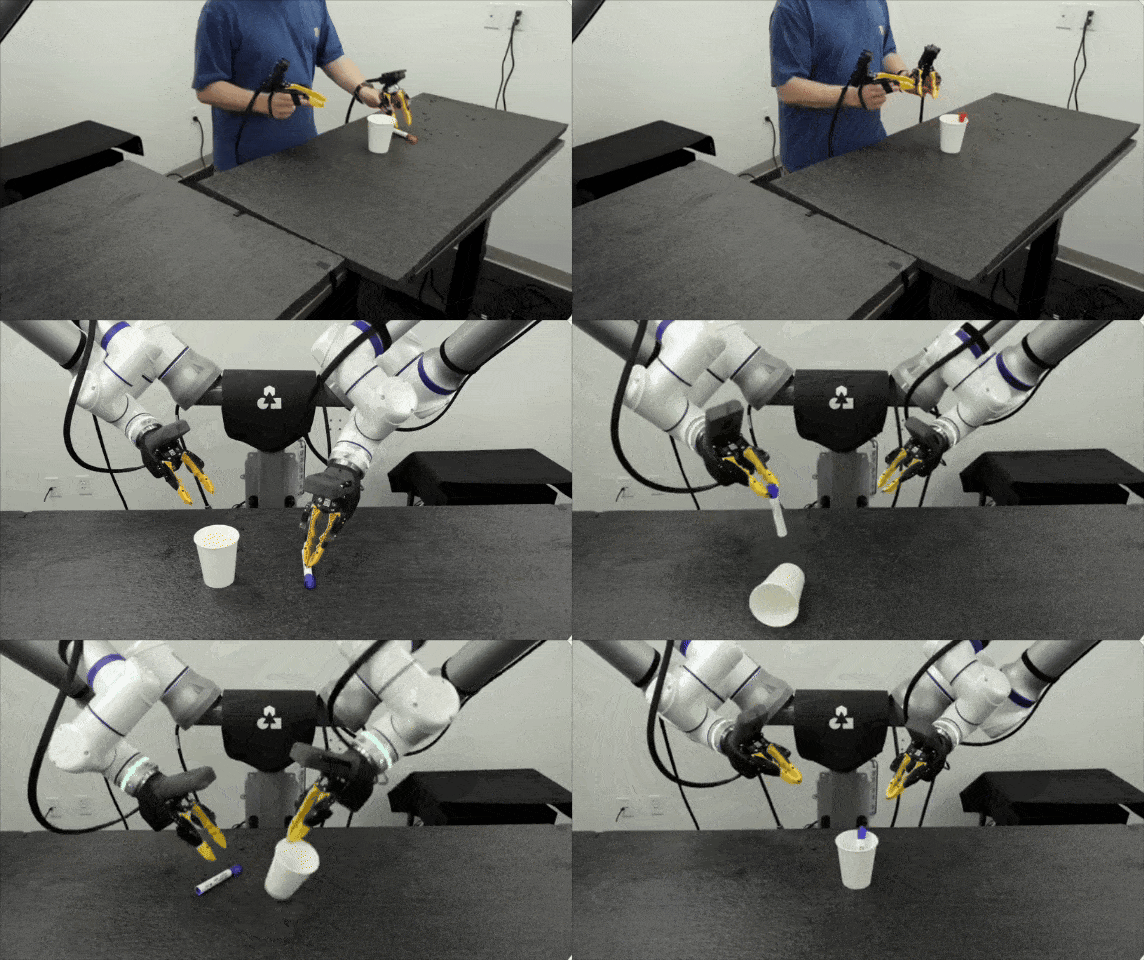
TL;DR - Generalist AI introduced GEN-1.5, a robotics foundation model that can learn novel physical tasks from a 3–12-second demonstration without immediate fine-tuning. The emergence of in-context physical learning could make robots far faster to adapt, though current one-shot reliability remains limited.
- GEN-1.5 treats recent demonstrations as “physical prompts,” enabling new task execution with zero gradient updates.
- It can compose separate demonstrations, infer unshown transition actions, recover from errors, and transfer simulated demonstrations to real-world robots.
- Across 10 tasks, one physical prompt yielded a 59% average success rate; adding five minutes of task data and 10 gradient updates raised it to 83%.
- Generalist says the capability emerged from large-scale pretraining on continuous real-world interaction data rather than a specialized meta-learning architecture or objective.
Sources (1)
机器人的GPT-3时刻真·来了!卡卡西上身,看3秒就学会新动作
Public signals
N/A
TL;DR - Generalist AI introduced GEN-1.5, a robotics foundation model that can learn novel physical tasks from a 3–12-second demonstration without immediate fine-tuning. The emergence of in-context physical learning could make robots far faster to adapt, though current one-shot reliability remains limited.
- GEN-1.5 treats recent demonstrations as “physical prompts,” enabling new task execution with zero gradient updates.
- It can compose separate demonstrations, infer unshown transition actions, recover from errors, and transfer simulated demonstrations to real-world robots.
- Across 10 tasks, one physical prompt yielded a 59% average success rate; adding five minutes of task data and 10 gradient updates raised it to 83%.
- Generalist says the capability emerged from large-scale pretraining on continuous real-world interaction data rather than a specialized meta-learning architecture or objective.