星海图高继扬:具身智能的终极商业模式,是售卖「物理世界 Token」 | WRC 2026
Ranking
Overall
64
Content
70
Popularity
N/A
No observed public metrics; popularity remains neutral/archived.
Merged summary
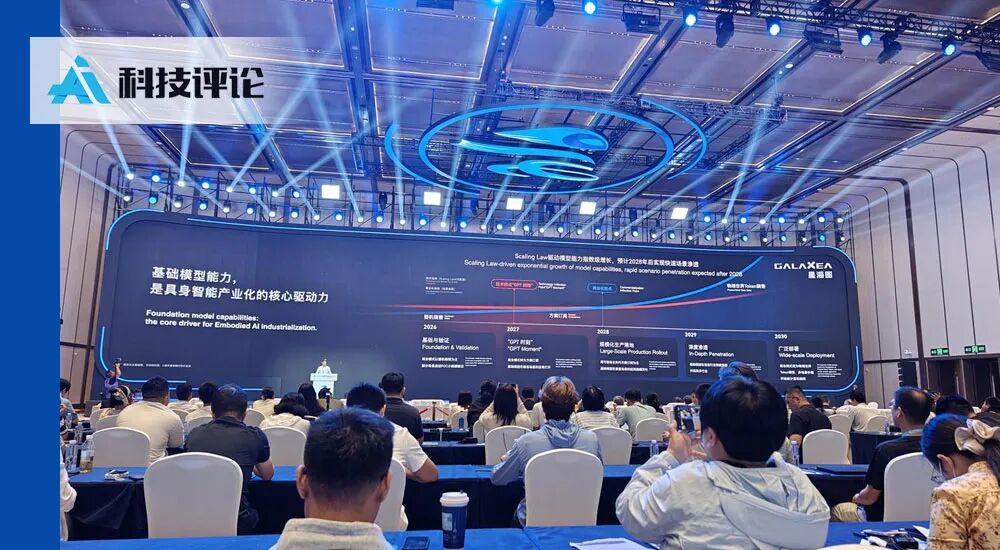
TL;DR - Galaxea AI co-founder Gao Jiyang argues that embodied AI will shift from selling robots to charging for “physical-world tokens”—successful actions and completed tasks—making foundation-model intelligence the industry’s primary source of value.
- Galaxea’s unified autoregressive architecture targets zero-shot generalization, general-purpose grasping, and long-horizon tasks with one model.
- Its post-training combines imitation learning with distributed reinforcement learning on physical robots; the company reports precision improving from centimeter to millimeter or submillimeter levels and task success reaching 99.9%.
- Gao frames generalization as training cost: adapting a robot to a new long-horizon task currently takes about 10 hours, with a stated goal of reducing this to one hour.
- The company is deploying autonomous systems in retail, manufacturing, logistics, and commercial services, including warehouse picking, handling, and flexible packaging across thousands of SKUs.
Sources (1)
星海图高继扬:具身智能的终极商业模式,是售卖「物理世界 Token」 | WRC 2026
Public signals
N/A
TL;DR - Galaxea AI co-founder Gao Jiyang argues that embodied AI will shift from selling robots to charging for “physical-world tokens”—successful actions and completed tasks—making foundation-model intelligence the industry’s primary source of value.
- Galaxea’s unified autoregressive architecture targets zero-shot generalization, general-purpose grasping, and long-horizon tasks with one model.
- Its post-training combines imitation learning with distributed reinforcement learning on physical robots; the company reports precision improving from centimeter to millimeter or submillimeter levels and task success reaching 99.9%.
- Gao frames generalization as training cost: adapting a robot to a new long-horizon task currently takes about 10 hours, with a stated goal of reducing this to one hour.
- The company is deploying autonomous systems in retail, manufacturing, logistics, and commercial services, including warehouse picking, handling, and flexible packaging across thousands of SKUs.