不是Demo!优必选把客户产线1:1搬进WRC,解锁具身智能真落地路径
Ranking
No observed public metrics; popularity remains neutral/archived.
Merged summary
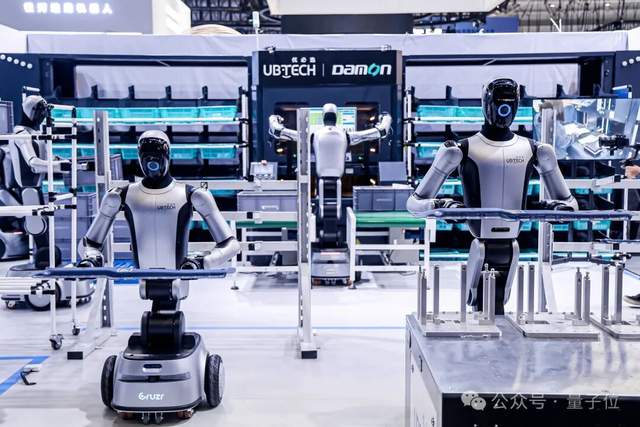
TL;DR - UBTech showcased humanoid robots performing continuous, autonomous industrial tasks on production-line replicas at WRC, emphasizing reliability and real-world deployment over staged demos. Its strategy combines on-device embodied models, scenario-specific hardware, and a data flywheel built largely from physical robot operations.
- Cruzr S2 and Y1 robots handled loading, palletizing, and mixed-item sorting without human intervention; reported performance included sub-millimeter positioning and nearly 1,100 picks per hour.
- The “embodied brain” comprises the Thinker foundation model for perception, Thinker-WM for outcome prediction, and Thinker-VLA for control and autonomous recovery from failures.
- Edge optimization reportedly improved Thinker-VLA inference efficiency by 176%, reduced storage use by 60%, and lowered full-module GPU memory requirements from 64 GB to 32 GB.
- UBTech says real-robot interactions provide 60–70% of its training data, supporting a deployment-to-data-to-model-improvement loop as industrial installations scale.
Sources (1)
不是Demo!优必选把客户产线1:1搬进WRC,解锁具身智能真落地路径
TL;DR - UBTech showcased humanoid robots performing continuous, autonomous industrial tasks on production-line replicas at WRC, emphasizing reliability and real-world deployment over staged demos. Its strategy combines on-device embodied models, scenario-specific hardware, and a data flywheel built largely from physical robot operations.
- Cruzr S2 and Y1 robots handled loading, palletizing, and mixed-item sorting without human intervention; reported performance included sub-millimeter positioning and nearly 1,100 picks per hour.
- The “embodied brain” comprises the Thinker foundation model for perception, Thinker-WM for outcome prediction, and Thinker-VLA for control and autonomous recovery from failures.
- Edge optimization reportedly improved Thinker-VLA inference efficiency by 176%, reduced storage use by 60%, and lowered full-module GPU memory requirements from 64 GB to 32 GB.
- UBTech says real-robot interactions provide 60–70% of its training data, supporting a deployment-to-data-to-model-improvement loop as industrial installations scale.