🛰️ Daily AI Frontier
63 works · 2 categories · 17 topics · wechat 15 blog 20 arxiv 30 generated 2026-08-24 04:13:12 UTC
Top highlights — Research

LLM Agents 10

AID-Guard: Stateful Authorization for Delegated Agent Effects

Rank 92 · Content 100 · Popularity 72

TL;DR - AID-Guard is a stateful authorization protocol that binds an approved agent request to at most one provider-side effect across commits, retries, and crash recovery. It matters because conventional admission-time authorization can allow changed requests or duplicate effects when delivery outcomes are ambiguous.

  • Revalidates both the approved request and provider state at commit, retaining a single reservation until a terminal result or certified no-effect outcome.
  • A Python/SQLite prototype produced no unauthorized or duplicate effects across evaluated MCP, Stripe, and Resend mutations, races, retries, and recovery schedules.
  • Under complete proposer compromise, it blocked all 44 tested attacks while admitting all 44 matched legitimate proposals.
  • Strict exact-manifest authorization reduced benign utility by 35.4–43.8 percentage points; a typed frontier recovered 9–10 completions without observed unsafe effects.

Task-CoEvolve: Efficient Harness Optimization via Adaptive Validation Task Selection

Rank 88 · Content 95 · Popularity 70

TL;DR - Task-CoEvolve reduces the cost of optimizing LLM agent harnesses by adaptively evaluating the validation tasks that best distinguish candidate harnesses. It matches full-validation-set search performance while using 80% fewer evaluations.

  • Samples tasks using outcome variance, emphasizing examples near the agent’s evolving capability frontier.
  • Estimates full-set performance from partial evaluations by correcting for each task’s sampling probability.
  • Enables consistent candidate comparisons even when different validation subsets are used across iterations.
  • Outperforms fixed-subset baselines on online text classification and Terminal-Bench 2.1.

Utility Under Attack: Agent Memory Poisoning and the Limits of Content Screening and Provenance Ranking

Rank 87 · Content 95 · Popularity 69

TL;DR - This paper shows that poisoning only 1.2% of an agent’s persistent-memory corpus can reduce accuracy from 0.850 to 0.300. Content screening fails to detect the false assertions, while provenance-weighted retrieval faces a fundamental tradeoff between blocking poison and retaining legitimate untrusted evidence.

  • A four-stage write-time screening pipeline rejected none of 360 poisoned memories, despite achieving 0.832 recall on indirect prompt injection.
  • The shipped provenance weight was statistically indistinguishable from no defense (p=0.80).
  • Stronger provenance weighting raised mixed-corpus accuracy from 0.3167 to 0.7000, but reduced evidence recall to zero and accuracy to 0.0417 when valid evidence was untrusted.
  • The authors propose bounded occupancy constraints during retrieval instead of additive provenance penalties.

AI4AI-Bench: Benchmarking LLM Agents in Algorithmic Design for Recursive Self-Improvement

Rank 87 · Content 95 · Popularity 69

TL;DR - AI4AI-Bench evaluates whether LLM agents can improve AI training algorithms across 10 frozen research repositories. Current agents show limited recursive self-improvement capability, with the best system reaching 0.250 on a scale where 0.1 is the original algorithm and 1.0 is optimal.

  • The benchmark separates genuine learning-algorithm changes from data collection and hyperparameter tuning.
  • It evaluates 29 configurations of six systems, giving each agent four hours on one B300 GPU before independently rerunning and scoring its code.
  • The mean score was 0.166; most submissions did not alter how the model learns.
  • Submissions that changed the learning algorithm averaged 0.226 versus 0.126 for others, and increased reasoning effort raised their frequency from 8% to 64%.

What You Can't See Is What You Learn: Restricted Evidence Visibility Favors Compositional Generalization in Shared-Genome Language-Model Societies

Rank 83 · Content 100 · Popularity 45

TL;DR - Restricting each module’s access to evidence made shared-model, multi-cell language-model societies far more likely to learn compositional communication protocols than giving every module global visibility. The results suggest information bottlenecks can encourage reusable internal interfaces, though the preregistered evaluation narrowly failed its depth-three accuracy threshold.

  • In 9 of 10 initialization-matched pairs, restricted-visibility societies outperformed globally visible counterparts by at least 20 points at both tested composition depths.
  • Communication ablations reduced restricted societies to chance, while packet transplant and counterfactual experiments indicated reusable, value-indexed messages that causally controlled outputs.
  • The depth-three advantage remained 0.558 for composite functions never seen during training, supporting genuine compositional generalization.
  • Restricted-arm median depth-three accuracy was 0.6988, missing the preregistered 0.70 requirement; an earlier cohort also failed the complete battery due to poor ordinary-language preservation.

Break It Down, Pass It On: Cross-Task Skill Transfer in LLM Agents

Rank 82 · Content 100 · Popularity 41

TL;DR - This controlled study finds that LLM agents transfer induced skills more reliably when skills represent subtasks rather than whole tasks and are stored as text rather than code. It also proposes an execution-free utility score for diagnosing whether a skill memory is likely to help on new tasks.

  • Task-level skills generally lowered performance below the no-memory baseline, while subtask-level skills improved it on average.
  • Text-form skills transferred more effectively than code-form skills.
  • Skill success depended on the combined effects of specificity and abstractness; neither property was predictive alone.
  • The proposed skill utility score consistently correlated with transfer success using only skills and task descriptions.
Representative image for From Agent Behaviour to Agent-Friendly Documentation: An Empirical Study of How Coding Agents Discover, Read, and Write Technical Documentation

From Agent Behaviour to Agent-Friendly Documentation: An Empirical Study of How Coding Agents Discover, Read, and Write Technical Documentation

Rank 82 · Content 100 · Popularity 41

TL;DR - An empirical study of more than 33,000 agentic pull requests and 557 coding-agent sessions finds that agents primarily use instruction files and working notes rather than conventional technical documentation. The results challenge assumptions that agent-friendly documentation reliably prompts action or validation.

  • Agent-facing artifacts represented 60.5% of documentation interactions, versus 10.6% for classical technical documentation and 1.3% for API references.
  • Evidence that documentation consultation leads to code editing was mixed: the adjacent transition probability was 0.002, while a stage-adjusted model found elevated odds (OR 1.33).
  • No explicit documentation-based validation sequence was observed; consultation correlated with less immediate testing (adjusted OR 0.39).
  • Consultation was usually self-initiated (70.2%), and code was touched before documentation 4.7 times more often in multi-commit pull requests changing both.

Loreley: Repository-Scale Program Evolution with Quality-Diversity Search

Rank 82 · Content 100 · Popularity 41

TL;DR - Loreley applies quality-diversity search to repository-scale software evolution by retaining and reusing complete Git states rather than following one edit sequence or repeatedly restarting. It successfully preserved stepping-stone branches, but did not demonstrate better final performance within a 48-job budget.

  • Candidates are Git commits created in isolated worktrees and scored by a project-defined evaluator.
  • A controlled Zstandard experiment evaluated 1,008 candidates across Loreley, sequential champion editing, and independent root proposals.
  • At 48 jobs, Loreley scored 0.135% below sequential editing and 0.320% above independent proposals; neither comparison established a QD advantage.
  • Non-incumbent states contributed to four of seven final Loreley winners by primary-parent ancestry, showing that archive reuse occurred even without a proven endpoint benefit.
Representative image for MidTool: Mid-training Data Synthesis for Agentic Tool Use

MidTool: Mid-training Data Synthesis for Agentic Tool Use

Rank 80 · Content 95 · Popularity 45

TL;DR - MidTool is a data-construction pipeline and open corpus for teaching LLMs general tool use during mid-training. Experiments on Qwen3 base models suggest dedicated mid-training improves agentic tool-use performance beyond relying solely on supervised or reinforcement-learning post-training.

  • Synthesizes supervision from real-world APIs, MCP skills, and document-grounded workflows using web, PDF, and code data.
  • Targets tool-affordance recognition, context-grounded arguments, multi-step tool-call composition, and recovery from incomplete information.
  • MidTool-Mix was used to mid-train Qwen3-4B-Base and Qwen3-8B-Base before follow-up supervised fine-tuning and reinforcement learning.
  • It consistently improved downstream results over baselines under both post-training methods on BFCL, tau2-Bench, and MCP Universe.

Don't Solve, Just Compare: Tiny Advisors for Runtime Intervention in LLM Agents

Rank 79 · Content 95 · Popularity 41

TL;DR - COTA improves LLM agents at runtime using a small comparator that selects promising alternative actions rather than solving tasks or generating corrections itself. It improved performance across all nine tested actor-environment settings, suggesting weaker auxiliary models can still provide effective recovery guidance.

  • The comparator evaluates same-prefix alternative continuations against the agent’s proposed action using pairwise judgments.
  • Repeated comparisons determine whether intervention is needed; preferred alternatives are offered as non-binding advice so the original agent can replan.
  • Training uses pairwise supervision from counterfactual branches sharing the same task prefix.
  • COTA outperformed the compared baselines across WebShop, ALFWorld, and tau³-Retail with three different actors.

Medical/Healthcare AI 9

Representative image for G-CARL: Grounded Checklist-Aligned Reward Learning for Patient-Oriented Medical Report Interpretation

G-CARL: Grounded Checklist-Aligned Reward Learning for Patient-Oriented Medical Report Interpretation

Rank 82 · Content 100 · Popularity 41

TL;DR - G-CARL is a reinforcement-learning framework for generating accurate, patient-friendly explanations of medical reports from user queries and dialogue history. It matters because it jointly targets verifiable medical factuality and personalized communication without forcing standardized responses.

  • Introduces Patient-oriented Medical Report Interpretation, an open-ended multimodal generation task combining report evidence, user questions, and dialogue context.
  • Uses multi-source retrieval to verify atomic medical claims and instance-specific weighted checklists to assess response coverage.
  • Provides structured rewards for factuality, user-demand satisfaction, and expression quality while preserving response diversity.
  • Introduces the real-world MMedReport benchmark; experiments and clinician preference evaluations show improvements over existing post-training baselines in overall quality, claim precision, and checklist recall.

Move by Move: Measuring and Steering How LLMs Conduct Psychotherapy

Rank 80 · Content 95 · Popularity 45

TL;DR - This paper introduces a psychologist-validated ontology of ten therapeutic moves to measure how LLMs conduct psychotherapy. Frontier models differ substantially from human clinicians, but tool-based guidance improves their alignment without fine-tuning.

  • Models use inquiry at up to three times the human rate while underusing psychoeducation.
  • LLMs tend to continue strategies introduced by human clinicians rather than initiate those strategies independently.
  • A judge-based annotation approach scales the ontology while matching expert agreement.
  • Exposing therapeutic moves as tools roughly halves deviation from human move distributions and improves turn-level alignment by 7–9 percentage points.
Representative image for Explainable Transformer Models for Clinical Prediction Tasks on Structured Electronic Health Records

Explainable Transformer Models for Clinical Prediction Tasks on Structured Electronic Health Records

Rank 79 · Content 95 · Popularity 41

TL;DR - BERT-LER is an explainable BERT-style model for structured EHR timelines, pretrained on de-identified records from 75 million patients. It combines percentile-binned laboratory values with token-level Integrated Gradients explanations, delivering competitive clinical predictions and clinically plausible attributions.

  • Represents quantitative laboratory results as discrete tokens while preserving graded information through percentile-based binning.
  • Evaluated on the public EHRShot benchmark and a real-world asthma severity progression study.
  • Matches benchmark models overall and often outperforms them on laboratory-related tasks.
  • Produces input-event attributions that align with established clinical risk factors.
Representative image for Towards Surgical World-Action Modeling: A Preliminary Joint Visual-Trajectory Forecasting for Surgical Motion Planning

Towards Surgical World-Action Modeling: A Preliminary Joint Visual-Trajectory Forecasting for Surgical Motion Planning

Rank 79 · Content 95 · Popularity 41

TL;DR - This paper introduces a preliminary surgical world-action model that jointly predicts future operative video frames and instrument trajectories. Joint forecasting could improve motion planning by capturing both tool movement and its visual consequences.

  • Historical video frames and tool trajectories are encoded jointly, processed by a temporal-spatial encoder, and decoded through separate visual and trajectory heads.
  • A chunked autoregressive rollout predicts 15 future steps and consistently outperforms direct one-shot prediction across evaluated horizons.
  • For the first segment, chunking raises PSNR from 18.86 to 23.11 dB and reduces average displacement error from 45.77 to 22.22 pixels.
  • Longer forecasts still suffer from progressive visual degradation and accumulated trajectory errors.
Representative image for Artificial Intelligence for Workflow Analysis in Colorectal Surgery: A Multicentric, Cross-Procedural Development and Generalization Study

Artificial Intelligence for Workflow Analysis in Colorectal Surgery: A Multicentric, Cross-Procedural Development and Generalization Study

Rank 79 · Content 95 · Popularity 41

TL;DR - AI-ColoWorkflow automates phase and step recognition in minimally invasive colorectal surgery videos using a vision transformer and temporal convolutional network. Training on pooled multicenter, multi-procedure data generally improved phase-recognition generalization, though procedure-specific models remained stronger for some step-level tasks.

  • The model combines fine-tuned DINOv3 frame features with a hierarchical multi-stage temporal convolutional network jointly trained for phase and step recognition.
  • On held-out data, it achieved 73.01% macro F1 for phase recognition and 39.82% for step recognition.
  • The pooled global model usually outperformed center- and procedure-specific alternatives, with the main exception being procedure-specific step recognition.
  • Generalization phase-recognition F1 averaged 48.42%, supporting hybrid training strategies for finer-grained surgical workflow analysis.
Representative image for V-REX: Efficient Specialist VLM Training for Veterinary X-Rays

V-REX: Efficient Specialist VLM Training for Veterinary X-Rays

Rank 79 · Content 95 · Popularity 41

TL;DR - V-REX is a specialist vision-language model trained from scratch to generate diagnostic reports for veterinary radiographs. It challenges the assumption that domain expertise requires fine-tuning large foundation models, reporting better task performance with substantially fewer parameters, data, and compute.

  • Redesigns the full VLM pipeline, including tokenization, generative pre-training, grounding, and inference.
  • Introduces training strategies intended to improve data utilization, efficiency, and downstream performance.
  • Uses only veterinary radiology data rather than relying on external foundation-model training data.
  • Reports significant gains over open foundation models, though the provided abstract gives no quantitative results.

CellPath-Bench: A Multidimensional Benchmark for Whole-Slide Cellular Representations in Pathology Foundation Models

Rank 79 · Content 95 · Popularity 41

TL;DR - CellPath-Bench is a cellular-resolution benchmark for evaluating how well frozen pathology foundation models encode cell-type information in whole-slide images. It enables standardized comparison of both within-section decodability and transfer across tissue sections, datasets, and organs.

  • Uses 25 spatially aligned H&E–Xenium tissue sections spanning 11 organs and more than 7 million cells.
  • Samples frozen whole-slide feature maps at registered nuclear coordinates and evaluates them with standardized multiclass linear probes.
  • Introduces Cell Representation Advantage for comparing nucleus-anchored features with patch-level pooling, and Cell Representation Transferability for measuring cross-domain generalization.
  • Evaluates 30 pathology-specific and general-purpose foundation models across 304,920 runs, revealing distinct model-dependent capability profiles.
Representative image for Cell | 渐冻症语言与执行功能衰退的差异细胞基础

Cell | 渐冻症语言与执行功能衰退的差异细胞基础

Rank 71 · Content 80 · Popularity N/A

TL;DR - A Cell study combining spatial transcriptomics and single-nucleus RNA sequencing identifies distinct cellular mechanisms behind language and executive-function decline in ALS. The findings clarify ALS cognitive heterogeneity and suggest phenotype-specific therapeutic targets.

  • Language impairment correlated with diffuse glial–vascular dysregulation in the BA44/45 language region, including altered perivascular myeloid-cell activity.
  • Executive dysfunction was linked to reduced mitochondrial, oxidative-phosphorylation, and synaptic activity in deep-layer BA46 excitatory and inhibitory neurons.
  • Reactive astrocytes, microglia, and stressed oligodendrocyte precursor cells increased across ALS samples, indicating a coordinated gliosis response.
  • Gliosis occurred independently of TDP-43 pathology, while oligodendrocyte-lineage abundance tracked neuronal synaptic and mitochondrial dysregulation.
Representative image for Sci Adv | 可介导原位免疫激活的CD5⁺树突状细胞机器人

Sci Adv | 可介导原位免疫激活的CD5⁺树突状细胞机器人

Rank 61 · Content 70 · Popularity 40

TL;DR - Researchers developed magnetically guided CD5⁺ dendritic-cell microrobots that penetrate solid tumors and activate local immune cells rather than directly killing cancer cells. In a mouse colorectal cancer model, one injection plus magnetic navigation suppressed tumor growth and extended survival while aiming to limit systemic inflammation.

  • The robots combine PD-L1-blocked CD5⁺ dendritic cells with internalized magnetic PLGA nanoparticles coated in tumor-cell membranes.
  • Tumor-membrane antigens promote dendritic-cell maturation and antigen presentation through MHC-I/II, activating CD8⁺ T cells and polarizing macrophages toward the antitumor M1 state.
  • Switchable magnetic fields form ribbon-like clusters for downstream vascular movement and chain-like clusters for upstream, vessel-wall-assisted movement.
  • Magnetic targeting concentrates the robots near tumors, after which natural chemotaxis drives deeper extracellular-matrix penetration and localized immune activation.

Bioinformatics AI 2

Representative image for Nature Biotechnology | 空间多组学解码新抗原-T 细胞原位互作:为 mRNA 肿瘤疫苗精准设计奠定核心技术框架

Nature Biotechnology | 空间多组学解码新抗原-T 细胞原位互作:为 mRNA 肿瘤疫苗精准设计奠定核心技术框架

Rank 85 · Content 100 · Popularity N/A

TL;DR - A Nature Biotechnology study introduces Slide-GoTags, a spatial single-nucleus multi-omics method that jointly maps gene expression, neoantigen mutations, T-cell receptors, and cellular locations. It could improve mRNA cancer-vaccine design by identifying neoantigens that trigger genuine in situ T-cell responses rather than relying mainly on computational predictions.

  • Slide-GoTags integrates spatial transcriptomics, targeted mutation genotyping, and full-length TCR sequencing on the same frozen tissue section.
  • In mouse tumors and samples from nine patients across four cancer types, neoantigen-expressing tumor cells spatially colocalized with cognate T-cell clones.
  • The study identifies IFN-driven “immunogenic niches” as major sites of antigen-specific T-cell recruitment, clonal expansion, activation, and exhaustion.
  • Strong HLA-binding neoantigens attracted more CD8+ T cells but were also associated with greater T-cell exhaustion, supporting vaccine combinations with checkpoint blockade.
Representative image for 空间多组学描绘胰腺癌中驱动代谢免疫重塑的CAF亚型梯度图谱

空间多组学描绘胰腺癌中驱动代谢免疫重塑的CAF亚型梯度图谱

Rank 75 · Content 85 · Popularity N/A

TL;DR - A spatial multi-omics study of pancreatic ductal adenocarcinoma identifies three cancer-associated fibroblast (CAF) states with distinct metabolic profiles and distances from tumors. The findings refine conventional CAF classifications and suggest more targeted stromal interventions, but remain largely associative.

  • Spatial transcriptomics, spatial metabolomics, and tissue coordinates from six tumors defined CAF_C0, CAF_C1, and CAF_C2 states.
  • CAF_C0 was associated with amino acids and small molecules, CAF_C1 with lipids and greater tumor distance, and CAF_C2 with tumor boundaries, hypoxia, inflammation, and extracellular-matrix remodeling.
  • Multiplex immunofluorescence, independent metabolomics samples, and TCGA data partially supported the spatial patterns and linked CAF composition with survival and gemcitabine response.
  • The analyses do not directly demonstrate metabolite transfer, causal immune suppression, chemotherapy resistance, or an independent clinical biomarker.

LLMs & Foundation Models 3

Nothing Changed but the Model: CellFill -- Bounded In-Cell Learning for Bit-Identical, Revocable Updates to Quantized LLMs

Rank 82 · Content 100 · Popularity 41

TL;DR - CellFill updates quantized LLMs by learning bounded residuals within each weight’s quantization cell, leaving the released 4-bit checkpoint bit-identical after re-quantization. This enables verifiable, exactly revocable knowledge updates while limiting model drift and cross-domain forgetting.

  • The integer codes and scales remain frozen; removing the learned residual fully revokes an update.
  • Constrained dense training nearly matched unconstrained fact recall across paired seeds: 58.9% versus 59.3%, a -0.5-point paired difference with 95% CI [-5.0, +4.0].
  • Cell projection reduced cross-domain forgetting relative to unmerged adapters in every converged run, acting as a trust region rather than fixing unstable training.
  • The method scaled to a 27B hybrid linear-attention model with 24 billion constrained weights and verified bit-identical re-quantization.
Representative image for Certified Multi-Turn Robustness for LLM Safety via Compositional Bounds and Safety Persistence

Certified Multi-Turn Robustness for LLM Safety via Compositional Bounds and Safety Persistence

Rank 82 · Content 100 · Popularity 41

TL;DR - MTCR is a framework for certifying LLM safety against multi-turn jailbreaks without the rapidly weakening guarantees produced by naive per-turn composition. It provides tighter lower bounds, interpretable safe-horizon estimates, and matching information-theoretic upper bounds.

  • Models conversational safety as a State-Adversarial MDP and defines robustness by the worst-case safety probability over (k) adversarial turns.
  • Uses embedding-space mode decomposition to produce tighter compositional certificates than multiplying independent single-turn bounds.
  • Introduces ((\alpha,\beta))-safety persistence, improving bound degradation from (\underline{p}^{k}) to (\beta^{k}), where (\beta>\underline{p}).
  • Across six LLMs and both (\epsilon)-bounded and Crescendo-style attacks, observed safety remained above the certified lower bounds.

Orthogonal JEPA: Factorized Predictive States for Latent World Models

Rank 79 · Content 95 · Popularity 41

TL;DR - Orthogonal JEPA is a latent world-modeling framework that factorizes predictive states into multiple orthogonal components rather than using one monolithic target embedding. The design aims to reduce redundant capacity, preserve less-dominant predictive structure, and support more stable forecasting, planning, and rollouts.

  • Learned basis matrices decompose each target state, while dedicated branches predict each component from shared context.
  • Predictive regression preserves factor magnitudes so the components can be synthesized back into a complete latent state.
  • Orthogonality, factor-activity, and online variance objectives discourage repeated directions, inactive factors, and encoder collapse.
  • The framework covers temporal, spatial, and partial-observation prediction and is evaluated across vision, biology, healthcare, control, and molecular dynamics.

Multimodal & Generative 2

CertVLA: Certified Defense against Physical Visual Attacks for Vision-Language-Action Models

Rank 82 · Content 100 · Popularity 41

TL;DR - CertVLA is a certified defense for vision-language-action policies facing bounded physical patch and texture attacks during closed-loop control. It extends certification beyond discrete predictions to continuous, temporally correlated robot actions and, under additional correctness assumptions, can guarantee task success.

  • Uses deterministic covering masks so at least one evaluated prediction remains free of any bounded-support attack.
  • Certifies actions by comparing masked predictions within a calibrated region of behavioral consistency, normalized by benign variation.
  • Extends per-query certificates across an entire closed-loop rollout and provides finite-sample clean-coverage guarantees.
  • Its guarantees are independent of patch content, generation method, and physical transformation, with validation in simulation and real-world patch-attack experiments.
Representative image for Latent Ordinal Evidence, Misaligned Outputs: Inference-Time Ordinal Lens Alignment for Multimodal LLMs

Latent Ordinal Evidence, Misaligned Outputs: Inference-Time Ordinal Lens Alignment for Multimodal LLMs

Rank 79 · Content 95 · Popularity 41

TL;DR - Multimodal LLMs encode strong ordinal information for tasks such as age estimation and disease grading, but their digit-token outputs fail to reflect it. Ordinal Lens Alignment (OLA) recovers this evidence at inference time without modifying the model backbone.

  • Hidden states yielded ordinal labels with Spearman correlation up to 0.938 across four benchmarks and four MLLM backbones.
  • Native outputs lagged linear probes by 16–77 absolute accuracy points because the unembedding layer largely filtered out the ordinal direction.
  • OLA trains lightweight lenses on intermediate-to-deep decoder layers, fuses their predictions, and adjusts only digit-token logits during generation.
  • It outperformed the LoRA-tuned OrderChain baseline in most settings and improved over an offline lens in every evaluated setting.

Efficiency & Systems 7

Representative image for Rethinking Expressivity and Efficiency in Test-Time Training

Rethinking Expressivity and Efficiency in Test-Time Training

Rank 90 · Content 100 · Popularity 66

TL;DR - E²-TTT is a test-time training method that parallelizes chunk-level computation while preserving the fast-weight and momentum states of per-token updates. It combines the throughput of chunk-wise methods with stronger long-context retrieval and length extrapolation.

  • Derives a closed-form chunk transition that exactly reproduces per-token recurrence states under the chunk-start gradient approximation.
  • Trains models up to 1.3B parameters from scratch and matches prior TTT and hybrid-attention baselines in language modeling.
  • Outperforms those baselines on in-context retrieval.
  • Retains over 90% passkey accuracy at eight times its training context length while matching efficient chunk-wise training throughput.

ReCache: Efficient KV Cache Reuse and Compression for Tool-Augmented LLM Agents

Rank 87 · Content 95 · Popularity 69

TL;DR - ReCache makes tool-augmented LLM agents more efficient by caching tool and skill schema representations independently, allowing reuse even when resources appear in different combinations or orders. It substantially reduces latency and KV-cache memory with minimal invocation-quality loss.

  • Resource-wise attention creates composition-invariant KV blocks by removing cross-resource interactions and using resource-local positions.
  • Selective layer/head-group routing and structural-semantic pruning retain only invocation-critical schema information.
  • Resource-wise attention achieved 82.3% Inv-F1 versus 82.4% for dense invocation, with a 3.655× time-to-first-token speedup.
  • The complete framework reduced allocated KV-tensor memory by 92.43% and accelerated attention by 1.423×.

Learning how to Forget: Fine-tuning for Long-Context Sparse Attention

Rank 86 · Content 95 · Popularity 66

TL;DR - This paper introduces a hardware-efficient method for fine-tuning language models with sparse attention, allowing models to co-adapt to arbitrary KV-cache policies for long-context inference. It can outperform models trained with exact attention while running on a single 40 GB Nvidia A100 GPU.

  • Supports any KV-cache selection or compression policy.
  • Provides an optimized H2O sparse-attention implementation with dedicated scaled dot-product attention kernels.
  • Reduces the hardware requirements of long-context fine-tuning compared with exact-attention sequence parallelism.
  • Releases the methods through KeysAndValues, an open-source library for long-context inference and fine-tuning.

TreeWY: Speculative Verification for Gated DeltaNet Hybrids

Rank 82 · Content 100 · Popularity 41

TL;DR - TreeWY is a speculative-verification method for Gated DeltaNet hybrid models that eliminates per-draft-node recurrent-state snapshots. It reduces memory pressure during serving, enabling higher throughput, lower time-to-first-token, or wider draft trees when memory is the bottleneck.

  • Uses a tree-structured WY transform and a single triangular solve to compute outputs for all draft nodes.
  • Stores a compact pseudo-value matrix and reconstructs only the accepted recurrent state at commit time.
  • Benchmarks on Qwen3.5 35B and 397B show reduced recurrent-state memory and KV-cache pressure at unchanged acceptance length.
  • Wider, higher-acceptance draft trees become memory-affordable, though they do not yet improve throughput; non-memory-bound cases incur a few percent overhead.

Memory Augmentation Unlocks Efficient Chain-of-Thought Reasoning

Rank 79 · Content 95 · Popularity 41

TL;DR - Memory-Augmented Compression retrieves reusable reasoning summaries as prefill context, enabling LLMs to produce shorter chain-of-thought traces without sacrificing as much accuracy. The training-free method improves reasoning performance over Chain-of-Draft while delivering 1.14–1.49× lower latency than standard CoT.

  • Formalizes a “Context-Generation Substitution Law,” framing explicit context as a substitute for some decode-time reasoning generation.
  • Builds memories from historical traces that capture reusable patterns, constraints, and critical operations rather than storing raw demonstrations.
  • Improves over Chain-of-Draft by 21.4 points on GSM8K, 28.0 on MATH, 29.5 on BBH, and 6.61 on MMLU-Sci.
  • Works with token-level, trace-level, and inference-state compression; analyses attribute gains to memory relevance rather than context length alone.

Just Noticeable Difference Modeling for Token Compression in Vision-Language-Action Models

Rank 79 · Content 95 · Popularity 41

TL;DR - Action-JND estimates how much each visual token in a vision-language-action policy can change without exceeding a tolerated action deviation. This enables safer token pruning and stale-KV reuse for lower-latency robotic control, particularly at aggressive compression ratios.

  • Defines token “noticeability” using language-conditioned action responses rather than indirect similarity, attention, or saliency signals.
  • Uses a lightweight token-wise estimator in deep visual-feature space to predict maximum action-preserving perturbations.
  • Produces action-tolerance scores that plug into multiple compression methods and prioritize tolerant tokens for compression.
  • Experiments with OpenVLA and OpenVLA-OFT on LIBERO report consistently improved compression reliability.
Representative image for HIERA: Workload-Aware Planning Across Implementation Spaces for GPU Kernel Optimization

HIERA: Workload-Aware Planning Across Implementation Spaces for GPU Kernel Optimization

Rank 79 · Content 95 · Popularity 41

TL;DR - HIERA is a hierarchical planning framework that helps LLMs optimize GPU kernels by choosing among PyTorch operators, CUDA libraries, and custom CUDA implementations. It improves validity, sample efficiency, and optimization performance without additional model training.

  • Uses contract-augmented task specifications to select an implementation space suited to each workload.
  • Combines profiling feedback and expert knowledge for structured iterative refinement.
  • Outperforms existing training-free methods on KernelBench across workload levels and base LLMs, while remaining competitive with training-based CUDA-L1.
  • Achieves a 1.53× speedup over cuDNN on a specialized scientific-computing stencil operator.

3D Scene Understanding 1

Representative image for 上海 AI Lab 提出 OccAnyScene:一个模型统一室内外 3D 语义占据预测

上海 AI Lab 提出 OccAnyScene:一个模型统一室内外 3D 语义占据预测

Rank 68 · Content 80 · Popularity 40

TL;DR - OccAnyScene is a unified 3D semantic occupancy model that handles indoor rooms and outdoor roads despite differing cameras, spatial scales, voxel grids, and label systems. Joint training nearly matches scene-specific models, suggesting a path toward general-purpose occupancy foundation models.

  • Uses pixel frustums as scale-adaptive geometric units and decodes them into 3D Gaussians representing visible and occluded regions.
  • Shares all model parameters across indoor and outdoor scenes except dataset-specific semantic mapping matrices.
  • The jointly trained model reaches 59.51% mIoU on Occ-ScanNet and 22.87% on SurroundOcc-nuScenes, within 0.41 and 0.19 points of scene-specific versions.
  • Evaluation covers only two benchmarks, and areas outside camera-frustum coverage still require supplementary spatial queries.

Robot Learning 1

Representative image for Beyond Imitation: Self-Improving Robot Policies via Off-Policy Q-Planning

Beyond Imitation: Self-Improving Robot Policies via Off-Policy Q-Planning

Rank 87 · Content 95 · Popularity 68

TL;DR - Q-Planning enables large behavior-cloned robot policies to improve from successful and failed deployment rollouts by training a small off-policy Q-function while keeping the original policy frozen. It delivers stable gains in simulation and on contact-rich real-robot tasks without further human demonstrations.

  • The Q-function guides inference using a single-step, Q-weighted average over actions sampled from the behavior-cloned policy.
  • After ten self-improvement iterations, success rose from 93% to 99% on LIBERO-10 and from 83.8% to 91.4% on bimanual RoboTwin.
  • In five real-robot iterations without human intervention, stack-cups improved from 40% to 90% and insert-wallet from 25% to 80%.
  • Under the same online data budget, Q-Planning was the only tested method to improve stably from failures without training an auxiliary actor.

Scalable Clustering 1

Representative image for 顶刊TPAMI 2026!GBSK:面向复杂分布的大规模高效聚类

顶刊TPAMI 2026!GBSK:面向复杂分布的大规模高效聚类

Rank 61 · Content 65 · Popularity N/A

TL;DR - GBSK is a large-scale density-clustering algorithm published in IEEE TPAMI 2026 that extracts a sparse “geometric density skeleton” instead of processing every sample directly. It reduces quadratic density-clustering costs to near-linear complexity while retaining competitive accuracy on datasets containing up to 100 million samples.

  • GBSK uses granular-ball density statistics as a lightweight proxy for kernel density estimation under balanced granular-ball constraints.
  • A divide-and-conquer pipeline identifies mode candidates from random subsamples, aggregates them, and estimates a distribution skeleton for fast clustering.
  • Tests across nine datasets showed order-of-magnitude speedups; MNIST8M and the 100-million-sample AGC100M were clustered within minutes on a standard workstation.
  • The paper, code, supplementary materials, data, and experiment records are publicly available in the project’s GitHub repository.

Spatial Epigenetics 1

Representative image for Nature | 基因放在哪,比修饰更重要——空间表观遗传学揭秘人类大脑发育新机制

Nature | 基因放在哪,比修饰更重要——空间表观遗传学揭秘人类大脑发育新机制 🔗 2 sources

Rank 64 · Content 65 · Popularity 63

TL;DR — A Nature study maps subnuclear genome organization during human fetal cortical development, showing that developmental genes are activated when they relocate from the repressive nuclear lamina to transcriptionally active nuclear speckles. Nuclear positioning can therefore control transcription independently of canonical histone modifications.

  • During radial glia-to-neuron differentiation, lamina-associated domains underwent 23% genome-wide reorganization; 305 of 739 genes released from the lamina moved directly to nuclear speckles.
  • Among relocating bivalent genes, 85% lost the repressive H3K27me3 mark, while expression increased by more than eightfold on average.
  • Pharmacological removal of H3K27me3 failed to activate genes that remained anchored to the nuclear lamina, demonstrating that spatial confinement itself can maintain repression.
  • Lamina-associated genes can initially recruit RNA polymerase II, but the lamina enriches pausing factors and excludes positive elongation factors, preventing productive transcriptional elongation.

Note: The second source summary concerns an unrelated mouse liver-cancer study on germline genetic background and cannot factually be merged with the titled brain-development work.

Top highlights — Industry & News

LLM Agents 3

Representative image for 万字长文拆解DeepSeek V4 Pro与Harness:从后训练到「代理自进化」,更大的变化在开源框架里

万字长文拆解DeepSeek V4 Pro与Harness:从后训练到「代理自进化」,更大的变化在开源框架里

Rank 78 · Content 90 · Popularity N/A

TL;DR - A hands-on analysis of DeepSeek V4 Pro and its open-source Harness argues that agent performance depends as much on post-training, model routing, context handling, and orchestration as on the base model. The Harness matters because it exposes the infrastructure used for official evaluations and enables longer-running, cost-aware agent workflows.

  • V4 Pro’s strongest gains are in agentic coding benchmarks and end-to-end task completion; the article infers, but cannot confirm, that improved post-training drove much of the progress.
  • Its advertised 1M-token context uses YaRN scaling from 64K, yet the authors retrieved all 10 facts planted across a 923,858-token test, including around the 902K position.
  • DeepSeek’s Anthropic-compatible API can silently route claude-sonnet, claude-haiku, and some older Claude model names to the smaller Flash model, so explicit model-variable overrides are needed for reliable Pro evaluation.
  • The open-source Harness emphasizes stable cache prefixes, strict control of tool-output size, and reproducible minimal-agent settings; Pro has relatively high token prices but low measured per-task cost due to efficient task completion and heavy cache reuse.
Representative image for 匿名牛来大模型被扒出智谱血缘,也有人怀疑Cursor拿开源GLM训的

匿名牛来大模型被扒出智谱血缘,也有人怀疑Cursor拿开源GLM训的

Rank 68 · Content 75 · Popularity N/A

TL;DR - Anonymous model Ox Alpha has attracted developers with a 1M-token context window, 131K-token output, multimodal inputs, and strong results on some coding-agent tasks. Community fingerprinting suggests links to Zhipu’s GLM family, while Google/Gemini and a Cursor-trained GLM derivative remain unconfirmed alternatives.

  • Ox Alpha appeared anonymously on OpenRouter and targets coding, complex reasoning, tool use, and long-running agent workflows.
  • Tokenizer tests reportedly show a stable relationship with GLM-5.3, including a 75-token offset plausibly caused by a hidden system prompt.
  • Controlled video tests found Ox Alpha and GLM-5V-Turbo had highly similar sampling and token-budget behavior; API error patterns also resembled Zhipu services.
  • Evidence remains circumstantial, and performance reports are mixed: one 10-task community test scored 80%, while other evaluators found it less impressive or weaker than Gemini on vision tasks.
Representative image for 唐杰说后训练是关键,GLM 5.3 实测却被自己的安全策略卡住了

唐杰说后训练是关键,GLM 5.3 实测却被自己的安全策略卡住了

Rank 64 · Content 70 · Popularity N/A

TL;DR - A hands-on comparison found that GLM 5.3’s expanded post-training improved long-horizon coding, tool use, delivery speed, and product polish over GLM 5.2. However, its stricter safety behavior repeatedly blocked benign steps in an automated development workflow, highlighting an integration challenge for agentic coding systems.

  • Both models delivered an offline browser-based 3D driving game from real OpenStreetMap data, including vehicle physics, traffic rules, navigation, persistence, documentation, and smoke tests.
  • GLM 5.3 finished in 50 minutes 47 seconds versus GLM 5.2’s 66 minutes 1 second, while producing a more polished experience with improved lighting, road signs, HUD elements, and driving feedback.
  • The models used the same base model; the article attributes GLM 5.3’s gains to larger-scale post-training on realistic, long-running engineering tasks involving tools, code modification, and validation.
  • GLM 5.3’s enhanced security checks triggered refusals in Claude Code’s automated approval flow, stalling development despite the underlying task being benign and technically achievable.

Medical/Healthcare AI 1

Representative image for AI制药全线疯涨!全球首个AI癌症疫苗大获成功,这些中国企业值得关注!

AI制药全线疯涨!全球首个AI癌症疫苗大获成功,这些中国企业值得关注!

Rank 75 · Content 85 · Popularity N/A

TL;DR - Moderna and Merck reported Phase III success for personalized mRNA cancer vaccine intismeran plus Keytruda in high-risk melanoma, meeting recurrence-free and distant-metastasis-free survival endpoints. The milestone highlights AI’s role in selecting patient-specific tumor neoantigens and designing individualized mRNA therapies.

  • The trial enrolled more than 1,100 patients and represents the first reported Phase III success for an individualized neoantigen and mRNA-based cancer therapy.
  • The workflow sequences tumor and normal samples, then uses a proprietary algorithm to rank mutations and select up to 34 neoantigens for a patient-specific mRNA vaccine.
  • AI-driven sequence design and screening can improve mRNA stability, translation, and manufacturability while reducing experimental work.
  • Chinese companies including Jitai Technology, XtalPi, Insilico Medicine, Raina Biosciences, and NeoCura are developing AI platforms for mRNA design, delivery, and tumor neoantigen prediction.

Bioinformatics AI 2

Representative image for 暴涨22%!Anthropic引爆AI制药,上游「卖水人」成最大赢家

暴涨22%!Anthropic引爆AI制药,上游「卖水人」成最大赢家

Rank 78 · Content 90 · Popularity N/A

TL;DR - Anthropic reported that Claude-designed protein binders succeeded for 14 of 15 targets in independent laboratory testing, highlighting generative AI’s growing role in de novo protein design. The announcement also boosted Twist Bioscience, whose high-throughput DNA synthesis platform produced designs for validation.

  • Anthropic sent 30 AI-designed protein binders to Twist Bioscience and Adaptyv Bio for independent production and testing.
  • Claude successfully generated binders for 14 of 15 targets, according to Anthropic’s disclosed results.
  • The work demonstrates a workflow linking computational protein design with automated, high-throughput synthesis and wet-lab validation.
  • Twist shares rose 22.64%, while several AI-healthcare and synthetic-biology stocks also gained following the announcement.
Representative image for 全球首个癌症疫苗背后:Moderna扛下多年质疑,正在成为一家AI公司!

全球首个癌症疫苗背后:Moderna扛下多年质疑,正在成为一家AI公司!

Rank 68 · Content 75 · Popularity N/A

TL;DR - Moderna says its personalized mRNA cancer vaccine intismeran (mRNA-4157) succeeded in Phase III, supporting its expansion beyond infectious-disease vaccines. The company is positioning AI as the core engine for patient-specific target selection, mRNA design, and automated manufacturing.

  • AI predicts which mutations in an individual patient’s tumor are most immunogenic, selects vaccine targets, and helps design candidate mRNA sequences within hours.
  • Personalized vaccines require a separate formulation per patient, making algorithmic coordination of synthesis, quality control, and delivery essential at scale.
  • Moderna’s Lucy R&D system reportedly closes the loop between sequence generation, automated DNA-to-mRNA production, high-throughput testing, and model updates.
  • The reported clinical milestone strengthens the case that mRNA can serve as a programmable therapeutic platform for cancer, immune disorders, and rare diseases—not only vaccines against viruses.

LLMs & Foundation Models 1

Representative image for 万字长文详解 DeepSeek、Llama、GLM 底层架构设计

万字长文详解 DeepSeek、Llama、GLM 底层架构设计

Rank 68 · Content 75 · Popularity N/A

TL;DR - A technical explainer compares the architectural evolution from Llama to DeepSeek, GLM, and Qwen, framing recent advances as efficiency improvements rather than wholesale Transformer redesigns. It shows how modern models increase capacity and context length while controlling inference memory and computation.

  • MLA compresses key-value representations to reduce KV-cache memory, while decoupled RoPE preserves positional information.
  • Sparse attention mechanisms such as DSA lower the computational cost of long sequences.
  • Mixture-of-Experts models expand parameter capacity without activating every parameter for each token, though they must balance traffic across experts.
  • RMSNorm, pre-normalization, GQA, QK-Norm, RoPE, and FlashAttention improve training stability or attention efficiency across modern LLMs.

Multimodal & Generative 2

Representative image for 刚刚,DeepSeek首个多模态模型发布!!

刚刚,DeepSeek首个多模态模型发布!!

Rank 68 · Content 75 · Popularity N/A

TL;DR - DeepSeek released its first experimental vision-language model, deepseek-v4-flash-vision-exp, adding image understanding to V4 Flash at the same API pricing. The launch expands DeepSeek’s low-cost offering toward multimodal agents that can interpret screenshots, charts, documents, and interfaces.

  • Handles up to 600 images per request, supports JPEG, PNG, GIF, and WebP, and accepts Base64 data, public URLs, or Files API references.
  • Supports images up to 8192 pixels on the longest side, with configurable detail levels and a maximum charge of 384 tokens per image.
  • Integrates through OpenAI Chat Completions, Responses API, and Anthropic-compatible formats, easing adoption in existing agent and developer tooling.
  • The model remains experimental; reported agent-benchmark performance near Claude Opus 4.8 awaits fuller documentation and independent evaluation.
Representative image for 万兴科技全新推出AI画布工作台

万兴科技全新推出AI画布工作台 🔗 2 sources

Rank 43 · Content 40 · Popularity N/A

TL;DR — 万兴科技推出 Filmora.TV,一款面向电视广告和品牌视频制作的 AI 原生画布工作台,将创意策划、内容生成、专业剪辑、团队协作和交付整合为端到端流程。其价值在于打通商业视频生产链路,而非仅提供单一素材生成功能。

  • 利用 TVC 专用提示词优化,将需求简报和脚本转化为可执行的分镜与视觉创意。
  • 采用无限节点画布,支持 AI 内容生成、多轨音视频编辑和时间线预览。
  • 集成云端素材共享、团队审阅及最终导出,覆盖协作式商业制作流程。
  • 支持通过 XML 将项目传输至 Premiere Pro、Final Cut Pro 和万兴喵影进行专业精修。
  • 万兴科技称该工作流最高可缩短 90% 的制作时间、降低 80% 的成本;这些数字属于公司估算。

注: 第二则来源实际介绍的是凯度 MEE 智慧厨房及“小紫”AI 智能体,与万兴科技 AI 画布工作台并非同一项工作,因此未将其内容混入摘要。

Efficiency & Systems 2

摩根大通:阿里云12%利润率被系统性低估,成熟态ROIC应接近20%

Rank 64 · Content 70 · Popularity N/A

TL;DR - 摩根大通认为,阿里云当前约12%的利润率低估了其AI基础设施的长期盈利能力;随着GPU和数据中心利用率提升,其成熟态资本回报率(ROIC)有望接近20%。

  • 近期高强度资本开支使大量新投产资产仍处于约60%利用率的爬坡阶段。
  • 新增资产首年单批ROIC约为6%,显著低于约20%的成熟态水平。
  • 堆叠vintage模型显示,即使资本开支和单位经济性不再改善,整体加权ROIC也可能随资产成熟自然升至接近16%。
  • AI基础设施净自由现金流预计在第三年前后跨越盈亏平衡点。
Representative image for 英伟达AI服务器将涨价15%!1GW数据中心成本激增50亿美元

英伟达AI服务器将涨价15%!1GW数据中心成本激增50亿美元

Rank 61 · Content 65 · Popularity N/A

TL;DR - Nvidia AI server prices could rise by more than 15% for early-2027 deliveries as memory and component costs surge. The increase could add at least $5 billion to the cost of a 1 GW AI data center, intensifying pressure on already capital-intensive AI infrastructure.

  • Grace Blackwell 300 and Vera Rubin 200 systems are reportedly affected, with some configurations expected to rise about 17%.
  • A 72-GPU Vera Rubin rack could increase from roughly $7 million to $8 million.
  • Tight HBM, DRAM, NAND, and LPDDR5X supplies are driving costs and forcing vendors to reconsider memory capacities and configurations.
  • Nvidia is also investing upstream in data-center developers and planning platforms to address constraints in land, power, cooling, networking, and deployment timelines.

AI Infrastructure 1

Representative image for 阿里拟配售800亿港元新股,全部投入AI建设;网友造谣「小红书因遭举报上市失败」被行拘;李斌:中国汽车行业三五年后玩家基本确定

阿里拟配售800亿港元新股,全部投入AI建设;网友造谣「小红书因遭举报上市失败」被行拘;李斌:中国汽车行业三五年后玩家基本确定

Rank 40 · Content 35 · Popularity N/A

TL;DR - Alibaba plans an HK$80 billion share placement and says all net proceeds will fund full-stack AI capabilities and infrastructure. The move reflects accelerating capital investment in AI compute as Alibaba’s AI product revenue grows.

  • Alibaba’s AI-related products have surpassed RMB 49.5 billion (US$7.3 billion) in annualized recurring revenue.
  • The company expects AI product ARR to reach US$10 billion next quarter.
  • Alibaba Cloud projects US$100 billion in external commercial revenue by 2030, with margins potentially exceeding 20%.
  • The digest also reports rising AI infrastructure costs, including planned price increases of more than 15% for Nvidia-powered servers.

Consumer Robotics 1

Representative image for 上纬新材“启元机器人”正式开启预订,个人机器人叩开家庭新消费大门

上纬新材“启元机器人”正式开启预订,个人机器人叩开家庭新消费大门

Rank 57 · Content 60 · Popularity N/A

TL;DR - 上纬新材旗下启元机器人开放Q1、T1两款消费级具身智能机器人预订,计划于2026年9月首发交付。此举推动人形机器人从展会体验迈向家庭消费和真实市场验证。

  • Q1身高约88厘米、重约15公斤,采用小尺寸全身力控设计,面向具身开发、科技潮玩和家庭陪伴。
  • T1身高约100厘米、重约16公斤,可在轮足人形与四足形态间自主切换,覆盖陪伴、户外伴行和影像创作。
  • 公司2026年上半年为消费级机器人业务投入研发资金1.6亿元,涉及AI模型、具身智能算法、运动与交互智能及轻量化关节。
  • 公司已实现2.1亿元预收货款,并通过万台级产线及核心部件合作推进规模化量产。

Embodied AI 6

Representative image for WRC 2026 风向标:具身智能下半场,比「大脑」更比「账本」

WRC 2026 风向标:具身智能下半场,比「大脑」更比「账本」

Rank 64 · Content 70 · Popularity N/A

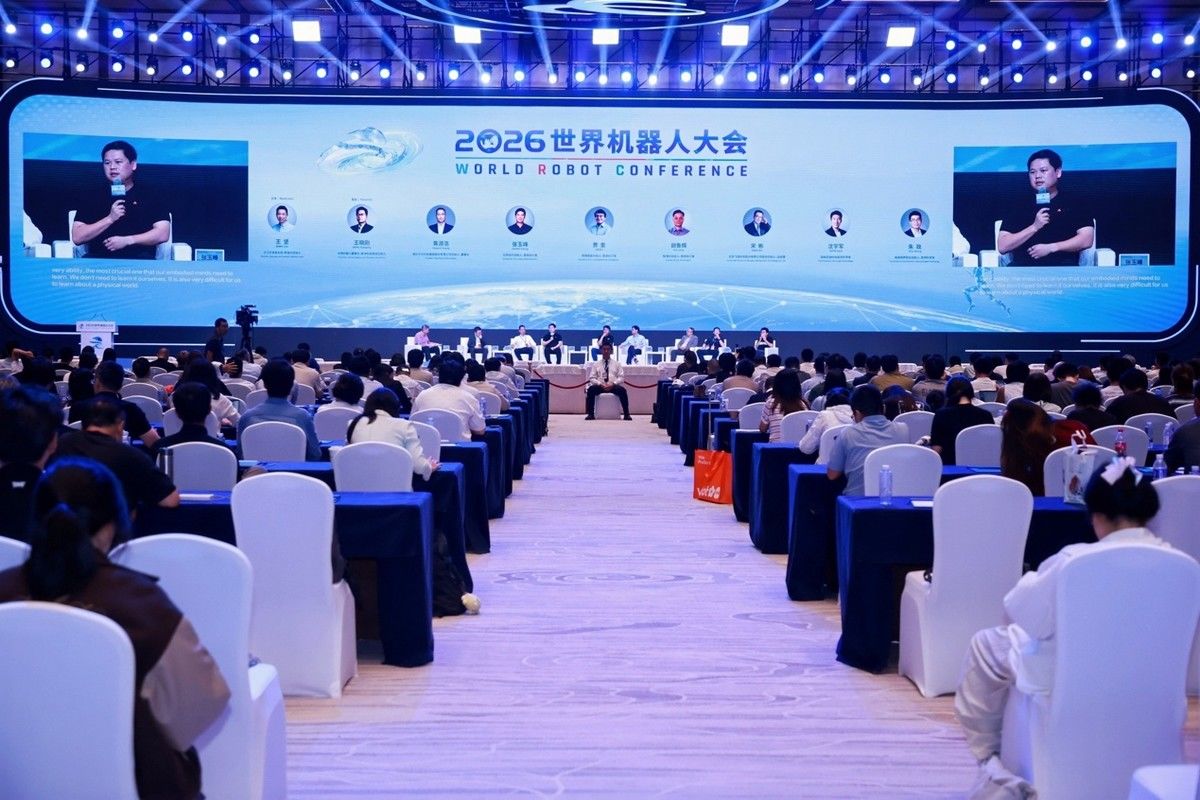
TL;DR - A field report from WRC 2026 argues that embodied AI competition is shifting from flashy robot demos toward reliable, sustained operation and commercially viable ROI. Vendors are differentiating through model generalization, full-stack integration, real-world deployment, and data-driven improvement loops.

  • Logistics sorting remains the leading commercialization testbed, with Force Robotics, Robot Era, and X Square emphasizing generalization, operational maturity, and speed/cost efficiency, respectively.
  • Vendors including UBTECH, Galbot, Spirit AI, and LimX Dynamics demonstrated longer-horizon work across industrial, household, retail, and service scenarios, including multi-robot coordination and recovery from disturbances.
  • World-action and world models are increasingly unifying perception, prediction, and control; examples include Galbot’s brain/cerebellum architecture and Octo Robotics’ real-time visualization of predicted future states.
  • Data infrastructure is becoming a competitive layer through human-operation capture, synthetic training data, real-world feedback loops, and reusable manipulation skills, while orders and measurable ROI increasingly outweigh benchmark claims.
Representative image for 机器人首秀网球场,银河通用突破具身智能「AstraTennis时刻」

机器人首秀网球场,银河通用突破具身智能「AstraTennis时刻」

Rank 61 · Content 65 · Popularity N/A

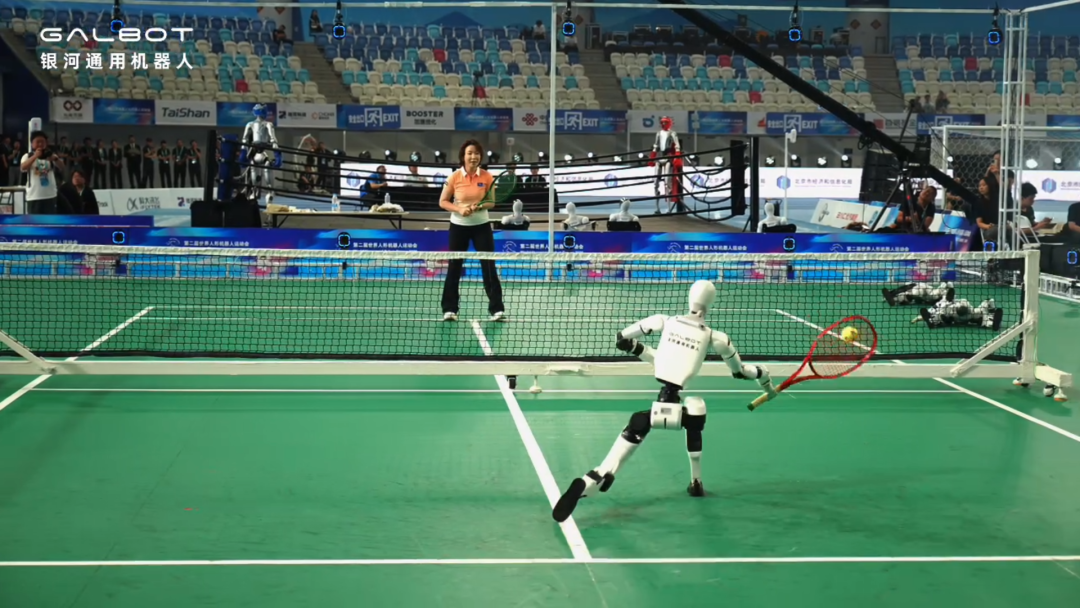
TL;DR - Galbot demonstrated AstraTennis, described as the first fully autonomous humanoid robot to sustain real-time tennis rallies. The showcase matters because it integrates high-level decision-making, whole-body control, and simulation-based training in a fast, unpredictable physical task.

  • AstraBrain unifies tactical reasoning, motion control, and translation of decisions into whole-body actions within a real-time closed loop.
  • AstraBrain Latent extracts reusable motion skills from fragmented, non-expert human demonstrations rather than relying on costly, complete teleoperation data.
  • The robot trains through multi-agent self-play in a simulated tennis environment built on the company’s large-scale embodied-AI dataset, followed by limited real-world calibration.
  • During live play, it handled serves, forehands, backhands, positioning, doubles coordination, and autonomous recovery after a fall.
Representative image for 全球首次!机器人迎战网球运动员,极限救球,摔倒光速弹起

全球首次!机器人迎战网球运动员,极限救球,摔倒光速弹起

Rank 61 · Content 65 · Popularity N/A

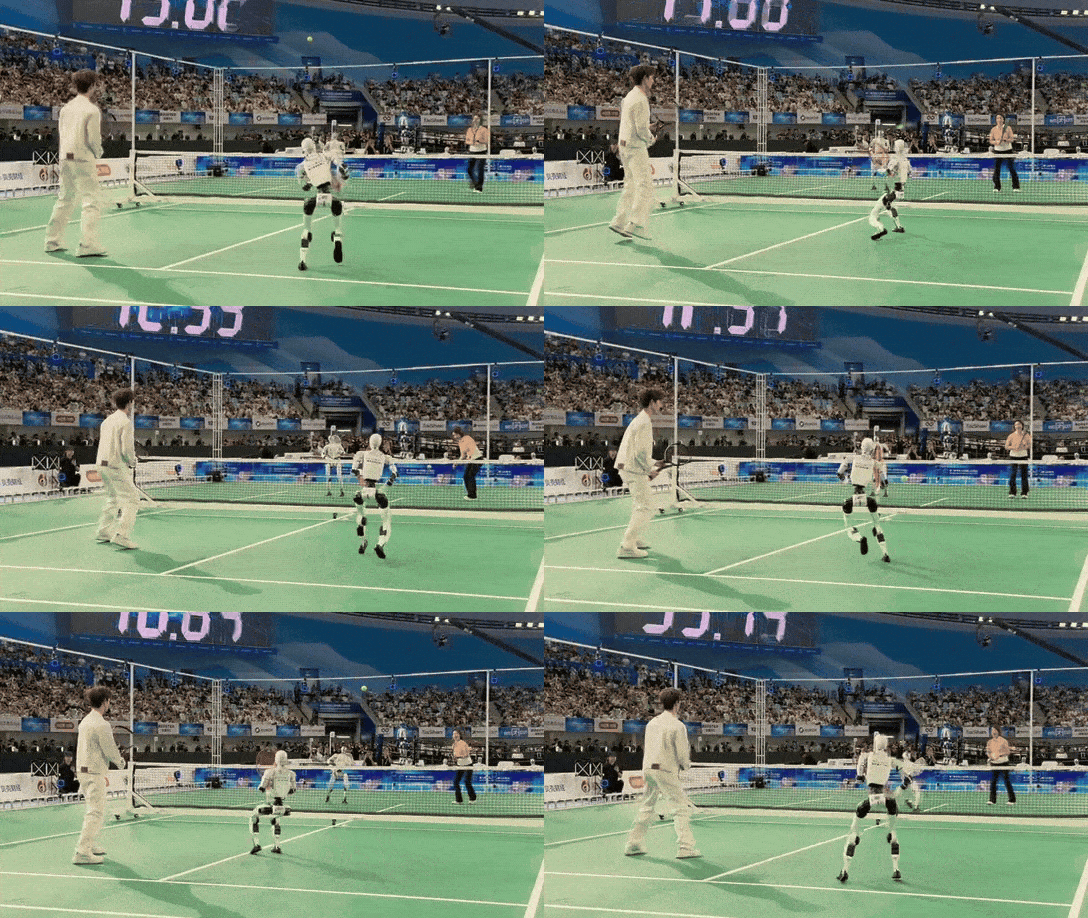
TL;DR - Galbot demonstrated its AstraTennis humanoid autonomously playing tennis against and alongside human athletes in a live event. The showcase matters as a real-world test of closed-loop perception, strategy, whole-body control, and human-robot coordination under fast, unpredictable conditions.

  • The robot demonstrated serving, forehands, backhands, volleys, court movement, multi-shot rallies, doubles coordination, and autonomous recovery after falls.
  • Galbot says its AstraBrain model unifies high-level decision-making, whole-body motion control, and low-level neural control.
  • Training combines imperfect human demonstrations, synthetic data, simulated practice, and multi-agent self-play before transferring learned skills to the physical robot.
  • The event was a company-backed demonstration rather than a formal benchmark; the article provides no quantitative comparisons or independently verified performance metrics.
Representative image for 不做硅谷follower:几个读博的年轻人,押注双足人形的一体化大脑

不做硅谷follower:几个读博的年轻人,押注双足人形的一体化大脑

Rank 61 · Content 65 · Popularity N/A

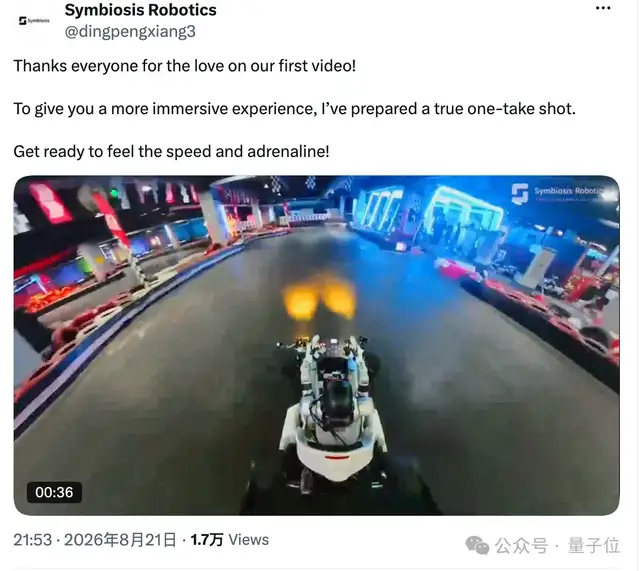
TL;DR - Chinese startup Symbiotic Intelligence is developing an end-to-end foundation model that directly controls bipedal humanoids from perception through joint-level action. Its bet matters because unified control could reduce the information bottlenecks of modular robot stacks, although the approach and the broader humanoid-model field remain unproven at commercial scale.

  • The two-month-old company demonstrated a humanoid autonomously driving a go-kart using coordinated vision, hands, feet, balance, and force control.
  • Its architecture replaces separate high-level planning and low-level control modules with one model that learns whole-body dynamics and outputs joint targets directly.
  • A dual-domain training method combines behavior cloning with DriftDistill, which transfers stability, disturbance resistance, and failure-recovery capabilities from specialized controllers into the unified model.
  • The team uses TrajBooster to convert trajectories from robot arms and wheeled robots into simulated whole-body training data, but estimates that commercially meaningful capabilities may require roughly one million hours of data.
Representative image for 从世界模型到现实生产力,无界动力深度参与WRC主论坛及多场同期活动

从世界模型到现实生产力,无界动力深度参与WRC主论坛及多场同期活动

Rank 54 · Content 55 · Popularity N/A

TL;DR - At the 2026 World Robot Conference, Wujie Dynamics presented its MWA embodied intelligence system and a “latent-space world model + reinforcement learning” approach for moving robots from demonstrations into industrial and commercial deployment. The company argues that real-world deployments should create data feedback loops that improve generalization and reduce adaptation costs.

  • MWA models decision-relevant physical representations and causal relationships in latent space rather than attempting pixel-level reconstruction of the environment.
  • Reinforcement learning adds trial-and-error feedback so robots can evaluate how actions affect the world and select higher-value behaviors.
  • The company uses industrial tasks to develop manipulation skills and variable commercial environments to test generalization under changing layouts, lighting, and human activity.
  • Its deployment strategy emphasizes safety redundancy, hardware-software integration, production-grade reliability, and continuous model improvement from operational data.
Representative image for 2026 WRC | 魔法原子“三大场景”全景亮相,“场景驱动·产需共融”主题论坛共探具身智能落

2026 WRC | 魔法原子“三大场景”全景亮相,“场景驱动·产需共融”主题论坛共探具身智能落

Rank 43 · Content 40 · Popularity N/A

TL;DR - At WRC 2026, Magic Atom showcased commercially deployed embodied robots for manufacturing, logistics, and public safety while announcing certification partnerships aimed at global expansion. The event reflects China’s embodied-AI sector shifting from prototype demonstrations toward standardized, scenario-driven deployments.

  • Magic Atom demonstrated vision- and multimodal-enabled robots performing material picking, factory operations, cleanup, and button manipulation in realistic settings.
  • The company reports deployments across nearly 30 countries and more than 90% self-controlled core algorithms and hardware.
  • Jiangsu’s robotics alliance signed agreements with TÜV SÜD and TÜV Rheinland covering product, functional, and quality certification for overseas market access.
  • Industry participants emphasized task success rates, deployment reliability, data feedback loops, and ecosystem coordination over general-purpose demonstrations.

Embodied Robotics 4

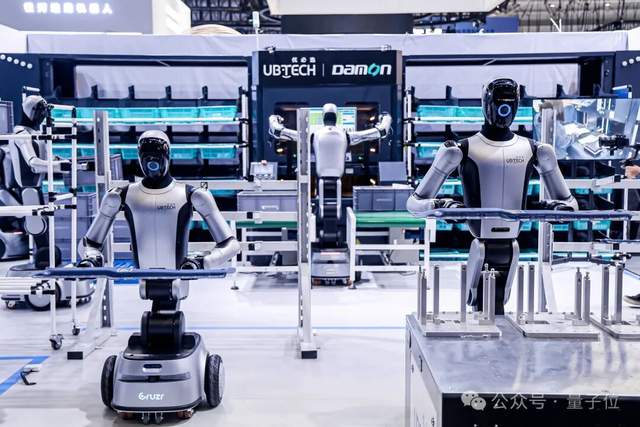
Representative image for 不是Demo!优必选把客户产线1:1搬进WRC,解锁具身智能真落地路径

不是Demo!优必选把客户产线1:1搬进WRC,解锁具身智能真落地路径

Rank 61 · Content 65 · Popularity N/A

TL;DR - UBTech showcased humanoid robots performing continuous, autonomous industrial tasks on production-line replicas at WRC, emphasizing reliability and real-world deployment over staged demos. Its strategy combines on-device embodied models, scenario-specific hardware, and a data flywheel built largely from physical robot operations.

  • Cruzr S2 and Y1 robots handled loading, palletizing, and mixed-item sorting without human intervention; reported performance included sub-millimeter positioning and nearly 1,100 picks per hour.
  • The “embodied brain” comprises the Thinker foundation model for perception, Thinker-WM for outcome prediction, and Thinker-VLA for control and autonomous recovery from failures.
  • Edge optimization reportedly improved Thinker-VLA inference efficiency by 176%, reduced storage use by 60%, and lowered full-module GPU memory requirements from 64 GB to 32 GB.
  • UBTech says real-robot interactions provide 60–70% of its training data, supporting a deployment-to-data-to-model-improvement loop as industrial installations scale.
Representative image for 浙江人形携 NAVIAI 亮相 2026 世界机器人大会, 一脑多机方案落地多场景

浙江人形携 NAVIAI 亮相 2026 世界机器人大会, 一脑多机方案落地多场景

Rank 54 · Content 55 · Popularity N/A

TL;DR - Zhejiang Humanoid Robotics Innovation Center showcased its NAVIAI robot lineup at WRC 2026, demonstrating a shared intelligence and hardware platform across industrial, retail, household, and data-collection scenarios. The exhibits suggest a shift from isolated robot demos toward reusable, multi-robot systems deployed in practical workflows.

  • Its SPIRE framework combines world models for environmental understanding and state prediction with embodied models for action adaptation and execution.
  • Three NAVIAI wheeled-arm robots coordinated an end-to-end assembly workflow covering depalletizing, sorting, transport, and assembly, with a claimed operational precision of 0.03 mm.
  • Retail and household demonstrations included 40-second drink-order fulfillment, product recognition reportedly above 98%, and autonomous cooking and cleanup workflows.
  • Teleoperation with data gloves captured synchronized visual, force, and tactile data, creating a feedback loop for improving robot capabilities during real-world operation.
Representative image for 伽利略全新Galileo X亮相WRC:锚定 “全域移动”,重构陆行具身移动行业逻辑

伽利略全新Galileo X亮相WRC:锚定 “全域移动”,重构陆行具身移动行业逻辑

Rank 54 · Content 55 · Popularity N/A

TL;DR - Galileo unveiled Galileo X at WRC 2026, positioning it as a unified ground-robot platform that combines AGV precision, long-range wheeled mobility, and legged obstacle traversal. The company aims to replace fleets of specialized robots with one adaptable base for industrial, energy, emergency-response, and public-safety applications.

  • Its multimodal architecture jointly integrates mechanical structure, powertrain, perception, and motion control rather than attaching separate wheel and leg modules.
  • A variable-configuration platform, active suspension, and 360-degree rotating joints enable transitions among indoor transport, outdoor travel, and rough-terrain traversal.
  • Galileo says one unit could reduce hardware, coordination, maintenance, and deployment complexity in mixed-environment workflows.
  • The product remains headed for further engineering iteration and mass production; the article provides no independent benchmarks or deployment results.
Representative image for 智身科技亮相2026世界机器人大会,定义"真正干活的机器人"

智身科技亮相2026世界机器人大会,定义"真正干活的机器人"

Rank 54 · Content 55 · Popularity N/A

TL;DR - At WRC 2026, Zhishen Technology showcased a full-stack robotics portfolio spanning actuators, humanoid and quadruped platforms, manipulation, simulation, motion control, and autonomous decision-making. The company emphasized deployment-ready robots for hazardous, repetitive, and labor-intensive work, backed by more than 15,000 units produced.

  • Its data-driven ZSD navigation model replaces fixed-route SLAM workflows with end-to-end autonomous navigation and ongoing model improvement from deployed-fleet data.
  • A perception-integrated locomotion model enables wheeled quadrupeds to identify footholds and coordinate wheel-leg movements before contact, including autonomous traversal of open-riser stairs.
  • Demonstrated hardware included a 1,010-gram actuator producing 220 Nm peak torque and the L2 quadruped supporting a 7:1 load-to-weight ratio, IP66 protection, and up to 5.5 hours of operation.
  • Robots are already deployed across security, emergency response, power inspection, disinfection, and accessibility scenarios; reported production exceeds 15,000 robots with monthly capacity above 5,000 units.

Industrial Embodied AI 1

Representative image for 工业具身智能的 "最后一公里",为什么是埃夫特&启智在走?

工业具身智能的 "最后一公里",为什么是埃夫特&启智在走?

Rank 61 · Content 65 · Popularity N/A

TL;DR - Chinese industrial robot maker EFORT and its spinout Qizhi are commercializing embodied AI through a shared software/model platform, real-factory data collection, and hybrid model-rule control. The approach targets flexible manufacturing tasks that conventional preprogrammed robots cannot economically handle.

  • Qizhi’s stack includes Openmind OS, Modou IDE, a data platform, the HumanGPT world model, and HALO wearable equipment for collecting multimodal demonstrations in real factories.
  • Its control architecture uses models for perception, planning, and decision-making while retaining deterministic algorithms and physical rules for collision avoidance, precision, and reliability.
  • Deployed applications include mobile manipulation for assembly and parts sorting, adaptive welding, vision-guided spray painting, and explosion-proof robots.
  • Reported outcomes include reducing welding setup from 72 hours to 4 hours and putting a line-side sorting system into production, though many performance claims are company-reported.

Speech Recognition 1

Measuring benchmark optimization in speech recognition

Rank 43 · Content 40 · Popularity N/A

TL;DR - Hugging Face presents material on measuring benchmark optimization in automatic speech recognition. Because only the title is provided, the specific methodology, benchmarks, and results cannot be determined.

  • Focuses on evaluating optimization effects in speech-recognition benchmarks.
  • Likely concerns whether improvements reflect broader model progress or benchmark-specific tuning, though the supplied metadata does not confirm the analysis.
  • No quantitative findings, datasets, or model comparisons are available in the provided content.

Wearable AI 1

Representative image for 莎士比亚智能戒指入场,智能珠宝能跑通吗?

莎士比亚智能戒指入场,智能珠宝能跑通吗?

Rank 40 · Content 35 · Popularity N/A

TL;DR - Shakespeare Intelligence launched a jewelry-first smart ring that combines health sensors with AI-generated emotional interpretations for urban women. Its differentiation from Oura, RingConn, and Samsung is notable, but sensor accuracy, algorithm validation, retention, and category adoption remain unproven.

  • The S925 silver and lab-grown diamond ring costs RMB 1,499–2,399 and targets women aged 20–40.
  • Its APOLLO3-based hardware monitors sleep, heart rate, blood oxygen, HRV, temperature, and menstrual cycles.
  • The LUMENX engine and “Xiao Sha” assistant translate biometric data into Shakespeare-styled mood insights, conversations, and emotional cards.
  • The product relies on supply-chain partners and Alibaba AIGC capabilities; Honor-affiliated platforms are strategic ecosystem partners and investors.