一篇论文改写AI科研评价规则!中国公司拿出实践数据,双榜第一
Ranking
Observed public metrics from 1 member.
Merged summary
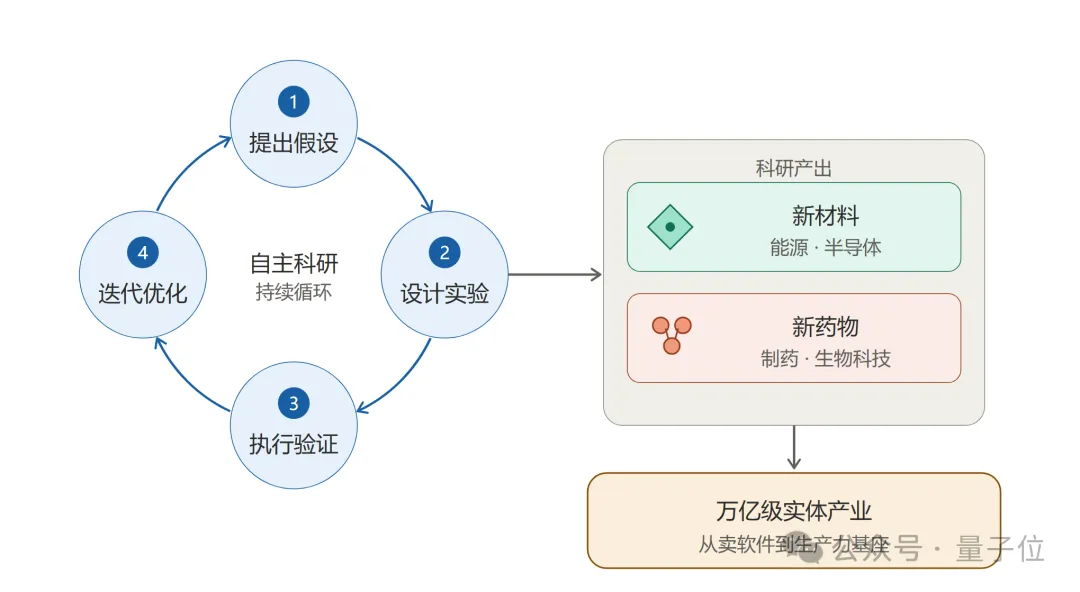
TL;DR — “Discovery Episode”框架将AI科研能力的评价从封闭式问答扩展到完整研究周期,综合考察假设提出、实验执行、结果解释、失败处理及成果创新性。Deep Principle的MIRA平台以多智能体、计算基础设施和自动化实验室组成闭环系统,并在两项科研智能体榜单中排名第一。
- 该框架记录科研流程中的每项关键决策,同时评估实验严谨性、可复现性、失败过程以及发现是否真正新颖。
- MIRA通过协作智能体连接高性能计算与自动化湿实验平台,实现从研究构思、实验执行到结果分析的闭环。
- 系统使用可复用的研究记忆积累实验经验,为后续任务和持续探索提供支持。
- MIRA在Research Claw Benchmark与Science Agent Arena上均位列第一;在后者取得81.1%的成绩,同时保持最低的平均任务成本。
- Deep Principle称,该平台已用于电池、工业冷却液和新能源材料等内部研发流程。
注: 量子位聚焦该论文及MIRA实践数据;其余来源分别讨论燧原科技IPO、个性化mRNA癌症疗法和阿里云业绩,与这项工作并非同一主题,因此未合并为技术事实。
Sources (4)
刚刚,人类历史上第一次用AI治愈癌症
TL;DR - Moderna and Merck report that their personalized mRNA cancer therapy, intismeran autogene plus Keytruda, met recurrence-free and distant-metastasis-free survival endpoints in a Phase III trial for high-risk melanoma. The result could mark a major clinical milestone for individualized neoantigen therapies, though the article’s claim that AI “cured cancer” overstates the reported findings.
- The global randomized, double-blind trial enrolled 1,137 patients with surgically resected stage IIB–IV melanoma and compared the combination therapy with Keytruda alone.
- The workflow sequences each patient’s tumor and healthy tissue, selects up to 34 tumor-specific neoantigens computationally, and encodes them in a personalized mRNA vaccine.
- The vaccine trains T cells to recognize tumor mutations, while Keytruda removes PD-1-mediated immune inhibition; no new unexpected safety signals were reported.
- Moderna and Merck plan regulatory discussions and are testing the platform in additional solid tumors, including lung, pancreatic, breast, bladder, and kidney cancers.
看完阿里财报才发现,AI烧越猛,越「养肥」卖铲人
TL;DR - Alibaba Cloud reported 45% year-over-year revenue growth and a 133% increase in adjusted EBITA, suggesting that AI’s clearest near-term monetization is accruing to cloud infrastructure and chip providers. Continued compute shortages, rising MaaS usage, and Alibaba’s vertically integrated stack could sustain growth and improve margins.
- AI training and inference demand drove Alibaba Cloud quarterly revenue to RMB 48.737 billion; Alibaba expects growth to accelerate over the next several quarters.
- Adjusted EBITA margin reached 11.6%, supported by expanding MaaS revenue, infrastructure optimization, and greater use of in-house chips.
- Alibaba says its chip, networking, storage, and scheduling optimizations improved model-output throughput by 2.5%–5.6% without adding hardware.
- Its new T-Head Zhenwu M890-based supernode instances were serving more than 650 customers, strengthening Alibaba’s full-stack position across chips, cloud, models, and applications.
一篇论文改写AI科研评价规则!中国公司拿出实践数据,双榜第一
TL;DR - A new “discovery episode” framework evaluates AI scientists on complete research cycles rather than closed-book answers, scoring hypothesis formation, experiment execution, and result interpretation. Deep Principle’s MIRA platform illustrates the approach with an agentic system connected to computation and automated laboratories.
- The framework records and assesses each decision across the scientific workflow, including failures, rigor, reproducibility, and whether findings are genuinely novel.
- MIRA uses collaborating agents, high-performance computing and automated wet-lab execution, plus reusable research memory to support closed-loop experimentation.
- The article reports that MIRA ranked first on Research Claw Benchmark and Science Agent Arena, scoring 81.1% on the latter while also achieving the lowest average task cost.
- Deep Principle says it is applying the platform to internal R&D pipelines in batteries, industrial coolants, and new-energy materials.
燧原科技启动科创板发行,全栈技术体系支撑AI芯片商业化落地
TL;DR - Chinese cloud AI chipmaker Enflame has begun its Shanghai STAR Market IPO process, seeking RMB 6 billion to fund fifth- and sixth-generation chips and hardware-software co-design. Its expanding product stack and reported commercial deployments signal growing demand for domestic AI training and inference infrastructure.
- Enflame has developed four architecture generations and five cloud AI chips, spanning accelerators, modules, computing systems, clusters, and programming software.
- Its proprietary stack includes GCU-CARE compute units, GCU-LARE chip interconnects, and the TopsRider software platform for model development and migration.
- The company reports revenue-generating deployments of thousand- and ten-thousand-accelerator computing centers, alongside work on supernode and high-speed interconnect designs.
- IPO proceeds are designated for next-generation chip commercialization and advanced AI hardware-software co-innovation.