BIMSA 王雅晴:Scaling Law 触及天花板,「数据高效学习」指向 AI 的下一站|IJCAI 2026
Ranking
No observed public metrics; popularity remains neutral/archived.
Merged summary
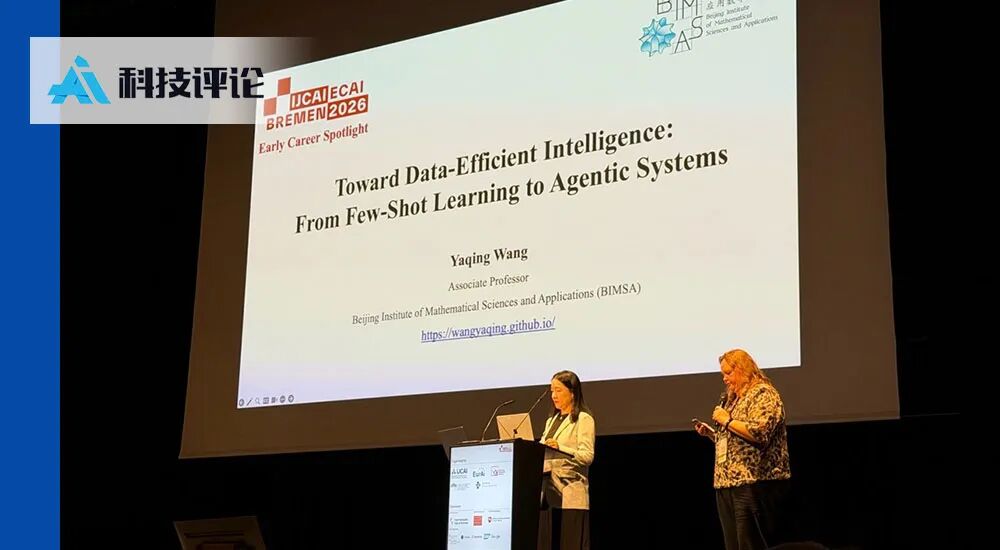
TL;DR - An IJCAI 2026 spotlight profiles Wang Yaqing’s vision for data-efficient intelligence, extending few-shot and meta-learning principles to agents that must learn from scarce, costly interactions. The proposed DEAL framework aims to move AI beyond brute-force scaling by using structured priors and limited experience more effectively.
- Wang’s work characterizes in-context learning as data-dependent meta-learning: Transformers can implicitly implement gradient-, metric-, and amortization-based adaptation during forward passes.
- DEAL addresses agents’ “data bottleneck” through experience augmentation, structured agent architectures, and budget-efficient combinations of in-context optimization, few-shot fine-tuning, and reinforcement learning.
- Structured priors—such as physical laws, mathematical rules, pretrained knowledge, and human behavior patterns—can constrain learning and improve generalization when supervision is scarce.
- Target applications include drug discovery, scientific modeling, cold-start recommendation, personalized agents, and robotics, where large labeled datasets or interaction histories are inherently unavailable.
Sources (1)
BIMSA 王雅晴:Scaling Law 触及天花板,「数据高效学习」指向 AI 的下一站|IJCAI 2026
TL;DR - An IJCAI 2026 spotlight profiles Wang Yaqing’s vision for data-efficient intelligence, extending few-shot and meta-learning principles to agents that must learn from scarce, costly interactions. The proposed DEAL framework aims to move AI beyond brute-force scaling by using structured priors and limited experience more effectively.
- Wang’s work characterizes in-context learning as data-dependent meta-learning: Transformers can implicitly implement gradient-, metric-, and amortization-based adaptation during forward passes.
- DEAL addresses agents’ “data bottleneck” through experience augmentation, structured agent architectures, and budget-efficient combinations of in-context optimization, few-shot fine-tuning, and reinforcement learning.
- Structured priors—such as physical laws, mathematical rules, pretrained knowledge, and human behavior patterns—can constrain learning and improve generalization when supervision is scarce.
- Target applications include drug discovery, scientific modeling, cold-start recommendation, personalized agents, and robotics, where large labeled datasets or interaction histories are inherently unavailable.