🛰️ Daily AI Frontier
43 works · 3 categories · 14 topics · blog 12 journal 5 arxiv 15 wechat 11 generated 2026-08-25 14:21:57 UTC
Top highlights — Research

LLM Agents 5

Representative image for AutoSaddler: Automatic Harness Optimization with Durable Updates from Agent Execution Traces

AutoSaddler: Automatic Harness Optimization with Durable Updates from Agent Execution Traces

Rank 86 · Content 95 · Popularity 66

TL;DR - AutoSaddler is an offline-learning framework that automatically improves LLM-agent harnesses using failure traces, structured patches, and validation-based update selection. It raises performance by 9.0–10.0 percentage points across three long-horizon agent benchmarks.

  • Diagnoses failures from execution traces and treats harness modifications as structured code patches.
  • Iteratively learns from mini-batches of failures rather than relying on manual prompt, tool, and control-logic tuning.
  • Improves base harnesses by 9.0 points on GAIA2, 9.6 on SWE-Bench Pro, and 10.0 on Terminal-Bench 2.0.
  • Ablations favor deep debugging, targeted edits, and generalization-aware validation over shallow reflection or trajectory-specific repairs.

Representative image for Apodex 1.1: Scaling Agentic Intelligence for Complex Work

Apodex 1.1: Scaling Agentic Intelligence for Complex Work

Rank 84 · Content 90 · Popularity 70

TL;DR - Apodex 1.1 targets sustained, verifiable completion of complex work by scaling both executable environments and coordination among agents. It reports leading-band performance across several professional and technical domains despite using a smaller model than many frontier systems.

  • Environment Scaling broadens executable file, search, and coding environments while emphasizing outcome verification.
  • Agentic Coordination Scaling trains long-horizon decomposition, parallel delegation, asynchronous result integration, and replanning.
  • A shared execution harness and AgentOS preserve task state and provenance across tools and agents.
  • The locally deployable 35B-parameter Apodex 1.1 Mini retains strong working capability.
Representative image for MobilePA-Bench: Benchmarking Mobile Planner Agents on Complex Real-World Tasks

MobilePA-Bench: Benchmarking Mobile Planner Agents on Complex Real-World Tasks

Rank 79 · Content 85 · Popularity 64

TL;DR - MobilePA-Bench is an interactive benchmark for evaluating mobile LLM agents on realistic, stateful planning and tool-calling tasks. It exposes substantial reliability gaps in frontier models under practical constraints such as permissions, strict action ordering, and runtime failures.

  • Provides an executable sandbox with live application databases, structured feedback, 13 functional domains, and 212 mobile tools.
  • Evaluates sub-agent collaboration, use of stored memories and user preferences, and invocation of pre-packaged composite skills.
  • Bridges GUI-centric benchmarks and static API-matching tests by exercising tools under real runtime constraints.
  • Uses evidence-based verification and can also serve as an interactive environment for agentic reinforcement learning.

Right-Sizing LLM-Agent Decomposition in VAT Determination: A Pilot Controlled Sweep

Rank 78 · Content 95 · Popularity 37

TL;DR - A controlled 4,400-run pilot tests how finely LLM-agent workflows should be decomposed for cross-border VAT determination. Intermediate decompositions achieved the highest accuracy, but the preregistered evidence threshold was not met, leaving their advantage unconfirmed at pilot scale.

  • Intermediate configurations reached 0.830 accuracy, versus 0.720 and 0.770 for the widest and most fragmented endpoints.
  • A token-matched single agent trailed the leader by 6.5 percentage points, but the confidence interval included zero, so prompt budget may explain the difference.
  • All configurations tolerated availability faults, while a schema-valid hallucinated record degraded every setup and harmed fragmented configurations most.
  • The authors release the oracle, dataset, evaluation harness, raw traces, and analysis pipeline alongside a heuristic that partitions work near the dependency-layer midpoint.
Representative image for Signal or Noise? A Benchmark Study of Agent Skills in Web Development

Signal or Noise? A Benchmark Study of Agent Skills in Web Development

Rank 78 · Content 95 · Popularity 37

TL;DR - WebDev-Skills-Bench evaluates reusable coding-agent skills across 50 web projects and finds that injecting matched skills often hurts performance while sharply increasing token costs. The results suggest skill injection should be routed and audited for each skill-project-model combination rather than treated as universally beneficial.

  • Across four models, target-skill injection reduced mean Pass@2 by 1.3%–4.2% and increased token costs by 72%–394%.
  • Skills improved results in only 17%–36% of skill-project pairs, with weak ranking transfer between models.
  • Length-matched irrelevant controls distinguished prompt-length distraction from cases where skill content itself misled the model.
  • Helpful skills favored anti-pattern rules over example-heavy content, while losses were concentrated on easier, earlier tasks.

Medical/Healthcare AI 5

Representative image for 通用模型竟然比医疗专用模型更懂医疗?一篇 ACL 论文的两个反直觉发现 | GAIR Paper 123

通用模型竟然比医疗专用模型更懂医疗?一篇 ACL 论文的两个反直觉发现 | GAIR Paper 123

Rank 82 · Content 95 · Popularity N/A

TL;DR - MedErrBench is the first multilingual benchmark for detecting, locating, and correcting medical errors across native English, Chinese, and Arabic data. Its ACL 2026 Findings results challenge assumptions that medical-specialized models or English-language inputs necessarily perform best.

  • The benchmark covers 10 clinical error types and evaluates models on error detection, localization, and correction, with clinician-reviewed annotations for key terms, difficulty, and reasoning type.
  • General-purpose models outperformed medical-specialized models such as MedGemma and HuatuoGPT; Doubao-1.5-Thinking-Pro led the English evaluation with 0.779 detection and 0.774 localization accuracy.
  • Doubao and DeepSeek generally surpassed the tested GPT-4o and Gemini versions across the three languages, suggesting broad reasoning and instruction-following capabilities are critical alongside medical knowledge.
  • Models performed better on native Chinese data than translated variants, indicating that translation can lose clinically important context; the benchmark still lacks error-severity labels and has limited Arabic data.

From Multimodal Observation to Interpretable Suggestions: Counterfactual Time-Expanded Relational Modeling of Surgical Teams

Rank 78 · Content 95 · Popularity 37

TL;DR - This paper introduces a multimodal, time-expanded relational framework for modeling surgical team dynamics and generating interpretable suggestions for better teamwork. It matters because surgical AI typically emphasizes technical execution rather than the behavioral interactions that also affect patient safety.

  • Represents evolving team behaviors and relationships with time-expanded graphs.
  • Targets low-data surgical settings while retaining strong relational and temporal expressivity.
  • Uses counterfactual analysis to identify minimal, structured behavioral or interaction changes associated with improved team performance.
  • Experiments on simulated procedures show improved prediction across multiple behavioral and interaction goals while yielding insights into team dynamics.

Future Querying: Can LLMs Serve as Implicit Medical World Models?

Rank 78 · Content 95 · Popularity 37

TL;DR - This paper introduces “future querying,” which tests whether LLMs can act as implicit medical world models by answering time-indexed questions about patient trajectories from unstructured clinical notes. It could support flexible, privacy-preserving clinical prediction without separate pipelines for every endpoint.

  • Uses endpoint-agnostic training so one model can answer diverse future-oriented clinical queries without manual feature engineering or task-specific retraining.
  • Evaluates the approach on synthetic medical reports and real ICU notes from MIMIC-IV.
  • Finds that small, locally fine-tuned open-weight models can match or approach larger proprietary systems.
  • Results suggest LLMs can capture aspects of clinical dynamics while remaining suitable for on-premise deployment.
Representative image for Conformal Risk Minimization for Semi-Supervised Domain Adaptation via Optimal Transport

Conformal Risk Minimization for Semi-Supervised Domain Adaptation via Optimal Transport

Rank 78 · Content 95 · Popularity 37

TL;DR - This paper integrates conformal risk minimization into semi-supervised domain adaptation, using optimal-transport pseudolabels to compensate for scarce labeled target-domain data. The approach aims to produce clinically useful prediction sets that remain coverage-valid and compact under patient-population shifts.

  • Jointly optimizes domain invariance, predictive performance, and conformal-set efficiency rather than applying conformal prediction post hoc.
  • Uses optimal transport to pseudolabel unlabeled target examples, supplying the training signal needed to estimate nonconformity thresholds with few target labels.
  • Targets compact, distribution-free prediction sets while preserving formal coverage guarantees.
  • Supports domain-specific constraints, such as excluding mutually contradictory diagnoses in skin-lesion classification.

Improving O-RADS Risk Stratification from Ultrasound Reports: A Comparative Evaluation of Hybrid versus End-to-End LLM Reasoning Strategies

Rank 78 · Content 95 · Popularity 37

TL;DR - A retrospective study found that a hybrid architecture—using an LLM to extract ultrasound features and deterministic rules to assign O-RADS categories—outperformed end-to-end LLM reasoning and original clinical reports. The approach matters because it improved accuracy while making guideline-based decisions more reliable and interpretable.

  • Eight LLMs and three reasoning strategies were evaluated on 390 ovarian masses from 310 patients.
  • Gemini 3.6 Flash with the hybrid strategy achieved 99.2% accuracy and a weighted kappa of 1.00 against expert consensus.
  • End-to-end strategies achieved 65.6%–95.9% accuracy, while original clinical reports achieved 87.7%.
  • Separating feature extraction from rule execution reduced classification errors and mitigated overstaging.

LLMs & Foundation Models 1

Representative image for A Physical Response-and-Memory Model for Muon Optimization

A Physical Response-and-Memory Model for Muon Optimization

Rank 78 · Content 95 · Popularity 37

TL;DR - This paper models Muon optimization as a physical medium with memory, interpreting semi-orthogonalized updates as maximally dissipative responses under a safety constraint. It derives a two-timescale Bi-Maxwell optimizer that reaches a target loss in fewer steps on a public LLM training benchmark.

  • The model explains momentum as accumulated internal stress and its averaging window as a stress-relaxation timescale.
  • Because real media can relax at multiple rates, Bi-Maxwell replaces Muon’s single-timescale memory kernel with fast and slow components.
  • Measurements across eight independent training runs support the prediction that optimal memory length should increase as gradient directions change more slowly later in training.
  • Changing only the memory kernel to the two-timescale form reduced the steps needed to reach the benchmark’s target loss.

Multimodal & Generative 5

Representative image for EchoWM: Open and Enterable Omnimodal World Models

EchoWM: Open and Enterable Omnimodal World Models

Rank 87 · Content 95 · Popularity 68

TL;DR - EchoWM is an omnimodal world model that turns continuous navigation inputs into interactive 720p video with synchronized environmental sound, music, and speech. It advances “enterable” generative media by supporting controlled, long-horizon first- and third-person experiences.

  • Unifies discrete commands and continuous camera poses as metric-scale relative 6-DoF trajectories.
  • Uses dataset-level calibration to preserve motion magnitude across heterogeneous training data.
  • Combines a complementary data engine, progressive training, and autoregressive post-training for audiovisual control and long-horizon generation.
  • Evaluations report strong trajectory following and visual quality, with synchronized sound and speech across varied scenes.
Representative image for ReWorld: An Interactive World Model with Long-Horizon Memory

ReWorld: An Interactive World Model with Long-Horizon Memory

Rank 85 · Content 95 · Popularity 61

TL;DR - ReWorld is an interactive video world model that combines real-time control with long-horizon visual memory under a fixed inference budget. It can stream 704×1280 worlds while recalling and regenerating previously visited views during minute-long rollouts.

  • Mixed local/global attention heads and randomized routing balance short-term action following with full-history learning.
  • A bounded KV cache and pose-indexed landmark bank retrieve memories near the current camera pose without retaining full-history attention.
  • Metric-aligned multi-source training and palindrome trajectories teach consistent physical controls and revisitation memory.
  • LoRA-based distillation reduces generation to four sampling steps, while evaluations report leading control fidelity and video quality against six recent models.
Representative image for From Generation to Simulation: How Far Are World Models from Being True Simulators?

From Generation to Simulation: How Far Are World Models from Being True Simulators?

Rank 80 · Content 90 · Popularity 57

TL;DR - This survey evaluates whether generative world models can replace traditional simulators by mapping 200 works across eight core simulation capabilities. Current models can support interaction and controllability in specific settings, but still lack reliable physics, structured state feedback, and reproducible long-horizon behavior.

  • Compares three technical routes: latent dynamics, video generation, and joint-embedding prediction.
  • Uses traditional simulators as an external benchmark across asset construction, physics, interaction, controllability, stability, state feedback, diversity, and evaluation.
  • State feedback is the largest cross-route gap: only 6 of 163 implementation papers provide runtime access to entity states or physical parameters.
  • Priorities include formalized physics, unified action interfaces, first-class state feedback, long-horizon stability, utility-based evaluation, and hybrid approaches.

Thinking Beyond Videos: Unifying Video Reasoning and Deep Research for Open-World Video Agents

Rank 79 · Content 95 · Popularity 42

TL;DR - VideoRover is an open-world video agent that coordinates targeted video inspection, multimodal search, and web browsing to answer questions requiring both sparse visual evidence and external knowledge. Its unified approach shows that active grounding, retrieval, and long-horizon reinforcement learning provide complementary gains.

  • Iteratively chooses among video cropping, multimodal search, and webpage browsing based on prior tool results.
  • Uses an automated curation pipeline yielding 26K verified supervised fine-tuning trajectories and 3K challenging reinforcement-learning instances.
  • Introduces VideoRover-Bench, stratified by video duration and research difficulty.
  • VideoRover-8B-RL matches proprietary models in direct answering without tools and outperforms larger open-source models given the same tool suite on the evaluated benchmarks.

EviSafe: Evidence-Grounded Safety Evaluation for Vision-Language Models

Rank 79 · Content 95 · Popularity 42

TL;DR - EviSafe is an evidence-grounded framework and benchmark that tests whether vision-language models make safe decisions based on the correct textual and visual evidence. Results across 11 VLMs reveal large gaps between apparently safe responses and genuinely grounded safety reasoning.

  • EviSafeBench contains 1,181 gold image-text scenarios and 2,452 targeted counterfactual variants spanning eight safety domains and eight risk-source types.
  • Its three-probe protocol evaluates natural responses, evidence reporting, and reactions to counterfactual changes in safety-critical evidence.
  • Natural severity accuracy ranged from 27.6% to 52.8%, while relaxed diagnostic consistency reached only 6.1% to 29.3%.
  • Unsafe-to-safe counterfactual transition success ranged from 30.4% to 58.4%, motivating evaluation beyond refusal rates alone.
Top highlights — Industry & News

LLM Agents 6

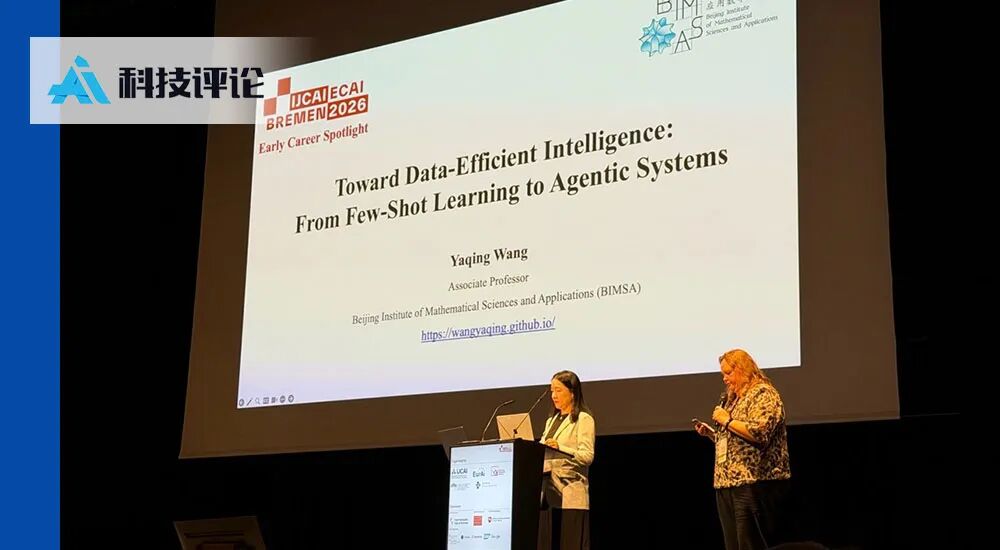
Representative image for BIMSA 王雅晴:Scaling Law 触及天花板,「数据高效学习」指向 AI 的下一站|IJCAI 2026

BIMSA 王雅晴:Scaling Law 触及天花板,「数据高效学习」指向 AI 的下一站|IJCAI 2026

Rank 75 · Content 85 · Popularity N/A

TL;DR - An IJCAI 2026 spotlight profiles Wang Yaqing’s vision for data-efficient intelligence, extending few-shot and meta-learning principles to agents that must learn from scarce, costly interactions. The proposed DEAL framework aims to move AI beyond brute-force scaling by using structured priors and limited experience more effectively.

  • Wang’s work characterizes in-context learning as data-dependent meta-learning: Transformers can implicitly implement gradient-, metric-, and amortization-based adaptation during forward passes.
  • DEAL addresses agents’ “data bottleneck” through experience augmentation, structured agent architectures, and budget-efficient combinations of in-context optimization, few-shot fine-tuning, and reinforcement learning.
  • Structured priors—such as physical laws, mathematical rules, pretrained knowledge, and human behavior patterns—can constrain learning and improve generalization when supervision is scarce.
  • Target applications include drug discovery, scientific modeling, cold-start recommendation, personalized agents, and robotics, where large labeled datasets or interaction histories are inherently unavailable.
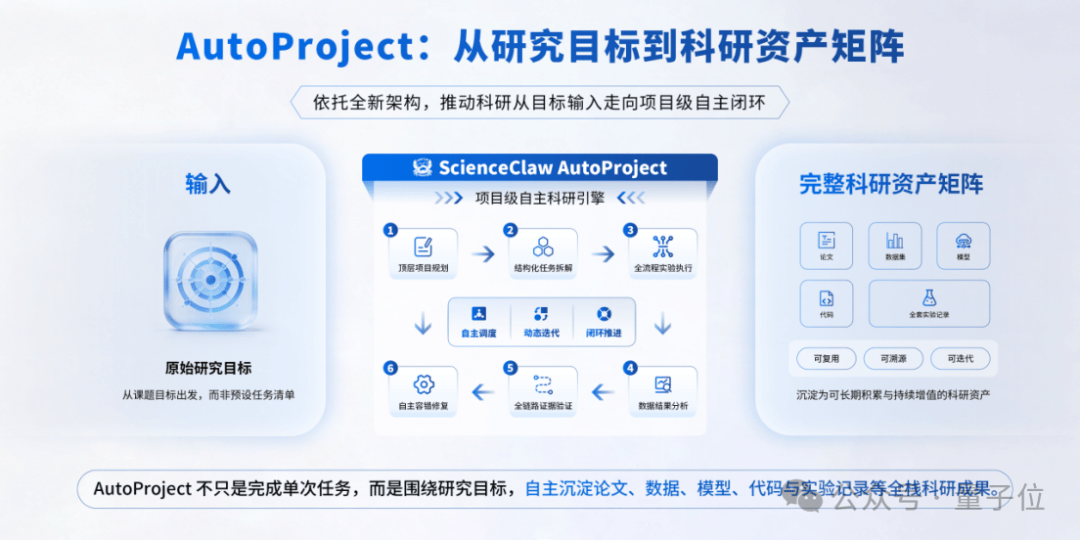
Representative image for AI4S开始进入「项目时代」:紫东太初把AI从做Task推向做Project

AI4S开始进入「项目时代」:紫东太初把AI从做Task推向做Project

Rank 68 · Content 75 · Popularity 50

TL;DR - Zidi Taichu upgraded its ScienceClaw research agent with AutoProject, an engine designed to plan, execute, validate, and revise entire AI-for-science projects rather than isolated tasks. The release signals a shift toward long-running, human-supervised agent systems that manage complete research workflows.

  • AutoProject combines Project2Task for dependency-aware project planning, TaskExecutor for iterative long-horizon execution, and EviGraph for evidence-based validation and repair.
  • The system can decompose broad research goals, coordinate specialized agents and tools, respond to failed or anomalous experiments, and consolidate outputs into reusable data, code, models, and reports.
  • On ARCBenchML, EviGraph reportedly scored 0.865 versus a 0.596 best baseline, while improving result-analysis accuracy from 0.442 to 0.794.
  • Researchers remain able to inspect and redirect plans, hypotheses, and intermediate results; the product is positioned as autonomous project execution with human oversight, not fully unattended science.

Wire It, Run It, Deploy It: AI Workflows in Gradio

Rank 64 · Content 70 · Popularity N/A

TL;DR - Hugging Face presents a guide to building, running, and deploying AI workflows with Gradio. Because only the title and metadata are provided, specific features and implementation details cannot be confirmed.

  • Focuses on connecting AI workflow components through Gradio.
  • Covers the workflow lifecycle from construction to execution and deployment.
  • Positions Gradio as an interface and delivery layer for operational AI applications.
Representative image for 赛博义父Tibo最新访谈:专门实体按钮搞重置,“我想重置就重置”

赛博义父Tibo最新访谈:专门实体按钮搞重置,“我想重置就重置”

Rank 61 · Content 65 · Popularity N/A

TL;DR - OpenAI Codex lead Thibault Sottiaux outlined a future in which Codex and ChatGPT merge into one personalized, multimodal agent backed by cloud-scale compute. The shift could replace today’s manually managed skills, memory, and agent swarms with faster, context-aware interaction and automated workflows.

  • Future agents are expected to continuously understand users, teams, goals, and routines rather than requiring explicit skill files, memory management, or sub-agent orchestration.
  • Laptop resources may become the limiting factor as models operate many applications concurrently, pushing advanced agents toward cloud infrastructure.
  • OpenAI’s proposed “Ultra Fast” mode could favor real-time, voice-driven collaboration over running 10–15 slow agents in parallel and repeatedly switching context.
  • OpenAI is using strong models to optimize CUDA kernels, inference systems, and infrastructure, creating a recursive efficiency-and-capability improvement loop.
Representative image for Codex「额度黑洞」终于查清!真凶竟是这个小功能

Codex「额度黑洞」终于查清!真凶竟是这个小功能

Rank 50 · Content 50 · Popularity N/A

TL;DR - OpenAI traced unexpectedly rapid Codex quota consumption to three bugs involving conversation title generation, context compaction, and Computer History. It reset quotas for all paid subscribers, highlighting how seemingly minor background agent features can impose substantial hidden inference costs.

  • Automatic conversation-title generation consumed far more quota than intended despite running invisibly in the background.
  • Repeated compaction of long, image-heavy conversations caused additional compute waste.
  • Heavy use of Computer History, which imports selected Mac app and web activity into ChatGPT and Codex, also drove unexpectedly high usage.
  • OpenAI acknowledged the bugs and granted a full quota reset to all paid subscribers.
Representative image for 刚刚,奥特曼炮轰达里奥「反人类」!绝密模型同日曝光

刚刚,奥特曼炮轰达里奥「反人类」!绝密模型同日曝光

Rank 40 · Content 35 · Popularity N/A

TL;DR - Leaked GitHub and community references reportedly point to experimental OpenAI and Anthropic models, while Sam Altman argues that social inertia will slow AI disruption and criticizes fear-based, centralized approaches to AI governance. The model identities and capabilities remain speculative because neither company has officially detailed them.

  • OpenAI codenames gpt-mewfour and gpt-nathree appeared alongside Codex activity, prompting speculation that they are checkpoints for a next-generation agent model.
  • The rumored OpenAI system, dubbed “Astra” by observers, is described as targeting multi-agent coordination and long-horizon scientific or mathematical workflows, but architecture and performance details are unconfirmed.
  • Anthropic codenames claude-marshmallow-eap and claude-melon-eap surfaced through third-party channels and may represent incremental Claude updates rather than new flagship models.
  • Altman said AI adoption is lagging technical progress because of social and economic inertia, while warning that concentrated control of AI is itself a major risk.

Medical/Healthcare AI 1

Representative image for 小狗Rosie走了三个月后,她的病历变成了一家AI医疗公司

小狗Rosie走了三个月后,她的病历变成了一家AI医疗公司

Rank 57 · Content 60 · Popularity N/A

TL;DR - AI-assisted veterinary oncology startup Gamgee raised a $4 million seed round to industrialize personalized mRNA cancer vaccines for dogs, building on an experimental treatment created for founder Paul Conyngham’s dog Rosie. The funding will support a clinical trial, as the approach’s efficacy remains unproven beyond the individual case.

  • The workflow sequences tumor and healthy tissue, identifies tumor-specific mutations and neoantigens, and designs a personalized mRNA vaccine for each dog.
  • Rosie’s design reportedly used tools including ChatGPT, AlphaFold, and Grok, but university researchers reviewed the data and manufactured the vaccine.
  • Gamgee aims to shorten and coordinate the full treatment pipeline—from veterinary intake and sequencing through production, dosing, and follow-up—not merely the AI design stage.
  • Australian clinical studies will determine whether the N-of-1 approach produces evidence acceptable to veterinarians and regulators; Rosie’s temporary remission alone is not sufficient proof.

Multimodal & Generative 3

Representative image for 李飞飞押注的空间智能:生成的世界,如何「经得起折腾」?

李飞飞押注的空间智能:生成的世界,如何「经得起折腾」?

Rank 71 · Content 80 · Popularity N/A

TL;DR - The article argues that useful AI-generated 3D worlds require a persistent, verifiable state layer—not just strong rendering—to remain coherent through actions and edits. This state-centric architecture could turn spatial generation from impressive demos into reliable systems that simulate, plan, validate, learn, and roll back changes.

  • A robust world model links a Renderer, Simulator, and Planner through shared records of object identity, geometry, relationships, constraints, runtime state, and version history.
  • Current visual and programmatic approaches struggle with slow time-to-first-valid-result and broken global consistency after local edits, often forcing costly full-scene regeneration.
  • The proposed closed loop records state–goal–action–new-state–verification trajectories, enabling incremental recomputation, failure diagnosis, rollback, and recursive improvement from user interactions.
  • Validation must extend beyond visual quality to geometry, physics, path feasibility, long-horizon state consistency, and successful task completion.
Representative image for 开源国产8B模型,比肩闭源Image 2了!

开源国产8B模型,比肩闭源Image 2了!

Rank 68 · Content 75 · Popularity N/A

TL;DR - SenseTime has released the open-source SenseNova U1.5 Lite, an 8B unified model for image generation and editing with native 4K output. The release targets production-ready visual workflows through stronger instruction following, layout and text rendering, precise editing, and preservation of unmodified content.

  • The model supports 3,000–4,000-character prompts, multiple image references, region annotations, complex layouts, and Chinese and English text.
  • Its NEO-unify architecture combines visual understanding, image generation, and editing in one model without an external expert router.
  • Specialized experts for text rendering, aesthetics, and editing are consolidated into the 8B model through multi-teacher online policy distillation (MOPD).
  • Post-training emphasizes instruction adherence, visual quality, and edit preservation; the article claims performance comparable to closed-source GPT-Image-2 in selected layout and editing tasks.
Representative image for 都在问世界模型怎么落地,PixVerse把答案做成了「好玩」

都在问世界模型怎么落地,PixVerse把答案做成了「好玩」

Rank 57 · Content 60 · Popularity N/A

TL;DR - PixVerse introduced R2, a real-time multimodal world model designed for persistent interactive entertainment rather than one-shot prompt-driven video. It combines continuous world simulation, low-latency controls, and direct model acceleration to support interactive stories, game-like environments, and digital characters.

  • A unified Omni Causal AR model accepts text, speech, reference content, and keyboard controls while generating synchronized audio and video streams.
  • Dynamic chunking, layered memory, noisy-history training, and an error replay bank target responsive control and long-term consistency; reported brightness drift fell from 0.201 to 0.129.
  • Real-time acceleration uses direct distillation from the base model, over 90% block-sparse attention, and pyramid ultra-few-step distillation to reduce latency and high-resolution computation.
  • Demonstrations include dynamically generated game events, persistent storylines after unscripted actions, and digital characters that respond to text or interrupting speech in real time.

Efficiency & Systems 2

Quantization-Aware Healing: a compressed, 4-bit model that outperforms its full-precision original

Rank 78 · Content 90 · Popularity N/A

TL;DR - Hugging Face highlights a quantization-aware “healing” approach for compressing a model to 4-bit precision while reportedly outperforming its full-precision original. Because only the title is provided, the method, benchmarks, and scope of the claimed improvement cannot be verified here.

  • The announced model uses 4-bit quantization, which generally targets lower memory use and more efficient inference.
  • “Quantization-aware healing” suggests post-compression adaptation intended to recover performance lost during quantization.
  • The title claims performance beyond the original full-precision model, but provides no metrics, evaluation tasks, or baseline details.
Representative image for 谷歌TPU创始负责人加入Anthropic

谷歌TPU创始负责人加入Anthropic

Rank 57 · Content 60 · Popularity N/A

TL;DR - Anthropic has hired former Google TPU leader Amir Salek as it builds an internal chip team, signaling a push toward custom AI hardware. The move could reduce long-term inference costs, supply-chain dependence, and reliance on external accelerators.

  • Salek led development and deployment of Google’s first seven TPU generations from 2013 to 2022 and previously worked on Nvidia’s system-on-chip business.
  • Anthropic currently uses Nvidia GPUs, Google TPUs, and AWS chips for Claude training and inference, while its 2026 compute spending could reportedly reach about $19 billion.
  • Custom hardware could be optimized for Anthropic’s models, particularly high-volume inference, but advanced chip development requires substantial investment and long production cycles.
  • Anthropic is expected to retain a multi-chip strategy and existing suppliers while developing its internal hardware capabilities.

AI App Development 1

Representative image for Meoo打通AI做App全链路,“一句话”就能做出安卓与iOS应用

Meoo打通AI做App全链路,“一句话”就能做出安卓与iOS应用

Rank 64 · Content 70 · Popularity N/A

TL;DR - Alibaba’s Meoo turns natural-language requirements into installable native Android and iOS apps, covering generation, iterative editing, device testing, and packaging. It lowers the barrier for non-programmers to build mobile applications without managing code or cloud infrastructure.

  • Users describe target audiences, core features, and visual styles conversationally; Meoo generates a preview and accepts further natural-language revisions.
  • Remote device debugging synchronizes workspace changes to test builds, enabling validation of native capabilities such as cameras, location, biometrics, notifications, and sensors.
  • One-click publishing packages the finished application for installation or sharing across Android and iOS.
  • Alibaba Cloud supplies the underlying compute, storage, databases, and networking, eliminating separate third-party infrastructure setup.

AI Influence Operations 1

Disrupting a new covert influence campaign from Russia

Rank 64 · Content 70 · Popularity N/A

TL;DR - OpenAI banned Russia-origin accounts that used AI in a covert influence campaign built around a fabricated Israel-based think tank. The operation promoted a “sovereignty” index that favored Russia while criticizing Western countries.

  • The campaign used AI-generated or AI-assisted content to advance geopolitical messaging.
  • Operators attempted to establish credibility through a fake think tank identity.
  • A purported sovereignty index served as a vehicle for pro-Russia, anti-West narratives.
  • OpenAI disrupted the activity by banning the associated accounts.

Embodied AI 6

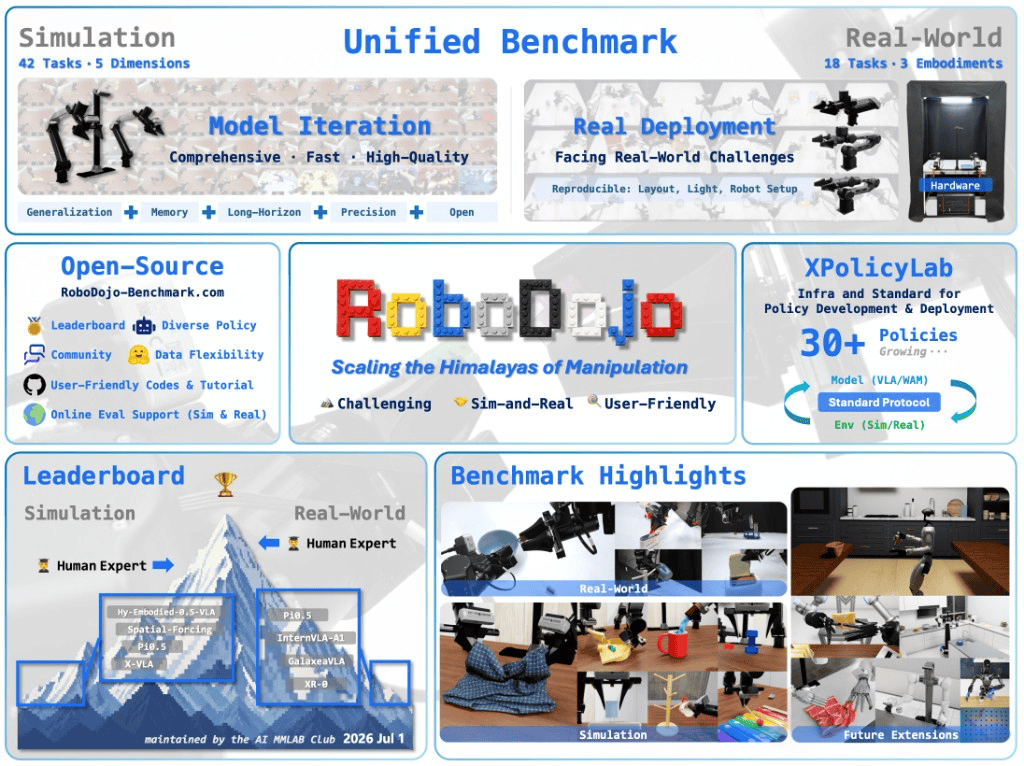
Representative image for 具身大满贯还全开源!原力灵机DM0.5登顶RoboDojo,且clone且珍惜

具身大满贯还全开源!原力灵机DM0.5登顶RoboDojo,且clone且珍惜

Rank 71 · Content 80 · Popularity N/A

TL;DR - Dexmal’s open-source DM0.5 vision-language-action model topped the RoboDojo embodied-AI benchmark with a 24.90 overall score and 19.34% average success rate. Its strong long-term memory, cross-task generalization, and substantially reduced inference latency support deployment across varied robotic tasks.

  • DM0.5 scored 47.74 on RoboDojo’s memory dimension and completed all three randomized Cover Blocks trials, aided by native support for up to 60 seconds of action history.
  • The model also reported 99.0% success on LIBERO and strong results on RoboTwin 2.0, VLA-Arena, and RoboChallenge Table30 v2.
  • Its architecture combines a 4B-parameter VLM with embodied chain-of-thought tasks, counterfactual instructions, trajectory-alignment supervision, and a System 1/System 2 control hierarchy.
  • Optimization reduced core inference latency from 534.04 ms to 57.49 ms—a 9.29× speedup—with LIBERO performance nearly unchanged; model weights, training framework, and downstream workflows are open source.
Representative image for 突破具身智能物理死角:IJCAI 2026 具身智能泛化与控制突破

突破具身智能物理死角:IJCAI 2026 具身智能泛化与控制突破

Rank 68 · Content 75 · Popularity 50

TL;DR - 雷峰网盘点了 6 项入选 IJCAI 2026 的中国团队具身智能研究,聚焦 VLA 空间泛化、机器人感知与极端环境控制。共同主线是以可解释表征、触觉反馈和物理约束弥补纯端到端大模型在真实世界中的脆弱性。

  • 文本隐变量插值无需重训,将 π₀ 在外推任务上的成功率从 9% 提升至 83%;RepSAM 仅微调 0.63% 参数,并在 Jetson AGX Orin 上实现 63ms 推理。
  • FILD-Nav 通过语言地标增强连续空间导航,在未见环境中将 Oracle 成功率提高 7%;PECHC 在无视觉近身空间中对 150 个真实物体取得 97.3% 抓取成功率。
  • DRIQN 将分布鲁棒优化融入强化学习梯度更新,在模拟极端海况中使导航成功率提升 13.51%、碰撞率下降 12.28%。
  • 无人机混合控制方案结合实时风扰估计、空气动力学模型与强化学习,以应对突发强风和未见风场。
Representative image for 对话维他动力秦海龙:具身智能真正难题不是让机器人「学会」,而是跨本体「继承」

对话维他动力秦海龙:具身智能真正难题不是让机器人「学会」,而是跨本体「继承」

Rank 57 · Content 60 · Popularity N/A

TL;DR - Vbot unveiled its ATOM humanoid robot and “Embodied Genome” architecture for transferring high-level intelligence across robot bodies while adapting low-level control to each morphology. The approach matters because reusable capabilities and real-world feedback loops could reduce the need to retrain every new robot form from scratch.

  • Vbot-OmniDuplex aligns streaming multimodal inputs in 240 ms micro-turns and separates low-latency interaction from asynchronous spatial reasoning and task planning.
  • Vbot-WorldModel predicts and scores action-conditioned futures, allowing a policy to select actions based on task completion, consistency, geometry, and collision safety.
  • Vbot-EvoMorph shares perception, latent state, and abstract action tokens across embodiments, then uses body-specific adapters for quadrupeds, humanoids, and manipulators.
  • A Real-Sim-Real loop reconstructs simulations from physical telemetry, trains with large-scale perturbations, and redeploys policies to robots so new failures feed subsequent iterations.
Representative image for 一个大脑,多种本体:江行智能详解物理AI工业落地的系统解法

一个大脑,多种本体:江行智能详解物理AI工业落地的系统解法

Rank 50 · Content 50 · Popularity N/A

TL;DR - Jiangxing Intelligence presented JX-Phi, an industrial physical-AI system that uses one shared “brain” across multiple robot embodiments. It targets reliable, cost-efficient deployment in safety-critical infrastructure rather than dependence on massive compute or a single robot form factor.

  • JX-Phi Brain combines multimodal encoding, shared and residual MoE components, action evaluation via a Critic and world model, and a rules-based Harness layer encoding industrial procedures.
  • JX-Phi World uses AutoEdge for automated data discovery and AutoWorld for simulation, pretraining, and augmentation of rare or extreme operating conditions.
  • The architecture supports drones, robot dogs, wheeled, bipedal, quadrupedal, and humanoid platforms across power grids, renewable energy, chemicals, oil and gas, storage, and data centers.
  • Products include complete robots, retrofit AI controllers for existing machines, and the OmniSight S4 multimodal sensing payload; the company reports long-term deployments in substations and wind and solar sites.
Representative image for 2026 WRC:人形机器人告别跳舞炫技,进入「真干活」,谁跑通了落地?

2026 WRC:人形机器人告别跳舞炫技,进入「真干活」,谁跑通了落地?

Rank 47 · Content 45 · Popularity N/A

TL;DR - At WRC 2026, UBTECH showcased humanoid robots moving beyond demonstrations into small-scale industrial deployment across material handling, machine tending, and sorting. The shift matters because commercialization now hinges on sustained reliability, precision, operating cost, and ROI in real production environments.

  • Cruzr Y1 and S2 demonstrated end-to-end perception, decision, grasping, and placement workflows, including sub-1 mm positioning for automotive production tasks.
  • Edge-deployed Thinker-VLA reportedly improved inference efficiency by 176%, cut storage use by 60%, and reduced GPU memory requirements from 64 GB to 32 GB.
  • UBTECH uses a Thinker foundation model, Thinker-WM world model, and Thinker-VLA stack; synthetic data supplements rather than replaces data collected from real robot deployments.
  • The company is targeting shared technology across industrial, commercial, and home robots while expanding manufacturing capacity, components, chips, and industry partnerships.
Representative image for 刚刚,销量第一的机器狗,长出了人形!

刚刚,销量第一的机器狗,长出了人形!

Rank 47 · Content 45 · Popularity N/A

TL;DR - Vbot unveiled its 1.6-meter ATOM humanoid robot and an “Embodied Genome” architecture intended to transfer high-level intelligence learned by its consumer robot dogs across different robot bodies. The strategy matters because it uses large-scale, real-world product telemetry to train and refine interaction, navigation, world-modeling, and control systems for household robots.

  • The architecture combines OmniDuplex for full-duplex multimodal interaction, a WorldModel for action-conditioned future prediction, and EvoMorph for adapting shared action intentions to quadruped, wheeled, and humanoid hardware.
  • Vbot says its world model was trained with more than 770,000 real navigation clips covering 3,000 hours of video and 5,000 kilometers of trajectories, using SFT followed by preference optimization.
  • Its Real-Sim-Real pipeline reconstructs measured environments and physical parameters from robot logs, then trains policies in simulations calibrated against real-world behavior.
  • ATOM has 31 degrees of freedom and is planned for year-end delivery in personal, enterprise, and developer editions; Vbot also launched a wheeled-leg EDU-W robot dog.

Robotics AI 1

Representative image for 影视飓风Tim看呆!鸡排哥2小时做出八大菜系,AI首次长出「大厨大脑」

影视飓风Tim看呆!鸡排哥2小时做出八大菜系,AI首次长出「大厨大脑」

Rank 36 · Content 30 · Popularity N/A

TL;DR - Chinese robotics company Xianglu unveiled CookingMuse, a multimodal cooking foundation model, alongside vision-equipped cooking robots and a mobile autonomous kitchen. The system aims to replace fixed recipe execution with real-time perception and adjustment, enabling more consistent food preparation and scalable unattended kitchens.

  • CookingMuse combines visual, voice, recipe, and cooking-process data gathered from more than 13,000 deployed restaurants and nearly one million digitized Chinese recipes.
  • Its cloud models learn ingredients, heat, and cooking stages, while lightweight on-device models make rapid decisions and adjust heat, timing, stirring, and seasoning when conditions change.
  • The new 3K robot uses two 40-megapixel global-shutter cameras at 30 fps to monitor cooking continuously, detect deviations, and intervene before serving.
  • The “Stir-Fry Ark” integrates dual cooking stations, robotic handling, dispensing, self-cleaning, and built-in fume treatment into a movable, unattended kitchen.
Top highlights — Opinions

Medical/Healthcare AI 1

China is changing the shape of global health. The terms are still up for negotiation

Rank 49 · Content 50 · Popularity 48

TL;DR - A Nature commentary argues that China’s expanding global health partnerships can improve access to affordable diagnostics, medicines, and other health-care resources, but their terms must protect recipient countries’ sovereignty and build durable local capacity.

  • Chinese partnerships are reshaping how health technologies and services reach other nations.
  • Low-cost diagnostics and medicines could broaden access to health care.
  • Global institutions should help structure agreements that strengthen local expertise and infrastructure.
  • Partnership terms must avoid dependency and preserve national control over health systems.

AI Copyright 1

Amend copyright licences to halt AI misuse and reassert human control

Rank 46 · Content 45 · Popularity 48

TL;DR - A Nature commentary argues that copyright licences should be amended to curb AI misuse and restore human control. Only the title and publication metadata are provided, so its specific proposals and legal mechanisms cannot be assessed.

  • Frames copyright licensing as a potential mechanism for governing AI use of protected works.
  • Emphasizes preventing misuse and strengthening human control over how content is used by AI systems.
  • Published online by Nature on 25 August 2026; no supporting evidence, technical details, or concrete amendments are included in the provided excerpt.

AI Education 1

Assessing students in the AI era

Rank 49 · Content 50 · Popularity 48

TL;DR - This Nature item addresses how student assessment should adapt in the era of AI. Because only the title and publication metadata are provided, its specific recommendations and evidence cannot be determined.

  • Focuses on the implications of AI for evaluating student learning.
  • Likely concerns assessment design rather than a technical AI model or research result.
  • No methodology, findings, or proposed assessment practices are included in the provided content.

AI Labor Economics 1

Representative image for Anthropic:AI没有导致失业率的增加

Anthropic:AI没有导致失业率的增加

Rank 50 · Content 50 · Popularity N/A

TL;DR - Anthropic economics lead Peter McCrory argues that AI has not yet measurably increased U.S. unemployment because it currently augments skilled workers rather than replacing entire jobs. He predicts this will remain true for 12 months but identifies labor-market indicators that could invalidate the view.

  • U.S. unemployment remains 4.2%, while occupations highly exposed to Claude-driven automation have not experienced disproportionately worsening unemployment.
  • No O*NET occupation has all its tasks systematically completed by Claude; coordination, physical interaction, planning, judgment, and error recovery remain critical human bottlenecks.
  • Claude usage data suggests expert users achieve better outcomes, and experienced users increasingly employ it as a thought partner, indicating that domain expertise still carries substantial value.
  • Key warning signals are unemployment in AI-exposed occupations diverging from other jobs and declining returns to human expertise in agentic workflows.

AI Peer Review 1

The future of peer review requires AI support, not AI bans

Rank 49 · Content 50 · Popularity 48

TL;DR - This Nature commentary argues that peer review should adopt AI assistance rather than prohibit it. Because only the title and publication metadata are provided, specific proposals and evidence cannot be assessed.

  • Frames AI as a potential support tool for peer review, not something requiring blanket bans.
  • Implies that responsible integration could help address challenges in the review process.
  • The provided content does not specify recommended tools, safeguards, workflows, or empirical findings.

Sleep Technology 1

How tech-enhanced sleep could improve rest but erode privacy

Rank 49 · Content 50 · Popularity 48

TL;DR - Nature commentary argues that sleep-enhancement technologies could improve health and performance while creating new privacy and accountability risks. Ethical standards and regulation are needed to prevent rest from becoming a monitored obligation.

  • Sleep technologies promise improvements beyond usual rest, with potential benefits for well-being and performance.
  • Collected sleep data could expose intimate behavioral and health information.
  • Employers, insurers, or other institutions might use such data to audit whether people meet expected sleep standards.
  • The article calls for ethical norms and regulations to govern these technologies.