独家 | 乐聚发布垂域具身模型:一倍工业提效,两项榜单第一
Ranking
Overall
61
Content
65
Popularity
N/A
No observed public metrics; popularity remains neutral/archived.
Merged summary
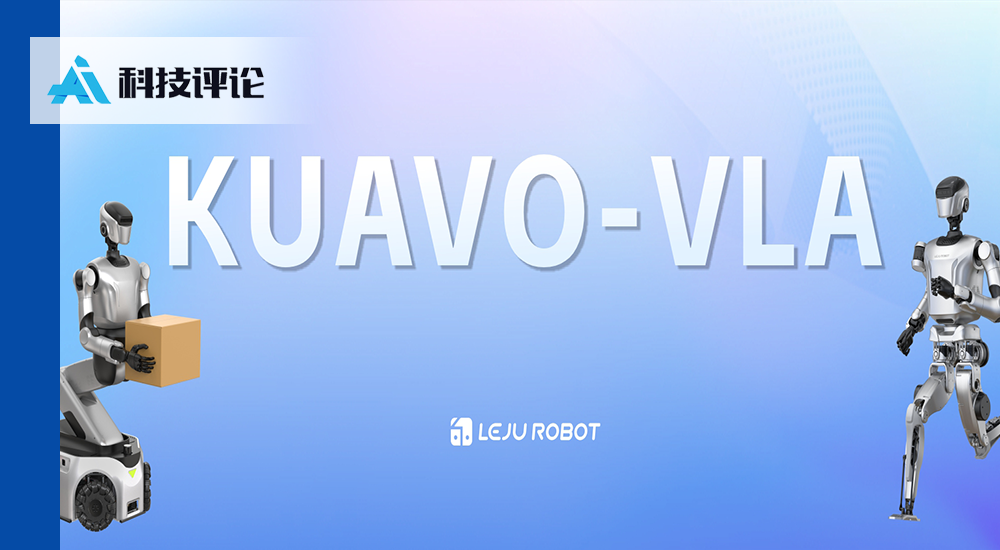
TL;DR - Leju Robotics introduced KUAVO VLA, an industrial vision-language-action model mid-trained on 600+ hours of robot data to reduce task-specific training and deployment costs. The company reports leading results against three general-purpose VLA models on a 25-task benchmark.
- KUAVO VLA inserts an industrial-domain training stage between general VLA pretraining and task-specific post-training, encoding 100 common capabilities such as sorting,搬运, loading, and assembly.
- Training uses real-world data exclusively from KUAVO robots, aiming to improve embodiment-specific control while avoiding interference from differing robot morphologies.
- Across 20 custom industrial tasks and five GM100 tasks, KUAVO VLA achieved a 48.27% task success rate and a 74.51% process score, ranking first on both metrics.
- Leju says the model can roughly double development efficiency in several scenarios and reduce the data collection, training, and debugging required for new industrial skills.
Sources (1)
独家 | 乐聚发布垂域具身模型:一倍工业提效,两项榜单第一
Public signals
N/A
TL;DR - Leju Robotics introduced KUAVO VLA, an industrial vision-language-action model mid-trained on 600+ hours of robot data to reduce task-specific training and deployment costs. The company reports leading results against three general-purpose VLA models on a 25-task benchmark.
- KUAVO VLA inserts an industrial-domain training stage between general VLA pretraining and task-specific post-training, encoding 100 common capabilities such as sorting,搬运, loading, and assembly.
- Training uses real-world data exclusively from KUAVO robots, aiming to improve embodiment-specific control while avoiding interference from differing robot morphologies.
- Across 20 custom industrial tasks and five GM100 tasks, KUAVO VLA achieved a 48.27% task success rate and a 74.51% process score, ranking first on both metrics.
- Leju says the model can roughly double development efficiency in several scenarios and reduce the data collection, training, and debugging required for new industrial skills.