AQuA:让量化研究 Agent 持续进化,也让回测结果经得起检验
Ranking
Overall
72
Content
90
Popularity
30
Observed public metrics from 1 member.
Merged summary
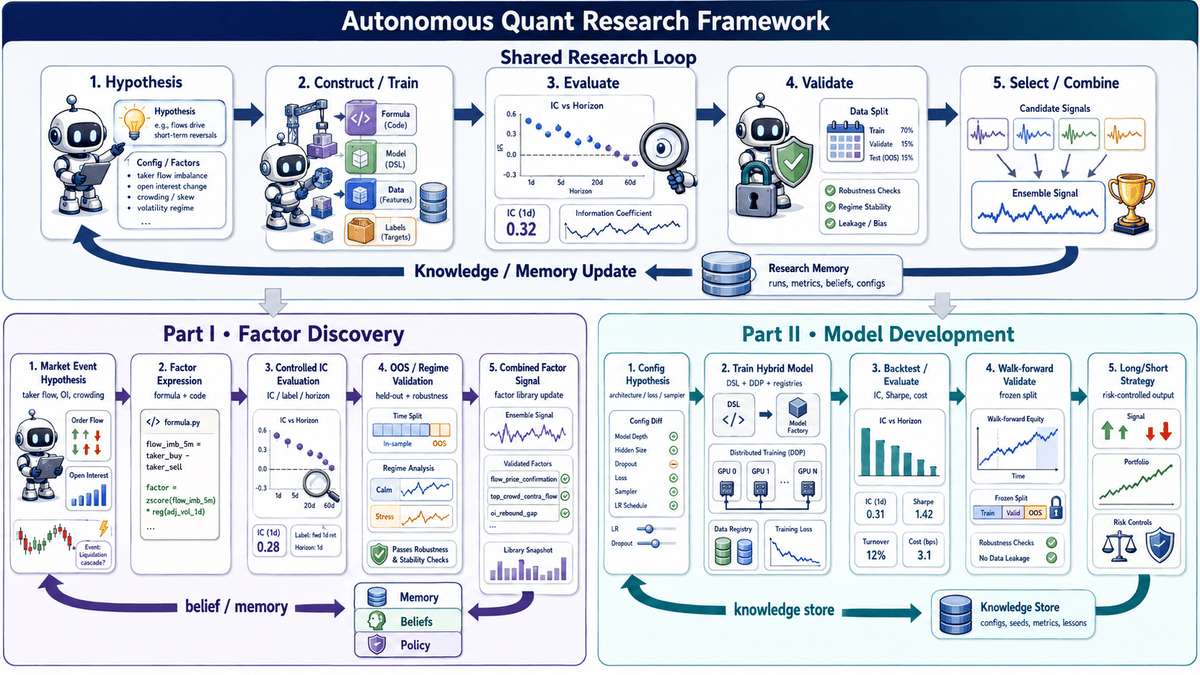
TL;DR - AQuA is a recursively self-improving quantitative-research agent framework that learns from validated experiments while isolating data pipelines and final evaluations from the search loop. Its design aims to prevent look-ahead leakage and test-set overfitting from becoming persistent “knowledge.”
- Separate systems explore symbolic trading factors and trainable models, but both retain traceable evidence from successes and failures in research memory.
- Agents may combine registered causal operators or submit model-configuration changes, but cannot rewrite data loaders, labels, splits, or evaluation logic.
- On five-minute cryptocurrency data, the factor system reached about 0.190 validation Spearman IC after 20 research rounds.
- For 30-minute US equity return prediction, the model system achieved 0.0843 per-stock IC and up to 2.50 out-of-sample Sharpe after 2 bps two-sided turnover costs and historical-only volatility control.
Sources (1)
AQuA:让量化研究 Agent 持续进化,也让回测结果经得起检验
Public signals
Semantic Scholar citations 0 · Semantic Scholar influential citations 0
TL;DR - AQuA is a recursively self-improving quantitative-research agent framework that learns from validated experiments while isolating data pipelines and final evaluations from the search loop. Its design aims to prevent look-ahead leakage and test-set overfitting from becoming persistent “knowledge.”
- Separate systems explore symbolic trading factors and trainable models, but both retain traceable evidence from successes and failures in research memory.
- Agents may combine registered causal operators or submit model-configuration changes, but cannot rewrite data loaders, labels, splits, or evaluation logic.
- On five-minute cryptocurrency data, the factor system reached about 0.190 validation Spearman IC after 20 research rounds.
- For 30-minute US equity return prediction, the model system achieved 0.0843 per-stock IC and up to 2.50 out-of-sample Sharpe after 2 bps two-sided turnover costs and historical-only volatility control.