蚂蚁百灵发布首个金融增强模型,AI开始进入真实投研工作流
Ranking
No observed public metrics; popularity remains neutral/archived.
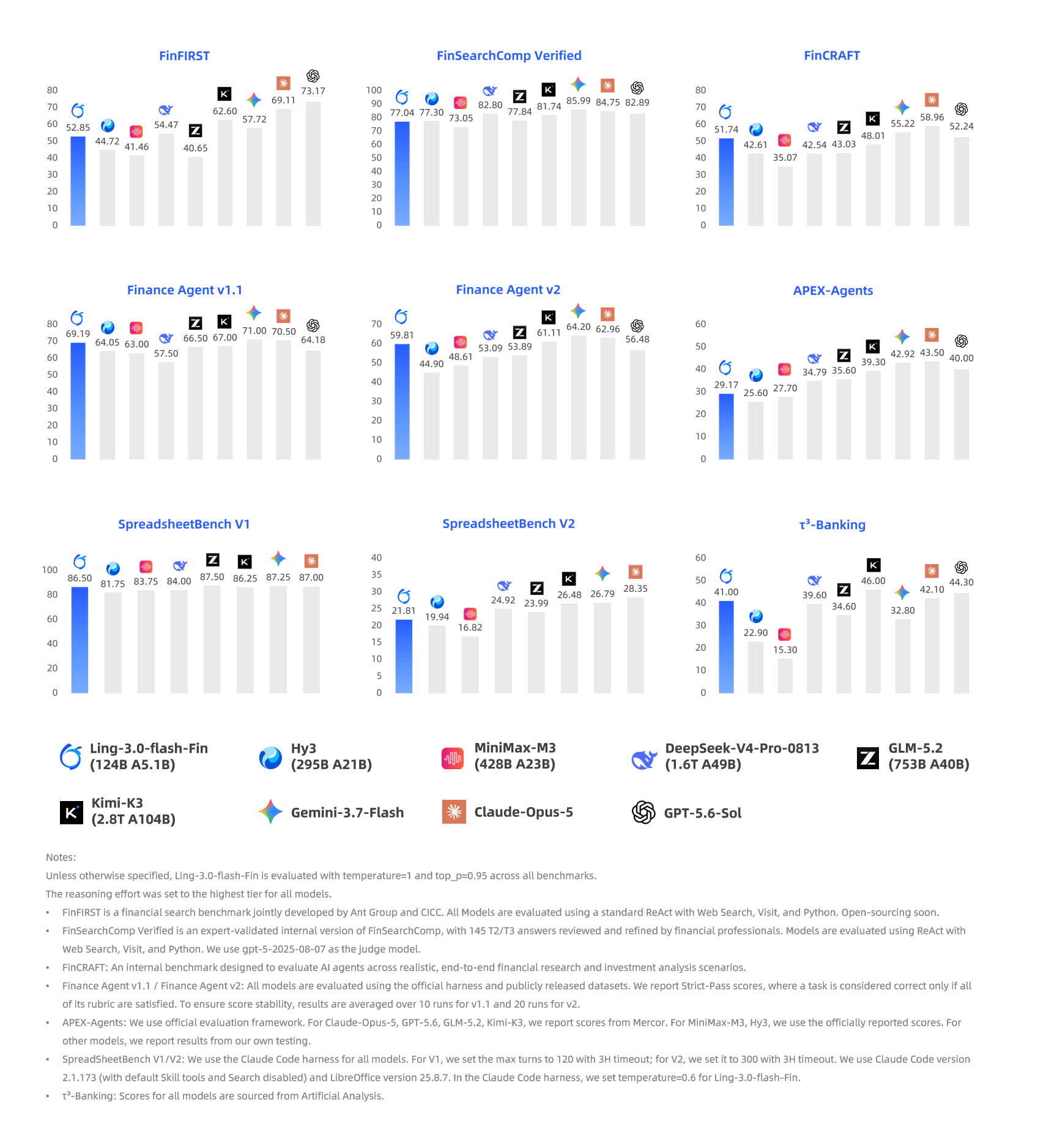
Merged summary
TL;DR — Ant Group released Ling-3.0-flash-Fin, an open financial model built to execute end-to-end investment-research workflows, alongside FinFIRST, a benchmark emphasizing evidence quality, reasoning, and traceability. One supplied source instead describes an unrelated gastric-cancer AI project and therefore cannot be merged into the financial-model report as the same work.
- Ling-3.0-flash-Fin is based on Ling-3.0-flash, with 124B total parameters, 5.1B activated parameters, and a 256K-token context window.
- It supports financial information retrieval, research reasoning, valuation modeling, report writing, and spreadsheet tasks such as formula generation, cross-sheet dependency handling, and error diagnosis.
- FinFIRST evaluates financial search agents on source selection, reporting-period and metric interpretation, explicit calculations, multi-source synthesis, and traceable derivations across Chinese and international markets.
- The model weights and benchmark are open-sourced, and an API is available; competitive performance is claimed, but no detailed scores are provided.
- The other source covers multimodal models for gastric-cancer complication, recurrence, and metastasis prediction, including retrospective multicenter results and a planned randomized trial—not Ling-3.0-flash-Fin.
Note: The sources emphasize different and apparently unrelated Ant Group projects: financial research automation versus clinical gastric-cancer risk prediction.
Sources (2)
蚂蚁百灵发布首个金融增强模型,AI开始进入真实投研工作流
TL;DR - Ant Group released Ling-3.0-flash-Fin, an open financial model designed to execute end-to-end investment research workflows rather than isolated question-answering tasks. It also open-sourced FinFIRST, a benchmark for evaluating financial search agents on evidence quality, traceability, and reasoning.
- Built on Ling-3.0-flash with 124B total parameters, 5.1B activated parameters, and a 256K-token context window.
- Targets information retrieval, research reasoning, valuation modeling, and report writing, including spreadsheet formulas, cross-sheet dependencies, and error diagnosis.
- FinFIRST evaluates source selection, reporting-period and metric interpretation, explicit calculations, multi-source synthesis, and traceable derivations across Chinese and international markets.
- Model weights and FinFIRST are open, while an API is available for developers; the article reports competitive benchmark performance but provides no detailed scores.
蚂蚁阿福与河北肿瘤医院在癌症领域取得研究突破:用AI提前预测胃癌术后风险
TL;DR - Ant Group’s AQ healthcare AI team and Hebei Cancer Hospital developed three multimodal models for predicting complications, early recurrence, and liver metastasis across the gastric-cancer treatment journey. The results suggest AI can improve risk stratification beyond conventional TNM staging, though randomized trials are still needed before clinical adoption.
- DeepComp combines contrast-enhanced CT, body-composition measurements, and clinical data; across 5,237 patients from 11 centers, its AUC was 0.888 internally and 0.824–0.869 in nine external cohorts.
- With DeepComp assistance, 10 surgeons’ average sensitivity for identifying patients at risk of moderate-to-severe postoperative complications rose from 47.1% to 87.9%.
- The pathology-based RSA model predicted early recurrence with AUCs of 0.843–0.887, while multimodal RCSA predicted liver metastasis with AUCs of 0.862–0.909.
- The evidence is primarily retrospective; a randomized controlled trial of DeepComp is being launched to determine whether model-guided care improves patient outcomes.